This blog is based on Frost & Sullivan’s recent analysis, Process Automation in the Chemicals and Petrochemicals Market, Global, 2025–2030, authored by growth expert Kiran Unni and lead analyst Sankara Narayanan Venkataramani from the Industrial Practice Area.
Chemical process automation is becoming a strategic priority for organizations seeking to improve production continuity, operational performance, and responsiveness to evolving demand, sustainability, and compliance requirements. Producers are under pressure to modernize long-life plant systems as demand increases for more flexible, scalable production across chemicals, petrochemicals, specialty chemicals, and agrochemicals.
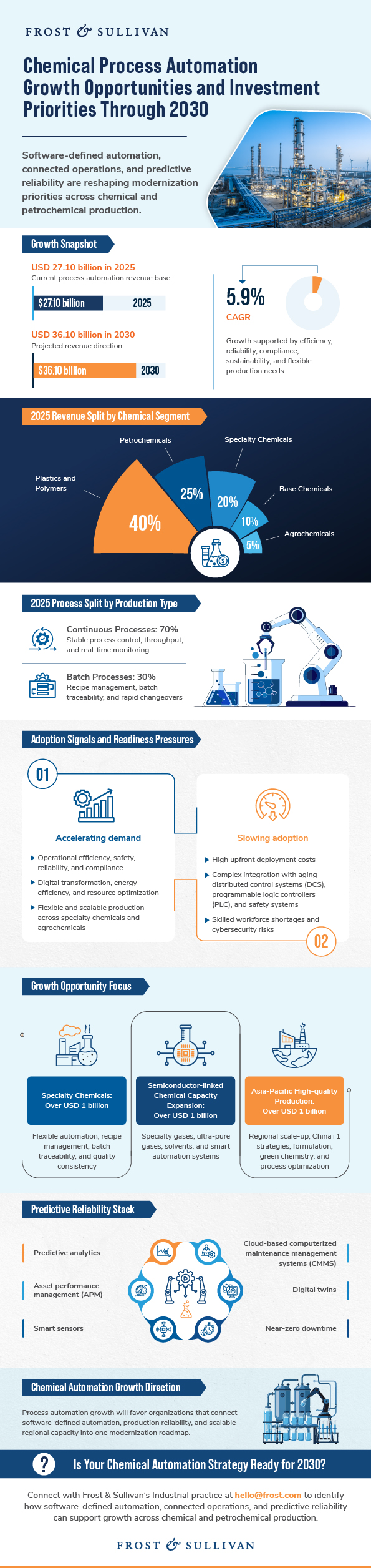
Revenue for process automation across the chemicals and petrochemicals industry is projected to grow from USD 27.10 billion in 2025 to USD 36.10 billion in 2030, supported by a 5.9% CAGR. Future supplier competitiveness will depend on helping customers move from hardware-centric systems toward software-defined automation (SDA), connected operations, and data-driven production without disrupting installed infrastructure.
Competitive advantage will strengthen for suppliers that support interoperable modernization, improve decision-making across plant and enterprise systems, and align process automation systems with flexible, scalable, and reliable production outcomes.
Turning Chemical Process Automation into Growth Action
Frost & Sullivan’s analysis helps automation suppliers and chemical producers assess:
- Software-defined automation priorities across legacy and modern plant environments
- Connected plant architecture requirements for cleaner, more actionable data
- Growth opportunities across specialty chemicals, semiconductor-linked capacity, and Asia-Pacific scale-up
- Predictive reliability priorities across asset performance management (APM), smart sensors, and near-zero downtime execution
Strategic Imperatives Guiding Software-defined Automation Priorities
- Innovative Business Models: Customer-centric production, co-development, collaborative research and development (R&D), and innovation ecosystems are increasing the need for automation systems that support faster recipe changes, process innovation, and specialized production requirements.
- Transformative Megatrends: Sustainability, circular economy practices, green energy transition, energy efficiency, and supply chain resilience are pushing producers to connect production data with emissions, waste, resource use, and quality performance.
- Disruptive Technologies: Software-defined automation (SDA), artificial intelligence (AI), predictive analytics, digital twins, cloud-based automation software, smart sensors, and advanced connectivity are becoming critical to adaptive operations.
These Strategic Imperatives point to a wider shift in automation priorities, with plant control now extending into production readiness, interoperability, and SDA. The result is a stronger focus on flexible production, sustainability performance, and data-driven decision-making across chemical and petrochemical operations.
Which Strategic Imperatives are shaping your next automation modernization priority?
Growth Forces and Readiness Pressures Shaping Automation Adoption
Chemical process automation is gaining investment relevance because producers need stronger operational efficiency, process optimization, profitability, safety, reliability, and compliance while adapting to sustainability and resource-efficiency priorities.
What is accelerating demand
- Operational Performance: Advanced process automation supports efficiency, process optimization, profitability, safety, reliability, and regulatory compliance across chemical and petrochemical operations.
- Digital Transformation and Sustainability: Investment is increasing where automation can improve energy efficiency, resource optimization, and sustainable production performance.
- Flexible Production: Specialty chemicals and agrochemicals are increasing demand for flexible, scalable, and efficient production processes, strengthening the role of SDA.
What could affect adoption
- Capital Intensity: High initial investment and upfront deployment costs can slow adoption, especially for small and medium-sized enterprises.
- Legacy Integration: Aging distributed control systems (DCS), programmable logic controllers (PLC), and safety systems can require costly overhauls or complex integration.
- Workforce and Cybersecurity Readiness: Skilled-personnel shortages, expanding digital attack surfaces, and resistance to digital transformation can weaken execution confidence.
Growth Opportunities Across High-value Chemicals and Asia-Pacific Scale-up
Growth is not spreading evenly across chemical and petrochemical production. The clearest opportunities are forming where process complexity, quality requirements, and regional capacity expansion make automation a business-critical investment. Each area is valued at over USD 1 billion within five years, with an action timeline of over three to five years.
- Specialty Chemicals and Flexible Automation
Opportunity signal: Specialty chemicals depend on smaller production volumes, proprietary formulations, frequent process adjustments, recipe management, and batch traceability. Demand is rising across electronics, automotive, and personal care applications.
Growth move: Prioritize flexible and scalable automation systems that support rapid changeovers, consistent product quality, waste reduction, and stronger response to high-value customer requirements. - 2. Semiconductor-linked Chemical Capacity
Opportunity signal: AI chip demand is increasing the need for specialty gases and chemicals, including ultra-pure gases and solvents used in semiconductor manufacturing and next-generation chip fabs.
Growth move: Align smart automation systems with scalable production, quality control, and reliable process performance for chip-related chemical requirements. - Asia-Pacific Scale-up and High-quality Production
Opportunity signal: Asia-Pacific (APAC) remains the largest chemicals and petrochemicals region, supported by rapid industrialization, capacity expansion, and industrial automation initiatives. India’s role as a non-China alternative under China+1 strategies adds relevance across formulation, green chemistry, and process optimization.
Growth move: Position automation portfolios around regional scale-up, high-quality production, and process-specific modernization needs.
Portfolio decisions should now separate commodity-scale control requirements from high-value, process-specific opportunities. Providers that connect flexible batch automation, smart automation systems, and APAC scale-up will be better placed to capture growth without diluting reliability or quality.
Supplier Positioning and Execution Priorities Across Chemical Automation
Competitive positioning in chemical process automation is becoming less about product breadth alone and more about how suppliers protect installed-system continuity while expanding software, control, and optimization value.
- Installed-base trust
Honeywell’s Experion PKS reflects the value of broad control-system deployment across refining, chemical, and petrochemical operations. - Modernization depth
Rockwell Automation’s PlantPAx distributed control system (DCS) aligns with plant priorities around reliable data, reduced product-quality variability, lower energy consumption, and higher throughput. - Portfolio coverage
Emerson’s strength comes from software and optimization tools, advanced controls, final control elements, and measurement devices across process automation layers.
Supplier fit will increasingly be measured by long-life asset support, software-centric upgrades, vendor-agnostic flexibility, process-specific expertise, and modernization that avoids operational disruption. The stronger execution path connects reliability, quality, energy use, material use, compliance, and throughput to measurable plant-performance gains.
Charting the Next Path for Chemical Process Automation
Chemical process automation is advancing toward connected, software-centric, and reliability-led operating models. The next phase of growth will depend on how well producers modernize long-life plant systems, improve interoperability, and turn operational data into decisions that strengthen quality, throughput, energy use, compliance, and sustainability performance.
Growth will be strongest where SDA, connected plant architectures, predictive analytics, asset performance management (APM), and smart automation systems support flexible production across specialty chemicals, semiconductor-linked capacity, and Asia-Pacific scale-up.
Ready to Lead the Transformation?
- Schedule a Growth Strategy Dialog: Align your growth roadmap with Frost & Sullivan’s Visionary Growth Pipeline™ Dialog.
- Engage with Growth Experts: Co-design AI-enabled, data-driven operating models that scale industry-specific and commercial impact.
- Showcase Your Transformational Leadership: Position your organization as a transformation leader through Frost & Sullivan’s Transformational Growth Leadership platform.
- Join the Growth Council: Collaborate with industry leaders shaping the future of your ecosystem.
- Explore Best Practices Recognition: Be recognized for excellence in growth strategy, execution, and customer impact.
- Benchmark Your Industry Positioning on the Frost Radar™: Benchmark your growth performance and innovation strength against industry competitors.
- Tell Your Story: Accelerate awareness, engagement, and revenue growth through integrated brand and demand generation strategies.
Connect with our growth experts at [email protected].
FAQs
1. What is software-defined automation in chemical process automation?
Software-defined automation (SDA) helps chemical and petrochemical producers reduce hardware dependence, support modular upgrades, and improve flexibility across long-life plant systems. It strengthens chemical process automation by helping producers modernize without disrupting installed infrastructure.
2. How does asset performance management support chemical manufacturing automation?
Asset performance management (APM) supports chemical manufacturing automation by connecting process, operational, and machine-level data. It helps maintenance and engineering teams improve asset visibility, plan earlier interventions, and reduce unplanned downtime.
3. What is shaping the process automation chemicals market?
The process automation chemicals market is being shaped by operational efficiency, safety, reliability, compliance, sustainability, energy efficiency, and demand for flexible production across specialty chemicals and agrochemicals.
4. Which petrochemical automation trends are influencing investment priorities?
Petrochemical automation trends include software-centric automation, connected operations, predictive analytics, digital twins, smart sensors, advanced process control, and cloud-based automation software that improve reliability, throughput, and production visibility.
5. How is AI process automation supporting chemical and petrochemical production?
AI process automation supports predictive maintenance, automated quality control, intelligent sourcing, and real-time production monitoring. In chemical and petrochemical operations, this can help producers improve reliability, process performance, and response timing.
6. Where do industrial automation chemicals priorities create supplier opportunities?
Industrial automation chemicals priorities are strongest where producers need flexible production, quality control, batch traceability, energy efficiency, and scalable regional capacity. Supplier opportunities are forming across specialty chemicals, semiconductor-linked chemical capacity, and Asia-Pacific production scale-up.