Based on Frost & Sullivan’s Frost Radar™: Cloud/Application Runtime Security, 2026, authored by Anh Tien Vu, this blog highlights the trends, strategic imperatives, growth opportunities, and leading innovators transforming cloud runtime security.
Executive Summary
Cloud/Application Runtime Security is becoming a strategic imperative as AI, cloud-native applications, and distributed workloads expand enterprise attack surfaces. Organizations that prioritize continuous runtime visibility, protection, detection, and response across applications, workloads, and cloud environments will be better positioned to contain threats faster, strengthen cyber resilience, simplify security operations, and support secure digital transformation at scale.
Key Takeaways
- Runtime security is becoming essential for securing AI-enabled and cloud-native applications.
- AI-driven threat detection is improving visibility and accelerating incident response.
- Unified security platforms are reducing operational complexity across cloud environments.
- Organizations investing in runtime intelligence will strengthen cyber resilience and enable secure digital transformation.
Cloud and application runtime security are emerging as critical capabilities for protecting modern cloud environments and applications. The rapid adoption of cloud-native architectures, artificial intelligence-enabled applications, containers, Kubernetes, application programming interfaces, and distributed workloads has expanded runtime risk, making continuous runtime visibility essential for detecting active threats, validating exploitability, and protecting business-critical applications.
By integrating runtime protection with application security and security operations, cloud and application runtime security enables organizations to strengthen cyber resilience, streamline security processes, accelerate threat detection and response, and support secure digital transformation.
Is your cloud security strategy prepared for the next generation of runtime threats?
Tune into our podcast episode on Top Innovators Reshaping Cloud/Application Runtime Security
What Is Cloud Runtime Security?
Cloud runtime security refers to the technologies and capabilities that continuously monitor, detect, investigate, and respond to threats while cloud workloads and applications are actively running.
Modern runtime security platforms help organizations:
- Detect malicious activity across cloud workloads and applications
- Identify exploitable vulnerabilities based on runtime context
- Secure containers, Kubernetes, virtual machines, serverless workloads, and APIs
- Investigate attacks using runtime telemetry
- Automate response through integrated security operations
What is Application Runtime Security?
Application runtime security is the practice of continuously monitoring, detecting, and responding to threats while an application is actively running. It provides real-time visibility into application behavior, helping organizations identify active attacks, validate exploitable vulnerabilities, and protect cloud-native applications from runtime threats before they impact business operations.
Strategic Imperative: Why Runtime Security Is Becoming a Business Priority
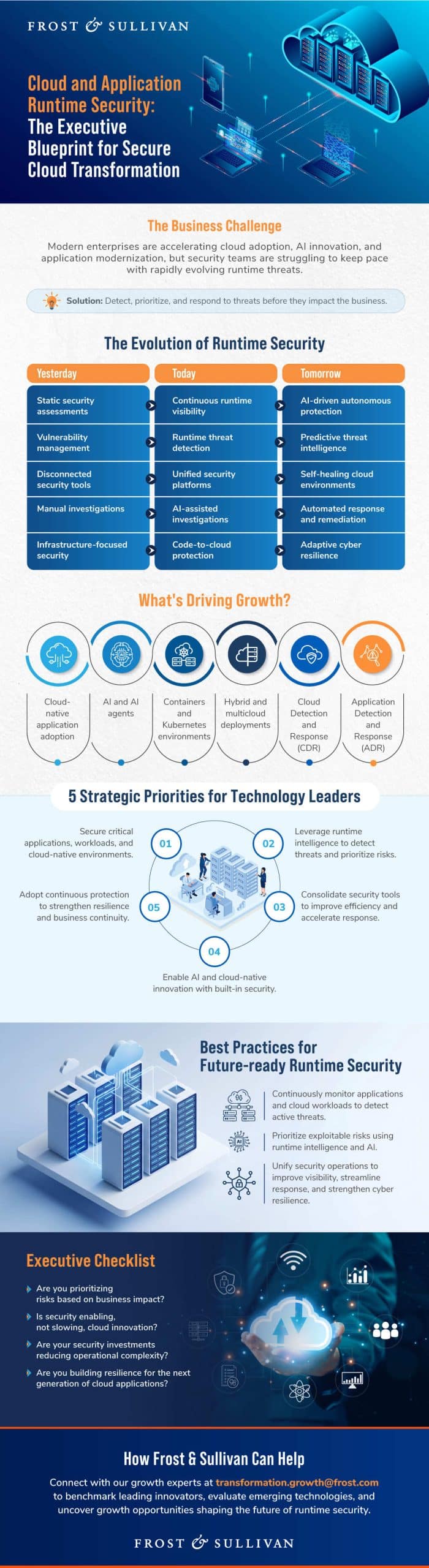
Enterprise security priorities are shifting toward unified platforms that bring together runtime protection, cloud application security, and security operations. This approach provides continuous visibility across cloud environments while improving operational efficiency.
Technology leaders are placing greater emphasis on runtime intelligence to identify actively exploitable risks, prioritize remediation, and accelerate incident response. Security decisions are becoming more context-driven, enabling teams to focus on threats with the greatest business impact.
For business leaders, cloud runtime security is becoming a strategic enabler of cyber resilience by helping organizations:
- Improve cyber resilience through continuous threat detection
- Reduce operational complexity with unified security platforms
- Prioritize remediation based on runtime risk
- Accelerate incident investigation and response
- Strengthen regulatory compliance through continuous monitoring
- Protect business-critical cloud applications supporting digital transformation initiatives
According to Frost & Sullivan, runtime security is evolving from a specialized cloud security capability into an enterprise-wide intelligence layer that enables organizations to identify exploitable risks, prioritize response, and strengthen cyber resilience across increasingly complex cloud ecosystems. Vendors that unify runtime visibility, AI-driven analytics, and security operations will define the next phase of market leadership.
Traditional Cloud Security vs. Modern Runtime Security
| Traditional Cloud Security | Modern Runtime Security |
| Periodic posture assessments | Continuous runtime security |
| Vulnerability-centric risk management | Runtime exploitability validation |
| Separate cloud, application, and SOC tools | Unified cloud security operations |
| Alert-heavy security workflows | Context-wave threat prioritization |
| Manual investigations | AI-assisted threat investigation |
| Reactive incident response | Automated detection and response |
| Infrastructure-focused protection | End-to-end code-to-cloud security |
Why This Matters for Business Leaders
Modern enterprises require security platforms that adapt to dynamic cloud environments without slowing innovation. Runtime security provides the operational intelligence needed to understand active risks, reduce alert fatigue, and improve security outcomes while enabling developers and security teams to work from a common operational view.
How Leading Innovators Are Advancing Cloud/Application Runtime Security
Leading vendors are moving beyond traditional workload protection by building integrated runtime security platforms that combine prevention, detection, investigation, and response into a unified operating model.
Several strategic priorities are shaping this evolution:
Cloud Detection and Response (CDR)
Organizations require continuous visibility across hybrid and multicloud environments to identify suspicious behavior before threats escalate. Leading providers are strengthening runtime telemetry, behavioral analytics, and threat correlation to improve detection accuracy while reducing false positives.
Application Detection and Response (ADR)
Application security is extending into runtime. Vendors are enabling organizations to validate exploitability, prioritize vulnerabilities based on active risk, and investigate attacks occurring inside live applications.
AI-driven Threat Detection
AI is enhancing runtime security by improving anomaly detection, correlating attack patterns, automating investigations, and accelerating incident response. AI also enables security teams to analyze larger volumes of runtime telemetry with greater speed and accuracy.
Kubernetes and Cloud-native Protection
Containers and Kubernetes have become foundational to modern application development. As a result, containers runtime security and Kubernetes runtime security have become critical investment areas, enabling organizations to protect containerized workloads, Kubernetes clusters, serverless functions, and cloud-native applications without slowing development.
Unified Security Operations
The next generation of platforms integrates runtime security with cloud application security, Cloud-Native Application Protection Platform (CNAPP), Extended Detection and Response (XDR), Security Information and Event Management (SIEM), and Security Operations Center (SOC) workflows, enabling security teams to manage cloud threats through a single operational framework.
Top 5 Growth Opportunities Shaping the Cloud Runtime Security Market
According to Frost & Sullivan, the greatest growth opportunities lie in platforms that combine runtime visibility, AI-driven analytics, cloud-native runtime security, and integrated security operations to strengthen cyber resilience and simplify security management.
- Cloud Detection and Response (CDR)
Hybrid and multicloud environments are driving demand for Cloud Detection and Response (CDR) solutions that provide continuous threat monitoring, contextual threat intelligence, automated investigations, and cross-cloud visibility to accelerate incident response.
- Application Detection and Response (ADR)
Application Detection and Response (ADR) is extending application security into runtime by helping organizations validate exploitability, prioritize runtime risks, and detect attacks targeting live applications, enabling faster and more effective remediation.
- Cloud-native Application Detection and Response (CNADR)
Cloud-native Application Detection and Response (CNADR) platforms unify telemetry across cloud infrastructure, workloads, applications, APIs, and Kubernetes environments, enabling earlier threat detection and streamlined collaboration between DevSecOps (Development, Security, and Operations), cloud security, and SOC teams.
- AI Runtime Security
The adoption of generative AI, Large Language Models (LLMs), and AI agents is creating demand for AI runtime security solutions that protect AI workloads from threats such as prompt injection, model manipulation, and data leakage while enabling secure AI adoption.
- Unified Code-to-Cloud Security Operations
Organizations are consolidating security technologies by integrating CNAPP, XDR, SIEM, and SOC workflows. This unified approach improves visibility, accelerates threat detection, and simplifies security operations.
Top Visionary Leaders Driving the Future of Cloud Runtime Security
The cloud runtime security landscape is being shaped by innovators that are advancing runtime protection, AI-powered threat detection, cloud-native monitoring, and integrated security operations. These companies are helping enterprises secure modern applications while improving operational resilience.
- Aqua Security – Comprehensive cloud-native security with strengths in runtime protection, Kubernetes security, and software supply chain security.
- CrowdStrike – AI-powered runtime protection integrated with cloud detection and response, identity security, and unified security operations.
- Microsoft – End-to-end cloud security with integrated runtime protection, cloud-native workload security, identity protection, and AI-powered security operations.
- Miggo – Runtime application security focused on exploitability analysis, application context, and real-time threat detection to prioritize critical risks.
- Mitiga – Cloud incident readiness and response platform that delivers deep cloud forensics, threat investigation, and rapid incident response to strengthen cyber resilience.
Want to explore more innovators shaping the runtime security market? Download our comprehensive analysis to benchmark leading providers, compare their innovation strategies, and uncover the technologies driving the future of cloud runtime security.
The Next Phase of Competition in Cloud Runtime Security
The competitive landscape is shifting from standalone runtime protection tools to unified security platforms capable of protecting applications throughout the entire cloud lifecycle.
Future runtime security market leaders will differentiate through their ability to combine runtime visibility, AI-driven analytics, cloud-native protection, and automated security operations within a single platform. Growth will depend on delivering operational simplicity while addressing increasingly sophisticated threats across hybrid and multicloud environments.
Frequently Asked Questions (FAQs): Cloud Runtime Security
1. What is runtime security?
Cloud runtime security refers to the technologies and capabilities that continuously monitor, detect, investigate, and respond to threats while cloud workloads and applications are actively running. It encompasses capabilities such as containers runtime security and Kubernetes runtime security, helping organizations protect modern cloud-native environments.
2. Why is runtime security important?
Runtime security provides visibility into active attacks that static security assessments cannot capture. It enables organizations to identify exploit attempts, prioritize runtime risks, accelerate incident response, and improve cyber resilience across dynamic cloud environments.
3. How does AI influence runtime security?
AI enhances runtime security by improving anomaly detection, correlating attack patterns, automating investigations, and accelerating incident response. At the same time, the rise of AI-powered applications is creating new security requirements for protecting LLMs, AI agents, and AI workloads.
4. Which industries benefit most from Cloud runtime security?
Runtime security delivers value across industries adopting cloud-native technologies, including financial services, healthcare, manufacturing, retail, telecommunications, government, technology, and critical infrastructure sectors where protecting business-critical applications and cloud workloads is essential.
5. What should organizations evaluate when selecting a runtime security platform?
Technology leaders should evaluate vendors based on runtime visibility, cloud-native protection, AI capabilities, Kubernetes and API security, detection and response effectiveness, platform integration, operational simplicity, scalability, and long-term innovation strategy.
Ready to Lead the Transformation?
- Schedule a Growth Strategy Dialog: Align your growth roadmap with Frost & Sullivan’s Visionary Growth Pipeline™ Dialog.
- Engage with Growth Experts: Co-design AI-enabled, data-driven operating models that scale industry-specific and commercial impact.
- Showcase Your Transformational Leadership: Position your organization as a transformation leader through Frost & Sullivan’s Transformational Growth Leadership platform.
- Join the Growth Council: Collaborate with industry leaders shaping the future of your ecosystem.
- Explore Best Practices Recognition: Be recognized for excellence in growth strategy, execution, and customer impact.
- Benchmark Your Industry Positioning on the Frost Radar™: Benchmark your growth performance and innovation strength against industry competitors.
- Tell Your Story: Accelerate awareness, engagement, and revenue growth through integrated brand and demand generation strategies.