This blog is based on the analysis, Frost Radar™: Enterprise Network Services, 2026, authored by Frost & Sullivan’s growth expert Stephen Thomas from the Enterprise Network Services team.
Executive Summary
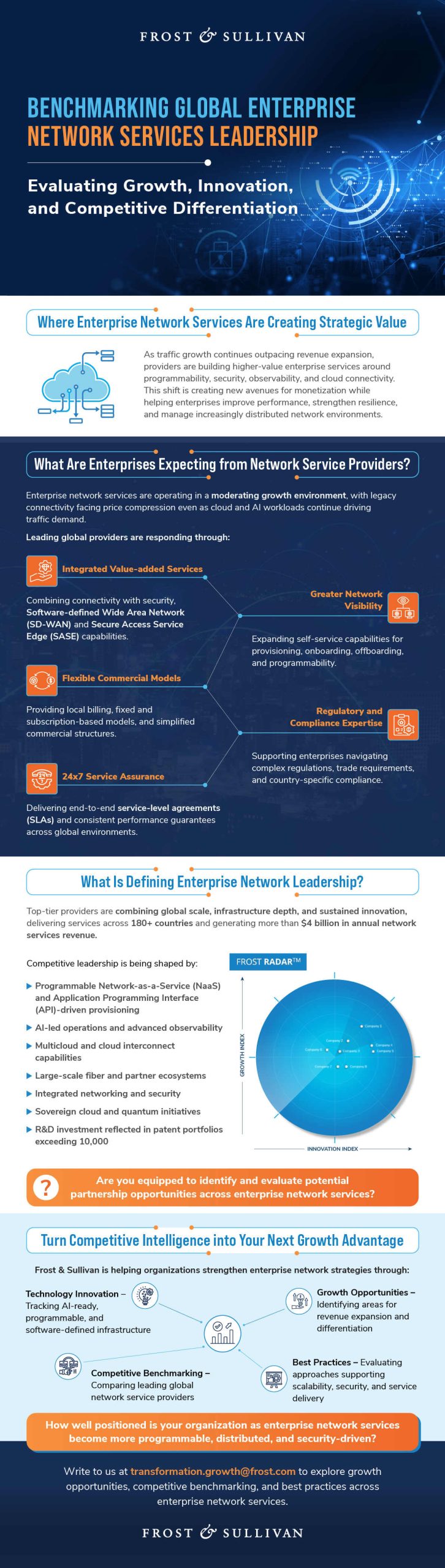
Enterprise network services is evolving into intelligent, software-defined infrastructure. Artificial intelligence (AI) workloads, cloud adoption, security, and the dispersion of data is increasing the demand for programmable connectivity, network automation, and integrated services. Additionally, simplification is also a strategic priority for technology leaders. Consequently, this is causing providers to move beyond bandwidth toward Network-as-a-Service (NaaS), AI-driven operations, multicloud networking, and advanced security, creating new opportunities to strengthen resilience, simplify network complexity, and support increasingly distributed business operations.
What Is Enterprise Networking?
Enterprise networking connects an organization’s users, applications, data centers, cloud environments, branches, and devices through secure digital infrastructure. Modern enterprise networks combine physical connectivity with software-defined capabilities, cloud integration, automation, observability, and security. Think of it as the nervous system of the IT infrastructure.
Explore the Leaders Redefining Enterprise Network Services
Discover competitive strategies and best practices shaping enterprise network services across intelligent, programmable, and secure infrastructure.
Unlike traditional static networks, modern enterprise networking is evolving into programmable infrastructure that can adapt to distributed applications, cloud environments, and AI workloads.
According to Frost & Sullivan, the growing convergence of connectivity, automation, cloud, and security is increasing the strategic importance of enterprise networks in supporting resilient operations, simplifying network complexity, and enabling scalable digital growth.
The Strategic Questions Shaping Enterprise Network Decisions
As enterprise environments become more distributed, network decisions are becoming closely connected to cloud performance, security, resilience, and application experience.
Business leaders are increasingly asking:
- How is network automation not only improving customer and operational experience, but also improving performance?
- How is Network-as-a-Service changing the way connectivity is being purchased, delivered, and managed?
- How is multicloud networking supporting data across clouds, data centers, and edge locations? Consequently, how can service providers help with end-to-end observability?
- How are organizations layering enterprise network security as infrastructure becomes more distributed?
- Which capabilities are becoming important when organizations evaluate the enterprise networking leaders in the ecosystem?
These considerations are moving enterprise networking beyond bandwidth toward the wider performance and operational requirements of distributed businesses.
Do you have the growth strategy to strengthen your enterprise network investments?
Rising Factors Shaping the Global Enterprise Network Ecosystem
- AI-native Operations and Network Observability
AI-driven network observability is enabling predictive and preventive maintenance, improving time to resolution, and increasingly automating operational tasks. - Hybrid and Multicloud Networking
Distributed applications and AI workloads are increasing demand for low-latency, high-capacity connectivity between clouds, data centers, and edge locations. - Network-as-a-Service and Programmable Connectivity
NaaS, API-driven provisioning, and usage-based pricing are changing how network services are being delivered and consumed. - Simplifying Multivendor Environments
Providers are bringing orchestration, unified policy management, and observability together as enterprises continue using best-of-breed networking and security technologies. - Sovereign and Compliant Networks
Security, privacy, and geopolitical pressures are increasing demand for jurisdictional control, auditability, and compliance-by-design architectures. - Quantum-safe Network Security
Post-quantum cryptography and quantum-resilient architectures are becoming relevant for regulated industries and long-term data protection. - Sustainable Network Infrastructure
Virtualization, renewable energy, and AI-driven optimization are supporting lower energy consumption and emissions. - Network Service Marketplaces
Digital distribution, partner ecosystems, and service chaining are changing how services are being discovered, procured, and delivered, while also preparing providers for the emergence of agent-to-agent commerce.
According to Frost & Sullivan
Enterprise network leadership is increasingly being defined by how effectively organizations turn connectivity into a secure, programmable operating environment. Leading organizations are using a combination of automation, observability, multicloud integration, and embedded security to reduce complexity, strengthen resilience, and support distributed AI and cloud workloads. Those building these capabilities into network strategy are creating greater flexibility to scale operations, respond to changing requirements, and capture value beyond traditional connectivity.
Where Is Enterprise Network Growth Accelerating?
Explore the Top 10 Growth Opportunities shaping enterprise network services in 2026.
Business Implications to Keep in Mind
- Organizations that continue relying heavily on legacy connectivity may face greater revenue and cost pressures as bandwidth economics weaken and cloud, edge, and AI traffic expands.
- Enterprises that leave networking and security environments fragmented may experience higher operational complexity, inconsistent performance, and greater security risk across distributed environments.
- Enterprises that do not account for security, sovereignty, and regulatory requirements in network decisions may face greater compliance risk and challenges protecting critical data.
- Organizations that do not modernize alongside AI and multicloud adoption may face performance constraints and the agility needed to support distributed, data-intensive workloads.
How prepared is your enterprise network for the shift toward intelligent, programmable infrastructure?
📄 Click here to access our Frost Radar™: Enterprise Network Services, 2026
Understanding the Intelligent Enterprise Network Services Ecosystem
How are leading providers transforming enterprise connectivity for the AI era?
🎧 Tune in to our podcast to hear more from our growth experts.
Enterprise Network Services: Growth Potential
| Area | Key Development |
| Global Growth Environment | Global GDP growth is estimated at approximately 3.4% in 2025, slowing to 2.8% in 2026 before recovering modestly to 3.1% in 2027, amid geopolitical disruption, trade tensions, and economic uncertainty. |
| Regional Momentum | Emerging economies continue to grow faster than advanced economies, while the United States and Europe are expected to grow at roughly 1–2%. G20 (top 20 countries) economies are expected to grow at approximately 3.0%. |
| Global Service Reach | Leading enterprise network service providers deliver services across 180+ countries, reflecting the scale required to support globally distributed enterprises. |
| Companies to Action | AT&T Business, Deutsche Telekom, Verizon Business, Orange Business, Lumen, Vodafone, and Telefonica are positioned as Visionary Leaders, with strengths spanning global scale, NaaS, programmability, AI-driven operations, cloud connectivity, and security. |
Read more: Explore the competitive strategies and best practices reshaping Carrier Ethernet services.
Top 3 Best Practices Shaping Enterprise Network Services
- Monetizing AI-ready Infrastructure Beyond Connectivity
Leading providers are expanding beyond traditional connectivity by monetizing next-generation services such as GPU (Graphics Processing Unit)-as-a-Service, edge AI infrastructure, and advanced cloud interconnects. This evolution is positioning the enterprise network as foundational infrastructure for increasingly data-intensive AI workloads.
- Strengthening Enterprise Network Security for the Quantum Era
Security innovation is expanding toward quantum-safe networking, post-quantum cryptography, and security capabilities embedded across both network and software layers. Providers investing early in these areas are strengthening their positioning as enterprises reassess long-term data protection and infrastructure resilience.
- Building Frictionless, API-driven NaaS Platforms
Leading NaaS strategies are increasingly combining Application Programming Interface (API)-driven network automation, real-time provisioning, self-service experiences, and flexible consumption. This is shifting enterprise networking away from static connectivity toward digital platforms capable of adapting more dynamically to changing business requirements.
The Future of Enterprise Networking Is Intelligent, Programmable, and Secure
According to Frost & Sullivan, competitive advantage in enterprise networking is increasingly being shaped by the ability to combine AI-driven operations, programmable NaaS, multicloud connectivity, integrated security, and high-performance infrastructure. Providers that are moving beyond legacy connectivity and building more software-defined, automated, and secure service environments are strengthening their position as enterprise demand becomes more distributed and data-intensive. For business leaders, the strategic focus is shifting toward network environments that can support AI workloads, simplify multivendor complexity, improve resilience, and adapt more quickly to changing performance and security requirements.
Ready to Lead the Transformation?
- Schedule a Growth Strategy Dialog: Align your growth roadmap with Frost & Sullivan’s Visionary Growth Pipeline™ Dialog.
- Engage with Growth Experts: Co-design AI-enabled, data-driven operating models that scale industry-specific and commercial impact.
- Showcase Your Transformational Leadership: Position your organization as a transformation leader through Frost & Sullivan’s Transformational Growth Leadership platform.
- Join the Growth Council: Collaborate with industry leaders shaping the future of your ecosystem.
- Explore Best Practices Recognition: Be recognized for excellence in growth strategy, execution, and customer impact.
- Benchmark Your Industry Positioning on the Frost Radar™: Benchmark your growth performance and innovation strength against industry competitors.
- Tell Your Story: Accelerate awareness, engagement, and revenue growth through integrated brand and demand generation strategies.
Frequently Asked Questions (FAQs) on Enterprise Networking
1. What is software defined networking?
Software defined networking (SDN) uses software-based control to manage network infrastructure more centrally. It is helping enterprises make connectivity more programmable and easier to adapt as applications, traffic, and capacity requirements change.
2. What should enterprises consider when evaluating a networking provider?
When organizations evaluate enterprise networking providers, key considerations include geographic reach, reliability, cloud connectivity, security, automation, service-level agreements, and support. The provider’s ability to integrate with existing infrastructure is also becoming increasingly important.
3. How is AI affecting enterprise network capacity planning?
AI workloads are increasing data movement between clouds, data centers, and edge locations. This is bringing bandwidth, latency, traffic patterns, and cloud interconnection into earlier capacity-planning decisions.
4. How can enterprises measure the value of network automation?
The value of network automation can be measured through provisioning time, incident resolution, service availability, operating costs, and application performance. These metrics help connect automation investments with operational and business outcomes.
5. How does multicloud networking affect network architecture?
Multicloud networking requires consistent connectivity across multiple clouds, data centers, branches, and edge locations. This is increasing the importance of centralized visibility, consistent security policies, and effective traffic management across the enterprise network.