This blog is based on the Buyer’s Guide: Digital Experience Platforms, 2026, authored by Frost & Sullivan growth expert Manuel Albornoz from the Digital Content Services team.
Executive Summary
Digital experience platforms are becoming a strategic foundation for how organizations create, manage, personalize, and optimize digital experiences at scale. As enterprises modernize legacy experience stacks, adopt composable architectures, and move AI from assistive generation toward governed workflow execution, digital experience platform (DXP) decisions are becoming increasingly tied to speed, governance, integration, and measurable business outcomes. Organizations that align platform capabilities with their architecture, operating model, and data readiness will be better positioned to accelerate execution, reduce integration friction, strengthen personalization, and build a digital experience foundation that can adapt as customer expectations and AI-driven interactions continue to evolve.
Why Business Leaders Need to Rethink Customer Experience Strategy
Customer expectations are changing faster than ever. Manufacturing organizations are expected to deliver more proactive support, customized experiences, and seamless engagement throughout the customer lifecycle. At the same time, BFSI organizations must balance increasingly personalized digital experiences with security, compliance, and customer trust. These changing priorities are prompting business leaders to rethink how customer experience management supports long-term business performance.
Turn DXP Selection into a Strategic Advantage
Understand the technology, business, and competitive factors that matter when selecting the right digital experience platform.
What Is a Digital Experience Platform?
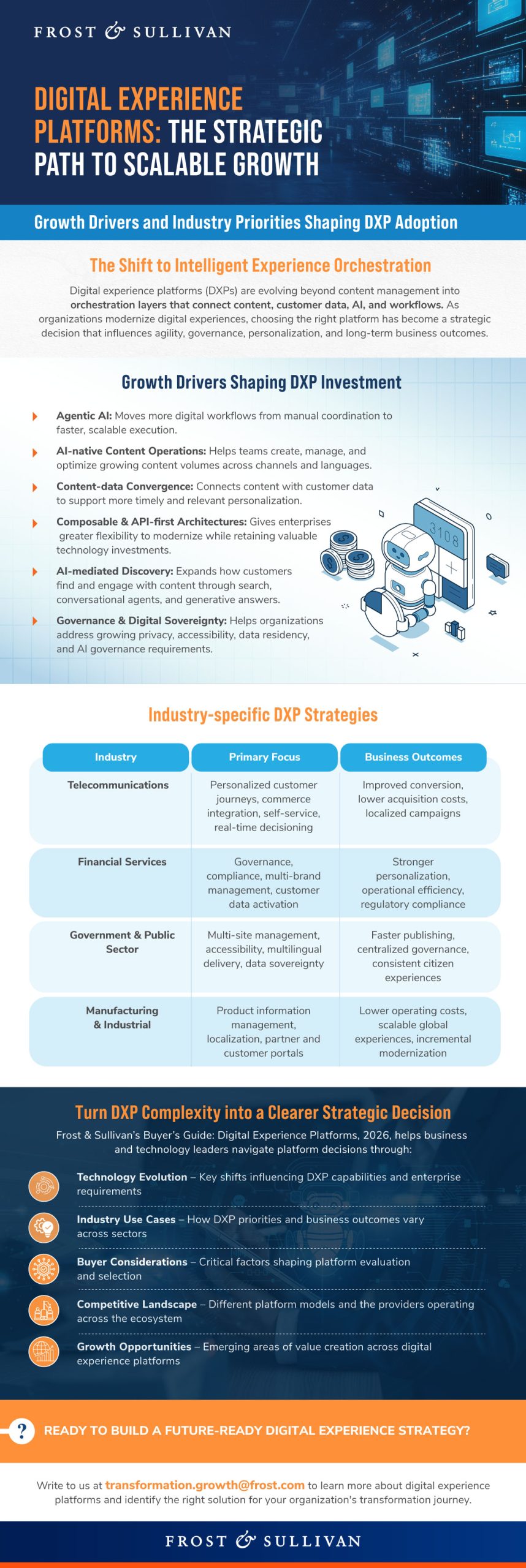
A digital experience platform (DXP) helps organizations create, manage, personalize, and deliver digital experiences across websites, apps, portals, commerce, and other customer touchpoints. Unlike traditional content management, a DXP connects content, customer data, personalization, analytics, and digital workflows within a broader experience environment. This is expanding the role of DXPs beyond content publishing toward more connected customer journeys, faster execution, and greater flexibility across digital operations.
Where will the next wave of digital content growth emerge as agentic AI reshapes the value chain?
Top 3 Strategic Imperatives Accelerating DXP Transformation
Frost & Sullivan estimates DXP revenue at $11.81 billion in 2025, growing at approximately 11% to 12% CAGR to $22.19 billion by 2031. Behind that expansion are three strategic imperatives.
- Disruptive Technologies: AI Moves into Workflow Execution
AI is moving DXPs from content assistance toward workflow execution across creation, personalization, testing, and optimization. As automation expands, governance, auditability, permissions, and approval controls become critical to responsible execution.
- Internal Challenges: Technology Is Moving Faster than Organizations
Platform adoption is moving faster than the teams, workflows, data foundations, and governance needed to support it. Organizational readiness and unified customer data are becoming as important as platform capabilities for scaling AI and personalization.
- Competitive Intensity: Feature Lists No Longer Define Differentiation
As vendors offer increasingly similar capabilities across AI, composability, and personalization, feature lists alone provide limited differentiation. DXP Platform evaluation is shifting toward real implementation requirements, including integration, migration, risk, cost, and time-to-value.
Business Implications to Keep in Mind
- Enterprises that automate before resolving data ownership and governance risk unreliable personalization, compliance exposure, and weak returns from AI investments.
- Organizations that retain fragmented, legacy experience stacks risk slower execution, higher integration friction, and inconsistent customer experiences.
- Buyers that select a platform primarily on feature breadth risk investing in technology that does not fit their architecture, operating model, or long-term digital experience strategy.
What happens when digital experience transformation extends beyond websites and applications, into physical spaces?
Navigating an Increasingly Competitive DXP Landscape
The competitive landscape spans large enterprise suites, API-first specialists, and providers differentiated by architectural or operational strengths. Choosing between them starts with understanding what type of technology foundation the organization is prepared to operate.
| Category | Strategic Fit | Companies to Action |
| Full-stack Experience Suites | Integrated content, data, analytics, personalization, commerce, and orchestration | Adobe – Integrated experience stack Acquia – Open, composable DXP HCL Software – Enterprise content foundation |
| Composable & Headless-first Platforms | API-first environments offering architectural flexibility and best-of-breed integration | Contentstack – Real-time composable DXP Contentful – Headless content infrastructure Uniform – Experience orchestration |
| Focused-strength Providers | Targeted strengths across sovereignty, portals, engagement, accessibility, content quality, and deployment flexibility | Squiz – Content intelligence Magnolia – Hybrid-headless integration |
Subscribe to our Growth Opportunity Newsletter to stay informed on DXP transformation.
Building the Foundation for Future-ready Digital Experiences
🎧 Tune in to our podcast for growth perspectives on the future of digital experience platforms.
7 Priorities Shaping DXP Decisions
As enterprises are evaluating digital experience platforms, the focus is moving beyond feature comparisons toward business fit, ease of use, cost, governance, and long-term value.
- Finding the Right Architecture: Organizations are weighing full-stack, composable, and focused-strength platforms against their existing technology environment and internal capabilities.
- Building AI Governance into Selection: Enterprises are looking beyond the number of AI features and examining approval workflows, permissions, audit trails, brand controls, and source traceability.
- Testing How Platforms Work in Practice: Marketing and technology teams are testing everyday tasks to understand how platforms perform outside controlled vendor demonstrations.
- Looking at the Full Cost: Organizations are considering implementation, development, training, maintenance, AI usage, and internal resources alongside platform licensing.
- Bringing Marketing and Technology Together: DXP decisions are increasingly reflecting both marketer usability and developer requirements, helping organizations avoid platforms that work well for one team but constrain another.
- Preparing Content for New Discovery Channels: Enterprises are improving content structure and metadata as conversational search, and generative platforms are changing how audiences find information.
- Looking Beyond Today’s Product: Organizations are examining vendor investment, product delivery, ownership stability, and long-term roadmaps as they consider platforms expected to remain in place for years.
Top 3 Growth Opportunities Across Digital Experience Platforms
- Operationalize Agentic AI Across Digital Experience Workflows
Agentic AI can move routine digital experience work from assistance to execution, covering activities such as page creation, personalization, testing, and optimization. For organizations, this means faster campaign execution, shorter localization and testing cycles, and fewer handoffs between teams. The priority is to scale this automation with the right approvals, permissions, and brand and compliance controls in place.
- Modernize Legacy Stacks Through Composable Architecture Adoption
Organizations no longer need to replace their entire technology environment to modernize. A composable DXP allows them to upgrade components over time while preserving existing investments in content, commerce, data, and analytics. This can lower the cost of change, simplify integration, speed up upgrades, and give businesses greater flexibility as requirements evolve.
- Unlock Real-time Personalization Through Content–Data Convergence
Bringing content and customer context closer together can move personalization beyond predefined, batch-based interactions toward experiences informed by real-time signals. This gives organizations an opportunity to respond more quickly to customer needs and deliver more relevant experiences with measurable outcomes. Strong data ownership, identity management, governance, and data quality remain essential to scaling personalization effectively.
As DXPs take on a broader role in content orchestration, where are the next opportunities emerging across the content value chain?
Explore the Top 10 Growth Opportunities in Content Creation, Management, and Orchestration for 2026.
Future Outlook for Digital Experience Platforms
According to Frost & Sullivan, the next phase of digital experience platforms will be defined less by the breadth of features and more by how effectively organizations turn platform capabilities into business value. The strategic value of a DXP will increasingly depend on the balance between autonomy and governance, flexibility and integration, and personalization and data readiness. This will reshape how enterprises evaluate technology investments, organize digital experience operations, and measure returns, making the DXP a longer-term decision about how the organization adapts, executes, and competes as AI and customer expectations evolve.
🎧 Listen to our growth podcast featuring Frost & Sullivan experts.
Ready to Lead the Transformation?
- Schedule a Growth Strategy Dialog: Align your growth roadmap with Frost & Sullivan’s Visionary Growth Pipeline™ Dialog.
- Engage with Growth Experts: Co-design AI-enabled, data-driven operating models that scale industry-specific and commercial impact.
- Showcase Your Transformational Leadership: Position your organization as a transformation leader through Frost & Sullivan’s Transformational Growth Leadership platform.
- Join the Growth Council: Collaborate with industry leaders shaping the future of your ecosystem.
- Explore Best Practices Recognition: Be recognized for excellence in growth strategy, execution, and customer impact.
- Benchmark Your Industry Positioning on the Frost Radar™: Benchmark your growth performance and innovation strength against industry competitors.
- Tell Your Story: Accelerate awareness, engagement, and revenue growth through integrated brand and demand generation strategies.
Frequently Asked Questions (FAQs) on Digital Experience Platforms
What is a composable DXP?
A composable DXP allows organizations to assemble their digital experience environment using individual technologies that can be integrated, replaced, or upgraded as requirements change. Unlike a tightly bundled suite, this approach gives enterprises greater architectural flexibility. It is particularly relevant for organizations that want to modernize gradually while retaining technology investments that continue to deliver value.
How do you evaluate a DXP for enterprise use?
Enterprise evaluation should extend beyond functionality to consider scale, security, governance, integration requirements, deployment options, and support for multiple brands, regions, and languages. Leaders should also assess whether the digital experience platform (DXP) can accommodate changing business requirements without creating excessive operational complexity or dependence on custom development.
What is the difference between a DXP and CMS?
In a DXP vs CMS comparison, the primary difference is scope. A CMS is principally designed to create, manage, and publish content. A DXP supports a broader experience environment, bringing together content with capabilities such as personalization, customer data, commerce, analytics, and orchestration to manage experiences across multiple digital touchpoints.
When should organizations consider an open-source DXP?
An open-source DXP can be relevant when organizations require greater control over deployment, customization, extensibility, or their underlying technology environment. An open-source digital experience platform may also suit enterprises with strong internal development capabilities and specific sovereignty requirements. The decision should account for internal resources needed to maintain, secure, integrate, and evolve the platform.
How does DXP vs CMS differ for government websites?
For government websites specifically, the decision often depends on the breadth and complexity of the digital estate. A CMS may support straightforward publishing, while a DXP can address multi-site management, multilingual delivery, accessibility, governance, data sovereignty, and experiences across websites, apps, knowledge bases, and service channels—requirements common to large public-sector environments.