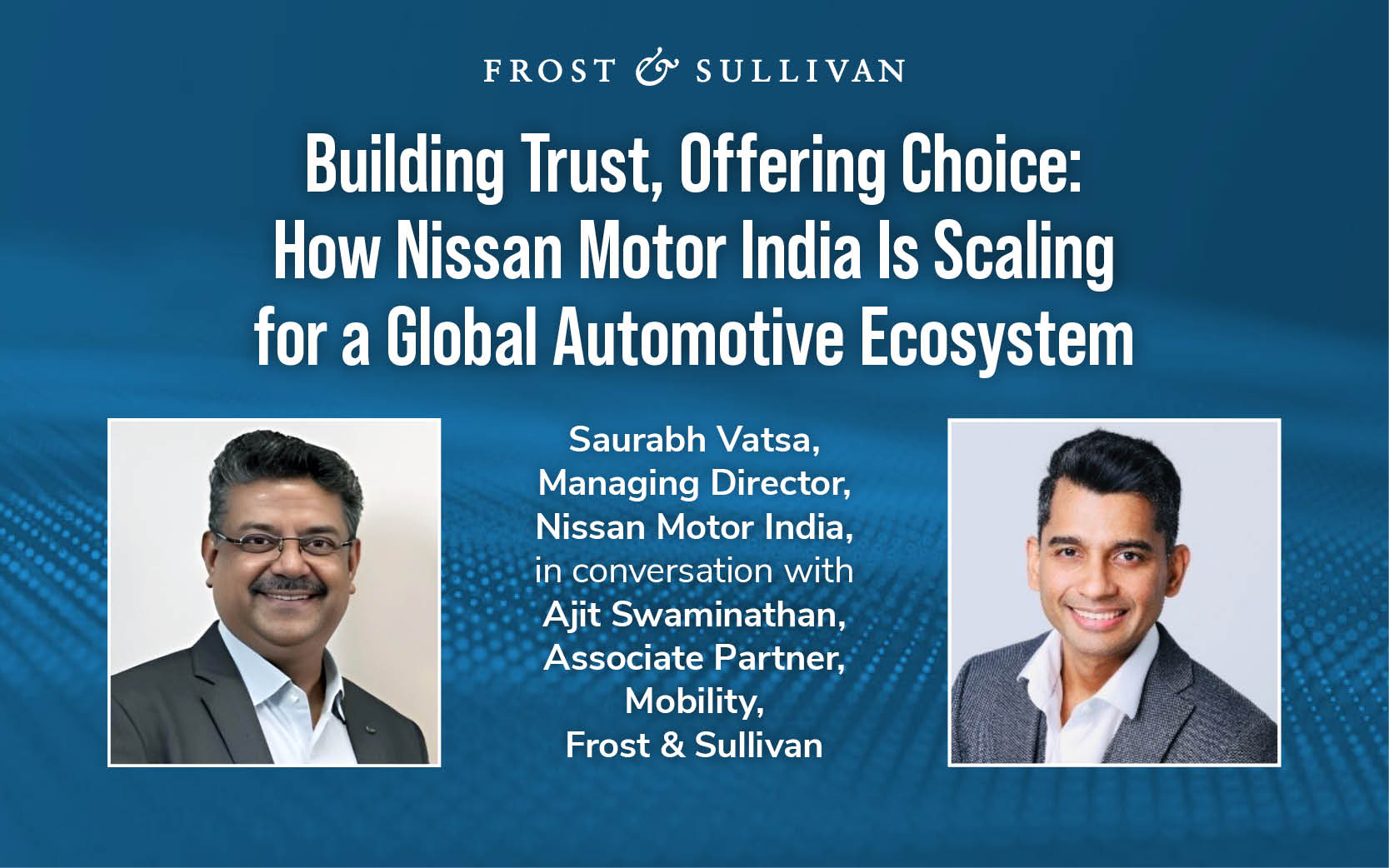
Saurabh Vatsa, Managing Director, Nissan Motor India, in conversation with Ajit Swaminathan, Associate Partner – Mobility, Frost & Sullivan.
Download this Transformational Growth Leadership Discussion with Saurabh Vatsa
India’s automotive industry is undergoing a significant shift in consumer preferences, with sports utility vehicles (SUVs), multi-energy vehicles, and connected technology increasingly shaping vehicle purchase decisions. For Nissan Motor India, this moment is coinciding with a broader push to launch new products, grow exports, and rebuild domestic volume, all at the same time.
In this Transformational Growth Leadership discussion, Ajit Swaminathan speaks with Saurabh Vatsa, Managing Director of Nissan Motor India, on the company’s multi-energy strategy, its approach to connected vehicle technology, the economics behind India’s export engine, and what building trust with the Indian consumer looks like at scale.
“At the end of the day, consumers look at your confidence. They look at the sparkle in your eyes before they sign the cheque. And that is what we are trying to build and deliver to the consumer.”
— Saurabh Vatsa, Managing Director, Nissan Motor India
Made in India, Built for the World
Ajit Swaminathan: With electrification, software, and customer expectations all shifting at once, what’s going to define Nissan Motor India’s growth in the years ahead?
Saurabh Vatsa: Nissan Motor India’s growth will be defined by our ability to combine strong local relevance with global scale. Our strategy is “India for India” and “India for the world”, designing products around Indian customer needs while building them to global standards from day one.
With the Chennai plant having capacity for nearly 500,000 vehicles where Nissan has secured 250K+ capacity, India is becoming an important part of Nissan’s global manufacturing and export footprint. After six years centered around the Magnite, Nissan is accelerating its portfolio expansion with the Gravite introduced in February 2026, the Tekton rolled out in July, and another seven-seater C-SUV on the way. This combination of product expansion, localization, global-quality manufacturing, and exports will be central to our growth in the years ahead.
An Export Hub Built on Global Standards
Ajit Swaminathan: What gives Nissan Motor India credibility as an export hub, and not just another manufacturing base?
Saurabh Vatsa: India’s stringent emission and safety standards, including Bharat New Car Assessment Program (NCAP), are the foundation for building world-class vehicles and exporting them.
That capability has made India Nissan’s second-largest Africa, Middle East, India, Europe, and Oceania (AMIEO) export hub after Sunderland, serving more than 65 countries. Our technical center and Nissan Digital India add engineering and software-integration depth.
When the Car Becomes A Part of Your Connected Life
Ajit Swaminathan: How much have customer expectations around products, technology, and the overall ownership experience changed?
Saurabh Vatsa: Customer expectations are moving beyond the car itself. Consumers increasingly want their vehicles to integrate seamlessly into their daily lives, much like their smartphones, while younger buyers are also showing greater interest in mobility on demand rather than traditional ownership.
The Tekton is a good example of this shift. Positioned in India as a premium C-SUV, it combines the Patrol-inspired design, 100% turbocharged engine with an embedded Subscriber Identity Module (eSIM) and built-in Google. Drivers can use Gemini or “Hey Google” without a phone for navigation, vehicle functions, and smart-home connectivity.
At the same time, technology cannot replace the fundamentals. Safety, air conditioning, performance, and a five-star Bharat New Car Assessment Program (Bharat NCAP) rating remain critical.
Reliability and Trust Ahead of Scale
Ajit Swaminathan: In a market this crowded, how are you carving out Nissan Motor India’s position?
Saurabh Vatsa: We intend to position Nissan Motor India as a reliable, trusted brand that delivers a consistent ownership experience. That positioning must be earned by keeping our promises at every customer touchpoint.
Our network is central to that promise. We currently have about 185 showrooms and 140 workshops and expect to close with 230–250 showrooms and around 170 workshops by March 2027. We will expand only as fast as we can maintain service quality.
Ultimately, customers choose a brand experience, not just a product. Nissan’s brand equity in India already exceeds its market share; a broader portfolio and dependable aftersales support can convert that trust into sustainable growth.
A Multi-energy Strategy Built Around Customer Readiness
Ajit Swaminathan: Given Nissan’s long history with electrification, how are you pacing the multi-energy strategy to match what Indian customers are actually ready for?
Saurabh Vatsa: Our electrification heritage predates the leading environmentally friendly affordable family car (LEAF). Nissan built the Tama in the 1940s, when Japan had limited oil but greater energy availability. We have multi-energy expertise; the priority is deploying it when Indian customers are ready.
Electric vehicles (EVs) and hybrids together account for about 7% of India’s industry volume. Customers are not moving directly to fully-electric vehicles; they want petrol, diesel, compressed natural gas (CNG), hybrids, and EVs to coexist.
Range anxiety remains real, especially on 500–700-kilometre trips. Geography, traffic, safety, and clean power generation also matter. We therefore offer the right energy option at the right time rather than push one technology prematurely.
What’s Really Shaping EV Adoption in India
Ajit Swaminathan: What’s really setting the pace for EV and hybrid adoption in India, policy targets, the math for consumers, or how ready the charging infrastructure is?
Saurabh Vatsa: All three factors are shaping EV and hybrid adoption in India, but the consumer equation is ultimately setting the pace. Buyers are increasingly looking at the total cost of ownership over five, seven, or even ten years, particularly the cost per kilometer. While policy has targeted around 30% EV adoption, EVs and hybrids together still account for only about 7% of industry volume.
For adoption to accelerate, consumers need greater confidence in vehicle safety and reliability, dependable charging infrastructure, and more affordable upfront prices. Charging constraints in multi-story housing and uncertainty about long-distance travel remain key barriers.
At Nissan, we see EVs, hybrids, and plug-in hybrids all having a role. The key is aligning each technology with customer demand, affordability, and infrastructure readiness.
India’s Expanding Role in Nissan’s Global Strategy
Ajit Swaminathan: How is India’s role within Nissan evolving across market growth, alliance manufacturing, engineering, and global exports?
Saurabh Vatsa: India is strategically important to Nissan. It is one of the world’s largest automotive markets, and its average consumer age is below 30, giving Nissan significant opportunity to build scale. Through our alliance partner, we share platforms while differentiating each brand’s design and experience. Nissan remains uncompromising on reliability, trust, and quality.
We are among India’s top five passenger vehicle exporters. Under our “one car, one world” philosophy, domestic and export vehicles meet the same testing, reliability, and longevity standards.
Growth Beyond Vehicles: Services, Software, and Scale
Ajit Swaminathan: Beyond the vehicle itself, where do you see Nissan Motor India’s biggest growth opportunities through 2030?
Saurabh Vatsa: Beyond new vehicle launches, Nissan’s growth through 2030 will come from expanding our customer base, entering more segments, particularly SUVs and EVs, and building new revenue streams through software and services. We have already announced three-product offensive spanning 2026 and early 2027 with more in development, while our focused showroom network will continue to expand alongside the portfolio.
Connected services will be another important growth lever, with customers able to continue using these features as paid services after the initial complimentary period.
Digital tools are also transforming after-sales, from faster vehicle diagnostics and repair estimates to longer warranties. Newer models offer warranties of up to 10 years. We also manage about 90,000 spare-parts line items for roughly 400,000 vehicles in India and export markets.
Combining Startup Agility with Global-brand Experience
Ajit Swaminathan: How is Nissan Motor India blending startup-style agility with the discipline of a global brand while managing such rapid product expansion?
Saurabh Vatsa: Our India team operates with a startup mindset while drawing on the discipline and experience of a global brand. Moving from one vehicle to four, managing multiple product lifecycles, and preparing for further expansion requires us to make decisions quickly and stay highly agile.
At the same time, experienced leaders bring institutional knowledge and global best practices, while younger colleagues bring fresh energy and new perspectives. Bringing these strengths together gives us the agility to move fast without losing the confidence and consistency customers expect from Nissan.
Choosing Partners on Capability, Not Geography
Ajit Swaminathan: How does Nissan choose its technology, software, and battery partners across global markets, including China?
Saurabh Vatsa: We evaluate technology, software, and battery partnerships based on capability rather than nationality or geography. What matters is whether a partner can meet our requirements for technical excellence, compliance, quality, and value. India is already part of Nissan’s global ecosystem, with our Chennai teams building vehicles for more than 65 countries and working with partners from different markets, including France. Ultimately, the best partnerships come from choosing the right capabilities, wherever they are available.
What India’s Next Mobility Shift Could Look Like
Ajit Swaminathan: By 2030, which shifts in Indian consumer preferences and technology adoption do you expect to have the biggest impact on mobility?
Saurabh Vatsa: The biggest shift will be the speed at which Indian consumer preferences and technology expectations evolve. In less than eight years, India has moved from a market where hatchbacks accounted for around 75% of sales to one where SUVs now exceed 55%. With demand growing across SUV sizes, we expect this shift to continue.
Technology adoption will be another major driver. Consumers are increasingly expecting in-car technology to become more deeply integrated into their daily lives, beyond navigation and basic connectivity. Over the next four to five years, meaningful connected and digital experiences will become increasingly important.
Autonomous driving will take longer to scale given India’s complex road and traffic conditions. The key for OEMs will be delivering technology that adds real value without making vehicles unnecessarily expensive or complex for customers.
Closing Reflection: From Product Launches to a Trust-Led Growth Ecosystem
Nissan Motor India’s growth ambitions rest less on any single product launch and more on the discipline of delivering consistently, across new SUVs, multi-energy vehicles, connected services, and an expanding export book, all moving at once. Saurabh Vatsa’s perspective points to a company treating trust as the foundation of its transformation, built through every customer touchpoint rather than something a single resurgence year can create on its own.
For Nissan Motor India, that shows up in deliberate choices, growing showroom and workshop numbers only as fast as service quality allows, offering multiple energy options instead of pushing one technology ahead of consumer readiness, and holding domestic and export vehicles to the same testing standards under the one car, one world philosophy. Software and connectivity are opening a parallel growth path, from paid connectivity services to faster digital repair estimation, without displacing the fundamentals of reliability and safety the brand is built on.
As the Indian automotive industry continues shifting toward SUVs, multi-energy vehicles, and connected vehicle technology, Nissan Motor India’s approach points to a model of sustained growth built not on chasing every new feature first, but on creating an ecosystem of trust that customers, dealers, and export partners can rely on for years after the sale.

About Saurabh Vatsa
Saurabh Vatsa is Managing Director of Nissan Motor India Pvt. Ltd., based in Gurugram. He brings more than 25 years of automotive industry experience across brand building, product planning, and sales leadership, with earlier roles at Stellantis, where he led the India launch of the Citroën brand, and General Motors, including an extended assignment in South Korea. At Nissan Motor India, he is leading the company’s product offensive, network expansion, and export growth across a fast-changing automotive industry.
Ajit Chander Swaminathan is Associate Partner and Mobility Practice Leader for Americas & South Asia at Frost & Sullivan. With 20+ years of experience, he specializes in strategic planning, business development, P&L ownership, and digital transformation. His industry leadership spans electrification, connected vehicles, manufacturing, aftermarket, and regulatory frameworks, helping mobility clients grow, scale, and transform across global markets.

About Ajit Swaminathan
Ready to Lead the Transformation?
- Schedule a Growth Strategy Dialog: Align your growth roadmap with Frost & Sullivan’s Visionary Growth Pipeline™ Dialog.
- Engage with Growth Experts: Co-design AI-enabled, data-driven operating models that scale industry-specific and commercial impact.
- Showcase Your Transformational Leadership: Position your organization as a transformation leader through Frost & Sullivan’s Transformational Growth Leadership platform.
- Join the Growth Council: Collaborate with industry leaders shaping the future of your ecosystem.
- Explore Best Practices Recognition: Be recognized for excellence in growth strategy, execution, and customer impact.
- Benchmark Your Industry Positioning on the Frost Radar™: Benchmark your growth performance and innovation strength against industry competitors.
- Tell Your Story: Accelerate awareness, engagement, and revenue growth through integrated brand and demand generation strategies.
Annexure:
Frost & Sullivan has curated analyses that highlight growth opportunities, strategic imperatives, and technological transformations across the electric mobility industry, offering critical insights for innovation and modernization.
Here are a few of them that you would like to read: