This blog is based on Frost & Sullivan’s recent analysis, Global Economic Transformations for 2026 (Q3 Update), authored by lead analysts Nikita Talnikar, Rituparna Majumder, and Neha Anna Thomas from the Economic Analytics Practice Area.
Executive Summary
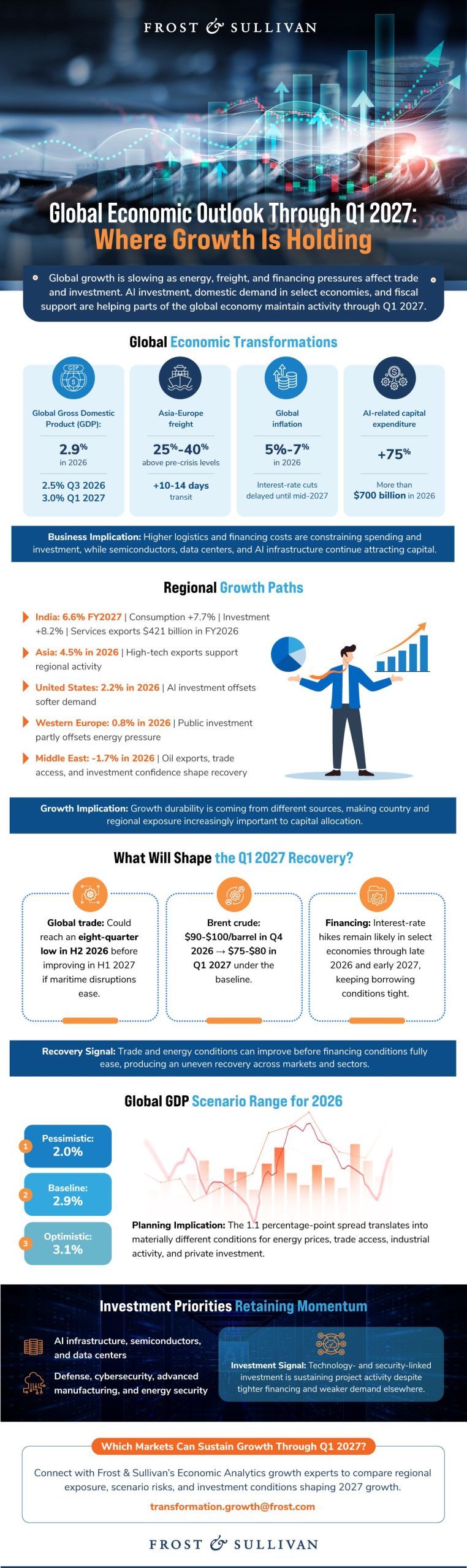
Global gross domestic product (GDP) growth is forecast to slow from 2.9% in H1 2026 to 2.5% in H2 as the US-Iran conflict raises energy, freight, and trade costs. AI investment and Asian technology exports are cushioning part of the slowdown, but growth is diverging across regions.
For organizations managing cross-border investment and supply chains, the key question is shifting from where growth is strongest to where investment conditions remain viable as costs, trade routes, and financing conditions evolve through Q1 2027.
Key Takeaways:
- Supply-chain costs are persisting even as oil prices are expected to ease: Brent crude could decline to $75-$80 per barrel in Q1 2027, but insurance, inventory, financing, and expected to remain elevated.
- Financing conditions are remaining tight: Global inflation of 5%-7% in 2026 is keeping rates elevated, delaying cuts and prompting further hikes in some economies, which is constraining credit growth and private spending.
- Scenario planning is becoming more important: Global growth ranges from 2.0% in the pessimistic scenario to 3.1% in the optimistic scenario, depending on energy prices, trade-route access, and geopolitical conditions.
What Is Global Economic Transformation?
Global economic transformation describes how shifts in geopolitics, trade, energy, technology, and policy are altering growth and investment conditions across economies. In 2026, the US-Iran conflict is transmitting beyond the Middle East through energy markets, shipping networks, supply chains, inflation, and financial conditions. These ripple effects are expected to bring annual global GDP growth to 2.9% in 2026, down 0.6 percentage points from 3.5% in 2025 and 0.2 percentage points below the January 2026 pre-conflict projection.
According to Frost & Sullivan, the strategic value lies in following how these shocks move through energy, shipping, financial conditions, trade flows, and investment activity. This helps distinguish where pressure is intensifying, where economic activity is holding, and where recovery conditions are beginning to improve across regions.
How Are Global Disruptions Changing Resilience Priorities?
Geopolitical and supply-chain disruptions are extending beyond shipping delays into operating costs and investment decisions. Higher logistics, insurance, inventory, financing, and supplier-diversification costs are raising the cost of cross-border operations, while uncertainty around trade-route normalization is affecting investment timing.
Where Is Global Resilience Holding Through Q1 2027?
Compare regional growth, trade and energy exposure, and recovery conditions to identify where investment momentum remains more resilient.
For organizations exposed to international trade and capital flows, resilience is extending beyond short-term disruption management. Route flexibility, diversified sourcing, working-capital planning, and operating flexibility are carrying greater weight as prolonged geopolitical uncertainty continues to affect supply continuity and investment decisions.
|
“In this environment, resilience, security, and geopolitical alignment are becoming important alongside cost, efficiency, and scale, reshaping supply chains, investment flows, and corporate strategy across regions.” — Vinod (Vinnie) Aggarwal, Chief Economist, Frost & Sullivan |
Top 3 Strategic Imperatives Shaping Global Commercial Conditions
- Internal Challenges: Businesses with high exposure to energy, logistics, inventory, and financing are entering 2027 with a higher cost base. Business models with limited cost pass-through face tighter margins, working-capital pressure, and less operating flexibility.
- Geopolitical Chaos: Trade and technology flows are likely to concentrate around emerging “trusted technology” and “trusted supply chain” ecosystems. Government use of trade measures, technology controls, and critical mineral policies is tying access to strategic inputs, partners, and markets more closely to geopolitical alignment.
- Transformative Megatrends: Global hyperscaler capital expenditure is forecast to exceed $700 billion in 2026, concentrating capital across artificial intelligence (AI) infrastructure, semiconductors, data centers, and associated high-tech value chains. This spending is supporting technology-linked project activity even as credit and private spending remain constrained elsewhere.
🔍 Explore how geopolitical risk and supply chain diversification are redirecting global investment.
Where Economic Resilience Is Holding
Several economies are retaining support from domestic demand, public investment, or technology-linked exports.
- India: Private consumption grew 7.7% in FY2026, while gross fixed capital formation increased 8.2%. India also recorded $421 billion in services exports in FY2026.
- United States: AI investment is supporting economic activity, with GDP growth forecast at 2.2% in 2026, up from 2.1% in 2025, while higher transport costs and trade-policy uncertainty remain key pressures.
- Asia: High-tech exports are supporting several East and Southeast Asian economies despite higher energy and freight costs.
These conditions are creating different levels of dependence on an external recovery. Economies with stronger domestic demand, diversified exports, or public investment have greater capacity to sustain activity while global trade and energy conditions remain uncertain.
|
“In the baseline, a deep Middle East conflict-led slowdown will be avoided due to upbeat global AI investments and associated technology exports momentum.” – Nikita Talnikar, Lead Analyst, Global Economic Transformation |
Regional Growth and Market Exposure Through Q1 2027
|
Region |
Growth Signal |
Primary Pressure |
Investment Consideration |
||
|
North America |
US growth is forecast to rise from 2.1% in 2025 to 2.2% in 2026, Canada slowing from 1.9% to 1.0% |
Transport costs, tariff tensions, trade-policy uncertainty |
Capital deployment remains sensitive to trade-policy clarity. |
||
|
Western Europe |
Regional growth at 0.8% in 2026 |
Energy-led inflation, softer demand, restrictive monetary conditions |
Recovery varies by national demand mix and energy import. |
||
|
Middle East |
GDP contracting 1.7% in 2026, with recovery expected from Q4 2026 |
Export constraints and logistics disruption |
Recovery depends on trade-route normalization and investment confidence. |
||
|
Asia |
Growth is forecast at 4.5% in 2026, with high-tech exports supporting several East and Southeast Asian economies. |
|
Technology-linked exports are providing resilience, but exposure varies by sector. |
The same global shock is therefore reaching regions through different channels. Trade policy is more important for North America, energy and interest rates for Western Europe, trade-route access for the Middle East, and logistics or external-balance pressures across Asia and India.
Are you considering diversification or expansion into new markets to bridge any existing growth gaps?
Download the Strategic Analysis to compare regional growth and market exposure.
Three Scenarios Shaping Investment Conditions Through Q1 2027
The scenarios differ less in the direction of growth than in the timing and breadth of capital deployment.
- Baseline: Trade and energy conditions improve gradually. A broader reopening of the Strait of Hormuz in Q1 2027 supports recovery, but reduced shipping flows and persistent rerouting and insurance costs keep trade conditions below pre-disruption norms.
- Optimistic: Near-normal Strait of Hormuz traffic by Q4 2026 lowers energy and transport costs. Western European manufacturing and private investment improve, Asian manufacturing and exports recover, and Gulf infrastructure and private capital expenditure regain momentum.
- Pessimistic: Prolonged restrictions keep energy and logistics costs elevated into 2027. Industrial bottlenecks deepen in Western Europe, capacity expansion slows across Asia, and weaker confidence delays non-oil investment in the Middle East.
For growth planning, the critical signal is how quickly an economy can move from maintaining existing activity to supporting new investment.
Future Outlook: Q1 2027 Marks a Transition, Not a Full Reset
Q1 2027 is expected to bring a broader recovery as energy supply conditions stabilize and trade routes reopen. Yet normalization will remain incomplete. Shipping flows may stay below earlier levels, while insurance, rerouting, and financing costs continue to affect cross-border activity even after energy prices ease.
The next phase of growth will therefore depend on how quickly trade, energy, and capital channels reconnect. Economies where these links recover sooner may gain clearer demand visibility and stronger conditions for renewed investment, while slower normalization is likely to keep commercial activity more selective.
Are you satisfied with your organization’s recent growth, or do you see a gap between current performance and your 2027 growth goals?
Download the Strategic Analysis to assess recovery conditions and market exposure through Q1 2027.
Ready to Lead the Transformation?
- Schedule a Growth Strategy Dialog: Align your growth roadmap with Frost & Sullivan’s Visionary Growth Pipeline™ Dialog.
- Engage with Growth Experts: Co-design AI-enabled, data-driven operating models that scale industry-specific and commercial impact.
- Showcase Your Transformational Leadership: Position your organization as a transformation leader through Frost & Sullivan’s Transformational Growth Leadership platform.
- Join the Growth Council: Collaborate with industry leaders shaping the future of your ecosystem.
- Explore Best Practices Recognition: Be recognized for excellence in growth strategy, execution, and customer impact.
- Benchmark Your Industry Positioning on the Frost Radar™: Benchmark your growth performance and innovation strength against industry competitors.
- Tell Your Story: Accelerate awareness, engagement, and revenue growth through integrated brand and demand generation strategies.
Connect with our growth experts at [email protected].
FAQs
1. What is the global economic outlook through Q1 2027?
The global economic outlook points to slower growth in H2 2026, with global GDP growth easing from 2.9% in H1 to 2.5% in H2. Growth is forecast to recover to 2.7% in Q4 2026 and 3.0% in Q1 2027 as energy and trade conditions begin to stabilize.
2. How is supply chain disruption affecting global business conditions?
Supply chain disruption is raising freight, insurance, inventory, and financing costs while extending delivery times. Asia-Europe freight rates are expected to remain 25%-40% above pre-crisis levels through H2 2026, with rerouting adding 10-14 days to transit times.
3. How is geopolitical risk influencing the 2026 global economy?
Geopolitical risk is affecting energy flows, trade routes, technology access, and investment decisions. The US-Iran conflict and Strait of Hormuz disruption remain central risks, while governments are also using trade, technology controls, and critical mineral policies as strategic economic tools.
4. Which factors are supporting economic resilience in 2026?
Economic resilience is being supported by domestic demand, public investment, services exports, and technology-linked activity across different regions. India is benefiting from domestic demand and services exports, while Singapore, South Korea, Taiwan, and Malaysia are benefiting from technology-linked export activity.
5. Why is AI investment important to the global growth outlook?
AI investment is offsetting part of the broader slowdown. Global hyperscaler capital expenditure is forecast to exceed $700 billion in 2026, supporting semiconductors, data centers, and associated high-tech value chains even as other parts of the economy face tighter spending conditions.
6. Why is scenario planning important for 2026-2027 growth decisions?
Scenario planning helps organizations evaluate different outcomes linked to energy prices, trade-route access, and geopolitical conditions. Global GDP growth for 2026 ranges from 2.0% in the pessimistic scenario to 3.1% in the optimistic scenario, compared with 2.9% in the baseline.