This blog is based on Frost & Sullivan’s analysis, Digital ID Solutions Market, Global, 2025–2030, and Frost Radar™: Digital Identity, 2026, authored by Deepali Sathe, from the Security Practice Area.
Executive Summary
Digital identity (ID) solution is becoming an essential layer of digital infrastructure, connecting public and private services through trusted credentials and verification. Regulatory change, fraud concerns, digital wallets, and technology innovation are reshaping adoption models across regions. For industry leaders, the priority is building secure, interoperable identity architectures that support reusable credentials, privacy, and seamless experiences across diverse ecosystems.
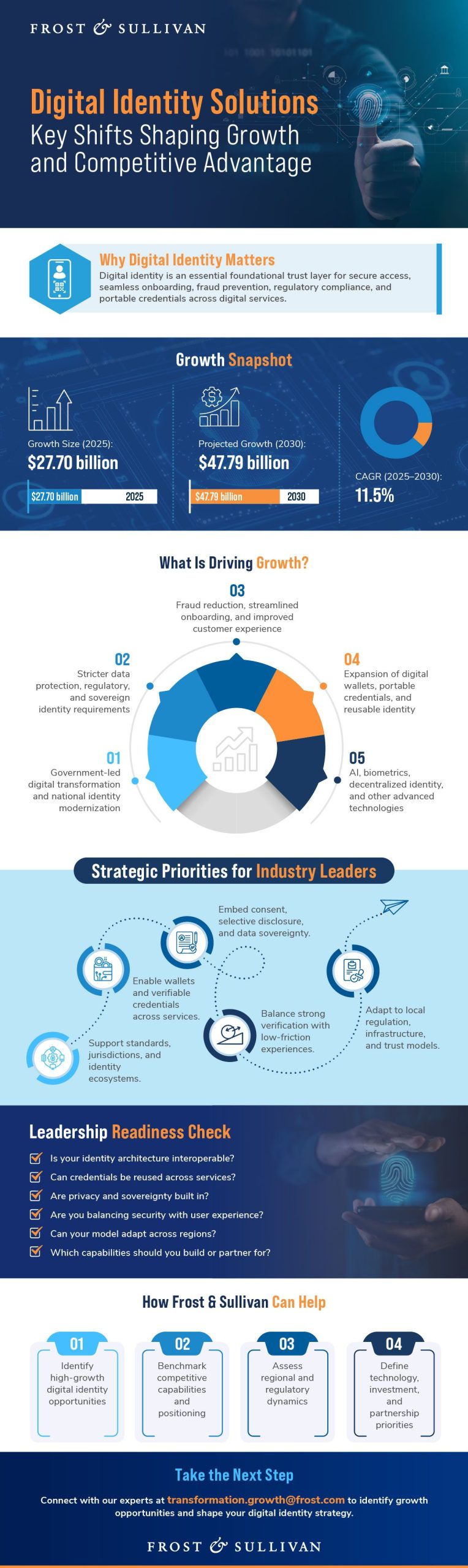
Digital identity is evolving into a foundational trust layer connecting governments, enterprises, platforms, and individuals. The global Digital ID solutions market is projected to grow from $27.70 billion in 2025 to $47.79 billion by 2030, at an 11.5% CAGR, driven by digital transformation, regulatory requirements, fraud reduction, and digital wallet adoption.
As wallets, verifiable credentials, biometrics, passkeys, and decentralized identity gain traction, organizations are prioritizing interoperability, privacy, security, and seamless identity experiences. New growth opportunities are emerging across credential orchestration, reusable credentials, offline verification, and digital public infrastructure.
How is your organization positioning its digital identity solution strategy to capture emerging growth while strengthening trust and interoperability?
Tune into our engaging podcast episode on Growth Opportunities Shaping Digital ID Solutions Market.
Key Takeaways
- National ID modernization and digital public infrastructure are accelerating digital ID adoption.
- Data protection and sovereign identity mandates are driving demand for verified, interoperable, privacy-preserving solutions.
- Regional differences in regulation, infrastructure, and ecosystem maturity are creating distinct opportunities across North America, Europe, Asia-Pacific, Latin America, and the Middle East and Africa. AI, biometrics, decentralized identity, and digital wallets are replacing document-centric identity models with reusable digital credentials.
- Interoperability is becoming an increasingly important competitive differentiator as identity ecosystems expand across jurisdictions, platforms, and services.
What Is a Digital Identity Solution?
A digital ID solution provides a digitally verifiable representation of an individual’s identity, credentials, and attributes, enabling secure access to services both online and offline. It supports authentication, fraud reduction, trusted interactions, and greater control over how personal data is shared.
The digital ID ecosystem includes national and federated ID systems, mobile IDs, verifiable credentials, digital wallets, and infrastructure for identity issuance, attestation, and verification. Governments, enterprises, and individuals use these capabilities across public services, financial services, healthcare, travel, and other digital interactions.
Strategic Imperatives Shaping the Digital Identity Solution Industry
- Transformative Megatrends
Digitization, platformization, demographic shifts, and regulatory realignment are making digital identity foundational infrastructure. The expansion of digital public infrastructure is also driving greater interoperability across public and private identity ecosystems, while rising fraud and regulatory scrutiny are increasing convergence between government credentials, enterprise identity, and digital wallets. - Disruptive Technologies
AI, biometric solutions, decentralized identity, and digital wallets are reshaping how identities are issued, verified, reused, and trusted. These technologies are supporting more dynamic, interoperable, and machine-verifiable identity ecosystems while creating demand for modular and composable architectures. - Competitive Intensity
Start-ups, cloud-native platforms, and ecosystem-based business models are increasing competitive pressure across digital identity. Differentiation is expanding beyond product breadth toward usability, interoperability, speed, partnerships, and the ability to operate across public and private trust domains.
Why Digital Identity Adoption Is Accelerating
- Government-led Digital Transformation
Governments are modernizing national ID infrastructure, introducing digital credentials, deploying mobile IDs, and developing digital wallets. Large-scale digital public infrastructure initiatives are creating foundational identity capabilities that can subsequently connect with banking, healthcare, welfare, payments, and other services.
- Regulatory and Sovereign Identity Requirements
Privacy, data protection, Anti-money Laundering (AML)/Know Your Customer (KYC), and digital trust requirements are increasing demand for verified and interoperable identity solutions. Regulatory environments also differ significantly by region, creating demand for architectures that can accommodate local assurance requirements, data governance, sovereignty, and compliance frameworks.
- Fraud Reduction and Customer Experience
Organizations are using digital identity Solution to address two connected priorities: reducing identity-related fraud while simplifying customer interactions. Automated identity proofing, biometrics, reusable credentials, and risk-based authentication can support onboarding and authentication across banking, travel, telecom, healthcare, and other regulated sectors.
- Expansion of Digital Wallets
Digital wallets are expanding the role of identity beyond one-time verification. Wallet-based models can enable users to store and present credentials across multiple services while supporting selective disclosure and greater control over information sharing.
Regional Digital Identity Landscape Analysis
Digital identity adoption is progressing through different models across major regions, reflecting differences in regulation, government involvement, infrastructure maturity, and ecosystem structure. Growth trajectories also vary, with Europe, North America, and Asia-Pacific representing significant revenue pools through 2030.
|
Region |
Strategic Focus |
2025 Revenue |
2030 Revenue |
CAGR (2025–2030) |
|
North America |
Interoperability, privacy, risk-based digital identity verification, digital credentials |
$5.33 billion |
$9.50 billion |
12.3% |
|
Europe |
Cross-border interoperability, wallets, verifiable credentials, privacy |
$8.34 billion |
$15.70 billion |
13.5% |
|
Asia-Pacific |
Digital public infrastructure, mobile identity, financial inclusion, scalable platforms |
$7.20 billion |
$12.45 billion |
11.6% |
|
Latin America |
Digital extensions of national IDs, fraud reduction, financial inclusion |
$2.97 billion |
$4.40 billion |
8.2% |
|
Middle East & Africa |
National identity, biometrics, wallets, public key infrastructure (PKI), eGovernment integration, offline capabilities, affordability |
$3.86 billion |
$5.74 billion |
8.2% |
*Source: Frost & Sullivan, Digital ID Solutions Market, Global, 2025–2030.
The Technologies and Challenges Shaping Digital Identity
As digital identity ecosystems expand, providers must address both the technologies enabling new identity models and the structural challenges that can limit deployment.
Technology Priorities
- Digital Wallets and Verifiable Credentials: Wallets and verifiable credentials are supporting portable and reusable identity models. They are also creating demand for issuance, verification, consent, lifecycle management, and interoperability capabilities.
- Biometrics and AI: Biometrics continue to support high-assurance digital identity verification, while AI is being applied across identity proofing, fraud detection, risk assessment, and user experience optimization.
- Passkeys and Adaptive Authentication: Passkeys and risk-based authentication are supporting passwordless and lower-friction authentication models while strengthening account security.
- Offline and Edge Verification: Offline credentials, on-device authentication, and cryptographic verification are becoming relevant where continuous connectivity cannot be guaranteed, including travel, mobility, emergency services, and distributed environments.
- Privacy-preserving Identity: Selective disclosure, consent digital identity management, data minimization, and user-controlled credentials are becoming important as organizations address privacy requirements and growing expectations around personal data control.
- Post-quantum Readiness: Long-lived identity infrastructure requires attention to cryptographic resilience. Frost Radar™ research highlights post-quantum readiness as an emerging consideration for identity and trust infrastructure.
Key Deployment Challenges
- Interoperability: Different identity schemes, technical standards, jurisdictions, and trust frameworks can make cross-platform identity exchange difficult.
- Regulatory Complexity: Regional differences in privacy, data protection, identity assurance, sovereignty, and compliance create implementation complexity for global providers.
- Trust and Data Governance: Users and organizations need confidence in how identity information is collected, stored, shared, and verified. Weak trust can limit adoption even where technical infrastructure is available.
- Infrastructure Limitations: Connectivity constraints, legacy systems, incomplete identity records, and uneven digital infrastructure can constrain deployment, particularly in developing economies.
- Program Investment: Large-scale identity programs require investment across infrastructure, cybersecurity, credential issuance, integration, governance, and ongoing lifecycle management.
Competitive Environment: From Identity Verification to Ecosystem Orchestration
The global Digital ID ecosystem remains highly competitive, with more than 100 competitors generating over $1 million in revenue.
Competitive differentiation is extending across:
- Regional presence
- Interoperability
- AI-enabled capabilities
- Reliability
- Open standards
- Consumer experience
- Regulatory readiness
- Ecosystem partnerships
Frost Radar™ analysis shows an increasingly layered ecosystem involving foundational providers, identity enablers, and relying parties. Established vendors are competing with specialist providers across identity creation, credential infrastructure, cryptographic trust, verification, and identity usage.
- Entrust
Entrust delivers identity verification, PKI, credential issuance, orchestration, and cryptographic capabilities, with additional capabilities in post-quantum cryptography, digital wallets, and secure credentialing.
- HID Global
HID Global spans physical and digital identity through mobile credentials, biometrics, cloud platforms, lifecycle digital identity management, and workforce identity, with a strong focus on interoperability.
- NEC
NEC brings together biometrics, AI-enabled identity verification, and population-scale digital identity platforms for government and commercial deployments.
- Signicat
Signicat advances reusable identity through Application Programming Interface (API)-driven platforms, digital identity schemes, wallets, and verifiable credentials.
The competitive environment indicates that scale alone is not defining differentiation. Interoperability, ecosystem positioning, technology breadth, regulatory readiness, and the ability to address specific industry and regional requirements are becoming important competitive dimensions.
|
Frost & Sullivan Perspective Frost & Sullivan identifies interoperability, ecosystem positioning, regulatory readiness, and technology integration as key dimensions of competitive differentiation in digital identity. Providers that can bridge fragmented identity environments, support diverse trust frameworks, and deliver adaptable solutions across public and private domains will be better positioned to strengthen their competitive relevance as the ecosystem develops. |
Top 3 Growth Opportunities Across the Digital Identity Ecosystem
The evolution of identity infrastructure is creating opportunities beyond traditional identity verification. Three areas stand out for providers seeking to expand their role in the digital identity ecosystem.
- Digital Wallet and Credential Orchestration
Digital wallets are creating demand for infrastructure that can manage credential issuance, storage, consent, verification, trust registries, and lifecycle digital identity management. Providers that can connect issuers, holders, and relying parties across multiple identity schemes can participate in a broader orchestration layer.
- Reusable Credentials Beyond Core Identity
Reusable credentials can extend into education, professional qualifications, healthcare, travel, eligibility verification, and KYC. This expands the addressable use cases for identity providers while creating new models for credential issuance and verification.
- Digital Identity Across the Global South
Expanding digital public infrastructure is creating demand for affordable, modular, and resilient identity platforms. Solutions supporting offline verification, assisted enrollment, low-connectivity environments, financial inclusion, and integration with existing public and private systems can address specific requirements across emerging economies.
Download the Sample Analysis to Explore More Growth Opportunities in Digital ID Solutions Market.
The Next Phase of Digital Identity Solutions
Digital identity is heading toward a more interconnected ecosystem where wallets, verifiable credentials, biometrics, trust frameworks, and digital platforms work seamlessly across organizational and sector boundaries.
The next phase will be defined not simply by the adoption of individual technologies, but by the ability to connect them into trusted, interoperable identity ecosystems. For industry leaders, the priority will be building identity architectures that can scale across ecosystems, adapt to evolving standards, and maintain trust as identity becomes increasingly embedded in digital interactions.
For technology providers, this creates an opportunity to move beyond individual identity capabilities and participate in the infrastructure that enables reusable, portable, and trusted digital credentials.
Frequently Asked Questions (FAQs):
1. What does digital identity mean?
Digital identity is a digitally verifiable representation of an individual’s identity, credentials, and attributes. It enables secure access to services, authentication, and identity verification while giving individuals greater control over how their personal information is shared across online and offline environments.
2. What are the types of digital identity?
Digital identity encompasses national and federated ID systems, mobile IDs, digital wallets, and verifiable credentials. These solutions support different stages of the identity lifecycle, including issuance, attestation, authentication, verification, and secure credential sharing across public and private services.
3. What is digital identity verification?
Digital identity verification is the process of establishing that an individual is who they claim to be and that their identity credentials are valid. Solutions can use biometrics, government-issued credentials, digital credentials, cryptographic verification, and other identity signals to establish trust.
4. How does digital identity verification work?
Digital identity verification typically involves identity proofing, credential issuance or validation, authentication, and verification. Depending on the application, organizations can use biometrics, digital credentials, device signals, passkeys, or cryptographic methods to verify identity while managing risk and data exposure.
5. What is driving growth in digital identity solutions?
Government-led digital transformation, regulatory and sovereign identity requirements, fraud reduction, customer experience improvements, and digital wallet adoption are key growth drivers. These factors are expanding digital identity use across financial services, healthcare, travel, telecom, public services, and other digital interactions.
6. Where are the key growth opportunities for digital identity providers?
Growth opportunities are emerging in digital wallet and credential orchestration, reusable credentials across sectors, and resilient identity infrastructure for emerging economies. Providers can also expand through solutions supporting offline verification, interoperability, consent, and integration with public and private services.
7. What should industry leaders prioritize when investing in digital identity?
Industry leaders should prioritize interoperable architectures, privacy and security, regional regulatory alignment, and technologies such as AI, biometrics, passkeys, and verifiable credentials. Building strong ecosystem partnerships can also support scalable deployment across government, enterprise, and service-provider environments.
Ready to Lead the Transformation?
- Schedule a Growth Strategy Dialog: Align your growth roadmap with Frost & Sullivan’s Visionary Growth Pipeline™ Dialog.
- Engage with Growth Experts: Co-design AI-enabled, data-driven operating models that scale industry-specific and commercial impact.
- Showcase Your Transformational Leadership: Position your organization as a transformation leader through Frost & Sullivan’s Transformational Growth Leadership platform.
- Join the Growth Council: Collaborate with industry leaders shaping the future of your ecosystem.
- Explore Best Practices Recognition: Be recognized for excellence in growth strategy, execution, and customer impact.
- Benchmark Your Industry Positioning on the Frost Radar™: Benchmark your growth performance and innovation strength against industry competitors.
- Tell Your Story: Accelerate awareness, engagement, and revenue growth through integrated brand and demand generation strategies.