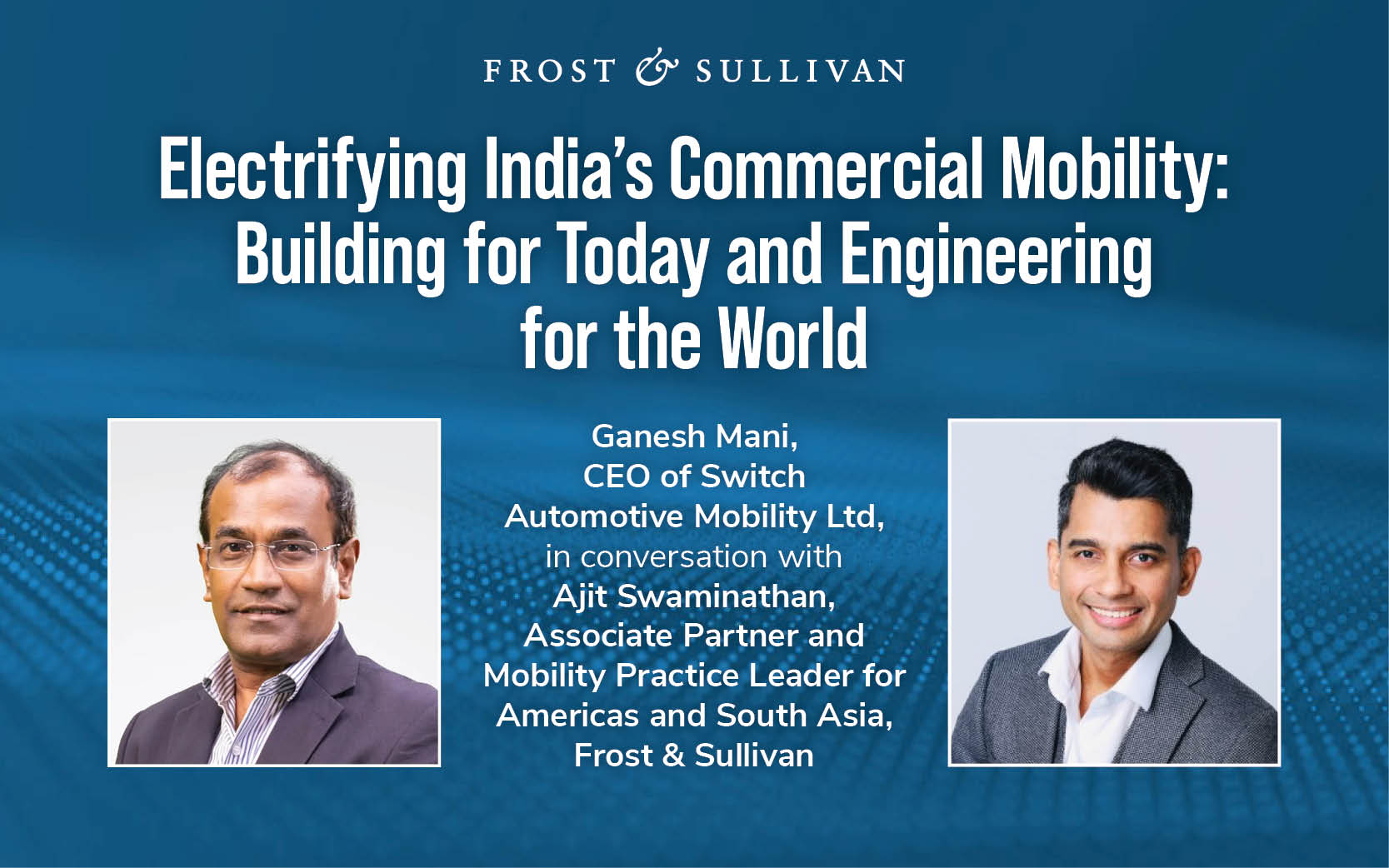
Ganesh Mani, Switch Mobility, in conversation with Ajit Swaminathan, Frost & Sullivan
Download this Transformational Growth Leadership Discussion with Ganesh Mani
India’s commercial mobility ecosystem is undergoing a significant transformation as electric vehicles move from early adoption toward broader commercial deployment. For fleet operators, total cost of ownership, operating efficiency, charging infrastructure, battery technology, and vehicle utilization are increasingly shaping the case for electrification.
In this Transformational Growth Leadership discussion, Ajit Swaminathan speaks with Ganesh Mani on India’s shift to electric commercial vehicles, exploring customer-led product development, real-world vehicle data, software-enabled opportunities, and Switch Mobility‘s ambitions to build in India and engineer for the world.
“Our principal motto is build in India and engineer for the world.”
—Ganesh Mani, CEO, Switch Mobility
Total Cost of Ownership Is Driving the Transition
Ajit Swaminathan: India’s mobility ecosystem has been seeing some of the biggest changes in decades. When you look ahead, what do you think will really reshape the commercial EV market over the next few years?
Ganesh Mani: The EV industry is a fast-evolving industry. The Government of India and the industry have been moving toward lower tailpipe emissions, and electrification is one of the important technologies driving that transformation. The government has set a target of 30% electrification by 2030, and the transition is already happening at a fast pace, year on year.
There are multiple things coming into play, but one of the first questions customers ask is total cost of ownership. Whether it is a bus, a truck, or a smaller commercial vehicle, the question is how effectively you can connect the vehicle to the customer’s operating costs. The operating-cost advantage can be around 30% to 40%, and that provides a quick impetus for customers to make the transition.
There is also the environmental benefit, with every vehicle helping to reduce CO2 emissions. At the same time, policy is evolving from tender-based electrification toward more retail-based adoption. We are already seeing examples such as Delhi’s policy changes, where electric trucks will be required in certain applications.
Charging infrastructure has grown significantly, and we expect it to increase many times over by 2030. Battery technology is also improving, particularly in terms of energy density, battery management systems, and vehicle weight. For commercial vehicles, reducing battery weight is especially important because the vehicle also needs to carry people or cargo.
Supply-chain localization is another important piece. Indigenization has already reached around 60% to 70% across many players, and we expect that to increase. At Switch, we are also working toward greater vertical integration, including battery assembly and, eventually, potentially cell manufacturing.
Where Electrification Makes the Strongest Economic Sense
Ajit Swaminathan: The economics can look very different depending on the application. Where are you seeing the strongest case for electrification today, and which segments do you think will move next?
Ganesh Mani: City buses are one of the strongest areas. The electrification drive started with city buses, and across Indian cities, many of the new vehicles being purchased are low-floor or ultra-low-floor electric buses. Governments have also recognised the efficiency benefits, which can be around 45% to 50% compared with conventional alternatives.
The intercity bus segment is another important opportunity. As charging facilities improve and ranges increase, operators can move beyond relying on very large batteries. Our buses can have battery ranges of around 325 kilometres. Our Mumbai-Pune intercity buses have been running successfully, and customers are seeing the financial benefits as well.
Longer-distance buses will follow as charging infrastructure and fast-charging capabilities continue to evolve. Trucks also offer significant opportunities. Take reefers, for example. They need electricity not only to move the vehicle but also to keep the refrigerated compartment running. In India, vehicles can spend a lot of time in traffic, and conventional engines have to keep running. With an electric vehicle, there are opportunities to manage charging and use the vehicle battery to support the refrigeration requirement as well.
There are also opportunities in smaller commercial vehicles, particularly in applications such as dark stores and point-to-point movement where there are large volumes but relatively lower weight requirements. As governments increasingly introduce areas where only electric vehicles can operate, these applications can become even more attractive.
Policy Can Enable the Market, but Products Have to Deliver
Ajit Swaminathan: Policy support has clearly helped get the transition moving. But as the market matures, what do you think will keep electrification moving forward?
Ganesh Mani: It cannot be done single-handedly. The customer has an important role because ultimately the customer has to pay and take responsibility for adopting electrification. But the most important players are the OEMs and the government.
A number of government policies have evolved over time to facilitate rather than simply subsidize the market. For example, support for batteries helps develop the broader ecosystem. But OEMs are equally responsible for developing products that genuinely suit customer needs.
That means offering the right products for different applications rather than providing a standalone solution. In our LCV range, for example, we have 17 different product varieties. We also have multiple bus configurations, including different lengths and applications.
Ultimately, the responsibility is to provide products that are sustainable, safe, reliable, and of high quality. We need to make sure the components are reliable and that the vehicles are properly tested and validated before deployment. That is how we make electrification viable from the Indian customer’s perspective.
Customers Are Shaping the Product Roadmap
Ajit Swaminathan: As customers have become more familiar with electric vehicles, how has the conversation changed? Are they coming to you with a clearer idea of what they need?
Ganesh Mani: Absolutely. EVs are a new-age product, and a lot of our learning comes from customers. Many B2B customers have large fleets and are educated about their operations. They tell us exactly what routes they need to cover, what range they expect, and what conditions the vehicle needs to operate in.
The product is also flexible. It is not a rigid product where everything has to remain fixed. Depending on the application, you can work with different battery sizes and motor configurations, subject to the right engineering process.
Customers therefore give us a lot of input and ideas. We take those inputs back into the product-development system. There is a lot of mutual learning, and we keep meeting customers and seeking ideas that can feed into the next product.
That feedback is particularly important because electrification is still a relatively nascent market. Our products have an uptime of around 98%, and we want to maintain that level. At the same time, around 14 parameters from the vehicles are constantly flowing back into our system. We have a data center where we can monitor the vehicles and use that information to improve the products and feed learnings back into R&D, including battery management systems and overall process efficiency.
Making the Economics Visible to Fleet Owners
Ajit Swaminathan: When you tell a fleet owner that an electric vehicle will save them money, can you quantify that clearly for them, or is there still a leap of faith involved?
Ganesh Mani: Each segment understands its own economics very well. Our job is to bring the vehicle into alignment with that. We calculate the total cost of ownership from A to Z based on the application.
For an LCV, for example, we can clearly see savings of at least five lakh rupees over five years. For buses with a range of more than 200 kilometres, the economics can start working from day one.
There is also a point at which adoption starts to accelerate. We have seen that when the cost difference between an EV and the equivalent conventional product comes down to around 25% to 40%, uptake can start to follow a hockey-stick pattern. We have seen this in two-wheelers, three-wheelers, smaller four-wheelers, and buses, and we expect to see similar developments in commercial vehicles.
The remaining concern customers have is whether the product will sustain over time. They are not used to electric vehicles and want confidence that the vehicle will not create problems. That is where companies like Switch have to step in and give customers that assurance.
Building a Premium Brand Around Customer Confidence
Ajit Swaminathan: Switch is still a relatively young brand. As you build it out, what do you want customers to immediately associate with Switch?
Ganesh Mani: We have been built specifically to make electric products, and we want to continue the premium positioning that is part of our product DNA. We also don’t differentiate between export and domestic vehicles. We believe domestic customers deserve the same level of treatment as export customers.
We have already started exporting, including to Mauritius, and our products are also operating in the UK and Dubai. The brand needs to remain agile and continue to respond to customers while delivering high levels of satisfaction.
Another important part of our DNA is speed. We have been bringing products to market very quickly, and we want to continue doing that. Ultimately, we want customers to feel that they are getting a premium product and to have a sense of pride of ownership.
Turning Vehicle Data into New Opportunities
Ajit Swaminathan: We are hearing a lot about software, connectivity, and AI across mobility. When you look at your own vehicles and customers, where are you seeing technology create value?
Ganesh Mani: One of the biggest advantages of electric vehicles is the amount of data you can generate. In some applications, you own the vehicle for 12 years, and after two or three years you already have a significant amount of data available.
The opportunity is to use that data to create advantages for both the customer and us, particularly around reliability and cost.
There are also opportunities for adjacent businesses. Insurance companies could use the data, and there could be a resale market based on battery health. Over time, we could have a much more developed market where battery health becomes an important factor in determining vehicle and battery value.
And because an electric vehicle is software-enabled and its parameters are measurable, it could also make autonomous applications easier to develop, particularly for electric buses and LCVs. These are areas where we see significant opportunities going forward.
Building in India, Engineering for the World
Ajit Swaminathan: You have already started taking Switch into markets such as the UK and Dubai. How do you see that international opportunity evolving, and what role can India play in that growth?
Ganesh Mani: Exporting is not new for us. Our electric buses are already operating in large numbers in the UK and Dubai. As a company that has historically exported to a minimum of 50 countries, we have a robust plan for international markets.
The Middle East is one of the biggest markets where we already have a presence, and we want to take that forward. Africa is another opportunity, and we are developing products that could serve those markets at the right time.
Our principal motto is “build in India and engineer for the world.” India has engineers with expertise in integrating different systems. We may not manufacture every component from the ground up, as some other countries do, but our teams have strong expertise in integrating those components to create the best possible solutions.
From both a cost and technology perspective, there is a lot of value that can be created in India. I believe India will become an important exporting hub, as we have already seen in some other industries, and Switch intends to lead that change.
Creating a Culture Built Around Speed and Innovation
Ajit Swaminathan: You have talked about moving quickly and launching products at a much faster pace. What does that require from the organization and the culture behind Switch?
Ganesh Mani: As a five-year-old company, we are thriving on the idea of “move better.” I call it Switch speed, or Switch speed to the power of two.
In the last three years, we have launched five or six important vehicle products, and the ambition is to increase that significantly over the next year and a half. That requires speed, agility, customer centricity, and innovation from every person in the organization.
And it isn’t only about the people working within the company. It includes the people running the buses on the road, the mechanics, and everyone across the ecosystem. Everyone needs to be focused on speed, innovation, and customer centricity.
Those three things will play an important role in determining what Switch becomes by 2030.
Looking Toward a 30% Electrified Commercial Market
Ajit Swaminathan: Let me end with a forward-looking question. If we come back and have this conversation in 2030, what do you think we’ll look back on and say the industry underestimated?
Ganesh Mani: I wouldn’t call it an underestimate. I would say that what people may think today is not possible will become a reality.
Electrification will definitely play an important role in buses, and we will see significant electrification in LCVs as well. The 30% target is not a small number.
India is a growing country, so the absolute numbers will also grow. We have moved from 2% to 3% and then toward 5%, and by 2030 I would not be surprised if electrification reaches more than 30%. That is the biggest change I believe will happen.
Beyond the Vehicle: Building Software-Led Revenue
Ajit Swaminathan: Before we wrap up, let’s talk about what’s beyond the vehicle itself. Where do you see opportunities to build additional revenue through software, services, or other capabilities?
Ganesh Mani: First and foremost, we need to be strong in our own area. We are not only working on the battery; we are also working on battery management systems and software-driven capabilities.
Once those core technologies are with us, we can build on them in multiple ways. We can move toward over-the-air updates, additional features, and eventually autonomous vehicles.
We already have roadmaps for making software a revenue model at a certain point. We have a team working on this, and they have already developed a number of ideas around how we can create additional value beyond simply selling a vehicle to the customer. There are a whole lot of opportunities, and you will see these developing in the future.
Closing Reflection: From EV Adoption to a Data-Led Commercial Mobility Ecosystem
India’s commercial vehicle electrification journey is moving beyond early adoption, with total cost of ownership, charging infrastructure, battery technology, and customer-specific applications increasingly shaping where electric vehicles make commercial sense. Ganesh Mani’s perspective highlights that the transition is not being driven by a single factor, but by the convergence of policy enablement, improving economics, evolving technology, and a growing ecosystem.
For Switch Mobility, the transformation extends beyond developing electric vehicles. Customer feedback and real-world vehicle data are feeding directly into product development, while battery management, connectivity, and software are opening new possibilities around reliability, insurance, battery value, and eventually autonomous mobility. At the same time, the company’s international ambitions position India not only as a domestic market, but as an engineering and export base for global commercial mobility.
The broader transformation is therefore moving from simply electrifying commercial vehicles to building a more connected mobility ecosystem, where vehicle economics, customer insight, data, software, batteries, and infrastructure increasingly work together.
For Switch Mobility, that evolution is reflected in its ambition to move faster, stay close to customers, build deeper technology capabilities, and ultimately “build in India and engineer for the world.”
About Ganesh Mani
Ganesh Mani is CEO of Switch Automotive Mobility Ltd, the electric commercial vehicle arm of Ashok Leyland. Based in Chennai, he previously served as Chief Operating Officer of Ashok Leyland. At Switch, he is focused on scaling electric buses and LCVs, deepening the charging and data ecosystem, and expanding across the Middle East and Africa.
Ajit Chander Swaminathan is Associate Partner and Mobility Practice Leader for Americas & South Asia at Frost & Sullivan. With 20+ years of experience, he specializes in strategic planning, business development, P&L ownership, and digital transformation. His industry leadership spans electrification, connected vehicles, manufacturing, aftermarket, and regulatory frameworks, helping mobility clients grow, scale, and transform across global markets.

About Ajit Swaminathan
Ready to Lead the Transformation?
- Schedule a Growth Strategy Dialog: Align your growth roadmap with Frost & Sullivan’s Visionary Growth Pipeline™ Dialog.
- Engage with Growth Experts: Co-design AI-enabled, data-driven operating models that scale industry-specific and commercial impact.
- Showcase Your Transformational Leadership: Position your organization as a transformation leader through Frost & Sullivan’s Transformational Growth Leadership platform.
- Join the Growth Council: Collaborate with industry leaders shaping the future of your ecosystem.
- Explore Best Practices Recognition: Be recognized for excellence in growth strategy, execution, and customer impact.
- Benchmark Your Industry Positioning on the Frost Radar™: Benchmark your growth performance and innovation strength against industry competitors.
- Tell Your Story: Accelerate awareness, engagement, and revenue growth through integrated brand and demand generation strategies.
Annexure:
Frost & Sullivan has curated analyses that highlight growth opportunities, strategic imperatives, and technological transformations across the electric mobility industry, offering critical insights for innovation and modernization.
Here are a few of them that you would like reading: