This blog is based on our analysis – Frost Radar™: Oil and Gas Automation, authored by Frost & Sullivan’s Growth Expert, Jonathan Robinson, from the Energy team.
The Shift Toward Intelligent Oilfield Operations
Oil and gas automation powers core operations, from asset monitoring and maintenance to safety management and production optimization. Traditionally, companies have relied on conventional technologies to automate processes, with a strong focus on reliability.
Today, growing demands from digitalization and decarbonization—coupled with rising operational complexity—are exposing the limitations of traditional systems. This makes it harder for operators to manage remote assets and enable real-time decision making across oilfield operations.
Accelerate Digital Oilfield Transformation
Learn how advanced automation solutions are reshaping oilfield operations and unlocking new opportunities.
In response, oil and gas companies are shifting toward advanced automation technologies like AI-driven predictive maintenance, Internet of Things (IoT)-enabled monitoring, and robotics for remote inspections. This transition is creating new opportunities for technology providers as operators reassess their automation strategies and accelerate the move toward more connected and intelligent oilfield operations.
As the oil and gas industry moves toward autonomous operations, is your growth strategy built to deliver long-term efficiency gains?
What’s Shaping the Future of Oilfield Automation?
Leading Solution Providers in Oil and Gas Automation
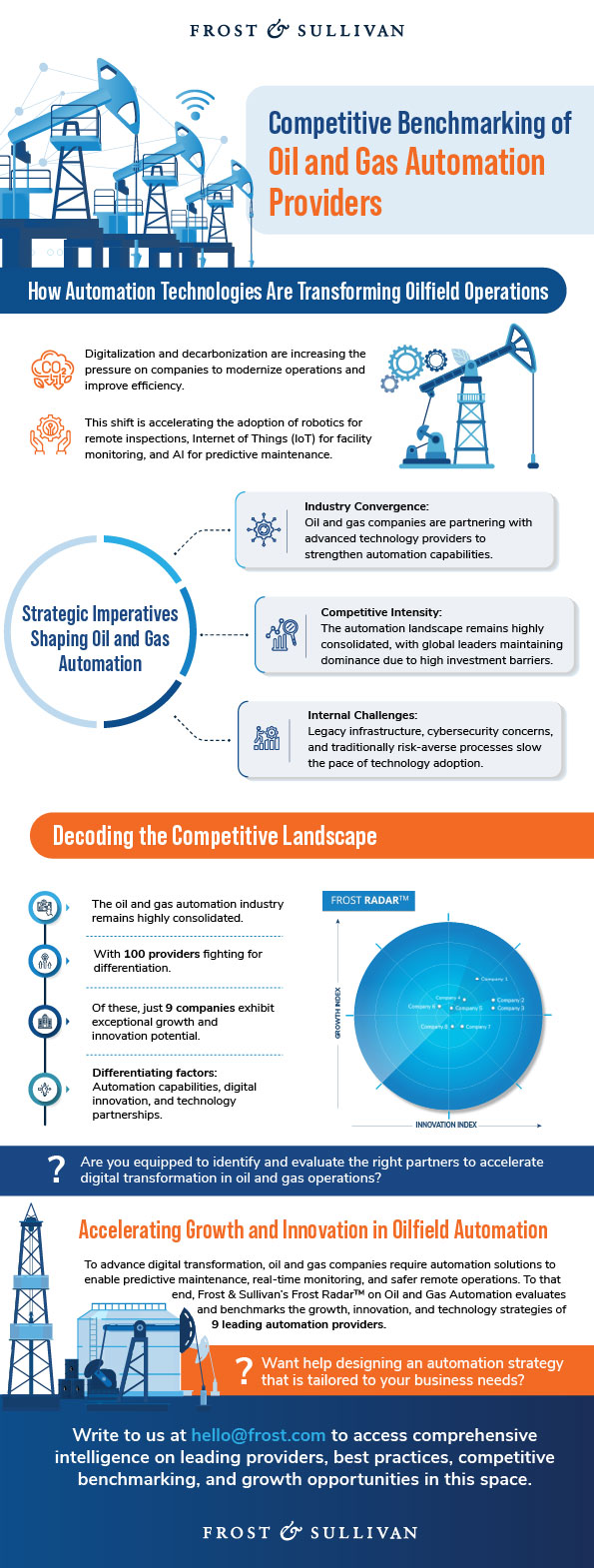
Our latest Frost Radar™ highlights the following three companies that set benchmarks in AI-driven automation, connected operations, and digital oilfield transformation in a highly consolidated automation landscape.
Emerson
- Integrated automation and digital ecosystem: Delivering end-to-end automation through IoT, AI, and digital twin technologies, supported by its Boundless Automation™ vision to unify data across cloud, edge, and field operations.
Honeywell
- AI-driven optimization and digital twin leadership: Enabling real-time monitoring, predictive maintenance, and emissions management through advanced analytics, IoT integration, and cloud-based digital twin solutions.
Rockwell Automation
- Edge-to-cloud automation and DataOps platform: Combining AI, IoT, and digital twin capabilities with real-time analytics to deliver scalable, intelligent automation solutions tailored for oilfield operations.
Will established automation leaders maintain their dominance as AI, IoT, and robotics accelerate innovation? Or will new entrants redefine oilfield operations with more agile, data-driven solutions?
Best Practices to Advance Oil and Gas Automation
As oil and gas companies accelerate digital transformation, they face challenges like legacy systems, safety compliance, complex operations, data silos, cyber risk, and skills gaps. The following best practices will help them move forward:
- Automate compliance processes: Standardizing health and safety workflows improve risk management and enhance workforce safety.
- Develop a clear implementation roadmap: Defining objectives, data ownership, and process workflows ensures automation systems are tested, scalable, and easy to maintain.
- Expand the use of advanced technologies: Leveraging AI, IoT sensors, and robotics enables predictive maintenance, real-time monitoring, and safer remote operations.
Is your organization leveraging these best practices to enhance operational efficiency and performance?
Emerging Growth Opportunities in Oil and Gas Automation
As the oil and gas industry moves toward more connected and low-carbon operations, companies can leverage the following opportunities to drive growth and differentiation:
- Autonomous Oilfields: Advancing toward fully automated operations reduces human intervention and optimizes upstream performance.
- Electrification of Subsea Operations: Electrifying subsea facilities lowers operational costs and reduces emissions.
- Repurposing Mature Assets: Transforming aging oilfields into geothermal energy assets minimizes decommissioning costs and creates new revenue streams through power generation.
Which of these growth opportunities will have the biggest impact on your business and how will you capitalize on it?
Next Steps to Modernize Oilfield Operation
Automated technologies are becoming critical for improving efficiency, safety, and operational performance. By adopting best practices, benchmarking leading providers, and leveraging opportunities in autonomous operations, electrification, and asset repurposing, oil and gas companies can stay competitive in an increasingly digital and evolving energy landscape.
Frequently Asked Questions (FAQs)
What is automation in oil and gas?
Automation in oil and gas refers to the use of technologies like AI, IoT, and robotics to monitor, control, and optimize operations. It enables real-time data insights, predictive maintenance, and safer, more efficient management of oilfield assets.
Who are the top 5 oil and gas automation companies?
According to Frost & Sullivan, the top 5automation providers in the oil and gas industry are Honeywell, Emerson, Rockwell Automation, Siemens, and ABB, known for their strong innovation capabilities and integrated automation solutions.
What technologies are driving oil and gas automation?
Oil and gas automation is driven by AI for predictive maintenance and decision intelligence, IoT-enabled sensors for real-time asset monitoring and connectivity, and robotics for remote inspection and maintenance in hazardous environments. In addition, digital twins and edge-to-cloud platforms are enabling simulation, optimization, and more autonomous operations.
Why is automation important in oilfield operations?
Automation is critical for improving efficiency, reducing unplanned downtime, and enhancing safety in complex and remote oilfield environments. By enabling real-time monitoring, predictive insights, and remote operations, it helps companies optimize performance, lower operating costs, and make faster, data-driven decisions.
Ready to Lead the Transformation?
- Book a Growth Strategy Session: Align your growth roadmap with Frost & Sullivan’s visionary Growth Pipeline™ Dialog.
- Engage with Growth Experts: Co-design AI-enabled, data-driven operating models that scale industry-specific and commercial impact.
- Share Your Transformation Story: Position your organization as a transformation leader through Frost & Sullivan’s Transformational Growth Leadership platform.
- Join the Growth Council: Collaborate with industry leaders shaping the future of your ecosystem.
- Nominate for the Best Practices Recognition: Be recognized for excellence in growth strategy, execution, and customer impact.
- Demonstrate Industry Positioning on the Frost Radar™: Benchmark your growth performance and innovation strength against industry competitors.
- Activate Brand & Demand Growth: Accelerate awareness, engagement, and revenue growth through integrated brand and demand generation strategies.