This blog is based on Frost & Sullivan’s recent analysis, Global Risk Mapping and Industry Resilience Strategies, 2026–2027, authored by growth expert Prerna Mohan and lead analyst Rituparna Majumder from the Economic Analytics Practice Area.
Executive Summary
Geopolitical instability, trade fragmentation, energy volatility, and technology disruption are reshaping global economic and industrial growth through 2026–2027. Rising supply concentration and exposure to critical trade and energy corridors are accelerating supply chain diversification, regionalized manufacturing, energy security, and digital infrastructure protection. These shifts are creating commercial opportunities across energy infrastructure, regional manufacturing, and cybersecurity while making resilience an increasingly important factor in long-term growth and competitive positioning.
Key Takeaways:
- Energy security investment extends commercial demand across infrastructure, storage, logistics, and industrial services.
- Cyber resilience brings secure connectivity, redundancy, and digital protection closer to infrastructure and continuity spending.
- Resilience now affects capital allocation, supplier relevance, and long-term competitive positioning.
What Is Supply Chain Diversification?
Supply chain diversification is the strategy of reducing dependence on concentrated suppliers, production locations, or trade routes by expanding sourcing, manufacturing, logistics, and supplier networks across multiple regions. As geopolitical and trade risks increase, companies are using diversification to improve continuity, reduce concentration risk, and maintain access to critical inputs and markets.
How Are Global Risks Reshaping Business Growth in 2026–2027?
Geopolitical instability across critical trade and energy corridors is reshaping the economics of global trade, production, and investment. In 2026, tensions around the Strait of Hormuz, which carries roughly 20% of global oil flows, reduced vessel traffic by more than 70% and pushed Brent crude above $100 in the first quarter. Red Sea diversions, tariff volatility, and tighter technology controls are adding pressure across freight, input costs, sourcing, and market access.
Turn Global Risk into Growth Advantage
See where resilience-led investment is creating new opportunities across supply chains, energy, and digital infrastructure.
These pressures are accelerating a shift toward more diversified and resilient operating models. Manufacturers, energy-intensive industries, logistics providers, and technology companies are reassessing sourcing, production footprints, trade routes, and infrastructure dependencies. As a result, supplier demand is shifting toward regional manufacturing, logistics, compliance, industrial infrastructure, energy security, and supply-chain resilience services.
Top Three Strategic Imperatives Shaping Resilience and Growth
- Geopolitical Chaos: Conflict across critical energy and maritime corridors is raising freight, insurance, and input costs while exposing the limits of concentrated supply networks. Alternative routes, diversified sourcing, and regional infrastructure are gaining commercial relevance, creating stronger entry points across logistics, energy security, and supply-chain services.
- Transformative Megatrends: China+1/+N strategies and regionalization are redistributing manufacturing capacity toward India, Southeast Asia, and select nearshore hubs. New production ecosystems are drawing investment into industrial infrastructure, logistics, and trade-enablement services, giving suppliers a broader role in regional expansion and market entry.
- Disruptive Technologies: Tighter technology controls and regulatory oversight are changing how advanced digital capabilities scale across markets. Secure deployment, compliance, cybersecurity, and workforce readiness now carry greater weight in technology-led growth, strengthening opportunities for providers that support resilient and regulation-ready digital ecosystems.
Frost & Sullivan Perspective
According to Frost & Sullivan, the next phase of global resilience will be shaped by geopolitical volatility, regionalized supply networks, and tighter technology governance. Market leaders will differentiate through diversified supply ecosystems, resilient infrastructure, and regulation-ready digital capabilities. Companies that embed resilience into their growth strategies will be better positioned to capture emerging opportunities.
🔍 Explore how geopolitical and trade fragmentation are reshaping global growth strategies
Where Growth Momentum Meets Higher Execution Risk
Selected growth markets continue to support consumption and capital spending, but the conditions surrounding that growth are less straightforward. Conflict is adding cost across trade routes, technology policy is complicating cross-border access, and specialized talent gaps are slowing project execution. The commercial picture now differs sharply by geography, infrastructure readiness, and exposure to these constraints.
| Growth Driver | Growth Restraint | Commercial Implication |
| Emerging Markets Lead Global Expansion | Geopolitical Conflicts Intensify Supply Chain Fragmentation | Faster expansion in India and Saudi Arabia opens a wider geographic demand base. At the same time, freight volatility and supply disruption favor regional sourcing, logistics capacity, and more distributed delivery networks. |
| AI Capex Surge Accelerates Near-term Growth | Revised United States (US) Chips Policy Raises Tariff and Compliance Pressures | Spending on digital infrastructure, semiconductors, power, and construction supports a broader supplier base. Tariffs and approval requirements, however, make technology access and cross-border market entry more complex. |
| Fiscal Expansion Cushions Energy Shock Impact | Chronic Skilled Talent Shortage Limits Advanced Technology Deployment | Fiscal support is preserving near-term investment despite energy volatility. Talent shortages remain a bottleneck, delaying projects and limiting how quickly advanced technology investment translates into operating capacity. |
Key Takeaway: Growth alone no longer defines commercial attractiveness. Regional demand, infrastructure capacity, policy exposure, and execution readiness now carry greater weight in supplier positioning. Markets where these conditions align offer clearer entry points for infrastructure, technology, logistics, and supply-chain providers.
Where are stronger demand conditions opening viable commercial entry points despite higher execution risk?
Where Concentrated Risk Is Reshaping Industry Economics
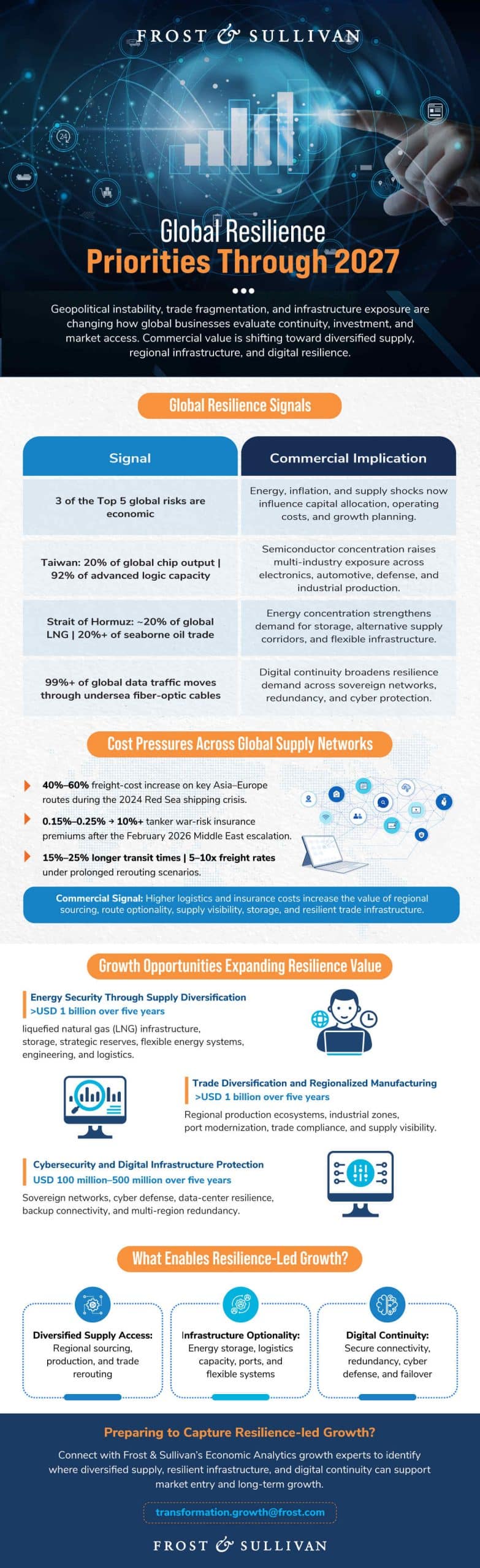
- Semiconductor concentration raises cross-industry exposure. Taiwan accounts for 20% of global chip output and 92% of advanced logic capacity, while revised US chip policy adds tariff and compliance pressure for providers such as NVIDIA.
- Critical-mineral disruption is already affecting manufacturing. China’s US-bound magnet shipments fell 93% year on year in May 2025, contributing to temporary production stoppages at manufacturers such as Ford.
- Energy shocks can alter operating costs rapidly. The 2026 Hormuz disruption cut global liquefied natural gas (LNG) supply by roughly 20%, while European gas prices rose by more than 60%.
Business Implication: Disruption at a major production hub, strategic input source, or trade corridor can quickly affect costs and availability across adjacent industries. That exposure raises the commercial value of regional sourcing, logistics flexibility, supply visibility, and resilience infrastructure across distributed operating networks.
📖 Read how global economic and supply-chain risks are redefining growth priorities in 2026.
Top 3 Growth Opportunities Turning Resilience Investment into Commercial Value
- Energy Security Through Supply Diversification
Valued at more than USD 1 billion over five years, this opportunity spans LNG import infrastructure, storage, strategic reserves, alternative fuels, and cross-border energy systems.
Business implication: Storage, engineering, logistics, and flexible energy infrastructure broaden supplier participation beyond traditional energy supply.
- Trade Diversification and Regionalized Manufacturing
US imports from China fell 29% in 2025, reflecting the redistribution of trade and production across regional hubs. The more than USD 1 billion, five-year opportunity covers industrial infrastructure, logistics modernization, port capacity, and trade-enablement services.
Business implication: Regional manufacturing growth widens market access for infrastructure, logistics, compliance, and supply-visibility providers, while regional integration carries greater weight in supplier positioning.
- Cybersecurity and Digital Infrastructure Protection
More than 100 cyber incidents were reported within the first 72 hours of the 2026 US-Israel-Iran conflict, while over 99% of global data traffic moves through undersea fiber-optic cables. The opportunity is valued at USD 100 million–500 million over five years.
Business implication: Secure connectivity, sovereign infrastructure, redundancy, and failover capabilities gain commercial relevance as digital continuity becomes a larger part of resilience investment.
Which of these 3 Growth Opportunities offers the strongest alignment with emerging resilience demand and supplier positioning?
Strategic Recommendations
- Diversify critical supply exposure: Map concentrated suppliers, production hubs, and trade corridors and establish alternative sources where disruption could materially affect continuity.
- Prioritize regional capability: Align manufacturing, logistics, energy, and technology investments with markets offering stronger infrastructure and policy support.
- Build resilience into growth strategy: Treat energy security, cybersecurity, supply visibility, and regulatory readiness as investment priorities rather than standalone risk-management functions.
Future Outlook: Where Resilience Will Shape Growth Through 2027
Through 2027, commercial advantage will depend less on avoiding disruption and more on the ability of regional ecosystems to sustain investment through it. Economic risks account for three of the top five global risks, while semiconductor supply chain breakdown remains the only technology risk in the top five.
Regional production depth, diversified supply access, infrastructure resilience, and regulatory compatibility will carry greater weight in supplier relevance and market entry. According to Frost & Sullivan, resilience is becoming integral to growth itself, influencing where capital can scale, where suppliers remain competitive, and where long-term commercial value can be sustained.
Ready to Lead the Transformation?
- Schedule a Growth Strategy Dialog: Align your growth roadmap with Frost & Sullivan’s Visionary Growth Pipeline™ Dialog.
- Engage with Growth Experts: Co-design AI-enabled, data-driven operating models that scale industry-specific and commercial impact.
- Showcase Your Transformational Leadership: Position your organization as a transformation leader through Frost & Sullivan’s Transformational Growth Leadership platform.
- Join the Growth Council: Collaborate with industry leaders shaping the future of your ecosystem.
- Explore Best Practices Recognition: Be recognized for excellence in growth strategy, execution, and customer impact.
- Benchmark Your Industry Positioning on the Frost Radar™: Benchmark your growth performance and innovation strength against industry competitors.
- Tell Your Story: Accelerate awareness, engagement, and revenue growth through integrated brand and demand generation strategies.
Connect with our growth experts at [email protected].
FAQs
1. What is global risk mapping?
Global risk mapping assesses economic, geopolitical, trade, technology, and infrastructure risks based on their impact, likelihood, and duration. It gives global risk management a clearer view of where disruption could affect costs, continuity, and investment conditions.
2. What is driving supply chain diversification in 2026–2027?
Geopolitical conflict, trade fragmentation, tariffs, and maritime chokepoint disruption are accelerating supply chain diversification. These pressures are also shifting production and supplier demand toward more regionalized operating networks.
3. How does geopolitical risk affect supply chain resilience?
Geopolitical risk can increase freight costs, delay shipments, and disrupt access to strategic inputs. Stronger supply chain resilience reduces dependence on concentrated production hubs and critical trade routes.
4. Why is energy security important to business resilience?
Energy security directly affects operating costs, industrial production, and supply continuity. Investment in storage, infrastructure, logistics, and diversified energy supply is therefore gaining greater commercial relevance.
5. How is cybersecurity risk affecting business continuity planning?
Cybersecurity risk can interrupt critical infrastructure, data flows, and connected operations across industries. Secure networks, redundancy, and digital resilience are becoming more closely linked to business continuity planning.
6. Which industries face the greatest supply chain risk?
Semiconductors, automotive, LNG, critical minerals, and logistics face significant exposure to concentrated supply and trade networks. This makes supply chain risk management increasingly relevant to production continuity and sourcing stability.
7. What growth opportunities are shaping enterprise resilience strategies?
Enterprise resilience strategies are supporting opportunities across energy security, trade diversification, regionalized manufacturing, and digital infrastructure protection. These themes are central to Global Risk Mapping and Industry Resilience Strategies, 2026–2027.