This blog is based on a recent analysis, “Impact of the US-Iran War on the Automotive Industry,” authored by Joe Praveen, Associate Director & Growth Expert, specializing in Mobility Disruptive Foresights.
Recent geopolitical developments involving the United States and Iran have reinforced the importance of automotive supply chain resilience. Temporary disruption in the Strait of Hormuz, one of the world’s most strategically important energy corridors, highlighted how quickly energy markets, logistics networks, and manufacturing costs can be affected. While market conditions have since stabilized, the situation offers valuable lessons for OEMs and suppliers looking to strengthen long-term resilience and unlock future growth opportunities.
Nearly one-fifth of global petroleum flows pass through the Strait of Hormuz. Even a brief disruption can raise costs across fuel, plastics, coatings, and freight for automotive supply chains worldwide.
Nearly one-fifth of global petroleum flows pass through the Strait of Hormuz. Even a brief disruption can raise costs across fuel, plastics, coatings, and freight for automotive supply chains worldwide.
ACCESS THE GROWTH ANALYSIS SAMPLE to explore the impact and emerging growth opportunities.
Key Takeaways
- Recent geopolitical developments involving the United States and Iran temporarily increased oil price volatility and logistics costs.
- The Strait of Hormuz disruption highlighted the importance of diversified supply chains.
- OEMs are accelerating regional manufacturing, supplier diversification, and electrification strategies.
- Automotive supply chain resilience is emerging as a long-term competitive advantage rather than simply a risk management initiative.
The recent US-Iran conflict served as an important reminder that geopolitical developments can rapidly influence the global mobility ecosystem. Temporary disruption in the Strait of Hormuz contributed to higher Brent crude prices before markets stabilized following a preliminary US-Iran agreement and the gradual reopening of shipping routes.
Beyond the immediate market response, the event has encouraged automotive manufacturers to strengthen sourcing strategies, diversify export corridors, accelerate electrification, and build more regionalized supply chains capable of adapting to future market shifts.
Listen to the Podcast: Where growth may come from amid the war
Strategic Imperatives Reshaping Automotive Supply Chain Resilience
- Geopolitical Volatility: The US-Iran conflict has disrupted trade routes, logistics, and supplier continuity, pushing automakers to diversify energy sources and strengthen contingency planning.
- Transformative Megatrends: Energy transition and supply chain regionalization are gaining momentum, increasing demand for localized production and battery chemistries less exposed to volatile trade corridors.
- Industry Convergence: Automotive, energy, petrochemicals, and shipping industries are becoming more interconnected, making feedstock, freight, and energy risk central to OEM growth strategies.
How is your organization aligning its growth strategy with these evolving market dynamics?
How Are These Developments Affecting the Automotive Ecosystem?
The impact differs across major automotive markets while creating opportunities to strengthen resilience.
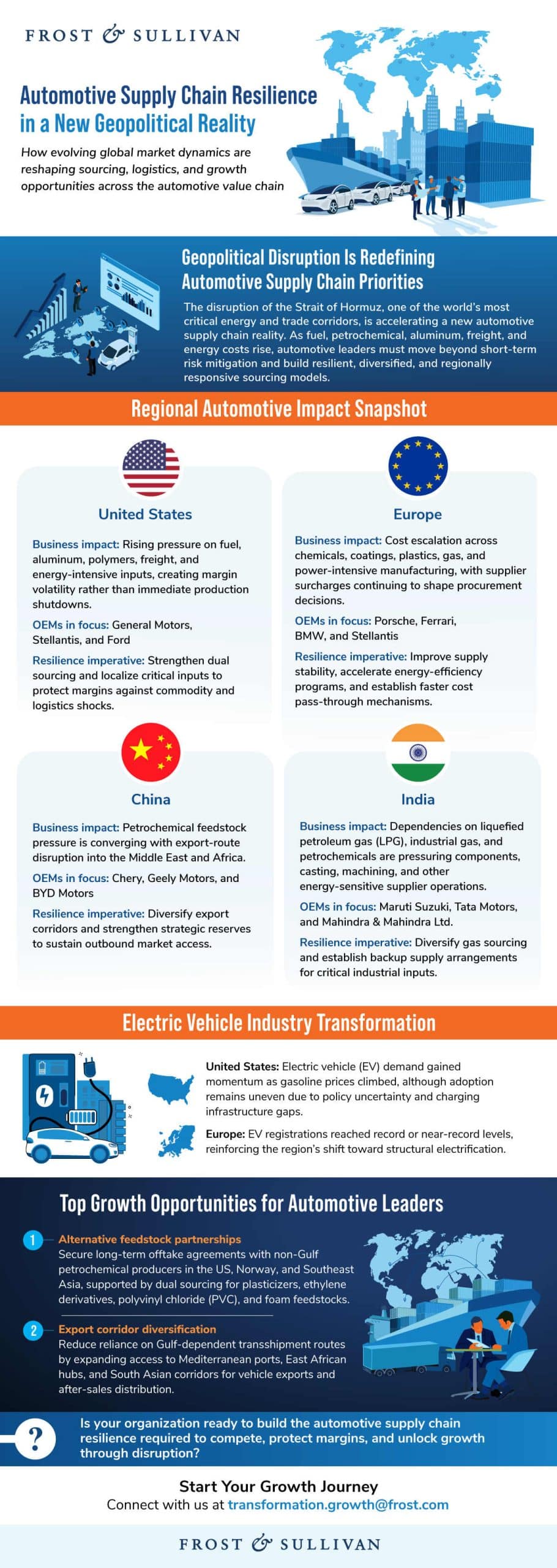
- The United States is experiencing higher fuel, aluminum, polymer, and freight costs.
- Europe is managing cost pressure across chemicals, coatings, and energy-intensive manufacturing.
- China continues to navigate petrochemical feedstock availability and evolving export logistics.
- India remains exposed through liquefied petroleum gas (LPG) and industrial gas dependencies that influence component manufacturing and machining operations.
Electric Vehicle Sales Are Responding to Market Volatility
Fuel-price volatility linked to Iran war oil prices is influencing electric vehicle (EV) demand, but market response varies by region.
United States: EV sales gained momentum in March 2026 as higher gasoline prices renewed consumer interest, though adoption remains uneven due to policy uncertainty, charging gaps, and affordability concerns.
Europe: EV registrations accelerated in March 2026, with several markets reporting record or near-record performance, signaling stronger long-term electrification momentum.
How is your organization converting EV demand momentum into sustained revenue growth?
Top Growth Opportunities Emerging from Recent Geopolitical Developments
- Building Petrochemical Resilience Through Alternative Feedstocks: The disruption in the Strait of Hormuz has exposed the risk of relying heavily on Gulf-based naphtha and LPG supplies. OEMs and Tier I suppliers are responding by diversifying petrochemical partnerships and securing alternative sources for key materials such as plasticizers, ethylene derivatives, and foam feedstocks.
- Diversifying Export Corridors to Reduce Logistics Risk: Gulf disruption has also highlighted the risk of depending on concentrated trans-shipment routes for automotive exports. OEMs are now exploring alternative corridors through Mediterranean ports, East African hubs, and South Asia to improve access, flexibility, and supply chain continuity.
Is your organization ready to turn disruption into a stronger, more resilient growth strategy?
Building Sustained Growth Beyond the Crisis
Although the ceasefire between the United States and Iran has contributed to greater market stability, the broader strategic lessons remain highly relevant. Automotive supply chain resilience is becoming a lasting source of competitive advantage for organizations that proactively diversify feedstock sourcing, strengthen export corridors, regionalize manufacturing, and accelerate electrification.
Listen to the Podcast: Where growth may come from amid the war
Frequently Asked Questions: US-Iran Conflict
1. How did the US-Iran war affect oil prices?
The conflict pushed oil prices higher, which increased fuel and transport costs across the auto ecosystem. Automakers, suppliers, and consumers all felt the pressure quickly.
2. Why did shipping delays increased during the middle east crisis?
Shipping delays rose because key routes became more uncertain and slower to use. That disrupted the movement of vehicles, parts, and raw materials.
3: Did the Iran war affect car sales?
Yes, car sales were affected as higher fuel costs and market uncertainty weakened buyer confidence. In several markets, this made consumers more cautious about purchases.
4. What was the US-Iran war’s impact on the auto industry?
The auto industry faced higher costs, logistics disruption, and planning uncertainty. Those pressures affected production schedules, distribution flow, and sales expectations.
5. What supply chain issues did the Iran war create for automobile companies?
The war created parts shortages, rerouting challenges, and longer lead times. Suppliers had to manage more volatility across sourcing and delivery networks.
6. Why is automotive supply chain resilience becoming a strategic priority?
Organizations are increasingly viewing resilience as a source of competitive advantage, enabling them to adapt more quickly to geopolitical developments, market volatility, and changing customer demand while supporting sustainable long-term growth.
Ready to Lead the Transformation?
- Book a Growth Strategy Session: Align your growth roadmap with Frost & Sullivan’s Visionary Growth Pipeline™ Dialog.
- Engage with Growth Experts: Co-design AI-enabled, data-driven operating models that scale industry-specific and commercial impact.
- Share Your Transformation Story: Position your organization as a transformation leader through Frost & Sullivan’s Transformational Growth Leadership platform.
- Join the Growth Council: Collaborate with industry leaders shaping the future of your ecosystem.
- Nominate for the Best Practices Recognition: Be recognized for excellence in growth strategy, execution, and customer impact.
- Demonstrate Industry Positioning on the Frost Radar™: Benchmark your growth performance and innovation strength against industry competitors.
- Activate Brand & Demand Growth: Accelerate awareness, engagement, and revenue growth through integrated brand and demand generation strategies