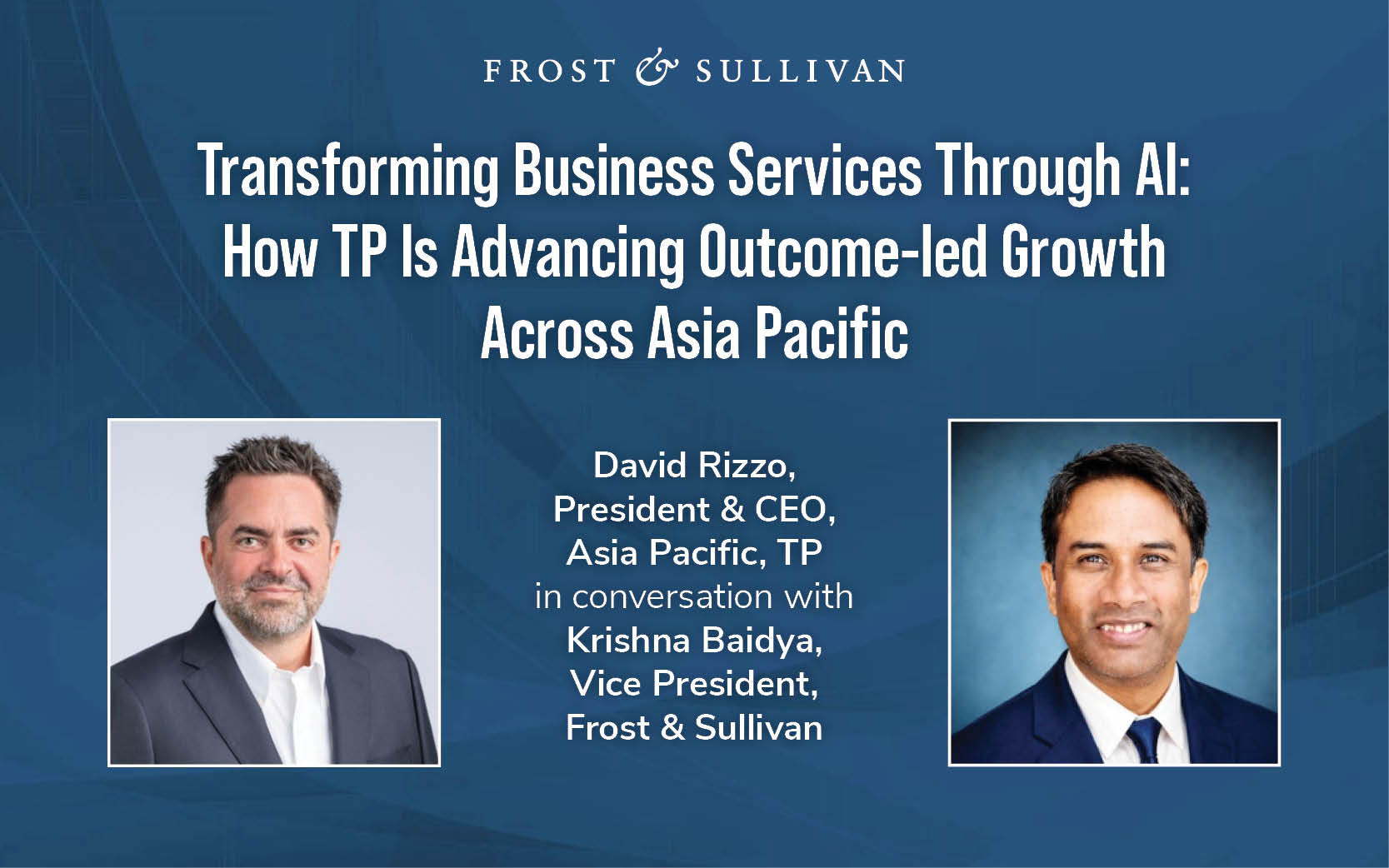
David Rizzo, President & CEO, Asia Pacific, TP, in conversation with Krishna Baidya, Vice President, Frost & Sullivan
Download this Transformational Growth Leadership Discussion with David Rizzo
The business services and outsourcing industry is being reshaped by AI, automation, and changing customer expectations; moving beyond traditional call centers, seats, and transactional models, and toward outcome-focused solutions that bring together people, technology, locations, and capabilities. For David Rizzo, President & CEO, Asia Pacific, TP, this evolution reflects a 27-year journey with the organization, including the last 13 years leading its Asia Pacific business across a diverse and rapidly evolving region.
In this Transformational Growth Leadership (TGL) conversation, David Rizzo speaks with Krishna Baidya, Vice President at Frost & Sullivan, about TP’s transformation journey, the growing role of AI and automation, the shift toward outcome-led services, and how talent, technology ecosystems, and regional agility are shaping the future of business services across Asia Pacific.
“We do not want to look at AI simply as something to apply for efficiency. We also need to think about what 2030 looks like, what we want to be in 2030, and how we can leverage AI and our capabilities to build towards that.”
— David Rizzo
President & CEO, Asia Pacific, TP
Building the Foundation for Transformational Growth Across Asia Pacific
Krishna Baidya: David, maybe we can start with your journey at TP. It has been quite a transformational one; how did it begin, and what eventually brought you to lead the Asia Pacific region?
David Rizzo: It was about 27 years ago. I took an opportunity to work at Salt Lake City with a company that TP acquired about a year later. That gave me the opportunity to develop offshore solutions in the Philippines for some of our US customers, and I quickly immersed myself in the region.
One of the fascinating things about Asia Pacific is recognizing that it is not one market. Japan, China, Singapore, the Philippines, and other markets have different experiences, paces, and economies. I have had the absolute joy of leading our business across Asia Pacific for the last 13 years.
During that time, we have seen tremendous transformation and change. That has meant investing in people, leadership, markets, tools, and technologies, while keeping everyone aligned around a collective mission. Today, we are in a period of disruption, and our mission is to be the disruptor in a disruptive environment.
Shifting from Transactional Services to Outcome-driven Value
Krishna Baidya: The industry has experienced several phases of transformation. With AI and its adoption accelerating on both the customer and internal sides, what makes this phase different from what you have seen before?
David Rizzo: We are all living through it right now. There was a lot of discussion around AI several years ago, and we began our adoption journey early, knowing where we needed to position ourselves for the future.
The industries and markets we support are still at very different stages. Some have a clear vision for AI and are further along in adoption, while others are still determining what they want to achieve.
What is exciting is that we have been preparing for an ecosystem that goes well beyond call centers, seats, and transactional models. The focus has shifted toward outcomes. That allows us to bring AI, automation, and other technologies from across our full suite of services to the table to solve specific customer problems. Our customers are coming to us with a problem statement, and we are aligning around solving that problem rather than piecing together a strategy to get there.
It starts with the problem and the outcome we want to achieve. From there, we assess the right mix of technology, people, locations, and other capabilities to determine the best way to solve it.
We do not want to look at AI simply as something to apply for efficiency. Of course, we all want to create efficiencies. But we also need to think about what 2030 looks like, what we want to be in 2030, and how we can leverage AI and our capabilities to build toward that.
Download this Transformational Growth Leadership Discussion with David Rizzo
Building Organizational Readiness for Disruptive Technologies
Krishna Baidya: That outcome-led approach also changes what the organization needs internally. How are you thinking about people and capabilities as the business evolves?
David Rizzo: First and foremost, I cannot underscore enough how important leadership and people are to the equation. The profiles of people we need are shifting. We are looking for more individuals to be involved in the ecosystem and the transformation journey in meaningful ways.
At the same time, specialization and expertise are becoming increasingly important by vertical, as well as, across horizontal capability layers such as AI solutions. What works in one industry does not necessarily transfer directly to another. But I take a bigger step back than that. I assess our readiness by looking at whether we can deliver on what we promise.
For me, TP is client zero. We need to ensure that we can apply these same principles and capabilities internally. If we were starting TP today, with the same customer expectations, we probably would not build it the way we did in the past.
So, we are reassessing the right people, the right locations, and the right capabilities, while leveraging automation and AI inside our own ecosystem.
We want knowledge and adoption across the entire business end to end. Whether it is our customer service team in Jakarta or our revenue-as-a-service team in Kuala Lumpur, they need to be able to show up for customers with an understanding of the full ecosystem of people, locations, services, and technologies, with the conversation centered around outcomes.
Strengthening Competitive Advantage Through Technology Ecosystems
Krishna Baidya: As technology becomes more central to customer expectations, how is TP bringing together its own capabilities and the broader technology ecosystem to deliver greater value?
David Rizzo: No two customers are the same, but one common thread is that we are spending much more time talking about technology. We are also seeing greater expectations around systems integration as customers bring technology, AI, and automation together.
We are comfortable playing the right partner role regardless of where a customer is in its transformation journey. That is also why TP being client zero is so important. We need end-to-end understanding and adoption of our own AI tools and solutions before bringing them to customers.
At the same time, you must be humble and self-aware enough to know where the best-in-class capability exists, whether that is within your organization or your partner ecosystem. The rate of change is mind-boggling. Assessing what best-in-class looks like is no longer an annual exercise. It is a weekly exercise.
Download this Transformational Growth Leadership Discussion with David Rizzo
Scaling Innovation Through Enterprise-wide Agility
Krishna Baidya: How are you taking those capabilities and making them part of the organization at scale?
David Rizzo: We have doubled down on investing in coding licenses across many parts of the organization, from finance and human resources to learning and development, operations, business development, and beyond.
We have top-down strategies and capabilities that we know work well globally at a given point in time. But when we give people across different parts of the business the ability to develop their own solutions, what we learn is exciting. We are trying to complement the top-down effort with bottom-up innovation. Our teams are finding ideas and solutions that create efficiencies for themselves, allowing them to take on new tasks and ideas. They are also finding capabilities that we can drive at scale throughout the enterprise.
We are seeing that convergence of top-down strategy and bottom-up innovation. But we also need to stay flexible, because what works best can vary, especially across a region as diverse as Asia Pacific.
Leveraging Frontline Intelligence to Drive Business Outcomes
Krishna Baidya: You mentioned how TP is adopting technology internally and seeing the benefits firsthand. Can you share an example where something you first implemented internally helped solve a similar challenge for a customer, and eventually, became part of the solution you offered them?
David Rizzo: Fundamentally, it comes down to empowering all aspects of our ecosystem to bring the value our customers expect. Some customers come to us with a very specific problem and tell us how they want it solved. Others are more curious and want to understand what they do not know.
In our industry, we need to take proper advantage of our frontline teams. They have tough jobs, and they do a great job. They provide knowledge about what is happening inside the business in real time. We can react in real time, but we can also aggregate that information over time, and make recommendations to customers that deliver better outcomes. Sometimes, that requires nothing more than changing how we are solving the problem. Other times, it requires a more meaningful conversation with different client stakeholders to drive change that improves the experience of frontline employees and the customers they support.
The opportunity is about large-scale adoption and knowing how to use technology to create value and benefits that customers may not be seeing themselves because they are so deeply involved in the day-to-day.
Download this Transformational Growth Leadership Discussion with David Rizzo
Harnessing AI to Reimagine Customer Engagement
Krishna Baidya: You mentioned how technology is becoming more embedded in operations and changing expectations around value. Are customers now looking at value differently, and how is that changing the conversations, and the relationships you have with them?
David Rizzo: There is naturally pressure around the responsibility to deliver on our promises. But we make promises because we truly believe we can deliver them. It is a partnership because it goes both ways. We also need support from our customers to enable us to bring many of our solutions to the table.
A good example is TP Collect, where we are using our TP technology backbone and AI to generate information about consumer behaviors that can help increase contact rates and, in turn, recovery.
AI can help us understand when people are more likely to engage and how they prefer to be contacted based on their behavior. That could relate to location, age group, or communication preference.
Some people may prefer to be contacted by phone, while others may consider a social channel less invasive. We align upfront with expectations, focus on outcomes, and identify the solution together that enables us to get there.
Navigating Disruption Through Organizational Alignment
Krishna Baidya: We have talked about the technology opportunity, but what happens when customer ambition moves faster than organizational readiness?
David Rizzo: That is something we are seeing, as every organization, including our partners, is experiencing disruption. Sometimes, partners have the ambition to reach outcomes quickly but are not yet ready to get there. It might be something as simple as a gap in stakeholder alignment.
If we are talking about customer data, for example, we need alignment between revenue generation, marketing, technology, privacy, and IT organizations. During periods of disruption, it is common to understand what is possible without fully knowing how to get there. That is where we can add value.
Our relationships are really based on two things: our ability to deliver and trust. Trust is not earned on day one. We earn that trust over time by being transparent with customers and giving them information they can act on. Sometimes, that also means helping their internal stakeholders understand what is possible and the role they need to play in achieving it.
That shift is well underway. I think we are probably still a year or two away from having that end-to-end alignment in just about every organization.
Download this Transformational Growth Leadership Discussion with David Rizzo
Evolving Commercial Models Beyond Traditional Pricing
Krishna Baidya: You mentioned that outcome-based pricing is becoming a bigger part of customer conversations, with some organizations positioning themselves around being paid only when they deliver the outcome. Are you seeing more of that with your customers, and how do you find the right balance when responsibility for delivering that outcome increasingly shifts to the service provider?
David Rizzo: It is logical and fair if there are certain conditions involved. If an operation is relatively static, with historical data and clear visibility into what the outcomes and best-in-class performance look like, we can build models that align with that. In those situations, the shift toward outcome-based models can be more aggressive.
Another reason outcomes-based models are becoming more relevant is AI itself. Many organizations do not yet know how to monetize AI. In some cases, AI costs are tied to token usage. Depending on how AI is being used, that usage can become extremely heavy, and the customer may not see the associated cost until later.
At the same time, it allows organizations like ours to bring AI into the solution stack more frequently. We start with the outcomes in mind and then align the people, technology, and locations required to achieve them. So, I would say outcomes-based models are particularly relevant where we have static, measurable data that allows us to build models around the expected outcomes—and where we want to leverage AI.
We do not want to simply layer AI in as a capability component from the buyer side and then pass that capability into the solution. We need to understand how it contributes to the solution and what the cost implications are.
Navigating Asia Pacific’s Evolving Technology and Delivery Ecosystems
Krishna Baidya: With technology reducing traditional boundaries around service delivery, how is TP adapting its technology and location strategy across a region as diverse as Asia Pacific?
David Rizzo: When we talk about China, we probably need to put it in its own box. Within China, we are working with Chinese technology, Chinese cloud, Chinese LLMs, and the broader ecosystem around them. By working with reputable LLM builders that are also our partners, we can create customized solutions together and accelerate acceptance.
Other markets are evolving differently. Indonesia, for example, has a large, young, digitally native population, while India and the Philippines remain mature markets for offshoring solutions.
As language translation capabilities develop, particularly in non-voice, we also need to think about investments in locations differently. It is not just about translation. Technology is changing what different locations can bring to the broader service ecosystem.
Download this Transformational Growth Leadership Discussion with David Rizzo
Capturing New Opportunities Across the Service Value Chain
Krishna Baidya: After 27 years of transformation, what excites you most about where the industry is heading?
David Rizzo: The excitement right now comes from the scale of disruption and the range of capabilities we can bring to it. It is no longer a case of AI taking off while we remain focused only on the people side of the business. The ecosystem has shifted.
We can be a systems integrator, an AI developer, a platform, revenue-as-a-service, or support practically any part of the end-to-end service journey. That is probably the biggest and most exciting change.
And when you combine that with a region as dynamic and fast-moving as Southeast Asia, the opportunity becomes even more significant.
Krishna Baidya: When customers and prospects hear TP, how would you like them to remember the company?
David Rizzo: I think it comes down to being transparent, open, and honest with our customers. We bring thought leadership, but we also remain agnostic. We do not feel tied to one location or one technology stack. That approach is reflected across the leadership team at TP and in the conversations we have with our customers.
Closing Reflection: Thriving Through the Business Services Transformation
TP’s transformation reflects a shift beyond traditional transactional service delivery toward outcome-focused solutions that bring together people, technology, locations, and capabilities. AI and automation are part of that broader evolution, supported by a “client zero” approach that combines internal adoption, top-down strategy, bottom-up innovation, and a flexible technology ecosystem. Across Asia Pacific, that flexibility is particularly important, as regional ecosystems differ in their technologies, languages, partnerships, and operating environments. As David Rizzo explains, TP is remaining agnostic about locations and technology stacks while expanding its role across systems integration, AI development, platforms, revenue-as-a-service, and the broader end-to-end service journey, with customer outcomes, delivery, and trust at the center.
Download this Transformational Growth Leadership Discussion with David Rizzo

About David Rizzo
David Rizzo is President & CEO, Asia Pacific at TP, a leading provider of end-to-end business services solutions. David leads the region across P&L, service delivery, sourcing strategy, people development, market entry, and business development. Under his leadership, TP has strengthened its position as an AI-driven digital business services and customer experience partner for multinational and globalizing brands, earning recognition for innovation and workplace excellence across Asia Pacific.
Krishna Baidya is Vice President of Information & Communications Technology at Frost & Sullivan. With more than 20 years of experience in the ICT industry, he advises business leaders on growth strategy, customer experience transformation, digital innovation, and emerging technology trends. Based in Singapore, Krishna has spent over 16 years with Frost & Sullivan, helping organizations identify new growth opportunities, navigate industry disruption, and accelerate business transformation across customer experience solutions.
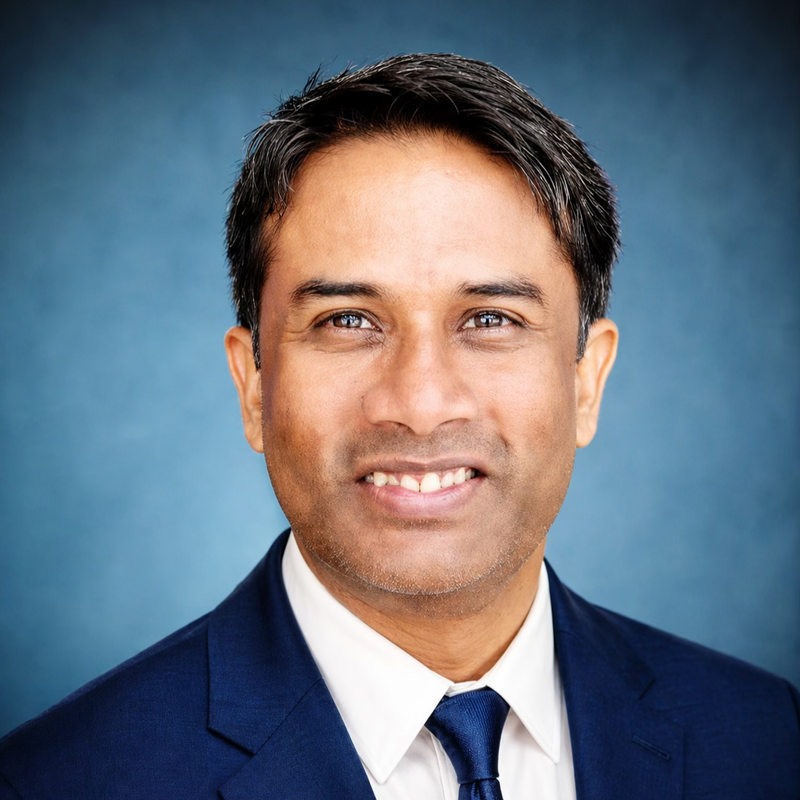
About Krishna Baidya
Ready to Lead the Transformation?
- Schedule a Growth Strategy Dialog: Align your growth roadmap with Frost & Sullivan’s Visionary Growth Pipeline™ Dialog.
- Engage with Growth Experts: Co-design AI-enabled, data-driven operating models that scale industry-specific and commercial impact.
- Showcase Your Transformational Leadership: Position your organization as a transformation leader through Frost & Sullivan’s Transformational Growth Leadership platform.
- Join the Growth Council: Collaborate with industry leaders shaping the future of your ecosystem.
- Explore Best Practices Recognition: Be recognized for excellence in growth strategy, execution, and customer impact.
- Benchmark Your Industry Positioning on the Frost Radar™: Benchmark your growth performance and innovation strength against industry competitors.
- Tell Your Story: Accelerate awareness, engagement, and revenue growth through integrated brand and demand generation strategies.
Appendix: Advancing AI-enabled Business Services
As AI, automation, and digital technologies become more deeply embedded across business operations, organizations are moving beyond traditional service models toward more intelligent, agile, and outcome-focused approaches. This shift is changing how enterprises combine people, technology, ecosystems, and delivery capabilities to solve business challenges and create measurable outcomes.
To support organizations navigating this evolution, Frost & Sullivan provides the following analyses:
📌 Frost Radar™: Customer Experience Management Services in Asia-Pacific, 2026
📌 Global Customer Experience Management Services, Forecast to 2030
📌 CX Unfiltered: Industry Trends Redefining Customer Obsession
These analyses complement the themes explored throughout this discussion, helping organizations navigate disruption, strengthen technology and organizational capabilities, and identify new pathways for growth in an increasingly AI-enabled customer experience landscape.
YOUR TRANSFORMATIONAL GROWTH JOURNEY STARTS HERE
Frost & Sullivan’s Growth Pipeline Engine, transformational strategies, and best-practice models drive the generation, evaluation, and implementation of powerful growth opportunities.
Is your company prepared to survive and thrive through the coming transformation?