This blog is based on the recent Frost & Sullivan analysis, “Frost Radar™: Revenue Cycle Management Operations,” authored by Sagar Mukhekar, Industry Analyst, Healthcare & Life Sciences Practice.
Healthcare revenue cycle management (RCM) encompasses the end-to-end financial processes that support patient care, from registration and eligibility verification to coding, billing, claims management, denial resolution, and payment collection.
Today, hospitals and physician groups are under mounting financial pressure. More than 10% of U.S. hospital claims are denied, while increasing payer complexity across prior authorization, coding, documentation, and reimbursement policies continues to strain in-house RCM operations.
Transform Your Revenue Cycle
Discover how AI, automation, and intelligent workflows are redefining RCM operations in Frost & Sullivan’s latest podcast.
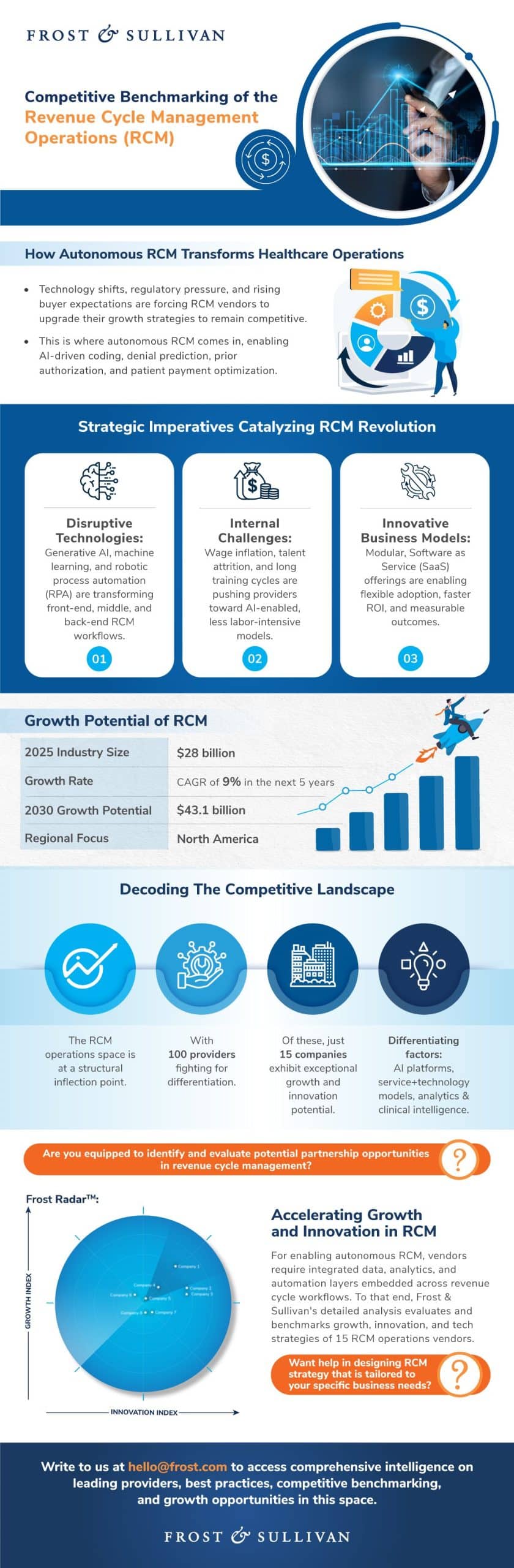
At the same time, RCM operations landscape is projected to grow at a CAGR of 9% through 2030, driving providers to adopt advanced technologies like AI, cloud, and advanced analytics into their workflows. This shift reflects a move away from traditional process-based outsourcing toward outcome-driven models focused on clean claim rates, denial prevention, and patient payment optimization.
With RCM operations evolving so rapidly, is your organization equipped with the right tools and technologies to optimize financial performance and reduce claim denials?
What’s Driving Transformation in the RCM Ecosystem?
Disruptive Technologies
AI, machine learning, and robotic process automation are becoming core components across front-end, middle, and back-end RCM workflows. As a result, RCM vendors are shifting away from labor-intensive delivery models toward more autonomous, technology-led operations that improve speed, accuracy, and scalability.
Innovative Business Models
The growing preference for modular, Software as a Service (SaaS)-like offerings reflects providers’ focus on flexible adoption and measurable outcomes. To stay competitive, incumbents are increasingly pursuing mergers and acquisitions or partnerships with AI companies to strengthen their value propositions.
Customer Value Chain Compression
With the emphasis on value-based care and patient centricity, RCM is expanding into the patient journey. Eligibility verification, billing accuracy, digital front doors, and patient payment portals now directly influence patient satisfaction, requiring vendors to integrate RCM with clinical and patient engagement workflows.
Internal Challenges
Payer rule complexity, interoperability requirements, CMS transparency regulations, and state-specific billing policies are compelling vendors to adopt technology and compliance frameworks. These frameworks ensure regulatory alignment and help reduce claim denials.
So, which growth processes and best practices will help your teams adapt to these headwinds?
The RCM Transformation at a Glance
Companies to Action Shaping the Future of RCM
From a pool of more than 100 companies, the Frost Radar™ identified 15 vendors setting benchmarks and shaping the future of RCM operations.
Optum
Optum delivers an AI-driven, outcome-focused RCM platform that transforms traditional, manual workflows.
- Key capabilities: End-to-end coverage including patient access, clinical documentation, coding, billing, denials, collections, and care management.
- Innovation: Autonomous coding, predictive analytics, and real-time decision support powered by $8.3 billion annual AI investment.
R1 RCM
R1 RCM provides comprehensive revenue cycle services with embedded AI for hospitals, health systems, and physician groups.
- Key capabilities: Full-spectrum RCM services, including coding, billing, denials management, and patient financial experience.
- Innovation: R37 AI Lab automates labor-intensive workflows and AI tools enhance billing engagement and Net Promoter Scores.
Waystar
Waystar offers a unified platform for healthcare payments and RCM, designed to streamline operations and enhance accuracy.
- Key capabilities: Covers patient access, claims, payments, and denial management end-to-end.
- Innovation: AltitudeAI and the Iodine acquisition adds generative AI, clinical intelligence, and pre-bill leak detection.
Will established RCM leaders sustain their advantage as AI and automation become widely embedded? Or will more agile platforms redefine value through outcome-driven performance?
Best Practices for Automating RCM in Healthcare
With the evolution of autonomous RCM, providers are also encountering real-world challenges that can slow progress like evolving healthcare regulations, payer variability, technology integration, and cyber threats. However, the following best practices can help industry incumbents surge ahead:
- AI-driven Workflows: Embedding AI in revenue cycle management and adopting human-in-the-loop models to reduce costs and improve throughput.
- Flexible, Modular Services: Offering service tiers that align with provider size and budget to boost adoption rates.
- Strategic Partnerships: Collaborating with electronic health records (EHRs), clearinghouses, cloud platforms, and specialized AI vendors to accelerate innovation and strengthen interoperability.
Can your organization execute these best practices at scale across the revenue cycle?
Emerging Opportunities in RCM
With denials rising into double digits, providers can leverage the following opportunities for competitive differentiation:
- AI-powered Denial Management: Predict and automate claim denials to recover revenue, reduce manual effort, and improve operational efficiency.
- Strategic Consolidation: Acquire or partner with AI-native specialists to integrate advanced capabilities into broader RCM platforms and strengthen market position.
- Value-added Integration: Link RCM with quality reporting, risk adjustment, and population health coding to enhance financial performance as well support better patient outcomes.
Which of these emerging opportunities will have the maximum impact on your organization, and how will you measure it?
Key Takeaways for RCM Providers
The era of autonomous RCM is here, reshaping revenue, efficiency, and patient experience. Organizations that act decisively can capture the full growth potential by:
- Optimizing Decision Intelligence: Use AI insights to anticipate denials, prioritize high-impact claims, and allocate resources where they matter most.
- Scaling Modular Platforms: Adopt flexible, outcome-focused solutions that grow with organizational needs and reduce operational friction.
- Building Strategic Alliances: Partner with technology, analytics, and AI specialists to expand capabilities and accelerate innovation.
To sum it up, providers that act decisively today will lead the transformation toward intelligent, efficient, and revenue-optimized operations.
Frequently Asked Questions (FAQs)
- What is revenue cycle management operations?
Revenue cycle management operations encompass all processes that manage a healthcare provider’s financial lifecycle, from patient registration and insurance verification to coding, billing, claims submission, denial management, and payment collection.
- What is the future of RCM?
The future of RCM is autonomous, AI-driven, and outcome-focused, with predictive analytics, automated workflows, and integrated platforms enabling faster claims processing, higher revenue capture, and improved patient experience.
- What is the healthcare billing revenue cycle?
The healthcare billing revenue cycle refers to the end-to-end process of generating, submitting, and collecting payments for patient care services, ensuring accurate reimbursement while reducing errors and denials.
- What are the first 3 steps of RCM?
- Pre-Service: Activities before the patient encounter, including registration, eligibility verification, and prior authorization.
- Service: The actual delivery of care or medical services to the patient.
- Billing/Post Service: Submitting claims, coding, and initiating payment collection.
- What is the difference between medical billing and RCM?
Medical billing focuses on submitting and following up on claims to receive payment. RCM is broader, covering the entire financial lifecycle of care, including registration, coding, claim management, denials, collections, and financial performance analysis.
Ready to Lead the Transformation?
- Book a Growth Strategy Session: Align your growth roadmap with Frost & Sullivan’s visionary Growth Pipeline™ Dialog.
- Engage with Growth Experts: Co-design AI-enabled, data-driven operating models that scale industry-specific and commercial impact.
- Share Your Transformation Story: Position your organization as a transformation leader through Frost & Sullivan’s Transformational Growth Leadership platform.
- Join the Growth Council: Collaborate with industry leaders shaping the future of your ecosystem.
- Nominate for the Best Practices Recognition: Be recognized for excellence in growth strategy, execution, and customer impact.
- Demonstrate Industry Positioning on the Frost Radar™: Benchmark your growth performance and innovation strength against industry competitors.
- Activate Brand & Demand Growth: Accelerate awareness, engagement, and revenue growth through integrated brand and demand generation strategies.