This blog is based on the recent Frost & Sullivan analysis, “Growth Opportunities in Medical Devices, 2026–2031,” authored by Utkarsha Kaustubh Soundankar, Industry Analyst, Healthcare & Life Sciences Practice.
Medical care is steadily moving beyond hospitals as capacity constraints, cost pressures, and patient demand for convenience reshape where treatment is delivered. Investment is following this movement, with greater attention on home diagnostics, clinical-grade wearables, and technologies suited to ambulatory and minimally invasive procedures.
As these technologies enter new care settings, manufacturers are rethinking how they are designed and used. Devices now integrate artificial intelligence (AI), software, cloud analytics, and clinical decision support, helping clinicians apply patient data across diagnosis, treatment, and follow-up. This development is creating opportunities in cardiovascular care, digital surgery, and surgical robotics, while raising expectations for clinical value and operational returns.
Capture Emerging Medical Device Opportunities
Understand the market developments and investment priorities driving growth through 2031.
Is your medical device strategy ready for the shift toward home and ambulatory care?
Listen to our latest podcast episode on the opportunities reshaping the medical devices industry.
Top 3 Strategic Imperatives Shaping the Medical Devices Industry
- Innovative Business Models
Connected devices, wearables, and AI-based solutions are creating revenue opportunities beyond product and consumables sales. Vendors are responding with subscriptions, device-as-a-service, and outcomes-based models tied to usage or performance. They are also bundling devices with software, services, and data to generate recurring revenue across the product lifecycle.
- Industry Convergence
Medical devices increasingly combine clinical technology with AI, telecommunications, and cloud infrastructure. This integration is bringing consumer wearables closer to clinical-grade monitoring and encouraging collaboration among manufacturers, technology companies, providers, and payers. The resulting platforms support continuous data exchange, predictive insights, and timely intervention across care settings.
- Transformative Megatrends
Remote monitoring, telehealth, and changing reimbursement models are moving care into ambulatory centers and patients’ homes. Delivering care in these settings reduces pressure on hospitals while supporting earlier detection and long-term disease management. This transition is increasing demand for portable, connected devices that provide reliable clinical data outside hospitals.
Medical Devices Industry – At a Glance
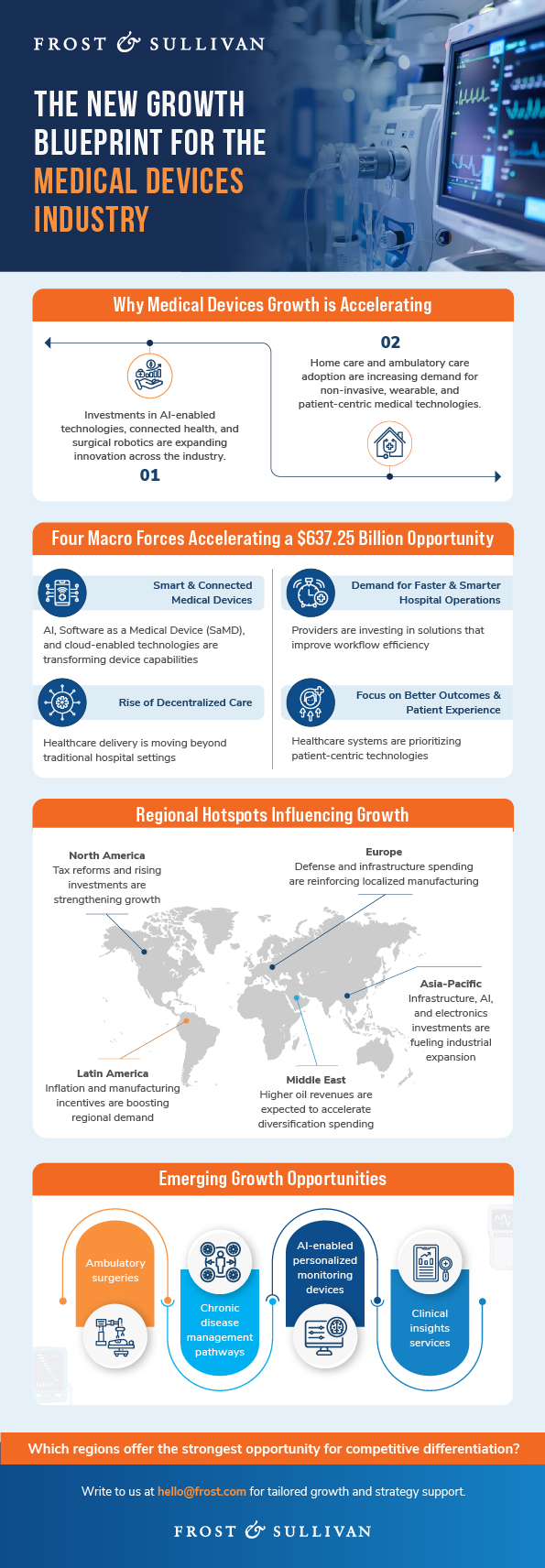
Regional Economic Conditions Influencing Investment in 2026
Investment in healthcare and medical technology remains influenced by the economic conditions affecting capital availability, manufacturing, and domestic demand across major regions:
- North America: Tax reforms under the One Big Beautiful Bill Act (OBBBA) are expected to support consumer spending in early 2026. Sustained capital expenditure in high-tech industries could also strengthen the region’s capacity to develop and commercialize advanced technologies.
- Europe: An approximate $5 billion allocation under the European Union (EU) defense budget is supporting manufacturing localization and supply-chain onshoring. Germany’s planned investment of approximately $46 billion in transportation infrastructure and social housing adds further support for domestic economic activity.
- Asia-Pacific: Tax reforms and infrastructure spending in India are increasing activity across construction, logistics, and consumer markets. At the same time, semiconductor, electronics, and AI investments across developed Asia, India, and China are expanding high-tech manufacturing capacity.
- Latin America: Fiscal support and easing inflation are helping households retain purchasing power. Manufacturing incentives in Brazil, Chile, and Mexico could further encourage nearshoring and regional production.
- Middle East: Higher oil prices in the second half of 2026 are expected to fund non-oil capital expenditure and diversification projects. In the United Arab Emirates (UAE), a 29% increase in public spending provides additional support for domestic and non-oil activity.
Medical Device Innovators to Watch
Within this environment, the following companies are addressing specific needs in hemodynamic monitoring, electrophysiology, and wound care:
- Retia Medical provides minimally invasive hemodynamic monitoring through its Argos Cardiac Output Monitor. The system analyzes cardiac output across several heartbeats, improving consistency over single-beat methods. Following a distribution agreement with Medtronic in April 2025, the company received 510(k) clearance for the Argos Infinity platform in February 2026.
- CathVision’s ECGenius System combines high-fidelity cardiac signals with automated analytics to guide decisions during ablation procedures. Its low-noise amplifier improves electrogram clarity, providing a stronger basis for lesion assessment. In January 2026, the PFUSyzer module demonstrated that high-fidelity unipolar electrograms could be used to assess lesions during pulsed field ablation.
- Convatec’s wound care portfolio includes biologics, advanced dressings, and negative pressure wound therapy. Its Hydrofiber Technology absorbs wound fluid and forms a cohesive gel, while MORE THAN SILVER technology combines three components for wound management. ConvaNiox, ConvaFiber, and ConvaVac form part of the company’s product pipeline.
Emerging Growth Opportunities in Medical Devices
The broader market developments point to two immediate areas in which manufacturers can align their products and commercial models with provider requirements:
- Ambulatory Surgical Centers (ASCs) Expand Their Scope
Lower costs and shorter patient turnaround times are moving more procedures into ambulatory surgical centers. CMS added 547 procedures to the ASC Covered Procedures List for 2026, bringing the number of separately payable codes to 946. Endoscopic systems, micro-robotics, and connected monitoring are widening the range of procedures these centers can perform.
Medical device companies can respond by:
- Designing portable, modular systems for smaller surgical environments
- Offering leasing, subscription, and pay-per-use options that limit upfront costs
- Providing training, workflow analytics, and technical support to increase equipment utilization
- Chronic Disease Management Becomes More Connected
Chronic disease care increasingly brings monitoring, therapy delivery, data sharing, and clinical decision support into the same care pathway. Yet providers still face delays in detecting patient deterioration, inconsistent treatment adherence, and difficulty using device data to adjust care between appointments.
Medical device companies can address these gaps by:
- Integrating software and remote monitoring into chronic disease portfolios
- Using early-warning alerts to support therapy adjustments and clinical oversight
- Providing decision-support tools, outcomes tracking, and remote patient management services
Preparing for the Next Era of Medical Devices
As devices follow patients across hospitals, ambulatory centers, and homes, providers need systems that preserve a complete clinical record without creating additional documentation for care teams. Interoperability must therefore be assessed at the workflow level, including how information enters electronic health records, reaches the appropriate clinician, and informs treatment decisions.
According to Frost & Sullivan, providers should evaluate technologies using defined measures such as clinician time saved, patient adherence, readmissions, and cost per episode of care. Cybersecurity requirements, staff training, system integration, and ongoing service costs must also be addressed before procurement. Applying these checks early can show whether a product is ready for wider deployment or likely to create additional work after implementation.
Ready to Lead the Transformation?
- Book a Growth Strategy Session: Align your growth roadmap with Frost & Sullivan’s visionary Growth Pipeline™ Dialog.
- Engage with Growth Experts: Co-design AI-enabled, data-driven operating models that scale industry-specific and commercial impact.
- Share Your Transformation Story: Position your organization as a transformation leader through Frost & Sullivan’s Transformational Growth Leadership platform.
- Join the Growth Council: Collaborate with industry leaders shaping the future of your ecosystem.
- Nominate for the Best Practices Recognition: Be recognized for excellence in growth strategy, execution, and customer impact.
- Demonstrate Industry Positioning on the Frost Radar™: Benchmark your growth performance and innovation strength against industry competitors.
- Brand & Demand: Accelerate awareness, engagement, and revenue growth through integrated brand and demand generation strategies.
Frequently Asked Questions (FAQs)
What is the medical device industry?
The medical device industry develops, manufactures, and commercializes products used in disease prevention, diagnosis, monitoring, treatment, and rehabilitation. It covers areas such as patient monitoring, cardiovascular care, wound care, respiratory care, diabetes management, orthopedics, ophthalmology, surgical systems, and clinical software.
What is medical technology?
Medical technology is a broad term covering devices, diagnostics, software, medicines, vaccines, procedures, and systems developed to address health problems and improve quality of life. Medical devices form one part of this field, alongside other technologies used in prevention, diagnosis, treatment, and rehabilitation.
What are examples of medical devices?
Medical devices range from everyday products such as bandages, thermometers, blood glucose meters, and contact lenses to complex technologies such as pacemakers, artificial joints, magnetic resonance imaging (MRI) systems, surgical robots, and clinical diagnostic software. They are used to prevent, diagnose, monitor, or treat medical conditions.
What is meant by a medical device?
A medical device is an instrument, machine, implant, test, software product, or related technology intended for a medical purpose. Unlike a drug, its primary function is not achieved through chemical action within the body or by being metabolized.
Which medical technology is best?
There is no single medical technology that is best for every patient or provider. The right choice depends on the clinical need, supporting evidence, safety, accuracy, usability, interoperability, cost, and the healthcare organization’s ability to operate and maintain the technology.
What is the most advanced medical technology?
AI-enabled diagnostic systems, robotic surgery platforms, smart implants, precision medicine, and closed-loop monitoring and therapy systems are among the most advanced medical technologies. Their value depends on clinical performance, proven safety and effectiveness, workflow compatibility, and appropriate regulatory authorization.