This blog is based on the recent Frost & Sullivan analysis, “Global Genetic Testing Industry, Forecast of 2025–2030,” authored by Chandni Hussain, Industry Analyst, Healthcare & Life Sciences Practice.
Genetic testing analyzes inherited variants to support risk assessment, early detection, reproductive planning, and more personalized treatment decisions. These insights now guide care across prenatal health, oncology, and pharmacogenomics.
Healthcare systems are under pressure to identify risks earlier and manage rising demand for reproductive and preventive services. At the same time, fragmented access, variable reimbursement, and the complexity of genetic data interpretation continue to challenge providers and laboratories.
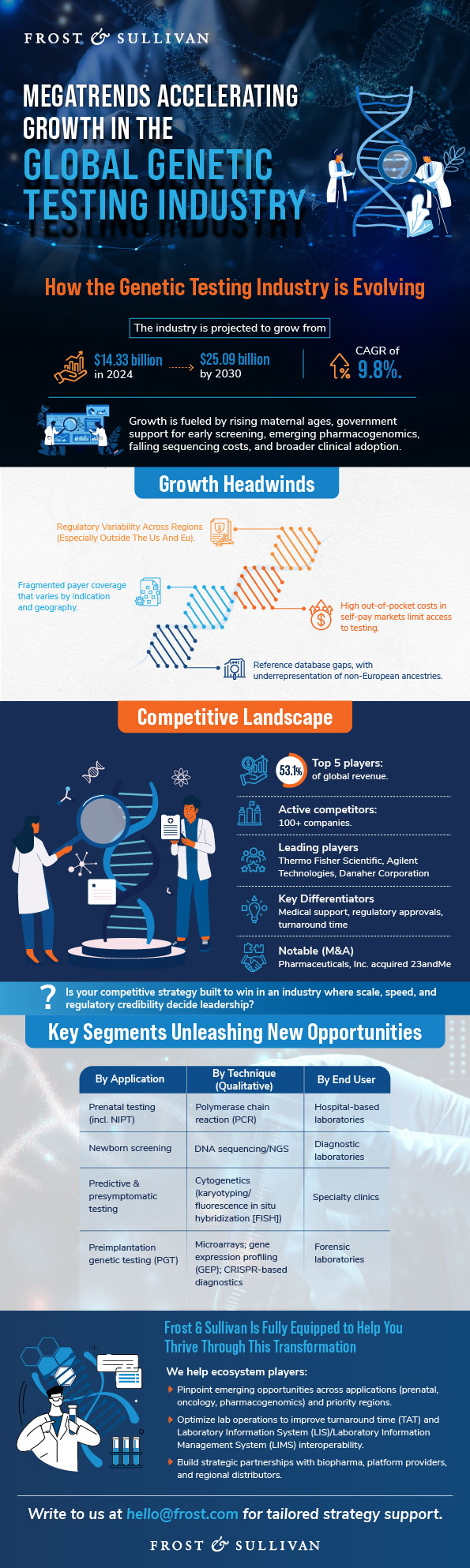
The global genetic testing industry is expanding rapidly and is projected to grow at a CAGR of 9.8% by 2030. This momentum is pushing providers and vendors to adopt next‑generation sequencing, digital platforms, and AI‑based interpretation at scale. The shift is moving testing away from isolated, lab‑centric models toward integrated, data‑driven workflows that enable faster insights and wider clinical adoption.
Reimagine the Future of Genetic Testing
Discover how population screening, digital platforms, and AI-based interpretation are reshaping the genetic testing industry.
As genetic testing moves from specialized use cases to routine care, is your organization equipped with the technologies, workflows, and partnerships needed to scale confidently?
What’s Changing the Genetic Testing Landscape
Disruptive Technology
Miniaturized next‑generation sequencing (NGS) and telegenetics reduce dependence on centralized labs, and they trim turnaround times, sometimes by days. As a result, genetic testing is becoming more accessible beyond traditional hospital settings.
Industry Convergence
AI, digital health platforms, and reproductive technologies are improving variant interpretation and embedding genetic insights into everyday clinical workflows. This is visible across noninvasive prenatal testing (NIPT), pharmacogenomics, and reproductive genomics.
Competitive Intensity
Lower sequencing costs and rising demand are increasing competition across NIPT, carrier screening, and hereditary testing. As competition intensifies, success increasingly depends on securing reimbursement access, integrating smoothly into clinical workflows, and navigating regulatory requirements effectively.
Which of these shifts will matter most as your organization scales its genetic testing strategy?
Where Genetic Testing Is Creating the Most Impact Across Healthcare Applications
Application Megatrends: Where Genetic Testing Is Expanding Fastest
Prenatal Testing
Noninvasive prenatal testing (NIPT) and carrier panels are becoming standard in many markets. Prices often range from USD 250 to 400, depending on market and panel scope, while rising maternal ages and in vitro fertilization (IVF) growth are expanding adoption.
Predictive and Presymptomatic Testing
Hereditary cancer panels, pharmacogenomics, and late‑onset disease tests are expanding quickly. Stronger payer support and updated clinical guidelines are helping clinicians and patients bring these tests into routine care.
Newborn Screening
Basic newborn tests often remain free or low-cost under public programs. Families in urban and tech‑forward regions are increasingly opting for advanced genetic panels when offered by their hospitals or pediatric groups. Other Applications – PGT, Pediatric/Rare Disease Panels, and Forensic/Paternity Testing
Preimplantation genetic testing (PGT) for IVF embryos is a premium add‑on. Most clinics quote about $3,000 to 6,000 per cycle, depending on panel design, embryology practices, and geography. Pediatric and rare disease panels are becoming more accessible, while forensic and paternity tests are widely commercialized and affordable.
Which applications is your organization prioritizing to capture growth and drive clinical impact?
Key Technologies Shaping the Genetic Testing Industry
DNA Sequencing
Next‑generation sequencing (NGS) now powers most modern genetic tests. It enables comprehensive panels, exome and genome analyses, and screening for hereditary cancers and pharmacogenomics. Falling costs and wider clinical adoption support growth across preventive, reproductive, and oncology care, while Sanger sequencing remains common for single‑gene confirmation.
Polymerase Chain Reaction (PCR)‑based Methods
Quantitative polymerase chain reaction (qPCR), conventional PCR, and mutation‑specific PCR remain reliable and cost‑effective for targeted testing like BRCA, CFTR, and selected prenatal panels. Growth is steady, although NGS is expanding across broader clinical applications.
Cytogenetics
Techniques like FISH (fluorescence in situ hybridization) and karyotyping continue to detect chromosomal abnormalities, especially in reproductive health, pediatrics, and oncology. Labs increasingly pair these methods with molecular testing, which limits standalone use and makes them more specialized.
Emerging and Specialized Tools
Microarrays, MLPA (multiplex ligation-dependent probe amplification), gene expression profiling, and early‑stage CRISPR (clustered regularly interspaced short palindromic repeats) ‑based diagnostics support niche use cases and drive innovation. These tools open opportunities in rare disease diagnostics and preimplantation genetic screening, and they complement established sequencing approaches.
Which emerging technologies will you prioritize to expand testing capabilities?
Emerging Opportunities in the Global Genetic Testing Industry
- Predictive and Presymptomatic Germline Genetic Testing in Personalized Medicine
Predictive and presymptomatic testing is helping shift care from reactive treatment to proactive prevention. These tests now cover cardiovascular, neurodegenerative, endocrine, and rare disorders, which allows providers to identify at‑risk individuals earlier and at scale.
Why Predictive Testing Matters
- Expand portfolios across disease areas. This increases clinical impact and supports consistent, guideline‑aligned pathways.
- Integrate with electronic health records (EHRs) and digital tools. This reduces handoffs, speeds review and shortens time to decision.
- Build population‑ready programs. Employers, health systems, and public agencies can widen access and standardize outreach.
- Expanding NIPT, Carrier, and Newborn Screening in Emerging Markets
Rising birth rates, the burden of genetic disease, and government focus on maternal and child health are driving reproductive and newborn screening in developing regions. Lower sequencing costs, improving infrastructure, and public‑private partnerships are helping scale programs across Asia‑Pacific, Latin America, and parts of the Middle East and Africa.
Key Actions for Companies
- Localize panels and protect affordability. This aligns with regional risk profiles and supports payer engagement.
- Partner with government programs. Pilots and phased rollouts can build trust and streamline uptake.
- Use digital platforms for telegenetics and AI‑assisted interpretation. This improves consistency and often shortens turnaround times.
What strategies will help you tap into growth opportunities in reproductive and neonatal genetic programs?
Next Steps in Advancing Your Genetic Testing Strategy
Predictive testing, NIPT, and newborn screening, supported by AI interpretation and digital integration, make it easier to identify at‑risk individuals early and at scale. Companies that broaden portfolios, tailor panels to regional populations, and use technology to improve access will be best positioned to drive growth and improve outcomes.
Is your organization ready to take advantage of these industry trends and lead the next phase of innovation in genetic testing?
Frequently Asked Questions (FAQs)
1: How big is the genetic testing market?
According to Frost & Sullivan, the global genetic testing market is projected to reach USD 25 billion by 2030, growing at a 9.8% CAGR, driven by prenatal, newborn, predictive, and pharmacogenomics testing.
2: What is throughput in genetics?
Throughput is the number of samples a lab can process over a defined period. High‑throughput NGS enables rapid, large‑scale testing for clinical use, research, and population screening.
3: What is the future of genetic testing?
Genetic testing is moving toward personalized and preventive care. Advances in NGS, AI interpretation, and digital integration are expanding testing into clinics, telehealth, and population‑scale programs.
Ready to Lead the Transformation?
- Book a Growth Strategy Session: Align your growth roadmap with Frost & Sullivan’s visionary Growth Pipeline™ Dialog.
- Engage with Growth Experts: Co-design AI-enabled, data-driven operating models that scale industry-specific and commercial impact.
- Share Your Transformation Story: Position your organization as a transformation leader through Frost & Sullivan’s Transformational Growth Leadership platform.
- Join the Growth Council: Collaborate with industry leaders shaping the future of your ecosystem.
- Nominate for the Best Practices Recognition: Be recognized for excellence in growth strategy, execution, and customer impact.
- Demonstrate Industry Positioning on the Frost Radar™: Benchmark your growth performance and innovation strength against industry competitors.
- Activate Brand & Demand Growth: Accelerate awareness, engagement, and revenue growth through integrated brand and demand generation strategies.