This blog is based on the recent Frost & Sullivan analysis, “Home Care Digitization Market, United States and Europe, 2026–2031,” authored by Sagar Mukhekar, Industry Analyst, Healthcare & Life Sciences Practice.
Executive Summary
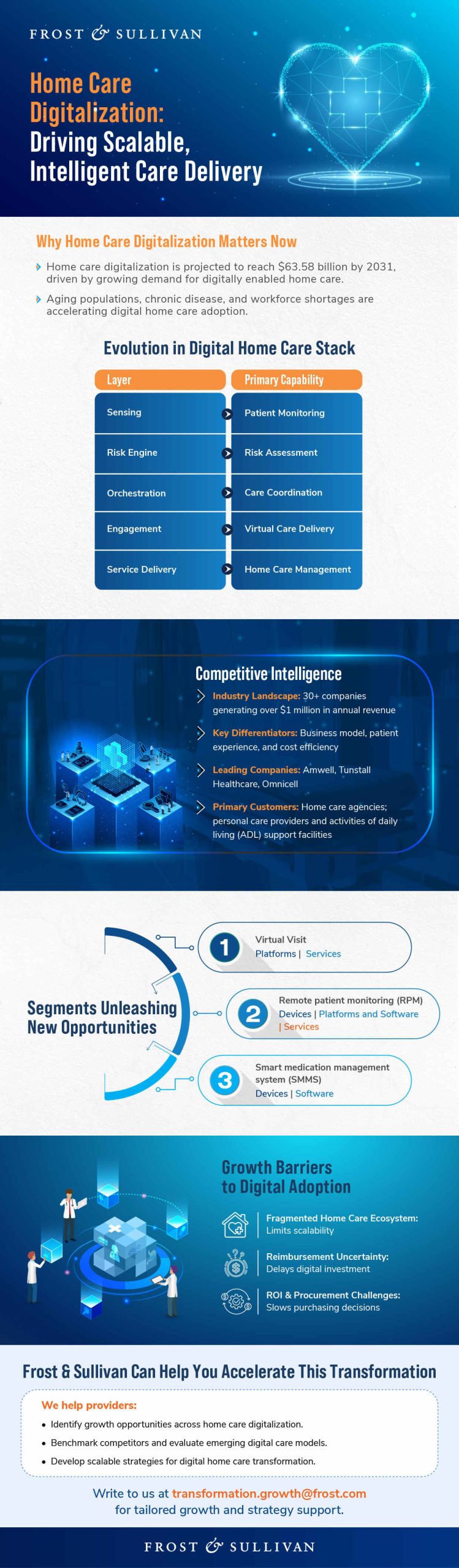
Home-based care is moving from the margins of healthcare delivery into the mainstream. Aging populations, chronic disease, staff shortages, and mounting costs are pushing providers in the United States and Europe to rethink how care is delivered. Remote monitoring, virtual visits, medication management, and AI can help teams respond sooner and support more people at home. As the market heads toward $63.58 billion by 2031, the strongest opportunities will emerge in hospital-at-home services and passive monitoring. Success will depend on simple experiences, practical workflow integration, and clear clinical outcomes.
Home care is becoming a larger part of healthcare delivery as more people manage long-term health needs from home. This shift is creating a stronger need for digital tools that help providers deliver care more consistently, whether through virtual visits, remote patient monitoring platforms, or smart medication management.
The pressure is especially visible across the United States and Europe, where aging populations, chronic disease, workforce shortages, and rising healthcare costs are stretching traditional care models. For home care agencies and health systems, digitalization is becoming essential to improving care coordination, supporting caregivers, reducing avoidable facility visits, and making home-based care easier to scale.
Transform Your Digital Home Care Strategy
Explore the technologies, growth opportunities, and competitive shifts shaping the evolution of home-based care.
With home care digitalization expected to reach $63.58 billion by 2031, driven by increasing adoption of remote patient monitoring, connected care platforms, hospital-at-home models, and value-based care initiatives, the market is moving into a stronger growth phase. Providers that invest in patient-centered digital solutions will be better positioned to meet rising demand, build more sustainable care models, and improve care coordination across the healthcare continuum.
What Is Home Care Digitalization?
Home care digitalization refers to the integration of digital technologies, including remote patient monitoring (RPM), virtual care platforms, smart medication management systems (SMMS), connected medical devices, and AI-powered analytics, into home-based healthcare delivery. These technologies enable providers to deliver more personalized, coordinated, and scalable care while improving patient outcomes, operational efficiency, and long-term healthcare sustainability.
Can your organization build the right capabilities to compete in the evolving digital home care ecosystem?
Listen now: How digitalization is transforming the future of home-based care.
Strategic Imperatives for Scaling Digital Home Care
Disruptive Technologies
Home care’s biggest bottleneck is not the lack of patient data, but the limited capacity to act on it. As remote patient monitoring (RPM), virtual visits, and smart medication systems generate more signals, care teams need a clearer way to separate urgent issues from routine updates. Without this triage layer, alert fatigue can weaken clinical confidence and slow adoption.
Geopolitical Chaos
The United States and Europe face similar aging pressures, but their reimbursement, regulatory, and procurement environments differ sharply. These differences matter more as cybersecurity risks, data governance requirements, and infrastructure scrutiny increase, especially in Europe. Vendors will need region-specific strategies rather than a standardized global approach.
Transformative Megatrends
Home care digitalization must be designed around elderly, frail, cognitively impaired, and digitally excluded users. Since these users often depend on already stretched caregivers, digital tools must reduce friction instead of adding complexity. This makes passive, low-friction models essential for scaling home-based care.
So, which growth processes and strategies will help your teams adapt to these industry headwinds?
Inside the Evolution of Home Care
What’s Driving the Shift Toward Home Care Digitalization?
Aging Populations and Multi-morbidity
The rapid growth of the elderly population is expanding demand for home-based care across the United States and Europe. As more people manage multiple conditions at once, providers need digital tools that support continuous monitoring, care coordination, and more consistent support at home.
As life expectancy increases and healthcare systems shift toward value-based care, digital home care solutions are becoming essential for enabling aging in place while improving patient outcomes and reducing pressure on acute care facilities.
Rising Chronic Disease Burden
The growing chronic disease burden is shifting home care from episodic support to ongoing condition management. Remote patient monitoring platforms, virtual visits, and smart medication management help providers stay connected to patients between scheduled visits.
By combining connected medical devices, predictive analytics, and AI-assisted clinical decision support, healthcare providers can identify health deterioration earlier, personalize interventions, and reduce avoidable hospitalizations.
Workforce Shortages
Shortages of nurses, personal care aides, and skilled caregivers are making it harder for home care providers to scale services through labor alone. Digital tools that reduce manual documentation, prioritize high-risk patients, and support virtual engagement are becoming more important for managing capacity.
Automation, AI-enabled workflows, and intelligent care coordination platforms are helping clinicians focus more time on high-value patient interactions while improving workforce productivity and operational efficiency.
Cost and System Pressures
Payers and public health systems are under pressure to control costs while maintaining access to care. This is positioning digitally enabled home care as a cost-containment strategy, especially when it helps reduce avoidable facility-based care.
As reimbursement models increasingly reward outcomes over volume, healthcare organizations are investing in digital home care technologies that improve quality, lower costs, and support value-based care delivery.
Technology Readiness
Growing preparedness for digital healthcare delivery is improving the adoption of home care solutions. As providers and patients become more comfortable with virtual care, RPM, and medication management tools, these solutions are becoming easier to integrate into home-based care models.
Greater adoption of cloud-based healthcare platforms, interoperable electronic health records (EHRs), connected medical devices, wearable technologies, and secure digital health infrastructure is accelerating the scalability of home care digitalization.
Companies to Action: Shaping the Home Care Ecosystem
- Amwell: Amwell brings large-scale virtual care infrastructure to home care, with established use across payers, providers, and employers. Its expansion from telemedicine into chronic care, longitudinal care, and remote monitoring integration supports more connected virtual care delivery. Its platform strategy demonstrates how integrated virtual care ecosystems can support long-term patient engagement beyond episodic consultations.
- Tunstall Healthcare: Tunstall Healthcare has built a strong presence in Europe through its long history in telecare and its relationships with municipal and public-sector care systems. Its focus on passive monitoring, falls detection, and elderly safety fits closely with aging-in-place models, particularly for frail elderly users and people living with dementia. Its expertise in passive ambient monitoring reflects the growing demand for low-friction technologies that enable independent living while reducing caregiver burden.
- Omnicell: Omnicell’s core strength is medication automation, supported by pharmacy integration and medication safety analytics. These capabilities position it within smart medication management for home-based care, especially where polypharmacy risk and complex medication routines are concerns. Medication adherence, pharmacy automation, and connected medication management will become increasingly important as healthcare organizations shift toward integrated home-based care.
Emerging Opportunities in Home Care Digitalization
- Hospital-at-home and Transitional Care Platforms
Hospital-at-home (HaH) and transitional care models are expanding as healthcare systems look for ways to reduce length of stay, prevent readmissions, and shift appropriate care episodes into the home. These models rely on integrated digital capabilities, including RPM, virtual visits, and smart medication management systems (SMMS), as well as connected care platforms, electronic health record (EHR) integration, predictive analytics, and AI-enabled clinical decision support, creating opportunities to deliver more coordinated and scalable home-based care.
To capitalize on this opportunity, organizations should:
- Develop integrated HaH offerings that combine RPM, virtual visits, SMMS, and clinical escalation services.
- Demonstrate clinical and financial value through outcomes dashboards that measure readmissions, avoidable emergency department visits, and time to intervention.
- Collaborate with health systems to embed digital platforms into virtual ward and transitional care programs.
Organizations that successfully integrate clinical workflows, digital technologies, and reimbursement strategies will be better positioned to scale HaH programs sustainably.
- Frailty and Dementia Care Through Passive Ambient Monitoring
Frailty and dementia represent one of the largest and most complex home care segments, where traditional remote patient monitoring platforms often fall short because patients have limited ability to engage with connected devices. Passive ambient monitoring technologies, including radar, radio frequency (RF)-based sensing, motion tracking, behavioral pattern detection, and fall detection, enable continuous oversight without requiring user interaction, helping reduce caregiver burden while supporting long-term safety monitoring.
AI-powered behavioral analytics can further enhance these solutions by identifying subtle changes in activity patterns that may indicate health deterioration before a clinical event occurs.
Key strategic priorities include:
- Invest in passive ambient monitoring technologies that convert movement patterns and behavioral changes into actionable risk alerts.
- Prioritize privacy first solution design through camera free monitoring and consent centered approaches that support municipal care programs and public sector deployments.
- Integrate analytics into home care workflows to identify falls, wandering, prolonged inactivity, and other risk events that require timely intervention.
Which of these opportunities will have the maximum impact on your organization, and how will you measure it?
What Lies Ahead for Digital Home Care
As AI-powered analytics, connected care platforms, predictive analytics, and value-based care models continue to mature, home care digitalization will become an increasingly important driver of healthcare transformation, operational efficiency, and long-term growth. Organizations that invest today will be better positioned to deliver more connected, personalized, and scalable care tomorrow.
Frequently Asked Questions (FAQs)
What is digitalization in healthcare?
Digitalization in healthcare is the use of digital technologies to improve how care is delivered, managed, and monitored. It includes virtual care and remote patient monitoring platforms that enhance patient outcomes and healthcare efficiency.
Digitalization also encompasses connected medical devices, AI-enabled analytics, electronic health records (EHRs), and cloud-based healthcare platforms that enable more coordinated, data-driven care delivery.
What technology is used in care homes?
Care homes use technologies such as remote patient monitoring (RPM), virtual visits, smart medication management systems (SMMS), and passive monitoring solutions. These technologies support continuous monitoring, improve patient safety, and help caregivers manage care more effectively.
Many providers also use wearable devices, AI-powered monitoring, predictive analytics, fall detection technologies, and connected care platforms to improve care coordination and enable proactive intervention.
How is AI used in care homes?
AI is used in care homes to analyze patient data, identify health risks, and support timely interventions. It strengthens remote monitoring, enables more proactive care, and helps providers respond more quickly to changes in a patient’s condition.
AI can also automate routine workflows, prioritize high-risk patients, detect behavioral changes, predict adverse events, and reduce caregiver burden through intelligent decision support.
What is remote patient monitoring (RPM)?
Remote patient monitoring (RPM) uses connected medical devices to collect and transmit patient health data from home to healthcare providers. It supports continuous monitoring, chronic disease management, and earlier clinical intervention while reducing unnecessary hospital visits.
RPM is a foundational capability within digital home care, supporting hospital-at-home (HaH) programs, chronic disease management, transitional care, and value-based healthcare delivery.
What are the benefits of home care digitalization?
Home care digitalization enables healthcare providers to improve care coordination, enhance patient engagement, reduce avoidable hospitalizations, optimize workforce capacity, and support value-based care delivery. It also helps patients receive more personalized care while remaining safe in their homes.
What challenges are slowing home care digitalization?
Despite rapid growth, organizations continue to face challenges related to reimbursement, interoperability, cybersecurity, data privacy, workforce adoption, digital literacy, and technology integration. Addressing these barriers will be critical to scaling digital home care successfully.
Ready to Lead the Transformation?
- Book a Growth Strategy Session: Align your growth roadmap with Frost & Sullivan’s visionary Growth Pipeline™ Dialog.
- Engage with Growth Experts: Co-design AI-enabled, data-driven operating models that scale industry-specific and commercial impact.
- Share Your Transformation Story: Position your organization as a transformation leader through Frost & Sullivan’s Transformational Growth Leadership platform.
- Join the Growth Council: Collaborate with industry leaders shaping the future of your ecosystem.
- Nominate for the Best Practices Recognition: Be recognized for excellence in growth strategy, execution, and customer impact.
- Demonstrate Industry Positioning on the Frost Radar™: Benchmark your growth performance and innovation strength against industry competitors.
- Accelerate Brand & Demand Growth: Accelerate awareness, engagement, and revenue growth through integrated brand and demand generation strategies.