This blog is based on Frost & Sullivan’s recent analysis, Frost Radar™: Industrial Connectivity Software, 2026, authored by growth expert Sebastián Trolli and lead expert Romeo Lopez Serrot from the Industrial Practice Area.
Executive Summary:
Industrial connectivity now plays a larger role in how manufacturers modernize operations and scale Operational Technology (OT) data across enterprise environments. Modern connectivity architectures improve data access, consistency, and security, providing a stronger foundation for analytics and AI. Demand is expanding across brownfield modernization, multisite standardization, and enterprise data programs. Manufacturers gain lower integration friction and greater scalability, technology providers gain clearer routes into enterprise modernization, and industrial leaders gain a stronger basis for investment, supplier selection, and architecture decisions.
Key Takeaways:
- Multisite standardization supports larger, repeatable enterprise connectivity programs.
- Brownfield integration keeps both established and specialist providers commercially relevant.
- Provider selection now extends beyond protocol breadth to architecture fit and enterprise scalability.
- AI-ready data foundations extend connectivity value into higher-value analytics and data programs.
What Is Industrial Connectivity Software? 💭
Industrial connectivity software links machines, control systems, and legacy assets while making Operational Technology (OT) data accessible across plant, edge, cloud, and enterprise environments. It enables reliable interoperability and secure data exchange across mixed industrial systems.
Beyond protocol conversion, these platforms support contextualized data and enterprise-scale integration for analytics and multisite operations. According to Frost & Sullivan, industrial connectivity is a critical layer of industrial data infrastructure, supporting brownfield modernization, scalable architectures, and AI-ready OT data.
Where Does Your Next Industrial Connectivity Advantage Lie?
Compare provider positioning across Growth, Innovation, and scalable OT data architectures to identify the right fit for modernization priorities.
Industrial Connectivity Now Underpins Scalable OT Data Strategies
Industrial connectivity now links fragmented plant-floor systems with the data architectures manufacturers and industrial operators use across edge, cloud, analytics, and enterprise applications. Its role spans heterogeneous asset connectivity, legacy protocol integration, secure data movement, and repeatable access to Operational Technology (OT) data.
The shift is gaining importance as brownfield facilities modernize existing infrastructure while greenfield projects adopt standardized connectivity from the outset. At the same time, Industrial Internet of Things (IIoT), enterprise analytics, and AI-ready data initiatives are raising expectations for contextualized, interoperable, and governed operational data.
For industrial organizations, this expands the value of connectivity from site-level integration to enterprise-wide data access and scalability. For software providers and ecosystem partners, competitive positioning increasingly rests on combining OT reliability with modern data architecture, interoperability, security, and multisite deployment.
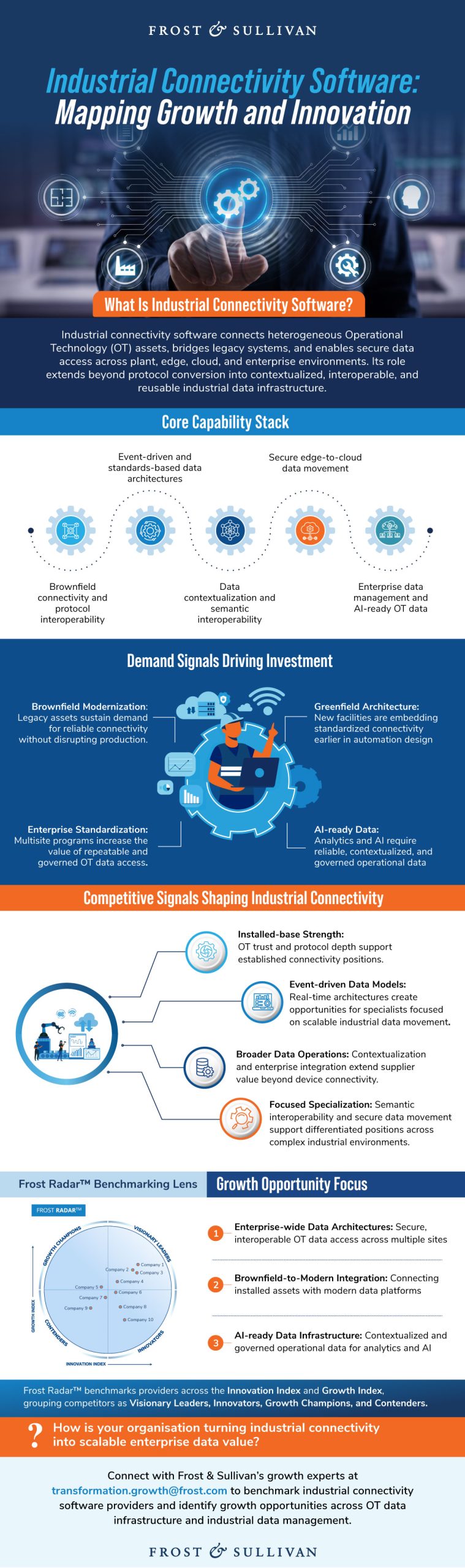
Strategic Imperatives Redefining Industrial Connectivity Growth and Supplier Positioning
Industrial connectivity has a wider role in industrial modernization as reliable OT data becomes essential to enterprise visibility, analytics, and multisite operations. This changes the commercial value of connectivity from protocol access alone to scalable industrial data infrastructure.
- Competitive Intensity: Brownfield modernization sustains established demand. Fragmented automation environments preserve the value of proven interoperability, while greenfield programs create opportunities around standardized connectivity from the outset.
- Disruptive Technologies: Modern data architectures create distinct supplier entry points. Event-driven data movement and semantic interoperability give specialist providers access to enterprise programs alongside established connectivity vendors.
- Industry Convergence: Enterprise scale changes supplier selection criteria. Governance, security, deployment flexibility, and ecosystem compatibility carry greater weight as connectivity becomes part of multisite standardization programs.
Frost & Sullivan Perspective
According to Frost & Sullivan, industrial connectivity is developing along multiple competitive paths rather than converging around a single architecture. Established providers retain an advantage in brownfield reliability and installed-base trust, while architecture-led challengers and specialists are gaining relevance in event-driven data movement, semantic interoperability, and secure OT access. Competitive positioning will reflect how effectively these capabilities translate into scalable industrial data infrastructure across sites and enterprise environments.
Frost Radar™ Benchmarking: Comparing Supplier Positions in Industrial Connectivity
Industrial connectivity now spans several supplier models, making competitive comparison more complex than protocol coverage alone. Frost & Sullivan evaluated 65 qualified participants and selected 10 companies for Frost Radar™ benchmarking across Growth and Innovation. The benchmark gives executives a clearer view of how different provider models align with brownfield modernization, enterprise data programs, and evolving industrial architectures.
| Competitive Path | Companies Benchmarked | Commercial Positioning |
| Industrial Connectivity Incumbents | Velotic Kepware, Softing Industrial Automation, Matrikon | Industrial credibility and broad interoperability support established positions in brownfield modernization and mixed automation environments. |
| Message Queuing Telemetry Transport (MQTT) and Event-driven Data Specialists | EMQ, HiveMQ, Cirrus Link | Real-time data movement provides a distinct entry route into distributed and enterprise-scale industrial data architectures. |
| Industrial Data Operations and Enablement Providers | Litmus Automation, Software Toolbox | Data enablement and integration extend connectivity into broader enterprise data operations and modernization programs. |
| Semantic Interoperability and Secure Data Movement Specialists | Prosys OPC, Skkynet | Focused interoperability and secure data access support specialist positions where governed, reusable OT data carries greater value. |
The commercial distinction lies in where each supplier model participates in the modernization journey. Installed-base strength supports brownfield programs, while focused data architecture capabilities provide other routes into enterprise standardization and industrial data initiatives. Frost Radar™ benchmarking helps reveal how these different positions compare without reducing the decision to scale or technology breadth alone.
How well is your organization positioned to navigate the industrial connectivity landscape and capture emerging growth opportunities?
Top 3 Growth Opportunities Expanding Industrial Connectivity Value
- Enterprise-wide Industrial Data Architectures
Multisite standardization is driving demand for secure, interoperable OT data access across plants and enterprise systems.
Business implication: Enterprise programs favor suppliers with repeatable deployment models, governance capabilities, and support for heterogeneous industrial environments. - Brownfield-to-modern Data Integration
Legacy assets remain embedded across industrial operations, sustaining demand for connectivity that links installed equipment with modern data platforms without disrupting production.
Business implication: Brownfield modernization supports established interoperability providers while giving flexible integration specialists a clear role in modernization programs. - AI-ready Industrial Data Infrastructure
Industrial AI and advanced analytics depend on contextualized, governed, and reliable operational data.
Business implication: Suppliers positioned across data enablement, edge integration, and enterprise interoperability can participate in higher-value industrial data architectures beyond basic transport.
Future Outlook: What Will Define Industrial Connectivity Leadership?
Brownfield modernization and enterprise data programs will anchor industrial connectivity growth. Existing plants sustain demand for interoperability, while multisite programs raise the value of governed, reusable OT data and repeatable deployment.
This creates distinct commercial routes. Established providers benefit from installed-base access, while specialists gain entry through scalable data architecture and secure enterprise connectivity. Ecosystem partners extend these positions into broader multisite programs.
According to Frost & Sullivan, future leadership will rest on converting operational credibility into enterprise-scale value. Supplier relevance will reflect how well current modernization requirements align with long-term data architecture priorities.
How well is your organization positioned to capture growth as industrial connectivity expands across brownfield modernization and enterprise data architectures?
Ready to Lead the Transformation?
- Schedule a Growth Strategy Dialog: Align your growth roadmap with Frost & Sullivan’s Visionary Growth Pipeline™ Dialog.
- Engage with Growth Experts: Co-design AI-enabled, data-driven operating models that scale industry-specific and commercial impact.
- Showcase Your Transformational Leadership: Position your organization as a transformation leader through Frost & Sullivan’s Transformational Growth Leadership platform.
- Join the Growth Council: Collaborate with industry leaders shaping the future of your ecosystem.
- Explore Best Practices Recognition: Be recognized for excellence in growth strategy, execution, and customer impact.
- Benchmark Your Industry Positioning on the Frost Radar™: Benchmark your growth performance and innovation strength against industry competitors.
- Tell Your Story: Accelerate awareness, engagement, and revenue growth through integrated brand and demand generation strategies.
Connect with our growth experts at [email protected].
FAQs
1. What is driving industrial connectivity growth in 2026
Brownfield modernization, greenfield standardization, Industrial Internet of Things (IIoT) adoption, and enterprise demand for reliable OT data access are expanding industrial connectivity beyond basic protocol conversion.
2. How is Industrial Internet of Things (IIoT) changing industrial connectivity requirements?
IIoT environments require secure, interoperable data flows across machines, edge systems, cloud platforms, and enterprise applications. This is increasing the importance of scalable connectivity and contextualized operational data.
3. What role does industrial automation software play in connected operations?
Industrial automation software relies on connectivity layers that make machine and control-system data accessible across operational and enterprise environments, supporting broader analytics, monitoring, and data-driven applications.
4. Why is OPC UA important for industrial interoperability?
Open Platform Communications Unified Architecture (OPC UA) supports standards-based interoperability and structured information models, helping industrial data remain understandable and reusable across heterogeneous systems.
5. How is industrial networking evolving for enterprise-scale operations?
Industrial networking is extending beyond point-to-point integration toward event-driven data movement, edge-to-cloud connectivity, and standardized architectures that support distributed and multisite operations.
6. Why is industrial data management important for AI-ready operations?
Industrial data management adds context, governance, and consistency to operational data, helping analytics and AI applications work with reliable information rather than fragmented or unstructured plant data.
7. Which capabilities are shaping competition in industrial connectivity software?
OT reliability, protocol interoperability, scalable data movement, semantic interoperability, secure data access, and enterprise deployment capability are shaping supplier differentiation across industrial connectivity software.
8. How does Frost Radar™ evaluate industrial connectivity software providers?
Frost Radar™ benchmarks companies through the Growth Index and Innovation Index, covering commercial performance, growth execution, innovation scalability, customer alignment, and evolving industrial connectivity capabilities.