This blog is based on Frost & Sullivan’s recent analyses, Growth Opportunities in the Automated Optical Inspection (AOI) Market, Global, 2025–2030, and Top 10 Growth Opportunities in the Dimensional Metrology Market, 2026, authored by growth expert Sujan Sami from the Industrial Practice Area.
Executive Summary:
Quality control in manufacturing is becoming a strategic driver of yield, throughput, and operational resilience as manufacturers respond to miniaturization, product complexity, reshoring, and zero-defect requirements across electronics, automotive, aerospace, medical devices, and advanced manufacturing. Artificial intelligence (AI)-enabled automated optical inspection (AOI), 3D metrology, digital twins, in-line measurement, and multimodal inspection are improving defect detection, traceability, and real-time process control. At the same time, stricter quality and safety standards are increasing demand for reliable, connected inspection systems. As competitive value moves beyond standalone hardware, software-led inspection, automation, analytics, and closed-loop control will become the primary differentiators for manufacturers, metrology vendors, inspection providers, and technology partners.
Key Takeaways:
- AI-enabled inspection, three-dimensional (3D) metrology, and in-line measurement are becoming central to faster, more consistent quality decisions.
- Competitive advantage will depend on connecting inspection data with software, analytics, traceability, and closed-loop process control.
- Electric vehicles (EVs), advanced packaging, aerospace, medical devices, and additive manufacturing are creating high-value growth pathways for solution providers.
- Vendor success will rely on lowering adoption barriers through modular systems, stronger integration, workforce enablement, and strategic partnerships.
What Is Connected Quality Control in Manufacturing?
Connected quality control combines inspection, measurement, software, and production data to verify product quality and guide faster process decisions. It spans automated optical inspection (AOI), machine vision inspection, dimensional metrology, and in-line or at-line measurement. Unlike conventional checks performed after production or in isolated quality rooms, it links inspection results with factory systems for traceability, corrective action, and closed-loop improvement. According to Frost & Sullivan, this transformation turns quality from a compliance function into an operating advantage by improving yield, reducing rework, and expanding software- and service-led value.
What Is Advancing Quality Control Toward Connected Production Intelligence?
Quality control in manufacturing is moving closer to production as miniaturized components, tighter tolerances, and higher throughput increase the cost of late defect detection. AOI, machine vision inspection, and dimensional metrology now support earlier corrective action, stronger traceability, and lower rework.
Three commercial shifts are widening investment and supplier opportunity:
Turning Quality Control into Scalable Manufacturing Value
Frost & Sullivan’s strategic analysis helps industrial leaders assess:
• Where AI-enabled inspection and 3D metrology can improve yield, throughput, and traceability
• How software, analytics, and closed-loop control are reshaping competitive differentiation
• Which end-use industries offer the strongest expansion pathways for solution providers
• What capabilities and partnerships are needed to scale adoption and revenue
- Rising production complexity: Zero-defect requirements are expanding demand for automated quality inspection across electronics, EVs, aerospace, medical devices, semiconductors, and advanced manufacturing.
- Lower-touch quality workflows: Workforce shortages and regionalized production are increasing the value of automated inspection and in-line measurement that reduce manual intervention and support consistent quality decisions.
- Connected production systems: Digital-twin workflows and factory-system integration are extending measurement data into process feedback, traceability, and closed-loop control.
Purchasing decisions now place greater weight on total cost of ownership, integration with established production environments, local support, and dependable operating outcomes. This creates clearer entry pathways for software providers, machine vision specialists, system integrators, and metrology vendors that can enhance installed systems and expand software, service, and application value.
Top Three Strategic Imperatives Redefining Quality Control Value
- Disruptive Technologies: AI and machine learning (ML), advanced optical systems, and 3D inspection are shifting quality control from rule-based detection toward adaptive, software-led decision-making. Their commercial value lies in reducing false calls, shortening programming cycles, and converting inspection data into faster production responses.
- Transformative Megatrends: Electronics miniaturization, EV production, advanced packaging, additive manufacturing, and Industry 4.0 are increasing component complexity and tolerance requirements. These shifts are expanding demand for automated, in-line, and multimodal inspection that protects yield without compromising throughput.
- Geopolitical Chaos: Tariffs, trade tensions, and supply-chain disruption are accelerating reshoring, manufacturing regionalization, and supplier diversification. New production facilities are widening commercial opportunities for inspection and metrology providers with local application expertise, integration capability, and responsive service.
Frost & Sullivan Perspective
Frost & Sullivan believes the next phase of quality control will be shaped by providers that combine reliable inspection hardware with software, analytics, automation, and factory-system integration. Competitive differentiation will move beyond equipment performance toward the ability to support predictive quality, traceability, and closed-loop process control. As regional manufacturing networks expand, local service strength, application expertise, and ecosystem partnerships will become increasingly important to supplier positioning, revenue, and long-term customer value.
How can your quality strategy turn inspection data into faster, more scalable production decisions?
Connected Quality Platforms Are Expanding Production and Revenue Value
Connected quality platforms create measurable value when they improve defect accuracy, enable earlier intervention, and bring measurement data closer to production.
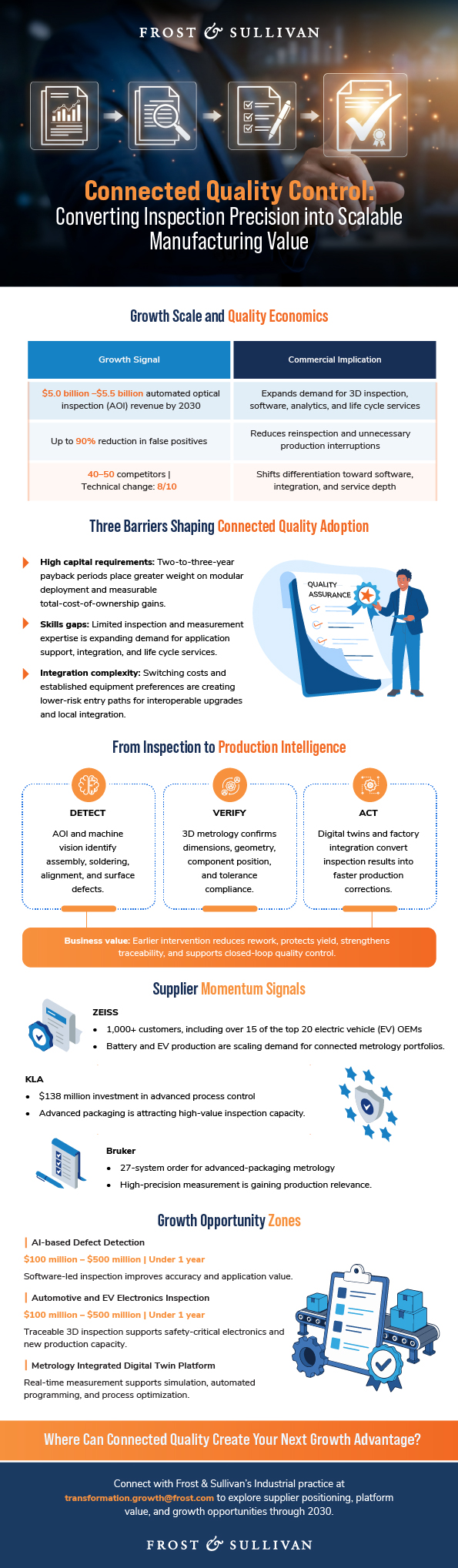
| Indicator | Evidence | Business Implication |
| AOI revenue potential | Global AOI revenue is expected to reach USD 5.0 billion to USD 5.5 billion by 2030. | Revenue potential is expanding beyond hardware into 3D inspection, AI-enabled software, application analytics, and life cycle services. |
| False-positive reduction | AI and ML integration can reduce false positives by up to 90% in relevant AOI applications. | Fewer false calls reduce production interruptions, reinspection, and unnecessary rework. |
| Production-integrated metrology | Dimensional metrology is moving from dedicated quality rooms into portable, automated, at-line, and in-line workflows connected with digital twins. | Earlier feedback supports predictive quality, faster corrective action, process adjustment, and recurring software and service value. |
Integrated quality platforms provide a clearer route from measurement capability to long-term customer value. ZEISS serves more than 1,000 customers, including over 15 of the top 20 EV original equipment manufacturers, through a portfolio spanning microscopy, computed tomography, coordinate measuring machines (CMMs), optical 3D systems, and software. Hexagon connects quality analytics, reporting, and equipment-health assessment through its Autonomous Metrology suite. Together, these models show how portfolio breadth and software connectivity can extend supplier value into traceability, analytics, integration, and life cycle services.
Top Three Growth Opportunities Converting Quality Data into Scalable Value
- AI-based Defect Detection and Classification
AI-enabled AOI platforms can classify defects in real time, adapt to printed circuit board variability, and reduce false calls. This growth opportunity is estimated at $100 million to $500 million over five years, with an action timeline of under one year.
Business implication: Hardware-agnostic platforms and application-specific AI models can expand software revenue while improving customer yield, programming efficiency, and production consistency.
- Automotive and EV Electronics Inspection
Electric vehicles contain more electronic components than internal combustion engine vehicles, increasing inspection demand across battery management systems, control modules, and safety-critical assemblies. Automotive reshoring and new production facilities are also expanding the requirement for traceable, high-accuracy inspection.
Business implication: Automotive application expertise, reliable 3D inspection, and factory integration can strengthen supplier positioning across OEM and Tier I networks by linking inspection performance with safety, throughput, and traceability.
- Metrology Integrated Digital Twin Platform
Real-time dimensional data can strengthen digital twins through virtual inspection planning, collision avoidance, automated CMMs programming, and continuous process feedback.
Mitutoyo is developing digital twin capabilities for CMMs through virtual commissioning and simulation-based program generation. Eleven Dynamics is advancing real-time process monitoring and integration across design, manufacturing, and measurement systems.
Business implication: Unified metrology platforms can generate software and analytics value while extending supplier influence into production planning and process optimization.
Future Outlook: Connected Quality Platforms Will Define Manufacturing Advantage Through 2030
Quality control will continue shifting from isolated inspection toward connected process assurance. In AOI, software will account for a larger share of customer value by 2030, while AI and ML reduce programming effort, false calls, and human intervention. Across dimensional metrology, digital twins, automated cells, and in-line measurement will extend quality intelligence closer to production.
Investment is converging on platforms that combine measurement, analytics, traceability, and process feedback. According to Frost & Sullivan, interoperable software, application expertise, regional support, and ecosystem partnerships will determine which providers can protect yield, improve throughput, and expand software and service value.
Which combination of inspection technology, software integration, and application expertise can strengthen your quality position through 2030?
Ready to Lead the Transformation?
- Schedule a Growth Strategy Dialog: Align your growth roadmap with Frost & Sullivan’s Visionary Growth Pipeline™ Dialog.
- Engage with Growth Experts: Co-design AI-enabled, data-driven operating models that scale industry-specific and commercial impact.
- Showcase Your Transformational Leadership: Position your organization as a transformation leader through Frost & Sullivan’s Transformational Growth Leadership platform.
- Join the Growth Council: Collaborate with industry leaders shaping the future of your ecosystem.
- Explore Best Practices Recognition: Be recognized for excellence in growth strategy, execution, and customer impact.
- Benchmark Your Industry Positioning on the Frost Radar™: Benchmark your growth performance and innovation strength against industry competitors.
- Tell Your Story: Accelerate awareness, engagement, and revenue growth through integrated brand and demand generation strategies.
Connect with our growth experts at [email protected].
FAQs
1. What is quality control in manufacturing?
Quality control in manufacturing combines inspection, measurement, traceability, and production feedback to protect yield and ensure product conformance. Modern industrial quality control systems increasingly connect inspection data with factory operations for faster corrective action.
2. What is automated optical inspection?
Automated optical inspection (AOI) uses cameras, optics, lighting, and software to identify assembly and component defects. The automated optical inspection market is expanding as electronics miniaturization and advanced packaging increase the need for accurate, high-throughput inspection.
3. How does machine vision inspection improve quality?
Machine vision inspection enables automated quality inspection by detecting missing components, alignment issues, surface defects, and assembly errors. It supports faster decisions, more consistent results, and lower dependence on manual inspection.
4. What is 3D metrology used for?
3D metrology measures component dimensions, geometry, alignment, surface characteristics, and tolerances. Dimensional metrology is moving closer to production through portable scanners, robotic cells, and in-line measurement systems.
5. What are digital inspection technologies?
Digital inspection technologies combine connected measurement, software, analytics, and factory-system integration. They help manufacturers translate inspection data into traceability, process feedback, and production improvement.
6. What is predictive quality?
Predictive quality uses inspection data, artificial intelligence, and analytics to identify potential defects or process deviations before they affect production. It can reduce rework, improve yield, and support closed-loop quality control.
7. What AOI manufacturing trends are shaping growth?
Key AOI manufacturing trends include AI-based defect classification, 3D inspection, edge processing, multimodal inspection, and greater software integration. These developments are shifting supplier value from standalone equipment toward analytics, applications, and life cycle services.
8. How are industrial NDT solutions related to AOI?
Industrial non-destructive testing (NDT) solutions fall outside the main scope of this blog, which focuses on AOI and dimensional metrology. The NDT market is included as an adjacent inspection category; no NDT-specific forecasts or conclusions are presented.