This blog is based on the analysis titled, “Innovations and Growth Opportunities in Cosmetic and Aesthetic Procedures,” authored by Frost & Sullivan’s growth expert, Neeraj Nitin Jadhav, and lead analyst, Urvashi Shakarwal, from the TechVision—Medical Devices & Imaging team.
Executive Summary
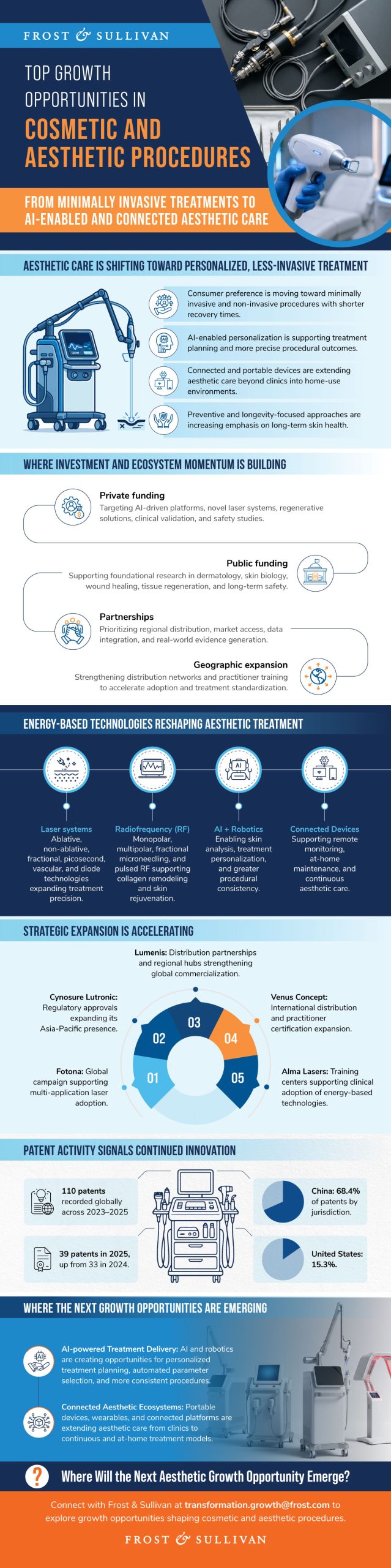
The cosmetic and aesthetic procedures industry is undergoing a significant transformation as consumer demand shifts toward safer, faster, and more personalized treatments with shorter recovery times. Laser-based systems, radiofrequency (RF) microneedling, dermabrasion, AI-enabled treatment personalization, and at-home solutions are expanding the range and accessibility of aesthetic interventions. For medical device companies, aesthetic technology providers, dermatology practices, and investors, this shift is creating growth opportunities across minimally invasive, preventive, and personalized aesthetic care.
What Are Cosmetic and Aesthetic Procedures?
Cosmetic and aesthetic procedures are treatments designed to improve physical appearance, skin quality, and aesthetic outcomes through surgical, minimally invasive, and non-invasive approaches. These procedures span treatments delivered across dermatology clinics and aesthetic centers as well as a growing range of technology-enabled solutions for home use. The industry is increasingly shifting toward minimally invasive and non-invasive approaches that use technologies such as laser-based systems, RF microneedling, and dermabrasion to deliver targeted results while reducing procedural risks, recovery time, and costs associated with traditional cosmetic surgery. According to Frost & Sullivan, cosmetic and aesthetic care is evolving toward a more personalized, preventive, and accessible model, driven by technology innovation, AI-enabled treatment personalization, and growing demand for longevity-focused interventions.
What Is Driving the Transformation of Cosmetic and Aesthetic Procedures?
Consumer expectations are shifting toward aesthetic treatments that combine visible results with convenience, personalization, and shorter recovery periods.
Several factors are accelerating this transformation:
- Growing preference for minimally invasive and non-invasive procedures
- Rising demand for safe, quick, and result-oriented aesthetic treatments
- Advances in laser-based systems, RF microneedling, and other device-based technologies
- Increasing use of AI to personalize treatment selection and planning
- Expansion of at-home aesthetic solutions and greater treatment accessibility
- Growing interest in preventive interventions and long-term skin health
- Increasing consumer awareness and acceptance of aesthetic procedures
What Will You Discover?
- AI governance applications across interoperability, data privacy, and digital ethics
- Regulatory and technology shifts shaping responsible AI deployment
- Growth opportunities across compliance, AI trust, and ecosystem collaboration
Together, these shifts are expanding aesthetic care beyond corrective procedures toward personalized and preventive treatment models across clinical and at-home environments.
Frost & Sullivan Perspective
Frost & Sullivan believes that future growth in cosmetic and aesthetic procedures will increasingly depend on the ability to combine minimally invasive technologies with personalization, accessibility, and preventive care. Medical device companies and aesthetic technology providers that align innovation with evolving consumer expectations will be better positioned to capture emerging growth opportunities.
What will shape the next phase of cosmetic and aesthetic care?
Listen to the Growth Podcast on personalized and minimally invasive aesthetic care.
Strategic Imperatives Shaping the Cosmetic and Aesthetic Procedures Industry
The cosmetic and aesthetic procedures industry is being shaped by economic uncertainty, rapid technology innovation, and growing convergence across healthcare and aesthetics. Three strategic imperatives are influencing investment priorities, technology development, and market growth.
- Geopolitical Chaos
- Ongoing geopolitical instability in the Middle East is disrupting energy supply chains, trade routes, and broader economic activity.
- Higher costs and economic uncertainty could influence discretionary consumer spending on aesthetic treatments.
- Manufacturers and providers will need to strengthen supply-chain resilience and respond to changing demand across key regions.
- Disruptive Technologies
- Advances in laser systems and radiofrequency (RF) devices are accelerating the shift toward minimally invasive and non-invasive procedures.
- Artificial intelligence (AI) is enabling more personalized treatment planning and supporting improved procedural outcomes.
- Continued device innovation is expanding treatment options while improving convenience and reducing recovery time.
- Industry Convergence
- Increasing regulatory approvals for minimally invasive and non-invasive aesthetic devices are supporting wider commercialization.
- Pharmaceutical, medical device, dermatology, and aesthetic care ecosystems are becoming increasingly interconnected.
- Cross-industry convergence is creating opportunities for integrated treatment approaches and new aesthetic care models.
Key Takeaways
- Personalization is becoming a competitive differentiator as AI supports more tailored aesthetic treatment strategies.
- Minimally invasive technologies are expanding the addressable market by improving convenience, accessibility, and recovery times.
- Industry convergence is widening growth opportunities across devices, therapeutics, dermatology, and aesthetic care.
- Economic uncertainty could reshape consumer demand, increasing the importance of cost-effective treatment options and resilient growth strategies.
Key Forces Shaping the Growth of Cosmetic and Aesthetic Procedures
Demand for cosmetic and aesthetic procedures is expanding as consumers seek less-invasive treatments, energy-based technologies improve clinical capabilities, and new demographic groups enter the market. However, reimbursement limitations, practitioner dependence, and inconsistent outcome measurement continue to influence adoption and scalability.
What Is Accelerating Growth?
- Preference for minimally invasive and combination procedures: Consumers increasingly favor treatments that offer visible results with less discomfort and downtime. Advances such as integrated cooling are also improving the treatment experience across laser-based procedures.
- Innovation in energy-based devices: Advances in laser and RF technologies are improving precision and enabling providers to address multiple aesthetic concerns through integrated platforms. Expanded regulatory clearances are further widening clinical applications.
What Could Slow Adoption?
- Limited reimbursement: Most aesthetic procedures remain outside insurance coverage, increasing out-of-pocket costs and constraining repeat treatments, particularly in price-sensitive markets.
- Dependence on practitioner expertise: Outcomes from RF microneedling, laser resurfacing, injectables, and other advanced procedures can vary significantly with practitioner skill, creating challenges around consistency and scalability.
Energy-based Technologies Transforming Cosmetic and Aesthetic Procedures
Energy-based technologies are playing a growing role in the shift toward minimally invasive aesthetic care. Laser-based systems offer targeted treatment across skin resurfacing, pigmentation, vascular lesions, scar reduction, and hair removal, while RF technologies support skin tightening, collagen remodeling, and rejuvenation.
- Laser-based Aesthetic Technology: Laser technologies use targeted wavelengths and energy delivery approaches to address specific skin and aesthetic concerns while limiting damage to surrounding tissue.
| Key technology approaches include | Companies to Action |
|
· Ablative lasers: Support deeper resurfacing for wrinkles, scars, and skin texture improvement. · Non-ablative lasers: Stimulate collagen while preserving the epidermis, supporting shorter recovery times. · Fractional lasers: Treat targeted micro-columns of skin to support faster healing and collagen production. · Picosecond lasers: Deliver ultra-short pulses for pigmentation, tattoo removal, and skin revitalization. |
· Cynosure: PicoSure® Pro picosecond laser for pigmentation disorders and aesthetic applications. · Candela Corporation: PicoWay platform targeting pigmentation, tattoos, and skin revitalization. · Quanta System: PICO laser with VarioPulse® technology supporting customizable treatments for tattoo removal, skin revitalization, and scar remodeling. |
- RF-based Aesthetic Technology: RF technologies use controlled electromagnetic energy to heat dermal tissue, stimulate collagen remodeling, and support skin tightening without damaging the epidermis
| Key technology approaches include | Companies To Action |
|
· Monopolar RF: Enables deeper tissue remodeling and treatment of larger areas. · Multipolar RF: Supports controlled heat distribution and consistent collagen stimulation. · Fractional RF microneedling: Combines microneedles with RF energy for targeted dermal remodeling. · Pulsed RF: Uses short energy bursts to improve comfort while reducing thermal damage. |
· Aesthetic Management Partners: Scarlet Pro RF microneedling platform for multi-layer dermal remodeling. · Cutera: Secret™ RF fractional microneedling platform targeting wrinkles, scars, pigmentation, and skin rejuvenation. · Cartessa Aesthetics: QUIADESS™ hybrid RF microneedling platform combining minimally invasive and non-invasive RF delivery. |
Frost & Sullivan Perspective
Frost & Sullivan believes that the next phase of energy-based aesthetic innovation will be shaped by greater treatment personalization, multi-modality platforms, and improved patient experience. Technologies that combine precision energy delivery with shorter treatment times, reduced discomfort, and the ability to address multiple aesthetic concerns through a single platform are likely to strengthen differentiation as demand for minimally invasive procedures grows.
Growth Opportunities Expanding the Aesthetic Care Ecosystem
Technology innovation is creating new opportunities to improve treatment precision, personalization, accessibility, and continuity of aesthetic care.
- AI and Robotics for Personalized Treatment Delivery
AI and robotics are moving aesthetic procedures toward more standardized and personalized treatment models.
- AI-enabled systems can support skin analysis, treatment planning, and automated parameter selection.
- Robotic assistance can improve procedural consistency and reduce dependence on practitioner technique.
- Integration with laser, injectable, and energy-based technologies can support more precise and repeatable procedures.
- Connected and Portable Aesthetic Device Ecosystems
Portable devices, wearables, and connected platforms are extending aesthetic care beyond traditional clinical settings.
- Portable systems can support maintenance and lower-intensity procedures at home.
- Connected devices and wearables enable continuous skin monitoring and treatment personalization.
- Tele-aesthetic platforms can connect in-clinic expertise with at-home treatment and follow-up.
Which growth opportunity could create the greatest value for your aesthetic care strategy?
The Next Growth Horizon for Aesthetic Care
The future of cosmetic and aesthetic procedures will be shaped by technologies that make treatments more precise, personalized, accessible, and connected. Frost & Sullivan expects AI-enabled treatment planning, energy-based devices, robotics, and portable platforms to accelerate the shift toward minimally invasive and continuous aesthetic care. As clinical and at-home models converge, opportunities will expand for companies that combine technology innovation with measurable outcomes, patient convenience, and scalable delivery models.
How will your organization capture the next wave of growth in aesthetic care?
Ready to Lead the Transformation?
- Schedule a Growth Strategy Dialog: Align your growth roadmap with Frost & Sullivan’s Visionary Growth Pipeline™ Dialog.
- Engage with Growth Experts: Co-design AI-enabled, data-driven operating models that scale industry-specific and commercial impact.
- Showcase Your Transformational Leadership: Position your organization as a transformation leader through Frost & Sullivan’s Transformational Growth Leadership platform.
- Join the Growth Council: Collaborate with industry leaders shaping the future of your ecosystem.
- Explore Best Practices Recognition: Be recognized for excellence in growth strategy, execution, and customer impact.
- Benchmark Your Industry Positioning on the Frost Radar™: Benchmark your growth performance and innovation strength against industry competitors.
- Tell Your Story: Accelerate awareness, engagement, and revenue growth through integrated brand and demand generation strategies.
Frequently Asked Questions
What are the key trends shaping cosmetic and aesthetic procedures?
Cosmetic and aesthetic procedures are shifting toward minimally invasive, non-invasive, personalized, and preventive treatments. Laser-based systems, radiofrequency (RF) devices, artificial intelligence (AI), robotics, and connected aesthetic devices are improving treatment precision, reducing recovery time, and expanding access across clinical and at-home settings.
Why are minimally invasive aesthetic procedures gaining popularity?
Minimally invasive aesthetic procedures are gaining popularity because they typically offer shorter recovery times, lower procedural risks, and greater convenience than traditional cosmetic surgery. Advances in laser and RF technologies are also improving patient comfort and enabling providers to address multiple aesthetic concerns.
How is AI transforming cosmetic and aesthetic procedures?
AI is supporting skin analysis, personalized treatment planning, automated parameter selection, and treatment optimization. When combined with robotics and energy-based devices, AI can also improve procedural consistency and enable more personalized aesthetic treatment pathways.
What roles do laser and RF technologies play in aesthetic treatments?
Laser and RF technologies enable targeted, minimally invasive treatments across skin resurfacing, pigmentation, hair removal, wrinkle reduction, collagen remodeling, scar treatment, and skin tightening. Continued innovation in energy delivery is improving precision, comfort, and the versatility of aesthetic device platforms.
Where are the key growth opportunities in cosmetic and aesthetic procedures?
Key growth opportunities include AI and robotics for personalized treatment delivery, connected and portable aesthetic devices, energy-based treatment platforms, and at-home aesthetic care ecosystems. Frost & Sullivan expects increasing convergence between clinical and consumer-facing technologies to create new opportunities for continuous and personalized aesthetic care.