Organizations across industries are navigating one of the biggest technology shifts in decades. While artificial intelligence is creating new opportunities to improve efficiency, automate processes, and enhance customer interactions, many leaders are discovering that technology alone is not enough. The real challenge lies in optimizing customer journeys, integrating AI into business operations, and creating experiences that balance automation with human expertise.
“Everyone is focused on cost reduction, but the real opportunity in AI is creating unique customer journeys that are personalized, differentiated, and impossible to replicate.”
— Chris Caldwell, Global President & CEO, Concentrix
Additionally, businesses are under increasing pressure to deliver measurable outcomes faster than ever before. As customer expectations continue to evolve, organizations are looking beyond traditional outsourcing models, towards partners that can help them design, build, and run integrated customer experience (CX) ecosystems.
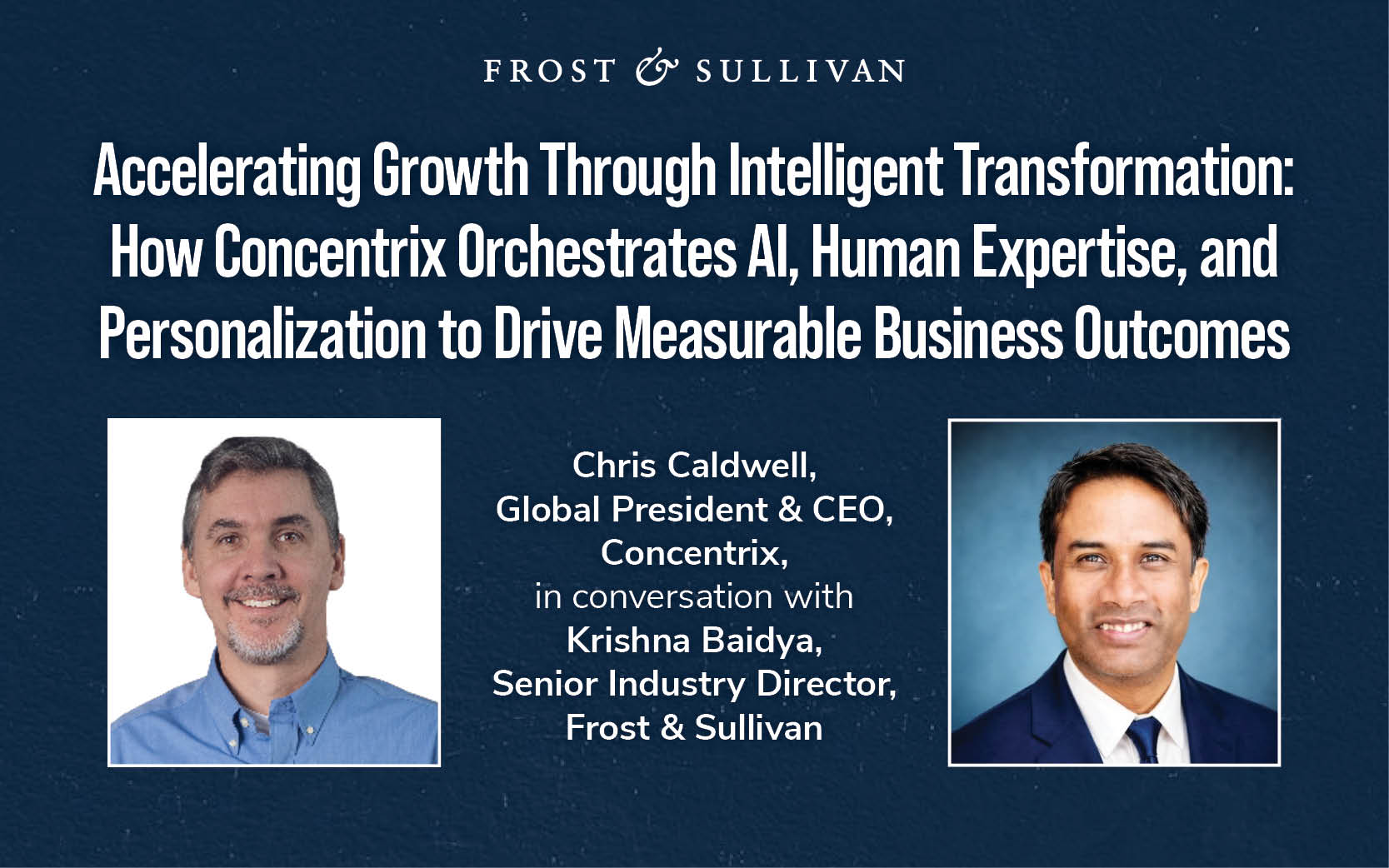
In this Transformational Growth Leadership (TGL) conversation, Chris Caldwell, Global President & CEO of Concentrix, speaks with Krishna Baidya, Senior Industry Director at Frost & Sullivan, about business transformation, AI-enabled CX, the evolution of service delivery models, and why the future belongs to organizations that successfully combine technology, human expertise, and intelligent orchestration.
Enabling Transformational Growth Through Continuous Reinvention
Krishna Baidya: Chris, before we talk about Concentrix, I’d love to start with your personal journey. When you hear the words transformation, growth, and leadership, what do they mean to you?
Chris Caldwell: It’s interesting because those three words really describe my own journey. I never imagined I would be involved in a global business or leading an organization of this scale. Early in my career, I was selling and working with computers, and when I eventually joined the company that would become Concentrix, the goal was to help transform a traditional distribution business into one that focused on higher-value services.
That transformation became the foundation of Concentrix nearly twenty-three years ago. We started with about thirty people focused on B2B (business-to-business) lead generation. Since then, we’ve continuously reinvented the business model every five to ten years, increased our investment in technology, and evolved our leadership capabilities.
One of the most important lessons I’ve learned is that transformation is never a one-time event. It requires a willingness to continually challenge assumptions, rethink what made you successful in the past, and adapt to what customers will need in the future.
Innovative Architecture for Global Scalability
Krishna Baidya: Concentrix has evolved from a relatively small organization, and into a global Fortune 500 company. Looking back, what were some of the pivotal milestones and leadership decisions that helped Concentrix continuously reinvent itself and sustain growth?
Chris Caldwell: First and foremost, it takes an incredible team. We’ve been fortunate to have many leaders who have grown with the company.
What has really driven growth is our culture of curiosity and our willingness to disrupt ourselves. We have never been comfortable relying solely on what worked yesterday. Instead, we’ve consistently looked ahead and asked what customers will need next, what technologies are emerging, and how we can evolve our business to create more value.
We built the company around several fundamental beliefs:
- One was that clients would increasingly prefer fewer partners that possessed deep domain expertise and intimate knowledge of their business.
- Another was that global organizations would need consistent service delivery around the world, while still respecting local cultural nuances and differences.
- The third was that technology would become a critical differentiator. We never viewed services alone as a sustainable long-term strategy. Technology had to be embedded within the business model to create greater value for clients.
These principles guided our growth and remain just as relevant today as they were two decades ago.
Thwarting Growth Challenges Through the Design-Build-Run Strategy
Krishna Baidya: You’ve spoken about continuous reinvention and the growing impact of technology. As Concentrix evolves from delivering customer experiences to helping clients design, build, and run them, what is driving that shift, and how is technology enabling it?
Chris Caldwell: One of the biggest challenges we see is that organizations often try to bolt AI onto existing processes and expect transformational outcomes. That approach doesn’t generate meaningful ROI.
Our philosophy is different. Rather than starting with current processes, we start with the desired future state. We understand what outcomes clients want to achieve and what experience they want customers to have. Once that vision is clear, we design the future-state journey and work backward from there.
That’s where the design phase becomes critical. It allows organizations to rethink processes, challenge assumptions, and create new operating models that fully leverage technology. We then build the necessary systems, implement the technology, establish the operational framework, and ultimately run the solution to deliver measurable outcomes.
Everyone wants to reach the run phase quickly because that’s where ROI is realized. But without proper design and implementation, organizations often struggle to unlock the full value of AI and other emerging technologies.
Download this Transformational Growth Leadership Discussion with Chris Caldwell
Competitive Differentiation Through Seamless Integration
Krishna Baidya: That’s interesting. As you move into the design and build phase, you’re also entering a different competitive ecosystem. You’re no longer just competing with traditional service providers—you’re increasingly competing with consultants, system integrators, and technology-led transformation firms. So, what gives clients confidence that Concentrix is the right partner to lead that journey?
Chris Caldwell: Clients don’t want to act as the general contractor for their own transformation initiatives. They don’t want to hire one company for strategy, another for technology, another for implementation, and then figure out how to connect all the pieces together. They want a partner that can bring everything together and deliver measurable business value.
That’s where we consistently win.
Our approach combines deep domain expertise, purposeful technology adoption, and operational execution. We focus on where technology can create measurable returns.
Most importantly, we help clients move quickly. Businesses today don’t want transformation programs that take three, four, or five years before delivering results. They’re looking for outcomes within quarters or within a fiscal year. Our integrated model allows us to align technology, operations, and business objectives much more effectively than fragmented approaches.
The Next Growth Opportunity: AI-powered Customer Experience
Krishna Baidya: Much of the conversation around AI today focuses on efficiency, productivity, and cost reduction. Where do you see the real opportunity, and what do you believe will be the true game changer as organizations begin to rethink what’s possible with AI?
Chris Caldwell: Honestly, I think many organizations are missing the bigger opportunity.
Everyone is talking about cost reduction. Cost savings will certainly happen, and efficiency improvements are important. However, given the increasing complexity of operations, we’re often seeing costs rise rather than decline.
But if that’s the primary focus, companies risk overlooking the true transformational potential of AI.
When I look five years into the future,
- I see highly personalized customer journeys tailored to individual consumers.
- It’s about leveraging more efficient AI models that sit closer to the edge, understand individual preferences, and operate within a framework where users maintain control of their data. AI then becomes the enabler of highly curated, personalized journeys.
The organizations that focus solely on efficiency may achieve short-term savings, but they’ll struggle to create differentiation. If every company offers the same generic AI-powered experience, customers will have little reason to remain loyal.
The real opportunity lies in using AI to create experiences that are unique, relevant, and valuable to each individual customer.
Best Practices for Harnessing Technology Innovation
Krishna Baidya: As we have these conversations, one thing that stands out is the pace at which technology is evolving. There’s often a gap between what’s possible and what’s actually being adopted. So, when you look ahead, what excites you most about the future of the industry? What do you believe has the potential to truly reshape it?
Chris Caldwell: We often talk about the new realities of our business and how AI is reshaping business models, and customer engagement. What excites us most is that this represents a completely new opportunity—a greenfield growth area with new services and revenue streams.
The kinds of experiences we discussed, particularly around SMBs and highly domain-specific, efficient AI models, are creating an entirely new marketplace. We see that as a significant growth opportunity.
On the other hand, Security is probably the biggest issue that keeps me up at night.
We’re still seeing organizations deploy AI solutions without fully understanding the security implications. In some cases, insufficient guardrails lead to unexpected behaviours, vulnerabilities, or reputational risks.
The challenge is that security must evolve just as quickly as the technology itself. Traditional approaches are no longer sufficient. Organizations need robust security frameworks, rapid response capabilities, continuous monitoring, and strong governance practices.
At Concentrix, we’ve invested heavily in security for more than a decade. In fact, security has become one of our fastest-growing investment areas, particularly around generative AI and data protection.
Download this Transformational Growth Leadership Discussion with Chris Caldwell
Delivering Higher-value CX Through Human-AI Synergy
Krishna Baidya: We’ve talked about processes that can be eliminated and others that can be fully automated. But there are also moments where the human touch remains essential. How do you think about that balance, especially given the growing narrative that AI is going to replace jobs?
Chris Caldwell: I think the reality is much more nuanced than the headlines suggest. Some tasks will certainly become automated, but we’re also seeing entirely new categories of work emerge. Data annotation, AI model support, analytics, cybersecurity, fraud prevention, orchestration, and AI governance are all creating new opportunities.
Customer interactions are becoming more complex. As routine inquiries become automated, what’s left are higher-value conversations that require judgment, empathy, and problem-solving capabilities.
We’re already seeing this trend across customer experience operations. Voice interactions, for example, are becoming more sophisticated and often involve more complex issues than in the past. The future isn’t humans versus AI. It’s humans and AI working together. Technology will automate routine activities, while people focus on the moments that matter most to customers.
That doesn’t mean people are becoming less efficient—it simply means they’re doing different kinds of work. They’re enabling and managing more of the technology, while customers are expecting different experiences from the brands they engage with. What’s left are often the more complex, higher-value interactions that create meaningful business impact. If organizations fail to invest in those areas, they risk losing customers, increasing churn, and missing valuable growth opportunities.
Turning AI Investments into Measurable ROI
Krishna Baidya: We often hear AI being discussed primarily in terms of cost reduction. But at the same time, organizations also need to think about the cost of using AI itself, whether that’s model usage, token consumption, or the broader technology investment. Do you think it’s time to rethink how we measure value?
Chris Caldwell: I believe organizations need to focus much more on outcomes than inputs.
Simply measuring token consumption or technology utilization doesn’t necessarily tell you whether value is being created. What matters is whether the investment is generating better customer experiences, stronger business outcomes, higher revenue, or greater operational efficiency.
We’re already seeing growing interest in outcome-based consumption models where incentives are aligned around business results. While these models are still evolving, they represent an important shift in how organizations think about technology investments.
Clients are often apprehensive about moving away from legacy technologies, and that must be considered when designing true outcome-based pricing.
Best Practices for Maximizing Organizational Readiness
Krishna Baidya: What advice would you give organizations that are trying to make that shift? And how important is change management in that journey? Too often, organizations assume they can simply layer on a new technology and expect it to work like a magic bullet.
Chris Caldwell: Success begins with clarity around the desired customer experience and strong leadership commitment.
We’re already working with brands that are using AI to deliver highly personalized experiences. Some are tailoring recommendations based on customer preferences and local market dynamics. Others are expanding multilingual support capabilities in ways that would have been prohibitively expensive just a few years ago.
To your point, success requires deep change management, a strong understanding of consumer needs, and the ability to enable technology at the right stages of the customer journey. What successful organizations have in common is ownership. Their leadership teams understand what they’re trying to achieve and are actively engaged in driving the transformation.
Equally important is cross-functional collaboration. Customer experience doesn’t belong solely to marketing, sales, IT, or support teams. It spans all of them. When organizations align around a shared vision and work together to redesign customer journeys, the results can be remarkable. Technology is important, but successful transformation is ultimately about people, processes, and organizational alignment.
Download this Transformational Growth Leadership Discussion with Chris Caldwell
Looking Ahead: Customer Experience Orchestration
Krishna Baidya: You’ve shared some great insights, Chris. As you look ahead, what excites you most about the future of the industry? And are there areas where you believe organizations, including Concentrix, will need to think differently as the industry continues to evolve?
Chris Caldwell: We’re entering an entirely new phase of growth. AI is creating opportunities to rethink customer engagement, redesign business processes, and create entirely new categories of services. We see significant opportunities emerging around orchestration, personalization, AI-enabled experiences, and the integration of technology and human expertise.
At the same time, organizations continue to need trusted partners that can help them navigate complexity, implement change, and deliver outcomes.
We’ve always believed in helping clients transform their businesses. The tools may be changing, but that mission remains the same. If we continue to focus on our people, support our clients, and embrace innovation, I believe we’ll remain relevant and continue driving growth for many years to come.
Closing Reflection: Building the Future of Intelligent Transformation
The technology and services industry is entering a new era where competitive advantage will be determined not simply by automation, but by an organization’s ability to orchestrate technology, data, and human expertise into seamless digital journeys.
For Concentrix, the opportunity lies in helping organizations move beyond fragmented transformation initiatives toward integrated design-build-run models that connect strategy, technology, operations, and outcomes. By combining AI-enabled innovation with deep domain expertise and operational excellence, the company is helping clients create more differentiated and meaningful customer experiences.
As Chris Caldwell emphasizes, the future belongs to organizations that look beyond cost reduction and focus instead on creating personalized, intelligent, and human-centred experiences that strengthen customer relationships and drive sustainable growth.

Chris Caldwell
Chris Caldwell is a transformative leader who has guided Concentrix (NASDAQ: CNXC) from its roots as a scrappy startup to one of the most respected global technology and services leaders in the world. His journey with Concentrix goes back to the very start, when SYNNEX (NYSE: SNX) purchased a small B2B sales company with only 20 people in 2004 and tasked him with turning it around. In 2006, they purchased another small company called Concentrix and merged it with the B2B sales business to enter the customer experience (CX) industry. Fast forward to today, and Concentrix is ranked on the 2026 Fortune 500 list and designs, builds, and runs fully integrated, end-to-end solutions at speed and scale across the entire enterprise for industry-leading companies and visionary scale-ups alike. With 35+ years of unrivalled business experience across diverse global geographies, Chris is an expert at forming strategic company visions and plans that maximize growth. Under his leadership, Concentrix has accomplished several industry-leading mergers and acquisitions, including IBM’s customer care business, Convergys, and Webhelp.
Krishna Baidya is Senior Industry Director at Frost & Sullivan and Head of Customer Contact & Connected Work Research. With more than 20 years of experience in the ICT industry, he advises business leaders on growth strategy, customer experience transformation, digital innovation, and emerging technology trends. Based in Singapore, Krishna has spent over 16 years with Frost & Sullivan, helping organizations identify new growth opportunities, navigate industry disruption, and accelerate business transformation. His expertise spans customer experience, contact centres, outsourcing, unified communications, collaboration technologies, telecommunications, and the broader ICT ecosystem across Asia-Pacific.

About Krishna Baidya
Ready to Lead the Transformation?
- Book a Growth Strategy Session: Align your growth roadmap with Frost & Sullivan’s Visionary Growth Pipeline™ Dialog.
- Engage with Growth Experts: Co-design AI-enabled, data-driven operating models that scale industry-specific and commercial impact.
- Share Your Transformation Story: Position your organization as a transformation leader through Frost & Sullivan’s Transformational Growth Leadership platform.
- Join the Growth Council: Collaborate with industry leaders shaping the future of your ecosystem.
- Nominate for the Best Practices Recognition: Be recognized for excellence in growth strategy, execution, and customer impact.
- Demonstrate Industry Positioning on the Frost Radar™: Benchmark your growth performance and innovation strength against industry competitors.
- Activate Brand & Demand Growth: Accelerate awareness, engagement, and revenue growth through integrated brand and demand generation strategies.
APPENDIX:
Frost & Sullivan is fully equipped with actionable intelligence that helps business leaders drive differentiation and innovation in the Intelligent Customer Experience landscape. Our expertise spans transformative megatrends, AI disruption, changing customer expectations, and new business models. To know more about the latest growth opportunities, companies to action, risk mitigation frameworks, and best practices, view our latest portfolio of growth analyses on the subject: