This blog is based on the analysis titled, The Remaining Performance Obligations (RPO) Surge and the Future of Cloud Capacity, authored by Frost & Sullivan’s growth expert, Anisha Vinny from the Cloud Business Solutions team.
For years, cloud infrastructure scaled in fairly predictable ways. More applications moved to the cloud, enterprises expanded workloads gradually, and hyperscalers kept adding capacity to stay ahead of that demand. But today, that model is under pressure. AI is changing the type of infrastructure enterprises need and the speed at which they need it. Suddenly, conversations are no longer just about storage and general-purpose compute. Businesses are asking for real-time inference, lower latency, cloud cost control, more resilience, and easier access to specialized AI infrastructure. This is forcing hyperscalers to rethink how they plan networking, edge strategy, cooling systems, power consumption, custom silicon, and long-term infrastructure design, while reducing operational complexity.
Want to Optimize You Cloud Strategy?
Our exclusive growth podcast dives into RPO quality assessments across four major hyperscalers: AWS, Microsoft, Google, and Oracle.
to know more about emerging growth opportunities — from Vertical-specific AI design to Sovereign Cloud Localism.
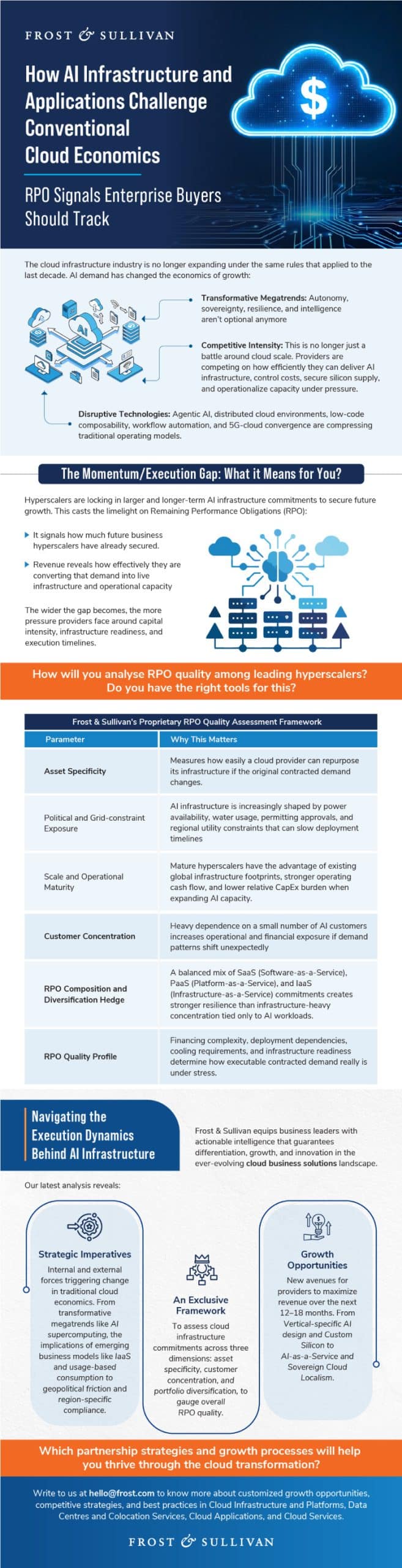
Consequently, the spotlight is on Remaining Performance Obligations (RPO), drawing attention to cloud execution capacity that hyperscalers have already promised their customers. Enterprises are locking in long-term AI and infrastructure deals, while providers are racing to secure enough graphical processing units (GPUs), multi-gigawatt data centers, power availability, networking capacity, and funding to keep those commitments on track. Large backlog numbers can create the impression of high future growth, but execution is significantly harder underneath the surface. The question then is — How will you identify the biggest growth opportunities emerging from this transformation?
Evolution of Cloud Infrastructure – Are You Growth Ready?
Today, tracking asset specificity, customer concentration, and portfolio diversification is important because:
- Megatrends That Alter Cloud Economics: AI supercomputing, multi-gigawatt data centers, and specialized AI factories are changing how cloud capacity is financed, built, and monetized. Enterprise buyers are paying closer attention to RPO quality, demand composition, concentration, and capital intensity before forging new partnership strategies.
- Competition is High: For providers and customers alike, general-purpose compute alone no longer guarantees long-term advantage or stability. Consequently, the competitive landscape is fast evolving, as neoclouds introduce GPU-dense business models, price wars intensify, and hyperscalers turn to divergent strategies in silicon, capacity planning, and AI workload monetization.
- Business Model Change: RPO has been a successful metric for Software-as-a-Service (SaaS) environments, but Infrastructure-as-a-Service (IaaS) introduces far greater variability because of usage-based consumption and large up-front capital requirements. This is necessitating change in how providers plan profitability and how enterprises evaluate long-term cloud spends.
- Custom Silicon: The need to reduce dependence on third-party GPU supply, build margin resilience, and improve performance-per-watt efficiency is pushing providers to go deeper into custom silicon design, semiconductor innovation, manufacturing partnerships, and hardware-software co-optimization. Future competition will therefore come down to who has more control over AI-specific silicon supply.
- Sovereign Cloud: National sovereignty requirements and data localization laws are influencing where cloud workloads can operate and how infrastructure is be governed. This is changing the dynamics of cloud strategy, as enterprise customers prioritize localized infrastructure, region-specific compliance, and jurisdiction-ready cloud capacity.
Do you have the analytical tools to compare RPO quality and make the right partnership decisions for your AI goals?
Understanding RPO: What it Means for You
Best Practices: What Can Providers Do Differently?
- Differentiate With AI: Growth can’t be won through scale alone. Providers building workload-optimized AI services and solutions that combine compute, custom silicon, high-performance networking, and automated compliance will be better positioned to combat direct price competition with hyperscalers.
- AI-native Networking: AI infrastructure puts enormous pressure on traditional networking because training and real-time inference require deterministic latency, ultra-fast data movement, and scalable backbone capacity. Providers shifting toward AI-native networking models with high-performance fabrics and tightly integrated connectivity layers will be better equipped to deliver resilience.
- Addressing Energy and Grid Limitations: Electricity availability, workload power density, advanced cooling technologies, and long-term grid capacity planning are becoming increasingly important in data centers. Power is no longer just an operational consideration, but a structural scaling constraint. Providers that invest in smart power management will win long-term advantages.
- Hybrid and Multi-cloud Flexibility: Enterprises are normalizing distributed deployment strategies as AI workloads move across public cloud, private cloud, sovereign cloud, edge environments, and on-premise infrastructure. Providers enabling workload portability, Application Programming Interface (API) compatibility, cross-cloud networking integration, and unified management across hybrid and multi-cloud ecosystems will be better positioned to reduce architectural friction.
Which growth processes will help your teams implement these best practices?
Growth Opportunities to Capitalize on Evolving Cloud Economics
Hyperscalers are looking beyond raw capacity expansion and focusing on growth areas that help improve margins, reduce execution pressure, and create more stability:
- Vertical AI Capacity Arbitrage: GPU-ready infrastructure is one of the hardest resources to secure. Providers that reserve portions of AI capacity for enterprise-specific deployments, private model training, and sovereign AI environments will be in a stronger position to capture premium demand.
- Proprietary Silicon and Margin Recovery: Relying heavily on third-party GPUs is becoming expensive as AI infrastructure costs rise. Providers investing deeper into custom silicon, AI accelerators, and hardware-software optimization automatically put themselves in a better position to improve performance efficiency, reduce supply pressure, and protect long-term margins.
- AI-as-a-Service (AIaaS): The real opportunity is gradually shifting away from selling raw compute capacity alone. Providers embedding AI models into enterprise workflows, automation platforms, and API-driven services can create higher-value revenue streams that are less dependent on infrastructure-heavy consumption models.
- Edge AI and Sovereign Cloud Localism: More enterprises and governments want AI infrastructure closer to where data is created and governed. This is creating fresh demand for localized AI regions, low-latency edge environments, and sovereign cloud deployments designed around regional compliance and data residency requirements.
Our Cloud Opportunity Universe
Frost & Sullivan has latest growth analytics and tech strategies across the full Cloud ecosystem. To know more about Cloud Infrastructure, Applications, Services, and Data Centers, visit:
Click Here to Assess Your Organization’s Infrastructure Readiness.
Ready to Lead the Transformation?
- Book a Growth Dialog:Align your 2026 Cloud strategy with Frost & Sullivan’s Growth Pipeline™ Dialog.
- Engage with Growth Experts:Co-design AI-enabled, data-driven cloud solutions that scale commercial impact across industries.
- Share Your Transformation Story: Position your organization as a transformation leader in cloud infrastructure, applications, and services through Frost & Sullivan’s Transformational Growth Leadership program.
- Join the Growth Council:Collaborate with global cloud leaders and hyperscalers shaping future ICT ecosystems.
- Nominate for Best Practices Recognition:Be recognized for excellence in growth, technology, innovation, and customer value leadership across the ICT landscape.
- See Industry Positioning on the Frost Radar™:Benchmark your growth performance and innovation strength against other growth champions, visionary leaders, contenders, and innovators.
- Activate Brand & Demand Growth:Accelerate awareness, engagement, and revenue growth through integrated brand and demand generation strategies.