This blog is based on Frost & Sullivan’s analyses, Data Center Colocation: Decision-Makers’ Insights and Strategic Priorities, 2026–2027 and Top 10 Growth Opportunities in Data Center Services, 2026, authored by Carina Goncalves from the IoT & Edge Solutions team.
Executive Summary
Data center services are becoming more closely tied to enterprise growth as AI adoption, cloud expansion, and rising compute requirements increase demand for scalable digital infrastructure. This momentum is raising the strategic importance of capacity availability, infrastructure readiness, and the ability to support increasingly demanding workloads.
For data center companies, growth is increasingly depending on how effectively infrastructure investment is translating into higher-value revenue opportunities. As enterprise requirements evolve, data center decisions are increasingly shaping expansion and long-term competitiveness.
What Are Data Centers, and Why Is Their Role Changing?
Data centers are facilities housing the computing, storage, networking, power, and cooling systems supporting business applications and digital services.
Their role is expanding as cloud environments, AI workloads, and distributed applications place greater requirements on capacity, performance, and reliability. Data center services are also broadening through colocation, managed services, connectivity, and interconnection.
According to Frost & Sullivan, this evolution is increasing the role of data centers in supporting changing workload requirements while delivering the capacity and operational continuity enterprises are requiring.
Is Your Data Center Strategy Ready for Rising Capacity Demand?
Access our whitepaper to uncover the growth opportunities shaping data center services.
Data Center Growth by the Numbers
- 63% have progressed beyond AI proof of concept into implementation. Growing AI deployment is increasing requirements for compute, storage, power, cooling, and connectivity.
- 44% are requiring sub-5 millisecond performance for ultra-low-latency applications. Distributed infrastructure is becoming more relevant for real-time and latency-sensitive workloads.
- Hybrid cloud is the leading AI deployment model at 36%. On the other hand, workloads spanning cloud, on-premises, colocation, and edge environments are strengthening the role of interconnected infrastructure.
Data Center Colocation Growth Across Regions, and Industry Sectors
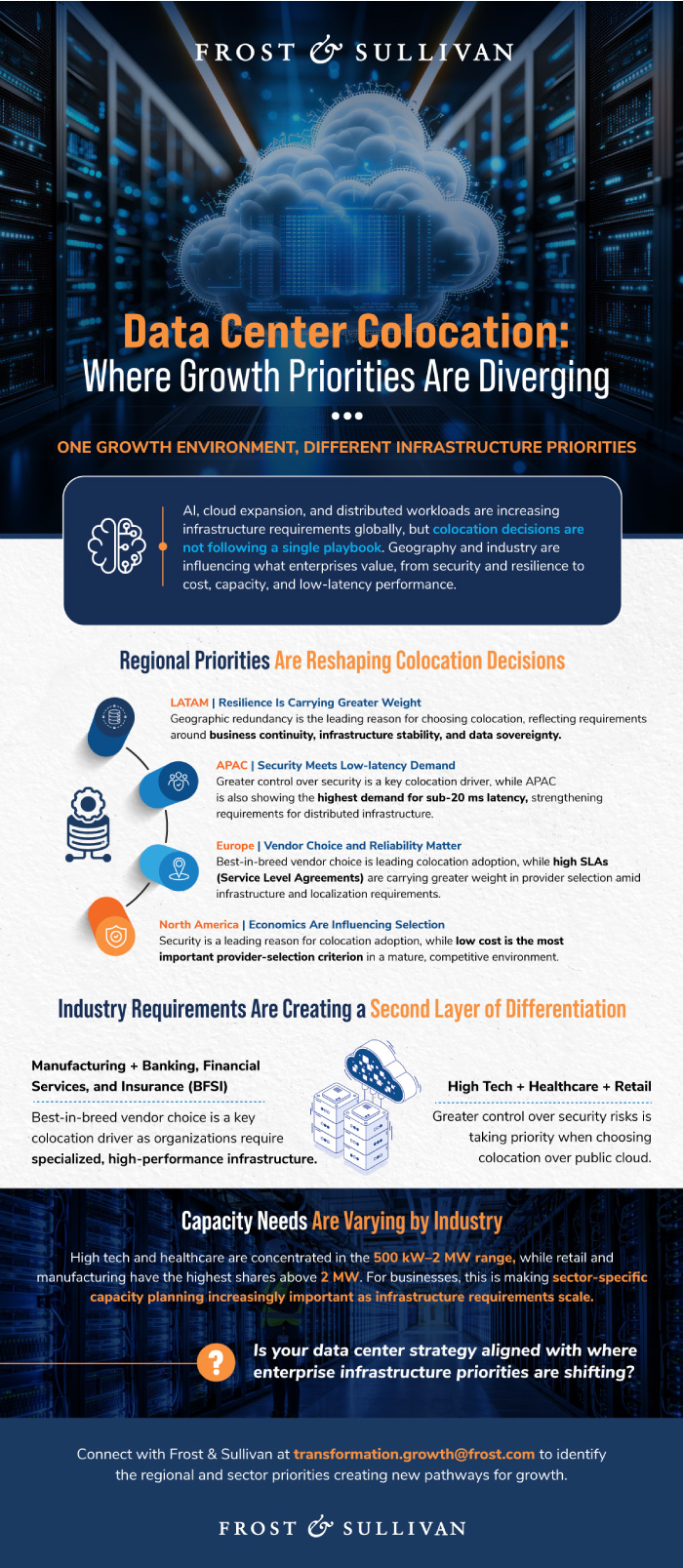
Listen to the Growth Podcast to explore the forces and opportunities reshaping data center services.
Top 3 Strategic Imperatives Reshaping Data Center Services
- Disruptive Technologies: AI Is Changing the Economics of Capacity
AI is changing how capacity is being planned and where infrastructure investment is being directed. Advanced AI training clusters are increasingly requiring 60 kW to 120 kW per rack or more, placing greater pressure on power distribution and cooling.
For data center companies, this means:
- Existing capacity is being evaluated against higher data center power density requirements.
- Direct-to-chip, liquid, and hybrid cooling are becoming more closely tied to AI readiness.
- Power and density capabilities are carrying greater weight in expansion and investment decisions.
Business implication: Companies unable to align capacity with changing AI workload requirements risk having infrastructure that is less suited to where enterprise and hyperscale demand is moving.
- Transformative Megatrends: Resource Constraints Are Reshaping Expansion
Data center expansion is becoming increasingly dependent on power availability, grid access, and energy resources. Power-rich locations, proximity to generation, battery storage, and on-site renewable energy are becoming more closely connected with site viability.
For growth strategies, this means:
- Site selection is increasingly reflecting available power alongside location.
- Grid constraints are influencing capacity timelines and expansion economics.
- Renewable sourcing and energy-efficient facility design are gaining importance as power requirements rise.
Business implication: Limited access to reliable power is increasing the risk of slower capacity expansion, higher operating costs, and fewer viable locations for growth.
- Innovative Business Models: Customer Value Is Extending Beyond Capacity
Data center colocation is expanding beyond physical hosting. Managed hosting, equipment provisioning, security and network operations, database administration, and infrastructure optimization are widening the service opportunity.
For data center companies, this means:
- Managed services are extending customer relationships beyond space and power.
- AI-optimized networking, graphics processing unit (GPU) installation, and predictive maintenance are creating specialized service opportunities.
- Broader service portfolios are opening additional sources of higher-value recurring revenue.
Business implication: Companies remaining centered on basic hosting risk competing more heavily on capacity and price as customers increasingly look for specialized capabilities.
Top 5 Growth Opportunities in Data Center Services
- AI Inferencing at Scale
As AI moves further into production, inferencing is increasing demand for infrastructure aligned with different performance and cost requirements.
- Lightweight workloads can remain distributed, while advanced multimodal applications are requiring greater GPU density and tighter latency control.
- AI-optimized regional hubs are supporting more performance-intensive workloads.
- Tiered environments are creating opportunities to align infrastructure with application-specific performance and cost requirements.
- Regional AI Edge Zones
AI inferencing, data sovereignty, and latency-sensitive applications are bringing compute closer to users and data sources.
- Regional and metro-edge locations are supporting faster processing and reduced reliance on centralized infrastructure.
- Modular edge facilities are enabling more flexible deployment across distributed environments.
- Stronger fiber connectivity and integrated edge-to-cloud environments are helping balance scale, cost, latency, and localization requirements.
- Hybrid Design Models for Flexible Expansion
Data center infrastructure is shifting toward flexible architectures combining standardized modular components with customer-specific configurations.
- Prefabricated power, cooling, and IT modules are supporting faster, phased expansion with lower upfront capital requirements.
- Modular designs are allowing capacity to scale as requirements evolve.
- Data center companies are gaining greater flexibility to support hyperscale, enterprise, and AI workloads across different regions.
- Interconnection and Connectivity as a Strategic Differentiator
As cloud and AI workloads become more distributed, enterprises are requiring faster and more resilient connections across compute, storage, networks, and cloud environments.
- Carrier-neutral ecosystems and expanded fiber infrastructure are strengthening application performance and network resilience.
- Access to submarine cable systems is supporting high-bandwidth, low-latency international data flows.
- Greater interconnection density is becoming a source of customer value, ecosystem growth, and competitive differentiation.
- AI and Automation for Operational Differentiation
AI is creating growth opportunities inside data centers as well as driving demand for capacity.
- Predictive maintenance and automated capacity planning are improving resilience and infrastructure utilization.
- Real-time environmental monitoring and workload optimization are helping reduce energy consumption and operating costs.
- AI-enabled operations are creating opportunities for differentiated services around reliability, latency, and carbon-aware workload placement.
How are you positioning your data center strategy as AI, infrastructure requirements, and growth opportunities continue to evolve?
Companies to Action: Where Growth Is Taking Shape
| Growth Area | Companies to Action |
| AI Inferencing at Scale Scaling AI-ready infrastructure for diverse workload requirements |
Equinix, HPE, Oracle |
| Regional AI Edge Zones Bringing compute closer to latency-sensitive and localized workloads |
EdgeConneX, Digital Realty, ST Telemedia GDC |
| Hybrid Design Models Enabling faster, flexible, and phased infrastructure expansion |
Aligned, Scala, AirTrunk |
| Interconnection and Connectivity Strengthening performance through connected digital ecosystems |
QTS, STT GDC, Telehouse |
| AI and Automation Improving efficiency, resilience, and infrastructure performance |
Digital Realty, NTT DATA, Siemens |
The Way Forward: Competing Beyond Capacity
The next phase of growth in data center services is increasingly being shaped by how companies are balancing scale, speed, capital efficiency, and differentiation. As infrastructure requirements become more complex, competitive positioning is extending beyond capacity toward the ability to adapt to changing workloads, strengthen interconnection ecosystems, expand higher-value services, and improve operations through AI and automation. For business leaders, this is making where to invest, how to scale, and where to differentiate increasingly important in determining which data center companies are best positioned to capture long-term growth.
How Will Emerging Technologies Redefine Data Center Operations by 2030?
Ready to Lead the Transformation?
- Schedule a Growth Strategy Dialog: Align your growth roadmap with Frost & Sullivan’s Visionary Growth Pipeline™ Dialog.
- Engage with Growth Experts: Co-design AI-enabled, data-driven operating models that scale industry-specific and commercial impact.
- Showcase Your Transformational Leadership: Position your organization as a transformation leader through Frost & Sullivan’s Transformational Growth Leadership platform.
- Join the Growth Council: Collaborate with industry leaders shaping the future of your ecosystem.
- Explore Best Practices Recognition: Be recognized for excellence in growth strategy, execution, and customer impact.
- Benchmark Your Industry Positioning on the Frost Radar™: Benchmark your growth performance and innovation strength against industry competitors.
- Tell Your Story: Accelerate awareness, engagement, and revenue growth through integrated brand and demand generation strategies.
Frequently Asked Questions on Data Center Services
What determines data center power requirements?
Data center power requirements depend on workload intensity, computing capacity, rack density, cooling systems, and supporting infrastructure. As AI workloads expand, power planning is increasingly accounting for higher-density computing alongside the electricity required to maintain reliable and resilient operations.
What components make up modern data center infrastructure?
Data center infrastructure combines computing, storage, networking, power distribution, cooling, connectivity, and supporting operational systems. Increasingly, infrastructure is being designed for greater flexibility, allowing data center companies to accommodate AI, cloud, enterprise, and distributed workloads as requirements evolve.
Why does data center power density matter?
Data center power density indicates how much computing power is being concentrated within a rack or physical space. Higher density can increase computing capacity, but it is also placing greater requirements on power distribution, cooling capabilities, and overall facility design.
How is data center cooling evolving for higher-density infrastructure?
Data center cooling is evolving beyond conventional air-based systems as computing density increases. Direct-to-chip, liquid, and hybrid cooling approaches are becoming more relevant for removing heat from high-density environments and supporting increasingly demanding AI and high-performance computing infrastructure.
What is driving higher data center energy consumption?
Data center energy consumption is increasing as AI, cloud services, and compute-intensive workloads require greater processing capacity. Higher-density infrastructure is also increasing electricity requirements across computing and cooling, making energy availability and efficient facility design increasingly important considerations for data center expansion.