Megan C., Founder and CEO, Longevity Clinic Malaysia (by Medkos), in conversation with Rathanesh Ramasundram, Regional Practice Area Leader, Healthcare & Life Sciences, Asia-Pacific, Frost & Sullivan
Download this Transformational Growth Leadership Discussion with Megan C.
Healthcare has traditionally focused on diagnosing and treating disease once symptoms emerge. Yet, as people become more aware of the importance of prevention, physical performance and healthy ageing, a different approach to healthcare is beginning to take shape. Longevity medicine is bringing together advanced diagnostics, clinical expertise, personalized interventions and continuous monitoring to help individuals understand their health earlier and maintain their capabilities for longer.
For Megan C., Founder and CEO of Longevity Clinic Malaysia (by Medkos), this shift is rooted in a personal experience that changed how she viewed healthcare. Her journey from aesthetics and wellness into longevity medicine led her to recognize a gap between conventional disease management and proactive health optimization. She set out to build an integrated, physician-guided model that connects biological assessment, personalized care, measurable outcomes and long-term follow-up. The ambition is not to replace hospitals or conventional medicine, but to complement them by helping people take action earlier.
In this Transformational Growth Leadership discussion, Megan speaks with Rathanesh Ramasundram, Regional Practice Area Leader, Healthcare & Life Sciences, Asia-Pacific, Frost & Sullivan, about the personal experiences behind her decision to establish Longevity Clinic Malaysia, the changing definition of healthspan, and the role of clinical evidence in building trust in longevity medicine. She also discusses the clinic’s Longevity Blueprint, its approach to personalization and measurable outcomes, the partnerships needed to expand access, and why responsible growth and standardization will be essential to the sector’s future.
“We need to move from treating symptoms to understanding the body, identifying risks earlier, and intervening before disease develops. Longevity is about helping people preserve their physical, cognitive, and emotional health so they can LIVE LONGER, LIVE BETTER.”
—Megan C., Founder and CEO, Longevity Clinic Malaysia (by Medkos)
The Personal Conviction Behind Longevity Medicine
Rathanesh: Your journey into longevity medicine seems to have been shaped by both personal experience and a broader view of healthcare. What convinced you that this was the right time to build Longevity Clinic, and what change did you want to lead in the way people approach their health?
Megan: My journey into longevity medicine began with my father’s health. After he suffered a major heart attack in 2012 and underwent cardiac procedures, including stent placement, his immediate symptoms were managed, but I felt that he was no longer the person he had been. Despite the procedures and medication, he continued to lose strength and body mass and was increasingly unable to do the things he had previously enjoyed. At one point, he began preparing the family for the possibility of his death. It was difficult because we were doing everything we thought we were supposed to do, yet we could see his overall condition declining.
We kept returning to hospitals for tests and follow-ups, often being asked to come back after three or six months. Approximately a year after his first stent procedure, another procedure was recommended, but my father had become reluctant to return to the hospital. We were left wondering where else we could seek help. Moving from one specialist to another did not give us a connected understanding of his condition or a clear plan for supporting his broader health. Functional medicine offered a different approach because practitioners spent more time understanding the person, exploring possible root causes and combining supplementation and lifestyle recommendations with existing medical treatment. Seeing my father improve through that approach changed the direction of my professional journey. I moved further into wellness, but I eventually realized that there was a more fundamental question to address: could we understand a person’s health risks and intervene before a major event occurred?
From Question to Blueprint
That experience made me think about how healthcare could move further upstream: from treating symptoms, to understanding underlying causes, and then to identifying biological changes before disease becomes established. I began exploring how we could decode biology, understand ageing and provide interventions that are clinically guided and measurable.
I spent roughly one to two years studying the field and developing the blueprint for the clinic before beginning operations. I approached it by writing down questions, identifying what was missing and connecting the different components until I felt we had a comprehensive system. I wanted to build something that I would confidently use for my own parents. There was considerable uncertainty. Public understanding of longevity in Malaysia was limited, the investment required was high and the proposition was not yet established. But I believed there was a gap between conventional treatment and proactive prevention that needed to be addressed.
A New Kind of Demand
What I wanted to build was not another wellness service organized around a specific treatment or a fixed number of sessions. Wellness is often transactional, and many people approach it when they are already managing a chronic condition. Longevity is different. We began seeing younger, healthier and more active individuals who were not necessarily trying to solve an immediate health problem. They wanted to optimize their physical performance and maintain their health over time. Many of our earlier wellness clients were commonly 50 to 80 years old and often living with chronic conditions. Our longevity clients are mainly 28 to 48, and more than half are healthy and active. They want to move from healthy to healthier. That demand emerged sooner than I had expected.
“Hospitals will always be essential for disease. What was missing in Malaysia was the layer that starts years earlier, decoding a person’s biology and acting before decline sets in.”
– Megan C., Founder and CEO, Longevity Clinic Malaysia
My wider ambition is to help make preventive health management a normal part of life, so people begin taking care of their health earlier rather than waiting until something goes wrong. In some ways, the journey of educating the market reminds me of how health insurance developed. People learned to invest in protection before an adverse event. I would like preventive health and ageing management to become just as normal, starting from a young age.
Moving Healthcare from Lifespan to Healthspan
Rathanesh: We are living longer, but that does not necessarily mean we are living healthier lives. Why do you believe extending healthspan needs to become the next major shift in healthcare, and what would that mean for individuals and the wider health system?
Megan: Living longer is not enough if a significant part of those additional years is spent with poor health or reduced function. For me, healthspan is about maintaining the capabilities that make life meaningful. I look at it through three connected dimensions: physical performance, cognitive capacity and emotional life. Physical performance determines whether we can move freely and carry out the activities we want to do. Cognitive capacity is equally important because being physically healthy does not mean much if we cannot think clearly, process information or make decisions. And emotional health matters because we need to feel contented and have a positive relationship with life. These dimensions should not be treated as separate conversations.
The healthcare mindset needs to move from reacting to illness towards understanding and managing health continuously. This does not mean conventional healthcare is unimportant. Hospitals and specialists remain essential for diagnosing and treating disease, and we need them. The gap is that many people still believe they only need healthcare when something goes wrong. But biological decline and chronic disease develop over time. There is an opportunity to understand what is happening earlier, identify emerging risks and act before the situation becomes more difficult to manage.
That shift also involves how people think about everyday choices. Nutrition, physical activity, and sleep are not simply lifestyle preferences; they influence long-term health and capability. People should become more comfortable understanding their own health data, tracking changes and taking an active role in decisions about their wellbeing. The earlier they start, the more opportunity there may be to address issues before they accumulate.
An Upstream Layer, Not a Replacement
For the wider healthcare system, longevity medicine can provide an upstream layer that complements established services. It can help individuals understand their health, monitor changes and take appropriate action, while referring them to hospitals or specialists when clinical findings require it. I also believe we need to look at the entire person rather than isolate individual services. Nutrition, mental health, physical function and disease risk are connected. The integrated system that brings these elements together is what matters.
When we were developing the proposition, business advisors told us it was too complicated and encouraged us to tie the brand to a simpler product. I disagreed. Reducing what we do to a particular injection, a biological-age test or a machine-based treatment would miss what actually creates the value. No single clinic can be the best at every discipline, which is why collaboration with external experts and technology providers is so important. We do not need to own every component or generate revenue from every part of the science. Our responsibility is to connect the right capabilities around the outcome entrusted to us by the client.
Defining Longevity Medicine Within the Healthcare Continuum
Rathanesh: Longevity is often discussed alongside wellness, anti-ageing, aesthetics and biohacking. How do you define longevity medicine, and where do you believe it should sit within the broader healthcare continuum?
Megan: I define longevity medicine as optimizing human potential and extending healthy lifespan. It should not be seen as a replacement for primary care, specialist services or hospitals. It needs to work alongside them, connecting preventive health management with the wider healthcare system. When diagnostics identify something that requires specialist attention, the client should be referred appropriately. The clinic can continue supporting the broader health-management journey, including coordination and recovery, rather than treating the referral as the end of the relationship.
One important distinction is that longevity does not have a fixed finish line. A conventional treatment may end once a condition has been addressed, and a wellness package may end when the purchased sessions are completed. Longevity is an ongoing cycle of assessment, intervention, retesting, adjustment and monitoring. We are continually collecting information, reviewing milestones and identifying what needs to change. That is why I do not see longevity as simply another wellness package or a collection of consumer optimization services.
We also see clients arriving with a considerable amount of information. They may have wearable data, previous test results, online research or even spreadsheets in which they have organized their health information. Some already have strong views about supplements or protocols they have read about. Their challenge is often not a lack of information, but understanding what is relevant, how different data points connect and what they should prioritize. Our approach is to listen to their goals, review the available information and agree on a medically responsible plan. If something they request cannot be supported, our clinicians explain why and discuss safer or more appropriate alternatives. The client remains involved in the decision-making process, but clinical judgment and safety provide the necessary boundaries.
Longevity is also frequently confused with aesthetics, anti-ageing, spa services and biohacking. Aesthetics may have a role in someone’s overall wellbeing, but it is only a small part of what we are trying to address. Our model looks at the complexity of the whole human body, including its organs, biological systems and functional capabilities. That breadth makes the proposition more difficult to communicate, particularly when people expect a single product or treatment. However, reducing longevity to one test, injection or machine would miss the point. The integrated system is the product.
“The best time to begin longevity medicine is before anything is broken — the fewer years of accumulated damage we carry, the more room there is to optimize.”
–Megan C., Founder and CEO, Longevity Clinic Malaysia
Building Trust Through Evidence, Standards, and Clinical Responsibility
Rathanesh: Longevity medicine is attracting growing attention, but it is also a relatively young and fragmented field. What will it take for the sector to earn wider trust and become a credible part of preventive healthcare?
Megan: Credibility has to begin with measurable outcomes and responsible communication. We cannot assume that an intervention will work simply because it has worked for another person. Every individual is different, and we need to understand how that person’s body responds. That is why checkpoints and retesting are important. If we recommend an intervention, we need to assess what changes after a defined period. If the expected improvement does not happen, that is still useful information. It tells us that we need to stop, reassess or try a different approach rather than continue something without evidence.
We have seen this through clients who arrive with their own supplementation or other approaches while we focus on a particular area, such as the microbiome. We do not necessarily ask them to abandon everything they are doing. Instead, we agree on what we will manage, establish a checkpoint and compare the results. In one example, the microbiome measure improved substantially while other markers deteriorated. The value was not simply the improvement in one score. It was that we could distinguish what appeared to be working from what needed further attention. We apply the same discipline to supplementation. We may request a marker test after a defined period, including around a hundred days in one such example, because supplements should not automatically be assumed to be safe or effective for everyone.
Trust also depends on respecting the client’s time and knowledge. Many of our clients are professionals or business owners who have limited time. We need to make consultations focused and help them understand what matters rather than add unnecessary processes. The objective is not to promise a particular result. It is to provide a disciplined process in which the physician and client can understand the evidence, make decisions together and adjust the approach when the results do not support continuing it.
Earning Trust in a Young Sector
The wider sector has another challenge: there is no single common standard. At international healthy-longevity events, I have seen the number of clinics growing rapidly, but different providers use the longevity label for very different practices. Some are moving in directions that may not be sufficiently ethical or clinically grounded. If the field does not establish appropriate standards and safeguards while it is still emerging, public confidence could be damaged before the category has a chance to mature.
For our clinic, this means having detailed testing and treatment protocols, maintaining physician oversight and exploring international accreditation so that our processes can be independently audited and certified. Technology also needs to be used responsibly. We are developing AI capabilities to organize data and identify patterns, but AI should not prescribe or replace clinical judgment. A software prediction must be reviewed in context. For example, medication can change the meaning of a measurement such as blood pressure, so a raw prediction cannot simply be presented or acted upon without a physician verifying it. We need collaboration across laboratories, technology providers, specialists, professional bodies and policymakers to establish a more credible ecosystem. Insurance could also play an important role in improving access, although progress in Malaysia remains slow and coverage is still largely focused on disease treatment.
The Longevity Blueprint: Connecting Data, Personalization, and Action
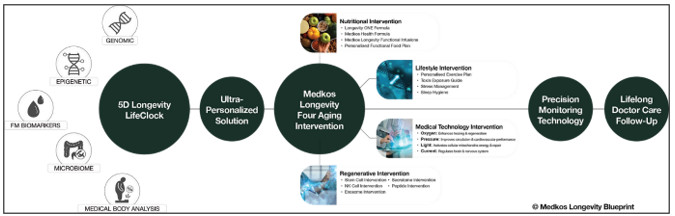
Rathanesh: You have described the integrated system as the real product rather than any single test or treatment. Can you take us through the Longevity Blueprint and explain how it brings the different parts of the client journey together?
Megan: The Longevity Blueprint starts with the understanding that biology is multidimensional. No single test, whether DNA, epigenetics or another measure, can provide a complete picture of a person’s health. Each source of information tells us something different. We therefore bring together relevant data such as DNA, epigenetics, functional biomarkers, microbiome results, body composition and other assessments. The purpose is to understand the different signals together rather than draw conclusions from one isolated result.
The next step is physician-led interpretation. The data may indicate areas of concern, but a prediction is not a diagnosis. Our doctors, including physicians trained in functional medicine, review the findings, consider the individual’s circumstances and medication, and decide which areas need attention. Personalization is not simply selecting a package based on a test result. It is the process of translating biological information and the client’s goals into a clinically appropriate set of priorities.
From Insight to Intervention
From there, we move into interventions. Nutrition is one of the foundations, alongside lifestyle adjustments, appropriate advanced medical technologies and innovative regenerative interventions. The philosophy is to understand what the body needs and provide the right support rather than introduce interventions for their own sake. We also use app-based assignments to turn recommendations into actions that can be monitored. For example, if blood pressure readings are slightly abnormal, a doctor may ask the client to track them in the morning and evening for two weeks. If muscle mass changes, exercise may need to be reviewed. If a supplement is being used, adherence and the relevant markers may be checked to understand whether it is having the intended effect.
We developed our app because clients often stop following up on tests when reports are scattered, misplaced or difficult to understand. The app brings their information together so they can revisit it, while the administrative portal allows doctors to review the same history during consultations. The client view can include information such as biological age, organ areas that need attention, body-composition changes and vital signs. It also helps doctors explain how different findings may be connected rather than treating every abnormal value as an isolated issue.
A Continuous Loop, Not a One-off Journey
The process then returns to monitoring and reassessment. We decode the available information, personalize the plan, intervene, monitor, retest and optimize. The data are organized over time so that both the client and the doctor can understand what is changing and whether the approach needs to be adjusted. AI can support data organization and risk flagging, but the physician remains responsible for verifying the findings and making clinical decisions.
The Blueprint is designed to continue beyond the physical clinic through the app and ongoing communication. That continuity is important because longevity is not a one-time transaction. It is a long-term health-management relationship. That continuity also shapes how clients find us. Advertising can create awareness, but it cannot by itself explain a category that many consumers do not yet understand, so consistent positioning and word of mouth matter more. If I were to summarize what makes the Blueprint distinctive, it comes down to four things: personalization, optimization, measurable outcomes, and precision.
Measuring Progress and Keeping Clients Engaged
Rathanesh: A lifelong health-management model depends on people staying engaged over time. How do you define meaningful outcomes, and how do you keep clients involved when progress may vary from one individual to another?
Megan: Meaningful outcomes need to be connected to the individual and the goals they are trying to achieve. Data are important because they empower physicians to make more informed decisions and help clients understand how their bodies are changing. When people can see the results of an intervention, they have a clearer reason to continue. But we should not define success only as an improvement in a particular marker. Stabilization, a better understanding of risk or evidence that an intervention is not working can also be valuable outcomes because they help determine the next decision.
Without measurement, people may continue taking something simply because it worked for a friend or because they read about it online. They may eventually lose motivation when they do not see the same results. Defined checkpoints help prevent this. We can review the relevant data, explain what has changed and decide whether the intervention should continue. If it is not working, we need to be comfortable telling the client that and moving to another approach. We should not defend an intervention simply because it was recommended earlier.
Engagement also comes from co-management. We listen to what clients want to achieve and work with them rather than issuing instructions in one direction. Clients should remain involved in their health decisions and understand the actions they are taking. The app supports this by making information accessible and allowing doctors to assign practical tasks between consultations. Follow-up and communication become part of the care model rather than something separate from it.
Honesty Strengthens Trust
Ultimately, every individual responds differently. We cannot promise that an approach will produce the same result for everyone, and we should be honest about that. When clients see that we are willing to measure, reassess and change direction instead of continuing an ineffective intervention, it strengthens trust. The relationship also grows through feedback. Our clients follow the clinic’s development, share suggestions and bring family members and friends. Some travel from other countries or from places such as Sabah to continue their journey with us. That level of engagement reflects the importance of building a relationship that extends beyond a single appointment or service.
“An unchanged marker is not a failure — it is a direction. It tells us where not to spend the client’s time and money.”
–– Megan C., Founder and CEO, Longevity Clinic Malaysia
Partnerships and Business Models for Expanding Access
Rathanesh: As longevity medicine develops, no single provider can deliver every part of the care journey independently. Which partnerships and business models do you believe will be most important in expanding access while preserving personalization and clinical quality?
Megan: An ecosystem approach is essential because no one organization can be the best at every component. We need to work with hospitals, specialists, laboratories, technology providers, and other experts who bring capabilities that complement our own. Hospitals and specialists remain important when a client’s diagnostic findings require further investigation or treatment. Laboratories and technology providers contribute specialized services and tools that would not necessarily make sense for one clinic to own. Our role is to connect these capabilities around the client’s health journey and make sure that the different parts work together.
Employers are also an important channel for expanding access. Companies are interested in preserving the physical and cognitive performance of their workforce because it has a direct connection to their people and business outcomes. That creates a practical starting point for conversations about preventive health. In Malaysia, corporate wellness and health screening can help introduce organizations and employees to the idea of taking action earlier.
Insurance could become one of the most important routes to making preventive care more accessible over the longer term. However, traditional insurance models are still largely focused on treating disease after it occurs. We are seeing some movement towards wellness activities, health screening and healthy-living programs, but broader support for longevity care will require more education and engagement with payers. We intend to continue those conversations as the sector develops.
I also do not believe that longevity providers should view one another only as competitors. The unmet need is significant, and the field is still being established. Different organizations can contribute different areas of expertise, and collaboration can help create something more meaningful than any one provider could build alone. We need to understand where conventional clinical care, wellness and longevity fit together without trying to make one category replace the others.
Scaling Without Compromising the Model
At the same time, growth cannot come at the expense of the model. The objective is not simply to open as many clinics as possible. We need to refine the protocols, learn from international experts and build a system that can be replicated while preserving personalization, physician oversight, service quality and the values behind the Blueprint. Scaling one profitable component in isolation might be commercially simpler, but it would weaken the integrated system we set out to build.
The Future of Longevity Medicine and the Clinic’s Role in Malaysia
Rathanesh: Looking ahead, how do you see longevity medicine reshaping preventive healthcare, and what role would you like Longevity Clinic Malaysia to play in the development of this field in Malaysia and the region?
Megan: I believe longevity medicine can help change how people think about ageing and preventive healthcare. We want to be an authoritative voice in Malaysia and contribute to a better understanding of what clinically guided longevity actually means. There is still confusion between longevity, general wellness, aesthetics and other services. We need to explain the differences and show how early diagnostics, personalized action and measurable outcomes can work together as part of a structured health-management approach.
We are also connecting with local and international technologies, scientists and specialists so that Malaysian clients can access expertise and approaches available in other leading markets. No single clinic can hold all the knowledge or capabilities needed to address every aspect of longevity. Partnerships allow us to bring different contributions together and make them accessible through a coordinated model. I see our role as more than building an individual clinic. We want to help cultivate understanding, connect stakeholders and demonstrate how a clinically guided approach can support the wider movement towards preventive healthcare.
Standards Before Scale
Standardization will be fundamental to that progress. Some businesses use longevity as a fashionable label or a commercial proposition, while the practices behind the label can be very different. If we do not establish shared clinical and ethical standards, regulation and appropriate safeguards, the sector risks losing public confidence. This is not just a concern for individual clinics. It could affect the credibility of longevity medicine as a whole.
For us, the immediate priority is to continue optimizing the system rather than pursuing aggressive physical expansion. We have potential investors and partners who are interested in the programs and the story behind the clinic, but we need to make sure the operating model, protocols and partnerships are ready. We also need to learn from international experts and keep improving what we do. Growth should be about expanding positive impact efficiently and safely, not simply increasing the number of outlets. If we simplify the model into disconnected components because they are easier to sell or scale, we risk compromising the very purpose of the clinic.
“I would rather build a category people can trust than a brand people can buy. That is why standards must come before scale.”
–– Megan C., Founder and CEO, Longevity Clinic Malaysia
A Legacy Beyond Business
On a personal level, I would like to see people begin managing their health at a younger age and reach later life without automatically fearing that ageing means decline. I would find fulfilment in knowing that we helped change that mindset and made longevity a credible, constructive part of healthcare in Malaysia. Being recognized as a first mover would be meaningful, but what matters more is the impact: helping people take charge of their health earlier and see ageing as an opportunity to thrive.
Closing Reflection
Longevity medicine is challenging the traditional boundaries of preventive healthcare by connecting early assessment, clinical interpretation, personalized intervention and continuous monitoring. Megan’s experience illustrates why this shift requires more than access to new diagnostics or individual treatments. It calls for an integrated system that helps people understand their health, make informed decisions and measure the effects of the actions they take over time.
For Longevity Clinic Malaysia, the next phase is about strengthening that system while contributing to a more credible and collaborative longevity ecosystem. Physician oversight, measurable outcomes, independent accreditation and shared clinical standards, alongside partnerships across healthcare and technology, will be essential to building trust and expanding access. As Megan emphasizes, the ambition is not simply to help people live longer, but to help them preserve the physical, cognitive, and emotional capabilities that make those years meaningful.

About Megan C.
Megan C. is the Founder and CEO of Longevity Clinic Malaysia (by Medkos), advancing preventive, precision and personalized medicine in Malaysia. With over a decade of entrepreneurial experience across aesthetics, wellness and longevity, she is passionate about shifting healthcare from reactive disease management to proactive health optimization.
Under her leadership, the clinic has gained national and international recognition, including recognition by the Institute for Functional Medicine (IFM), USA, and has served clients from more than 30 countries. She is focused on building an integrated longevity ecosystem connecting advanced diagnostics, medical expertise, technology and personalized interventions, with a mission to make longevity medicine more accessible, measurable and sustainable: LIVE LONGER, LIVE BETTER.
Longevity Clinic Malaysia, based in Petaling Jaya, is Malaysia’s first longevity clinic recognized by the Institute for Functional Medicine (IFM), USA. Fully registered with the Ministry of Health (MOH), with all services delivered by MOH-licensed physicians, the clinic has earned national and regional recognition for its pioneering model. It is listed in the Malaysia Book of Records (2025) as “The First Longevity Clinic Partnership with the Institute for Functional Medicine (IFM), USA”, inducted into the ASEAN Records (2025) as the “First MOH-Compliant Longevity Clinic Partnered with IFM, USA”, and named “Pioneer Longevity Clinic of the Year in Malaysia” at the GlobalHealth Asia-Pacific Aesthetics, Wellness & Longevity Awards 2026.

Rathanesh Ramasundram is the Regional Practice Area Leader for Healthcare & Life Sciences across Asia-Pacific at Frost & Sullivan. With over 20 years of experience in the healthcare industry, including 16 years in strategy consulting, she leads research and advisory initiatives focused on healthcare transformation, market growth, and emerging industry trends. Rathanesh works closely with healthcare providers, life sciences and medtech companies, and public sector stakeholders to identify growth opportunities, shape strategic direction, and advance innovation across the healthcare ecosystem.
About Rathanesh Ramasundram
Ready to Lead the Transformation?
- Schedule a Growth Strategy Dialog: Align your growth roadmap with Frost & Sullivan’s Visionary Growth Pipeline™ Dialog.
- Engage with Growth Experts: Co-design AI-enabled, data-driven operating models that scale industry-specific and commercial impact.
- Showcase Your Transformational Leadership: Position your organization as a transformation leader through Frost & Sullivan’s Transformational Growth Leadership platform.
- Join the Growth Council: Collaborate with industry leaders shaping the future of your ecosystem.
- Explore Best Practices Recognition: Be recognized for excellence in growth strategy, execution, and customer impact.
- Benchmark Your Industry Positioning on the Frost Radar™: Benchmark your growth performance and innovation strength against industry competitors.
- Tell Your Story: Accelerate awareness, engagement, and revenue growth through integrated brand and demand generation strategies.
Appendix: Advancing the Shift Toward Longevity and Preventive Healthcare
As healthcare moves beyond reactive disease management, greater emphasis is being placed on early risk identification, biological age assessment, personalized interventions and continuous health monitoring. These capabilities are creating new opportunities to extend healthspan and make preventive healthcare more measurable and accessible.
Frost & Sullivan examines these developments through its research on preventive and predictive healthcare, biological age tracking, longevity platforms and science-led healthy ageing solutions.
Recommended Frost & Sullivan research