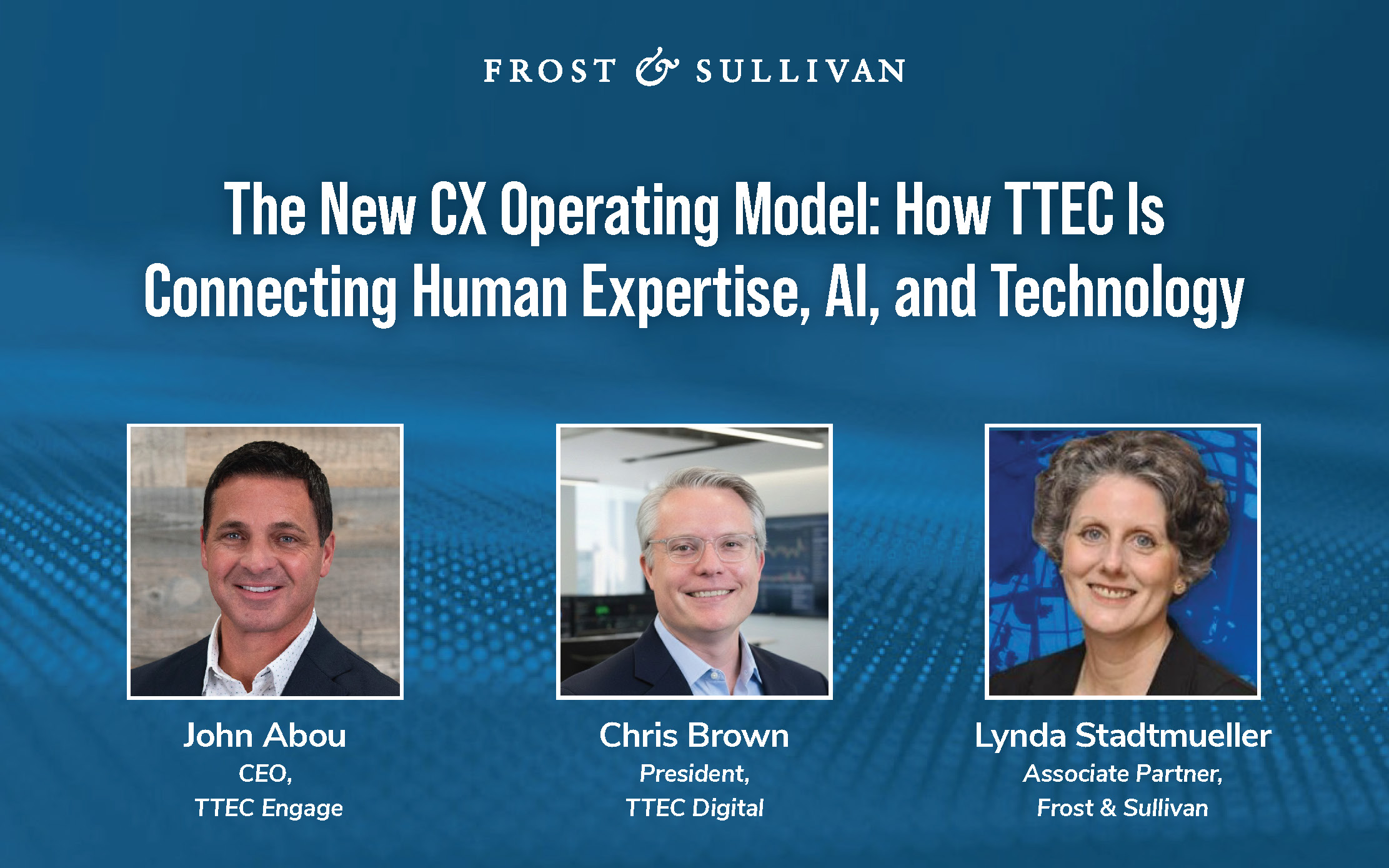
John Abou, CEO, TTEC Engage, and Chris Brown, President, TTEC Digital, in conversation with Lynda Stadtmueller, Associate Partner, Frost & Sullivan
Download this Transformational Growth Leadership Discussion with John Abou and Chris Brown
Customer experience (CX) is moving beyond traditional models built around people, seats, and capacity, and toward outcome-focused approaches that bring together human expertise, technology, data, artificial intelligence (AI), and workflows. For TTEC, this evolution comes to life through the complementary strengths of TTEC Engage and TTEC Digital, combining operational experience and execution at scale with AI, and digital capabilities to address client challenges and deliver measurable outcomes.
In this Transformational Growth Leadership (TGL) conversation, John Abou, CEO, TTEC Engage, and Chris Brown, President, TTEC Digital, speak with Lynda Stadtmueller, Associate Partner at Frost & Sullivan, about bringing operations and technology together, the shift from capacity to outcomes, the growing role of AI in CX, and why successful transformation depends on more than technology alone. They also explore innovation, customer-led development, ecosystem partnerships, and the leadership challenge of delivering for clients today while preparing for what comes next.
“AI can eliminate friction and augment people, but it is not a substitute for leadership or operating discipline. Organizations still need strong processes, accountable owners, and a clear experience strategy to determine where AI can make the greatest difference.”
— John Abou, CEO, TTEC Engage
Transforming CX Through Integrated Operations and Technology
Lynda Stadtmueller: John and Chris, you each represent a different but essential part of TTEC’s business. John, you are on the Engage side, which is really focused on operations, while Chris, you are on the Digital side, focused on technology. How does that dynamic work in practice, and how do the two sides come together when you’re working with a client?
John Abou: A great partnership starts with one client agenda. TTEC Engage brings the operational environment, frontline experience, strategy, and ability to execute at scale. TTEC Digital brings the platform, data, AI, and the emphasis on more transformational capabilities.
The real value is created when those capabilities come together as one integrated solution. For clients, it is important that we are jointly accountable for the outcome rather than operating as two separate organizations. Ultimately, it comes down to CX orchestration; combining AI and technology with the human element to produce measurable results.
Chris Brown: There is an operational element to TTEC Digital as well; it just happens to be centered around technology. A big part of our focus is on technology enablement, and that is where everything really comes together.
We work with a group of strategic technology partners that we bring into our CX solutions, combining both people and technology. On the digital side, that includes consultants, solution architects, data scientists, change management, technology implementation and operations.
How we bring those capabilities together depends on the client. Every client is different, so we customize the approach to fit their specific situation, needs, program, and level of complexity.
Lynda Stadtmueller: And from a leadership standpoint, how do your different perspectives complement each other when you are shaping those solutions?
John Abou: Chris and I usually come at an opportunity with the same desired outcome, but from different and complementary angles. Chris’s lens is more focused on technology, architecture, and data, while mine is more operational.
Bringing both sides together allows us to challenge each other and make sure the innovation is bold, while also ensuring the operating model is practical enough to deliver effectively. While we are a technology-focused business, we are also a people business at the end of the day, so having the hearts and minds of both our partners and employees is important.
Chris Brown: I tend to push conversations into more uncomfortable territory and challenge what might initially seem possible. John brings more of the operational and client lens, which helps ground those ideas in what can work in practice. That creates what I would call a healthy tension between pushing the boundaries and staying focused on what we can effectively deliver for the client.
Download this Transformational Growth Leadership Discussion with John Abou and Chris Brown
Creating Business Value Through Outcome-led CX
Lynda Stadtmueller: John, you have been in this industry for a long time. When you look at how the contact center industry has evolved, what feels fundamentally different today, both in terms of what clients are looking for and how vendors are responding?
John Abou: Clients are no longer buying just people or seats. They are buying outcomes. They are looking for lower effort, better resolution, stronger retention, improved revenue, and a more resilient operating model. The fundamentals still matter; service excellence and delivery remain critical, but the value has moved from a labor-only or capacity-based model toward intelligent orchestration.
The objective is to combine the right touch of the human element with technology into one solution that ultimately delivers the desired outcome for the client.
That evolution is also reflected in TTEC’s long-standing client relationships. Over time, those relationships have expanded into different types of work and new ways of thinking, including introducing technology where it makes sense while still maintaining the human element. Solid performance and a strong track record have helped build trust over time, creating the foundation for how those client relationships continue to evolve.
Navigating a New Cycle of CX Disruption
Lynda Stadtmueller: Chris, we have discussed how technology has continued to shape CX, and AI is now becoming an increasingly important part of that transformation. How has AI changed the industry, both for TTEC and for the clients you work with?
Chris Brown: Technology enablement and disruption have always been part of CX. We have seen different technology cycles over the years, from IVRs and the internet, to email and RPA. AI is another disruptive shift, although I would not necessarily put it in the same category as those earlier technologies.
What makes AI particularly relevant is how well suited it is to CX. For TTEC, that has brought the conversation around CX technology much more front and center, creating greater interest in AI, automation, and the transformation these technologies can enable.
At the same time, AI can look deceptively simple. There are still significant workflow and operational considerations, along with the governance, tools, and guardrails required to make AI work effectively at scale.
As people become more familiar with AI, I think the conversations will become easier and more grounded in what the technology can and cannot do. Right now, organizations are eager to move forward because AI has become an executive-level priority, but there are also more stakeholders involved in these decisions than ever before. That creates opportunity, but it also adds complexity to how those conversations are navigated.
Download this Transformational Growth Leadership Discussion with John Abou and Chris Brown
Positioning AI Within the CX Opportunity Universe
Lynda Stadtmueller: John, you mentioned earlier that the fundamental challenge has remained largely the same: how businesses communicate with and serve their customers. What challenges continue to drive the need for CX solutions today, and where is AI uniquely positioned to help address them?
John Abou: The industry is balancing several pressures at once. Customer expectations are rising, organizations are looking for better cost models, and the technology landscape is changing rapidly. At the same time, brands cannot compromise trust, security, compliance, or consistency.
AI can eliminate friction and augment people, but it is not a substitute for leadership or operating discipline. Organizations still need strong processes, accountable owners, and a clear experience strategy to determine where AI can make the greatest difference.
Lynda Stadtmueller: Chris, you mentioned earlier that CX is one of the key use cases for AI. We also talk about the idea that AI alone is not enough. Where do you see the greatest potential for AI-driven transformation within CX, and where does the broader workflow still matter?
Chris Brown: At the end of the day, it is about the workflow. That means successfully bringing together the legacy technology already in place, the AI technology being introduced, and the human element that remains critical to making the end-to-end experience work.
AI can provide capabilities such as call summarization, automated quality assurance, and proactive knowledge management, but it does not solve the change-management side. These tools change what it means to be a customer service associate, including how people are trained and supported. And AI is only one part of the technology environment. Connectivity, data platforms, outbound capabilities, and other infrastructure remain critical to CX. AI enhances those capabilities; it does not replace them.
John Abou: Where I see some organizations getting it wrong is when they start with the technology rather than the business problem. They launch pilots without clean data, redesigned processes, adoption plans, or a clear strategy. Bringing AI into an already broken journey can introduce even more complexity.
The real value comes from combining AI with human judgment, tying it to a clear business outcome, redesigning the workflow, thinking through adoption and the use case, and then applying the right technology. That is where we are seeing real value with our customers.
Building Organizational Agility for Continuous Innovation
Lynda Stadtmueller: Innovation has clearly been an important part of TTEC’s growth and its ability to remain a leader. How do you encourage your teams to think differently and develop new approaches to services, delivery, and technology that keep TTEC ahead of the competition?
John Abou: Innovation must be part of the operating rhythm. It cannot be a separate event. It starts with staying close to clients and listening to frontline teams to identify opportunities and friction points. From there, the objective is to turn those ideas into action, starting with a real problem, proving value, and learning quickly.
Leaders need to create room for this way of thinking while maintaining their organizational accountabilities and commitments to clients. Innovation cannot become something that sits outside the business; it needs to be integrated into how the organization operates.
Lynda Stadtmueller: Chris, many companies tend to associate innovation primarily with technology. Do you see it the same way, and how do you encourage innovation more broadly across the business?
Chris Brown: Technology is one element of innovation, but innovation also requires changing the dialogue around CX. Rather than starting with technology, TTEC believes in working backward from the outcomes and experiences the organization wants to deliver.
That can lead to a very different way of thinking about the role of the contact center employee. If the desired experience requires a person to act more like an advisor or consultant, then the technology should be designed to enable that role rather than simply automate an existing process.
We also believe TTEC should test innovation on itself before asking clients to adopt it. Our own CX operations, including technology and HR help desks, provide environments where we can apply and test new approaches.
And speed matters. We need to move toward an 80-20 approach, accept that something may break, learn quickly, and remain agile as the technology cycle continues to accelerate.
Download this Transformational Growth Leadership Discussion with John Abou and Chris Brown
Balancing Operational Excellence with Transformational Growth
Lynda Stadtmueller: One of the challenges of transformation is balancing the needs of today with what is coming tomorrow. How do you ensure the business continues to run effectively and deliver what clients need today, while also investing the attention and resources needed for the future?
John Abou: TTEC needs to deliver today’s service expectations because, without that, it does not earn the right to lead tomorrow. That requires clear direction, a vital few priorities, assigned accountability, and owners. At the same time, the organization needs to protect capacity for modernization so that today’s demands do not consume the future.
For me, the balance comes from combining flawless delivery and trust with disciplined transformation. When you deliver consistently, you build deeper trust and longer-term value, and that creates the opportunity to continue innovating with clients and partners.
Chris Brown: The organization also cannot become so focused on innovation that it stops doing the things clients need today. An innovation-first approach still needs to include the operational fundamentals required to run the business.
There is always a balance between pushing into what is next and making sure the fundamentals are being delivered. Innovation should strengthen the business rather than become a reason to lose focus on the commitments that already exist.
Innovation always needs to be part of the conversation, but it cannot become the entire conversation.
Building Competitive Advantage Through Customer Proximity
Lynda Stadtmueller: You operate in a fragmented and crowded CX space, with a lot of different players across the ecosystem. In that kind of environment, how does TTEC stay ahead, and what helps shape where you go next?
John Abou: The way TTEC stays ahead is by being close to its clients, acting quickly, and maintaining discipline around execution.
Our Customer Advisory Board plays an important role in that approach. Twice a year, TTEC brings together leading brands to share its roadmap and vision, understand their business challenges, and use those insights to help shape its agenda and solutions.
TTEC integrates operations, technology, data, and global talent around those challenges. The combination of Engage and Digital allows the company to pair a practical operational perspective with technology-led, digital-first solutions.
Having strong relationships and expertise across the technology ecosystem gives us a deeper understanding of how those systems work within CX. That becomes a powerful tool when we are looking to align the right solutions with the business challenges our customers are facing.
Download this Transformational Growth Leadership Discussion with John Abou and Chris Brown
Capturing Emerging Growth Opportunities Across the CX Ecosystem
Lynda Stadtmueller: Looking ahead, if we come back to this conversation three to five years from now, what do you think will be fundamentally different about CX, and what roles will humans and AI each play?
Chris Brown: I think we are going to see continued consolidation, along with a growing war for talent around AI. There is a significant gap between what clients want to accomplish with AI and the experienced talent available to build those solutions, so developing that expertise will be increasingly important.
Our technology partner ecosystem is also a key part of how we approach this. We are co-selling with technology partners, including major hyper-scalers, most of the time and bringing those relationships into the broader TTEC opportunity.
Technology will also change some of the legacy requirements that have shaped CX. Capabilities such as accent neutralization and translation could change traditional assumptions around geography and how work is delivered.
I also expect outcome-based solutions to become more prevalent, although how those outcomes are defined will continue to evolve. Security will remain critical, particularly as AI amplifies existing security considerations.
Finally, I think the competitive landscape will change materially. New companies are emerging without the technology debt, process debt, or legacy ways of working that established organizations carry. As a result, the companies considered relevant and market-leading could look very different in the future. AI will be a critical part of that change, but there will also be other factors that we cannot necessarily predict today.
John Abou: AI will continue to evolve and resolve many of the routine tasks that are out there. But I do think the remaining human interactions will be more complex and more valuable.
The companies that win in this mix will be able to connect those interactions to product, revenue, and loyalty decisions in real time.
I do not see the future as a choice between humans and AI. It is a deliberately designed system in which each does what it does best.
“We need to move toward an 80-20 approach, accept that something may break, learn quickly, and remain agile as the technology cycle continues to accelerate.”
— Chris Brown, President, TTEC Digital
Download this Transformational Growth Leadership Discussion with John Abou and Chris Brown
Closing Reflection: Designing the Next Generation of Customer Experience
The next phase of CX will be defined not by technology alone, but by how effectively organizations turn new capabilities into meaningful customer and business value. As AI reshapes the technology landscape, the differentiator will increasingly be the ability to connect innovation with operational discipline, clear business priorities, and the realities of customer experience.
TTEC’s approach reflects this balance. By combining operational expertise with digital capabilities, staying close to clients, and testing new approaches against real business challenges, the organization is building for change without losing sight of the fundamentals that sustain trust and performance.
Looking ahead, human expertise and AI will play increasingly complementary roles. As technology takes on more routine activity, the human interactions that remain are likely to become more complex and valuable. The opportunity for CX leaders is therefore not simply to automate more, but to design experiences where people and technology each contribute where they create the greatest value.
About John Abou
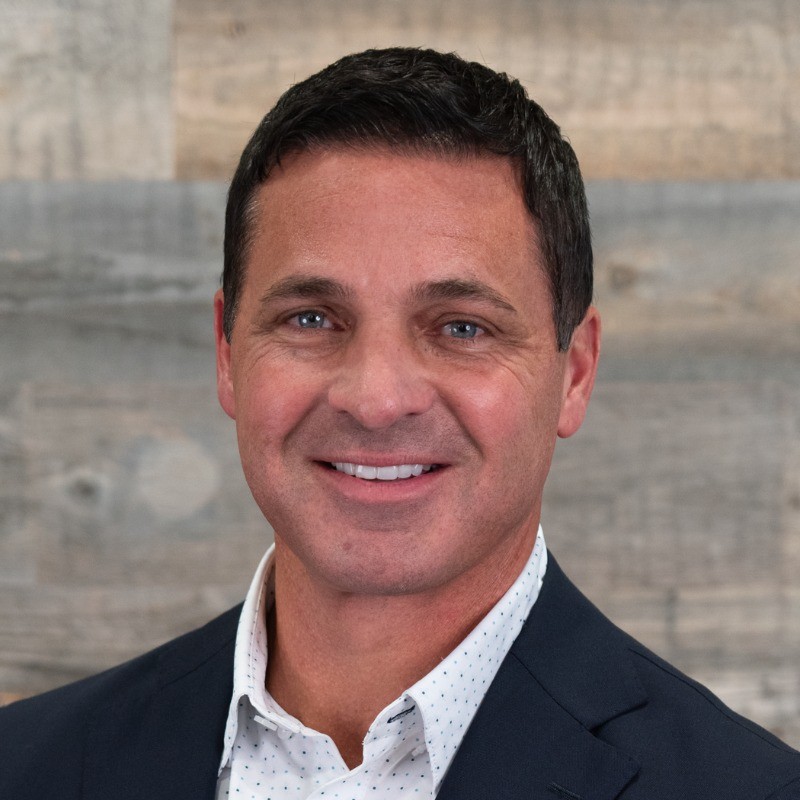
John Abou is the CEO of TTEC Engage, bringing nearly 30 years of industry experience across business development, global operations, and customer experience transformation. He has led expansion across North America, EMEA, Latin America, and APAC, with expertise spanning the process transformation lifecycle and partnerships with global brands. At TTEC, he focuses on strengthening customer-centricity, expanding global capabilities, and advancing differentiated service offerings.
Chris Brown is the President of TTEC Digital, leading the company’s global CX technology business at the intersection of data, AI, and security. He oversees global strategy, P&L management, corporate development, strategic partnerships, and portfolio strategy. Since joining TTEC in 2015, he has played a key role in building TTEC Digital’s competitive positioning and AI-first roadmap. He brings more than two decades of experience across technology, investment banking, management consulting, and strategic transformation.

About Chris Brown

About Lynda Stadtmueller
Lynda is the Associate Partner and Program Leader, Cloud at Frost & Sullivan. She has been with the company since 2008, covering enterprise network services, digital transformation, hybrid & multi-cloud, and edge-to-cloud network configurations. She is a frequent speaker and contributor to technology publications, with over 40 years of experience in the communications industry. Prior to joining Frost & Sullivan, she served in several leadership positions with AT&T and other technology firms.
Ready to Lead the Transformation?
- Schedule a Growth Strategy Dialog: Align your growth roadmap with Frost & Sullivan’s Visionary Growth Pipeline™ Dialog.
- Engage with Growth Experts: Co-design AI-enabled, data-driven operating models that scale industry-specific and commercial impact.
- Showcase Your Transformational Leadership: Position your organization as a transformation leader through Frost & Sullivan’s Transformational Growth Leadership platform.
- Join the Growth Council: Collaborate with industry leaders shaping the future of your ecosystem.
- Explore Best Practices Recognition: Be recognized for excellence in growth strategy, execution, and customer impact.
- Benchmark Your Industry Positioning on the Frost Radar™: Benchmark your growth performance and innovation strength against industry competitors.
- Tell Your Story: Accelerate awareness, engagement, and revenue growth through integrated brand and demand generation strategies.
Appendix: Orchestrating People, Technology, and CX Outcomes
As customer experience moves from capacity-based delivery toward outcome-focused models, leaders are being challenged to transform without losing sight of what clients need today. That means balancing innovation with operational discipline, starting with the business problem rather than the technology, and bringing together people, AI, data, workflows, and ecosystem capabilities around a shared customer outcome.
To support leaders navigating this evolution, Frost & Sullivan provides the following analyses:
📌 Frost Radar™: Customer Experience Management Services in North America, 2026
📌 Frost Radar™: Customer Experience Management Services in Latin America, 2026
📌 Global Customer Experience Management Services, Forecast to 2030
📌 CX Unfiltered: Industry Trends Redefining Customer Obsession
These analyses complement the leadership themes explored throughout this discussion, helping organizations understand how CX expectations are evolving, align technology investments with business outcomes, strengthen operational and digital capabilities, and identify where innovation can create meaningful customer and business value.
YOUR TRANSFORMATIONAL GROWTH JOURNEY STARTS HERE
Frost & Sullivan’s Growth Pipeline Engine, transformational strategies, and best practice models drive the generation, evaluation, and implementation of powerful growth opportunities.
Is your company prepared to survive and thrive through the coming transformation?