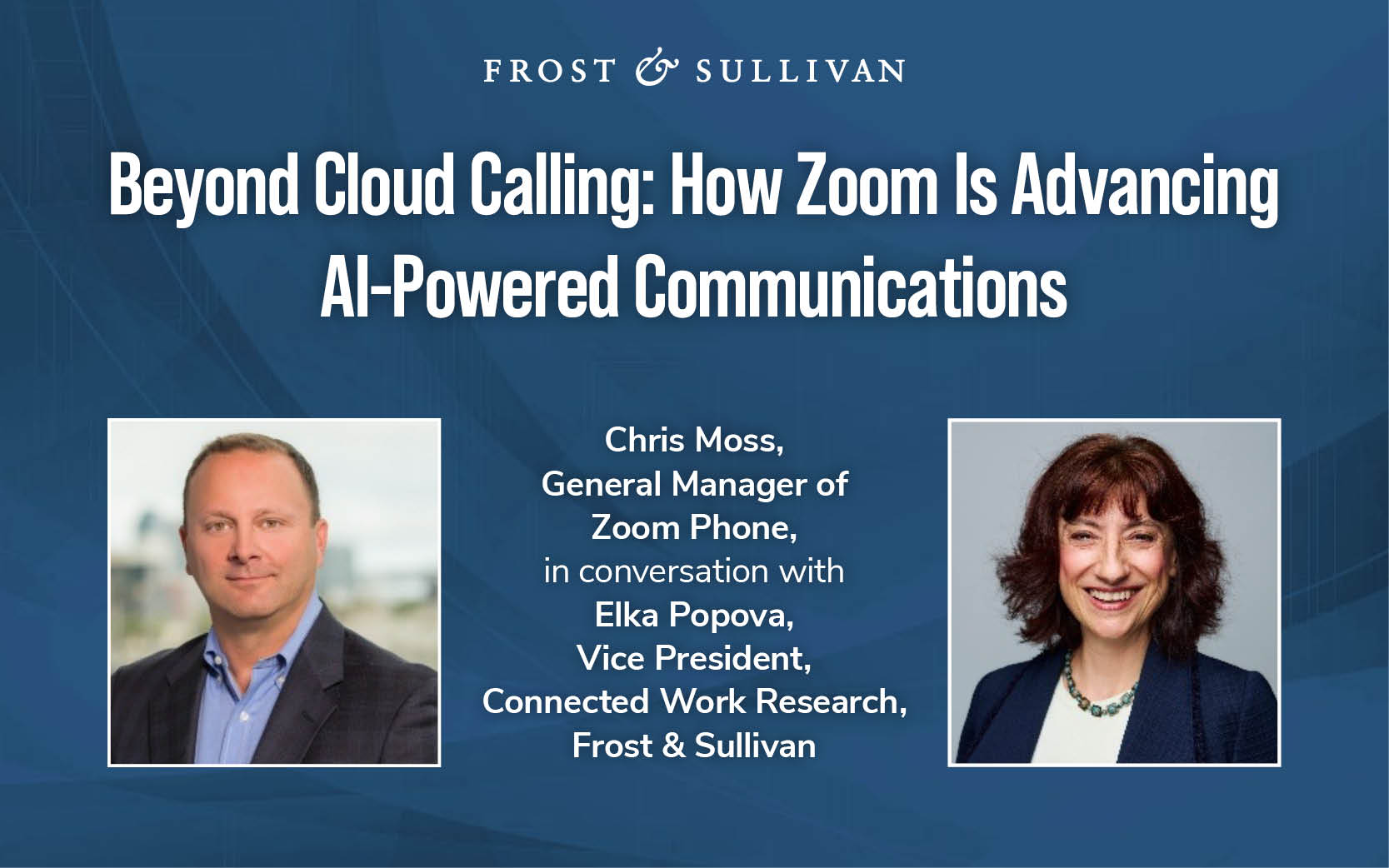
Chris Moss, General Manager, Zoom Phone, in conversation with Elka Popova, Vice President, Connected Work Research, Frost & Sullivan
With more than 10 million installed seats globally, Zoom Phone remains a key growth driver for Zoom and a formidable competitor in the cloud-based Private Branch Exchange (PBX) and Unified Communications as a Service (UCaaS) ecosystem. Building on the success of Zoom Meetings, Zoom Phone has grown into the world’s third-largest cloud calling platform in just seven years, surpassing competitors with decades of industry presence.
Zoom Phone is also a foundational component of Zoom’s integrated cloud communications platform, bringing together meetings, messaging, calling, and contact center capabilities through a shared AI-powered intelligence layer. Beyond communications, it supports Zoom’s broader “system of action” vision, which aims to translate conversational data into business outcomes through workflow automation, streamlined processes, and enhanced productivity.
At Zoomtopia 2026, Zoom’s premier customer and partner event, Elka Popova, Vice President, Connected Work Research at Frost & Sullivan, spoke with Chris Moss, General Manager of Zoom Phone, about the factors behind the platform’s rapid growth. Their discussion explores Zoom’s vision for the continued evolution of Zoom Phone and its broader communications and customer engagement portfolio, including the opportunities emerging from artificial intelligence (AI)-powered innovation.
“What AI has unquestionably done is re-energize the market and accelerate cloud adoption by creating an additional layer of value beyond traditional communications.”
— Chris Moss, General Manager, Zoom Phone
Sustaining Competitive Growth Through Simplicity and AI Innovation
Elka Popova: Chris, I have been monitoring Zoom Phone’s evolution and market performance since launch, and I have been impressed with how far it has come. You have been leading Zoom Phone for the past three years. Are you happy with where the business is today?
Chris Moss: I am. We are growing in the mid-double digits, which is a very strong trajectory for the business. That said, there is always more opportunity ahead of us.
Elka Popova: The cloud PBX and UCaaS market is maturing, and it is becoming harder to maintain double-digit growth rates. Solution differentiation will be critical to Zoom Phone’s success. Where do you see the biggest opportunities to differentiate from competitors?
Chris Moss: One of Zoom’s greatest strengths, and particularly Zoom Phone’s, is simplicity. A solo entrepreneur can purchase a license online, install it, and start using it immediately. At the same time, that same platform scales to some of the world’s largest enterprises running hundreds of thousands of users.
Behind that simplicity sits a substantial set of advanced capabilities. Zoom Phone is also what I would call AI-ready. We remain open and highly integrative, but because much of the innovation happens inside Zoom, customers benefit directly from investments in summaries, transcriptions, voicemail intelligence, agentic voice, conversational intelligence, coaching, live assistance, and more.
Another major focus area for us has been industry-specific solutions.
Accelerating Cloud Communications Adoption Across Key Verticals
Elka Popova: Tell me more about that. I am a strong proponent of verticalization in business communications, whether through tailored functionality or through integrations or even simply through tailored messaging and use-case positioning.
Chris Moss: Industries with significant business-to-consumer engagement still rely heavily on voice communications. Financial services is one of our strongest verticals, and we have completed several migrations of more than 100,000 seats from on-premises environments to Zoom Phone.
Healthcare has also been a key growth area. One differentiator for us is our ability to support clinical environments with the reliability and survivability those organizations require. We have replaced legacy systems in hospitals, emergency departments, nurse stations, and similar settings.
Another area where Zoom Phone has done well is education. Zoom’s longstanding strength in the education market extends to phone services as well. In fact, we recently had one of our strongest quarters ever in education.
Connecting Frontline Intelligence with Enterprise Workflows
Elka Popova: When you think about verticals, do you take a different approach to serving knowledge workers versus frontline or deskless workers? What role do integrations and systems of record play in enabling different workflows?
Chris Moss: That’s a great question. We strongly believe in meeting users where they already work, which is why we are deeply committed to openness and integrations.
We integrate with Microsoft Teams, Salesforce, ServiceNow, HubSpot, Epic, and many others because customers depend on those applications every day. We do not believe in forcing users into a particular environment.
For frontline workers, we have invested heavily in shared devices, mobility, mobile-first experiences, shift awareness, and related capabilities. What’s particularly interesting is that AI is helping organizations realize that frontline employees often possess valuable customer and operational insights that were previously difficult to capture.
Historically, communications investments primarily focused on knowledge workers and IT buyers. Today, organizations are extending that focus to operational functions such as sales, HR, supply chain, legal, and customer-facing teams. We are increasingly helping customers capture context from those interactions and automate workflows around it.
Unlocking New Growth Opportunities Through Role-specific Solutions
Elka Popova: What’s your vision for creating more role-specific user experiences?
Chris Moss: A lot of that already appears through our integrations and the workflows we tailor for specific industries. Healthcare is a good example. The needs of a nurse station differ from those of an emergency room. We customize workflows, communications rules, and experiences accordingly.
We are also investing in templates and industry-specific vocabulary, schemas, and workflows to simplify deployment and adoption.
Some of the most exciting opportunities are emerging in SMB markets and sub-verticals. Consider a dental practice, where scheduling is central to daily operations. Our AI Receptionist can help automate many front-desk functions, and that’s opening entirely new workflow opportunities for small businesses. You will see continued investments from us in these areas.
Strengthening Competitive Advantage Through Customer-led Innovation
Elka Popova: How do you identify industry-specific pain points before product development begins?
Chris Moss: Honestly, that’s one of Zoom’s greatest strengths. I have spent more than 30 years in this industry, including time at Cisco, Avaya, and Poly. What stands out at Zoom is how directly customers influence our roadmap.
When a major healthcare provider with 20,000 clinicians chooses Zoom, they tell us exactly what they need. The trust they place in us allows us to develop solutions collaboratively. The same applies to large financial services organizations operating highly distributed environments. We listen, adapt, and build. In one case alone, we developed more than 70 features to address a customer’s requirements.
Scaling Vertical Expertise to Accelerate Enterprise Adoption
Elka Popova: Do you also employ industry specialists who understand healthcare, education, retail, and financial services?
Chris Moss: Absolutely. We have dedicated healthcare and education teams, as well as specialists serving both enterprise and mass-market customers.
What’s interesting is that once we solve a challenge for one customer, those capabilities become available to the next customer facing similar requirements. Over time, that expertise compounds. We can now walk into many healthcare opportunities and confidently address issues such as nurse workflows, emergency room communications, or patient transfer processes because we have already built those capabilities.
That reflects both customer trust and Zoom’s ability to move quickly from an engineering and product perspective.
Expanding Enterprise Value Through Open Technology Ecosystems
Elka Popova: How is that reflected in your app marketplace strategy?
Chris Moss: We continue to invest heavily in integrations and use-case-driven experiences. Marketplace remains central to our strategy because it is how customers connect Zoom to the applications that matter most to them.
We are committed to being open and partner-friendly. We do not play games by placing essential capabilities behind artificial barriers. Customers appreciate that approach.
Capturing Growth Beyond Traditional Cloud Telephony
Elka Popova: Vertical solutions are clearly one growth vector. What other opportunities do you see over the next four or five years?
Chris Moss: Even today, there are still more than 100 million on-premises seats in the market. That is a significant opportunity.
Beyond migration, one of the most important expansion areas is what I would call the customer engagement layer. While it is not a conventional contact center, its capabilities extend beyond those of traditional telephony. There are many customer-facing professionals who need lightweight engagement tools without requiring a full contact center deployment.
Financial services provide a good example. Some of our customers wanted WhatsApp communications integrated into their compliant communications environment. We were able to extend those capabilities into Zoom Phone, creating a richer engagement experience while maintaining compliance requirements.
At the same time, agentic voice experiences, such as AI Receptionist, represent a significant opportunity. Organizations can automate front-desk functions with a simple setup process, creating a compelling consumption-based growth opportunity.
Expanding the Role of Communications Through AI-driven Workflow Automation
Elka Popova: It seems the industry is moving beyond communications and toward turning conversations into completed actions. How do you define that emerging market?
Chris Moss: It’s a fascinating question. AI and contextual awareness are encouraging organizations to rethink how they communicate and where they invest. We are seeing communications data drive workflows across legal services, supply chains, HR, sales organizations, and frontline operations.
For example, some legal professionals use mobile applications while AI handles transcription, summarization, and workflow creation in the background. By the time a conversation ends, assistants and caseworkers may already be acting on key information, with portions of the process automatically flowing into systems of record.
I think we are still in the early stages. Organizations are beginning to understand how AI-powered communications can capture context and trigger workflows. Whether this eventually becomes its own market category remains to be seen, but it is certainly expanding the role communications platforms can play.
Elka Popova: Perhaps in a few years we’ll be talking about an entirely new market category rather than UCaaS or CX.
Chris Moss: That’s very possible. What AI has unquestionably done is re-energize the market and accelerate cloud adoption by creating an additional layer of value beyond traditional communications.
Building New Revenue Streams Through AI-powered Services
Elka Popova: Speaking of AI, analysts are increasingly trying to quantify AI-driven revenue uplift. Five or six years from now, what percentage of Zoom Phone revenue could reasonably be attributed to AI-related services?
Chris Moss: Zoom Phone is already a substantial business, so predicting exact percentages is difficult.
That said, given the growth of consumption-based services, agents, workflow orchestration, and AI-powered experiences that sit on top of traditional seat licensing, I can envision AI-related services accounting for 20% to 30% of revenue over time.
Unifying Communications and Customer Engagement Through Shared Intelligence
Elka Popova: To wrap up, is there anything we haven’t discussed that you would like readers to know about Zoom Phone?
Chris Moss: One important area is the convergence of unified communications and contact center technology, along with that engagement layer we discussed earlier.
We are intentionally building a shared context layer, so information follows customers seamlessly across front-office, back-office, and contact center interactions. The goal is to eliminate repetition and create a more connected experience.
We are applying the same philosophy to analytics and insights. Having worked on similar initiatives at both Avaya and Cisco, I believe the advantage today is that we are delivering these capabilities through a modern cloud architecture. It may sound foundational, but customers are seeing real value, particularly in highly distributed retail environments where contact centers often serve as the operational hub. We have had significant success with that approach.
Closing Reflection: Capitalizing on the Next Wave of Communications Innovation
The next phase of growth for Zoom Phone will depend on how effectively it capitalizes on the substantial base of legacy telephony users while expanding into new service categories. As Chris Moss outlines, opportunities in lightweight customer engagement, agentic voice, and consumption-based AI services could create additional revenue streams beyond traditional seat licensing. His outlook also points to the growing importance of shared customer context across unified communications and contact center environments, where conversational insights can inform decisions and trigger business workflows. For Zoom, the opportunity is to translate these capabilities into scalable commercial offerings while maintaining the simplicity, reliability, and flexibility that have supported its growth.

About Chris Moss
Chris Moss is the General Manager of Zoom Phone, where he leads the platform’s growth and innovation across cloud communications, AI-powered services, and enterprise customer engagement. With more than 30 years of experience in enterprise communications, he has held senior product and technology leadership roles at HP, Poly, Cisco, and Avaya. At Zoom, he focuses on accelerating cloud adoption, expanding industry-specific solutions, and advancing AI-enabled communications that connect enterprise workflows and deliver greater business value.
Elka Popova is Vice President, Connected Work at Frost & Sullivan, bringing more than 25 years of experience in enterprise communications, technology analysis, and strategic consulting. She specializes in unified communications, cloud collaboration, Communications Platform as a Service (CPaaS), and competitive intelligence. Elka established Frost & Sullivan’s UCaaS practice and played a key role in developing its Connected Work program. Through her industry expertise, she helps organizations identify growth opportunities, assess competitive positioning, and develop strategies for enterprise communications transformation.

Ready to Lead the Transformation?
- Schedule a Growth Strategy Dialog: Align your growth roadmap with Frost & Sullivan’s Visionary Growth Pipeline™ Dialog.
- Engage with Growth Experts: Co-design AI-enabled, data-driven operating models that scale industry-specific and commercial impact.
- Showcase Your Transformational Leadership: Position your organization as a transformation leader through Frost & Sullivan’s Transformational Growth Leadership platform.
- Join the Growth Council: Collaborate with industry leaders shaping the future of your ecosystem.
- Explore Best Practices Recognition: Be recognized for excellence in growth strategy, execution, and customer impact.
- Benchmark Your Industry Positioning on the Frost Radar™: Benchmark your growth performance and innovation strength against industry competitors.
- Tell Your Story: Accelerate awareness, engagement, and revenue growth through integrated brand and demand generation strategies.
Appendix: Exploring Growth Opportunities in Intelligent Communications
As AI-powered communications, cloud platforms, and connected devices reshape enterprise collaboration, organizations are rethinking how they integrate voice, messaging, and customer engagement across business operations. The convergence of unified communications, intelligent endpoints, and automated workflows is creating opportunities to modernize infrastructure, improve productivity, and unlock new sources of business value.
To support organizations navigating this evolution, Frost & Sullivan provides the following analyses:
📌 Global Desktop, VoWLAN, and DECT Phones Market, 2024–2032
📌 Global Audio Conferencing Devices Market, Forecast to 2032
📌 Frost Radar™: Integrated Cloud Communications Platforms, 2026
📌 Top 10 Growth Opportunities in Communication and Collaboration Endpoints and Devices, 2026
These analyses complement the themes explored in this Movers & Shakers discussion, helping organizations assess competitive positioning, identify emerging growth opportunities, and align communications investments with evolving enterprise requirements. Together, they provide perspectives on the technologies, platforms, and connected devices shaping the future of intelligent enterprise communications.