This blog is based on the competitive analysis titled, Top 10 Growth Opportunities in Communication and Collaboration Endpoints and Devices, and, Global Desktop, VoWLAN, and DECT Phones Market, authored by Frost & Sullivan’s growth expert, Chris Pennell from the Unified Communications team.
Enterprise communication devices have long been considered a voice connectivity tool. The indicators of effectiveness were service uptime, call quality, and reliability. That definition is becoming obsolete today.
Hybrid work, the rise of artificial intelligence, cybersecurity concerns, and workplace digitization are changing the role of communication endpoints completely. Devices are no longer passive voice terminals. They are becoming intelligent, connected assets, directly impacting productivity, compliance, employee experience and operational effectiveness.
Enterprise Communications: Press Play on Growth
In under 8 minutes, explore the growth opportunities, ecosystem shifts, and innovation strategies transforming enterprise collaboration technology.
This transformation is occurring against the backdrop of a major disruption simultaneously. Revenues from traditional desktop phones are predicted to drop from $2.39 billion in 2025 to $1.96 billion by 2032, as softphones, Unified Communications-as-a-Service (UCaaS) platforms, and mobile-first work frameworks reduce reliance on traditional hardware.
At the same time, the evolution of workplace communications is offering multiple growth opportunities. The top contenders will not be firms that are focused on incorporating devices. They will be enablers of intelligent workplace experiences, secure distributed communications, AI-powered collaboration and workflow-integrated frontline operations.
Is your organization prepared to capitalize on emerging technologies and business models, to survive and thrive through this transformation?
Click here to access our detailed Growth Opportunity Analytics.
Strategic Forces Redefining Enterprise Communication Technology
- Customer Value Chain Compression
AI is removing friction in the communications lifecycle. AI-powered diagnostics, predictive maintenance, automated provisioning, and intelligent support systems are altering how endpoints are deployed, managed and optimized.
As more devices detect faults before users do, there is a decreased need for IT intervention, while also enhancing overall employee experiences. For enterprise leaders, it means communications endpoints are becoming intelligent service nodes, rather than cost centres.
- Industry Convergence
Today, communication endpoints are at the centre of collaboration, cybersecurity, workplace management, compliance and enterprise IT. Organizations demand more security, visibility and governance, as Internet Protocol (IP) phones, room systems and wireless devices become fully networked assets. What was once a voice device is now an integral part of the larger digital workspace infrastructure.
At the same time, communications solutions are steadily being connected with collaboration platforms, workflow applications, facilities management systems, and industry-specific software environments. The result is a rising convergence of communication technology, operational technology, workplace experience platforms and corporate applications.
- Transformative Megatrends
The increase of AI-aware environments, hybrid work and intelligent workplaces are redefining business norms. Employees are beginning to expect workplace technology that automatically adapts to context, location, and work culture. Meeting rooms should support seamless in-person and remote participation. Communication systems need to recognize the surrounding environment, optimize audio performance, and offer consistent experiences across distributed teams.
As smart buildings become more widespread and workplace occupancy patterns keep shifting, communication endpoints need to become more responsive, contextual, and intelligent. This evolution is creating a new generation of workplace infrastructure, one that is built on adaptability, rather than standardized configurations.
Do you have the growth strategies needed to leverage intelligent workspace infrastructure, strengthen competitive positioning, and deliver greater customer value?
Enterprise Communications Ecosystem at a Glance
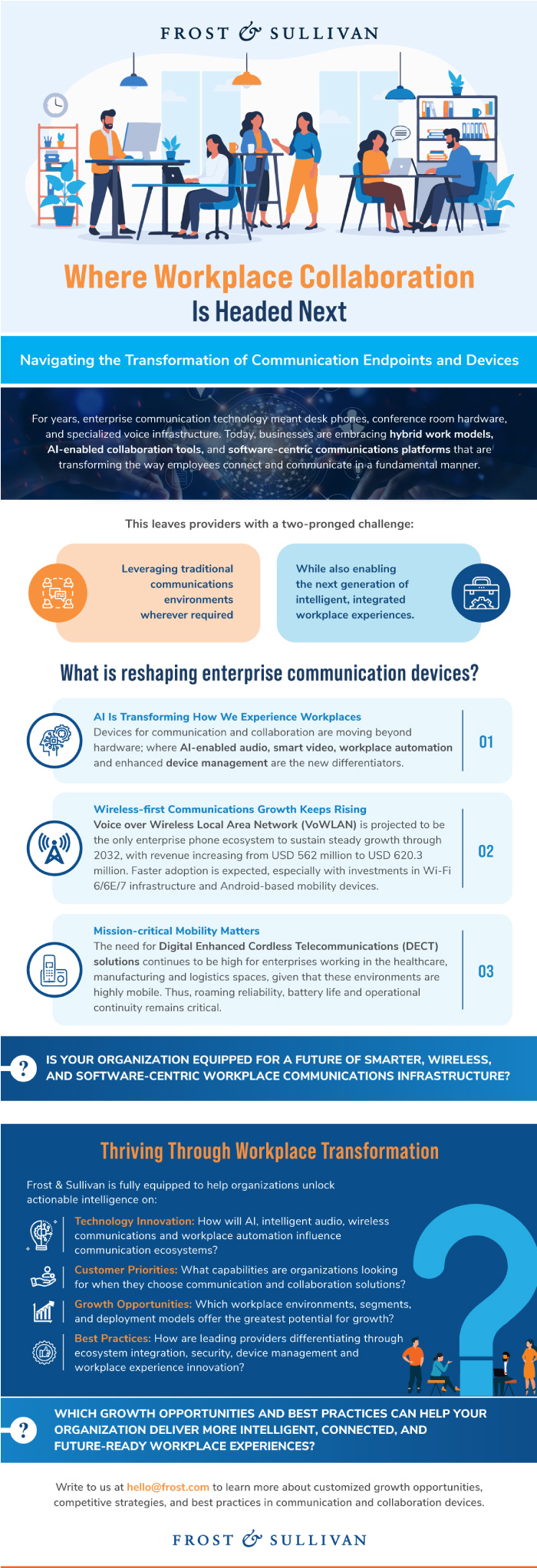
Listen to our growth podcast on connected, workplace technology today!
Enterprise Perspectives on the Growth Potential of Workplace Technology
1) Operational efficiency is important: 50% of CEOs are planning to boost their investment in device provisioning and administration, to enable easier deployment of communications devices.
2) Moving to managed security: 66% will adopt managed security services.
3) DECT is resilient: Healthcare digitalization, Session Initiation Protocol (SIP) DECT upgrade & Internet of Things (IoT) integration in healthcare, manufacturing and logistics environments continue to drive demand.
4) Traditional Endpoints Are Not Obsolete: Internet Protocol (IP) phones account for 59.3% of revenue, whereas wireless and software-based communications solutions continue to gain their share in the ecosystem.
Four Growth Opportunities Shaping the Future of Enterprise Communications
Growth Opportunity 1: Drive Transformation with Intelligent Workplace Experiences
Hybrid work may have matured, but workplace transformation is accelerating. Organizations are redesigning offices as collaboration hubs rather than collections of assigned desks. It means demand is moving towards intelligent workspaces that incorporate AI-driven audio, video, analytics and workplace optimization. The opportunity is not just about conference room technology.
Leading organizations are investing in:
- AI experiences in meeting rooms
- Intelligent collaborative spaces
- Adaptive workplace configurations
- Platform certified communication environments
- Data-based optimization of the workplace
Leaders are increasingly creating workspaces that can foster high-value collaboration, regardless of physical constraints.
Growth Opportunity 2: Unlock Competitive Advantage Through Intelligent Audio
The next growth frontier is audio intelligence. Today’s communication spaces need more tools that can grasp context, discern background distractions, adjust to room conditions and improve engagement for both in-person and remote players.
This is increasingly critical as firms adopt larger hybrid environments and distributed collaborative models. Forward-thinking suppliers are transforming audio equipment into IT-managed, AI-enabled platforms that deliver:
- Contextual sound optimization
- Spatial audio experiences
- Remote diagnosis and management
- Audio-Over-IP Architectures
- Visibility and control across the enterprise
With collaboration becoming more dispersed, intelligent audio will be key to establishing productive meeting experiences.
Growth Opportunity 3: Seize the Edge AI Opportunity to Enhance Privacy, Performance, and Efficiency
Enterprise privacy has become a boardroom priority. Organizations are harnessing AI without increased data exposure — 63% of IT decision-makers view privacy and compliance issues as a significant hurdle. This is fuelling interest in edge AI systems, which process sensitive information closer to endpoints.
The benefits for companies are significant:
- Lower compliance risk
- Lower costs for cloud processing
- Faster response rates
- Improved user experience
- Enhanced data sovereignty controls
Privacy-first AI architectures are transitioning from technical features to strategic differentiators for several ecosystems, such as healthcare, financial services, government, and critical infrastructure. Organizations that infuse privacy by design into workplace technology investments will increase trust and operational efficiency.
Click here to access our detailed Growth Opportunity Analytics.
Ready to Lead the Transformation?
- Schedule a Growth Strategy Dialog: Align your growth roadmap with Frost & Sullivan’s Visionary Growth Pipeline™ Dialog.
- Engage with Growth Experts: Co-design AI-enabled, data-driven operating models that scale industry-specific and commercial impact.
- Showcase Your Transformational Leadership: Position your organization as a transformation leader through Frost & Sullivan’s Transformational Growth Leadership platform.
- Join the Growth Council: Collaborate with industry leaders shaping the future of your ecosystem.
- Explore Best Practices Recognition: Be recognized for excellence in growth strategy, execution, and customer impact.
- Benchmark Your Industry Positioning on the Frost Radar™: Benchmark your growth performance and innovation strength against industry competitors.
- Tell Your Story: Accelerate awareness, engagement, and revenue growth through integrated brand and demand generation strategies.
Frequently Asked Questions: Enterprise Collaboration and Communication Technology
1.Why is digital employee experience becoming a board-level priority?
A strong digital employee experience directly influences workforce productivity, collaboration quality, employee engagement, and talent retention. As hybrid work becomes standard, organizations are investing in communication technologies that deliver consistent, secure, and intuitive experiences regardless of location. Executive leaders increasingly view employee experience as a strategic business outcome rather than simply an IT initiative.
2.How will workplace AI reshape future workplace technology investments?
Workplace AI is expected to become a foundational capability within modern workplace technology, enabling intelligent audio, adaptive collaboration experiences, automated device management, predictive diagnostics, and contextual workplace insights. Rather than replacing employees, AI will increasingly augment decision-making, improve collaboration quality, simplify IT operations, and deliver more personalized digital workplace experiences across distributed teams.
3.How should organizations rethink enterprise collaboration strategies over the next five years?
Successful enterprise collaboration strategies will extend beyond deploying communication tools. Executive leaders should focus on creating integrated ecosystems where AI, collaboration platforms, security frameworks, workflow applications, and communication devices operate seamlessly together. Organizations that align collaboration investments with employee productivity, operational efficiency, and digital transformation objectives will be better positioned to create sustainable competitive advantage.
4.How should executives evaluate unified communications for enterprise as a strategic growth investment?
Leading organizations no longer evaluate unified communications for enterprise as a standalone technology initiative. The most effective enterprise communication solutions connect collaboration, AI, security, analytics, and workflow automation into a unified ecosystem. Executives should assess investments based on their ability to improve workforce productivity, strengthen business resilience, simplify operations, and enable long-term digital transformation.