This blog is based on Frost & Sullivan’s analyses, “Frost Radar™: Managed Security Services in the Americas, 2026” and “Frost Radar™: Managed Security Services in EMEA, 2026,” authored by Lucas Ferreyra and Claudio Stahnke respectively from the Security Practice Area.
Executive Summary
Managed Security Services are evolving from traditional monitoring toward AI-enabled, integrated, and outcome-driven security operations. Across the Americas and EMEA, enterprises are prioritizing proactive threat detection, platform integration, exposure management, sovereignty, and measurable resilience. As Managed Security Services providers expand AI, automation, and cross-domain capabilities, competitive differentiation is increasingly centered on adaptive security operations, regional trust, and measurable risk reduction.
Key Takeaways
- The Managed Security Services market is becoming outcome-driven, focusing on measurable risk reduction and resilience.
- AI is transforming security operations through automation and intelligent threat response.
- Regional priorities differ, with automation and operational efficiency shaping the Americas while sovereignty, governance, and regulatory alignment are more prominent in EMEA.
- Platform integration is critical, connecting cloud, identity, endpoints, networks, and applications.
Managed Security Services (MSS) are becoming a strategic component of enterprise cyber resilience as organizations contend with expanding attack surfaces, hybrid and multicloud environments, security talent shortages, and increasingly sophisticated threats. Enterprises are moving beyond continuous monitoring toward AI-enabled operations, integrated security platforms, proactive exposure reduction, and measurable security outcomes. This shift is creating significant growth opportunities across the Americas Managed Security Services Market and EMEA (Europe, the Middle East, and Africa) Managed Security Services Market. While the Americas is emphasizing automation, AI-powered managed detection and response (MDR), identity security, and operational efficiency, EMEA is placing greater emphasis on sovereignty, governance, regulatory alignment, and auditable resilience.
For technology and security leaders, the priority is shifting toward identifying MSS partners that can translate advanced security capabilities into measurable improvements in risk, resilience, and operational performance.
Listen to our latest podcast episode on Top MSS Providers Shaping Cybersecurity Resilience.
What Are Managed Security Services (MSS)?
Managed Security Services involve the outsourcing or co-management of cybersecurity operations to specialized providers that monitor, detect, investigate, and respond to security threats across an organization’s technology environment.
Traditional MSS models have typically centered on Security Operations Centers (SOCs), security information and event management (SIEM), threat monitoring, and incident response. The model is now expanding across managed detection and response, cloud security, identity, exposure management, endpoint protection, security orchestration, automation, and response, and Secure Access Service Edge (SASE).
The evolution is moving MSS from a collection of managed security functions toward a more integrated operating model. Managed Security Services providers are increasingly connecting telemetry, analytics, orchestration, and reporting across cloud, identity, endpoints, networks, operational technology (OT), and software-as-a-service (SaaS) environments.
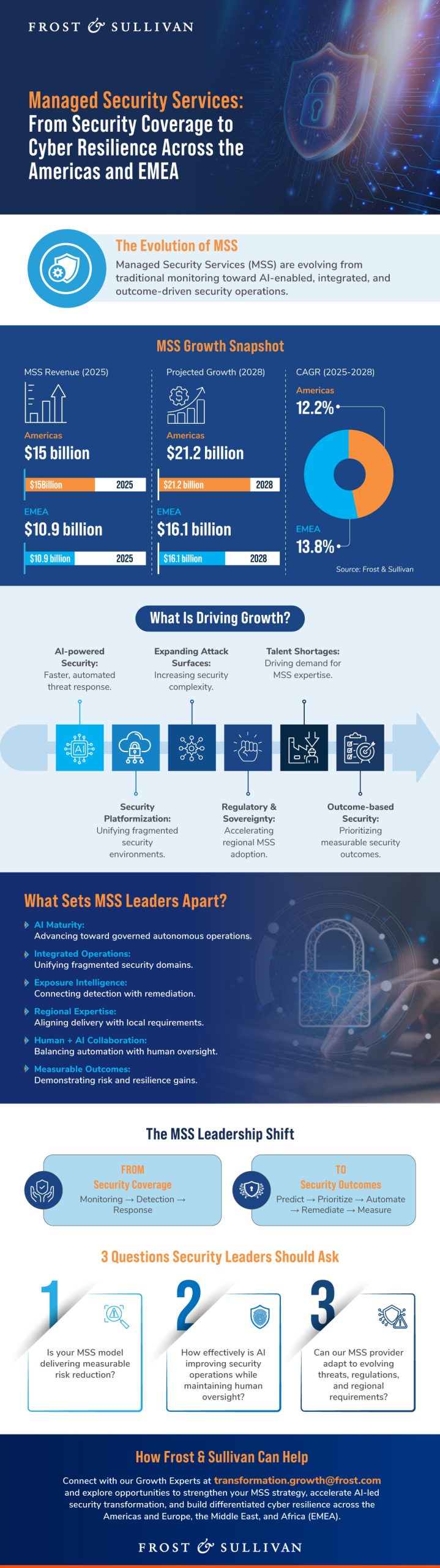
Regional Growth Comparison: Americas vs. EMEA
| Parameter | Americas | EMEA |
| 2025 MSS Revenue | $16.8 billion | $10.9 billion |
| 2028 Projected Revenue | $24.0 billion | $16.1 billion |
| CAGR (2025–2028) | 12.6% | 13.8% |
| Primary Growth Drivers | Outsourced security operations, proactive MDR, cloud and identity protection, SASE, AI-enabled security | Regulatory requirements, cyber resilience, sovereignty, platformized MSS, AI-enabled efficiency |
| Regional Dynamics | North America provides scale; Latin America offers higher-growth opportunities | Strong demand across regulated and critical sectors |
| Key Regulatory Drivers | Compliance and operational resilience | Network and Information Systems Directive 2 (NIS2), Digital Operational Resilience Act (DORA), General Data Protection Regulation (GDPR), sovereignty, and auditability |
| Key Enterprise Challenge | Security complexity, talent shortages, and expanding digital environments | Regulatory complexity, sovereignty, operational resilience, and security talent shortages |
| Managed Security Services Market Direction | AI-enabled, automated, integrated security operations | Sovereign, auditable, platformized, and outcome-driven security operations |
Source: Frost & Sullivan
According to Frost & Sullivan, the regional outlook points to two distinct MSS growth trajectories. The Americas Managed Security Services Market is representing the larger opportunity, with scale and technology-led modernization driving demand, while the EMEA Managed Security Services Market is expanding at a faster pace as regulatory complexity, sovereignty, and resilience requirements accelerate adoption. This divergence is prompting providers to tailor their operating models, technology investments, and value propositions to regional enterprise priorities.
Strategic Imperatives Shaping MSS Leadership Across the Americas and EMEA
- Moving From Monitoring to Outcome-driven Security
Enterprises are shifting toward MSS models that deliver measurable improvements in risk reduction, detection and response efficiency, alert management, and operational resilience rather than basic security monitoring.
- Unifying Fragmented Security Environments
Platformized MSS is gaining traction as enterprises seek integrated visibility across cloud, identity, endpoints, networks, operational technology (OT), and Software-as-a-Service (SaaS) environments. Convergence with SASE/Security Service Edge (SSE) and cloud-native architectures is further strengthening this shift.
- Building Regionalized and Sovereign Delivery Models
Regional requirements are becoming increasingly important. The Americas requires MSS models that balance advanced capabilities with scalable and cost-efficient delivery, particularly across Latin America. EMEA is placing stronger emphasis on sovereignty, data residency, governance, auditability, and regulatory alignment.
- Adapting Go-to-market Models to Regional Maturity
The Americas spans highly mature North American enterprises and faster-growing Latin American markets with different adoption and budget dynamics. EMEA similarly requires providers to tailor delivery to regulatory and sector-specific requirements. Flexible, scalable, and regionally aligned service models are therefore becoming important competitive differentiators
The Top MSS Providers Setting New Benchmarks in the Americas
The Americas MSS landscape is combining scale, AI-led security operations, broad technology ecosystems, and flexible service models. Leading providers are differentiating through automation, identity and zero-trust capabilities, platform integration, and their ability to connect managed security with broader technology transformation.
- LevelBlue
LevelBlue leads the Americas Frost Radar™ across Innovation and Growth, supported by portfolio expansion, acquisitions, and a comprehensive managed security proposition.
- IBM
IBM is advancing agentic AI and autonomous SOC operations while combining MSS with consulting-led cybersecurity transformation.
- NTT and Accenture
Both providers are leveraging global scale, advisory capabilities, and broader technology relationships to expand MSS through cross-selling and transformation-led engagements.
- DXC and CDW
DXC is combining AI-enabled SOC modernization, identity, and zero trust, while CDW is differentiating through vendor-neutral integration and flexible managed service models.
Download the Full Analysis to Explore More MSS Providers in the Americas
The Top MSS Providers Shaping Leadership in the EMEA
EMEA’s competitive landscape is being shaped by a stronger emphasis on sovereignty, regulatory alignment, platformization, and trusted security operations. Leading Managed Security Services providers are combining AI and automation with regional delivery capabilities to address the requirements of regulated and security-sensitive enterprises.
- Orange Cyberdefense
Orange Cyberdefense is combining intelligence-led operations, exposure management, platformization, and sovereign security delivery, particularly for regulated European sectors.
- Deutsche Telekom Security
Deutsche Telekom Security is combining network-native visibility, modular MDR, AI-driven operations, and regional delivery capabilities.
- BT
BT is combining managed security, network infrastructure, platformization, and sovereign delivery, with particular relevance for government and regulated environments.
- IBM and Accenture
IBM is advancing autonomous SOC capabilities and agentic AI, while Accenture is connecting MSS with broader transformation, AI, and cybersecurity programs.
Download the Full Analysis to Explore More MSS Providers in the EMEA
What Should Technology and Security Leaders Be Watching?
The evolution of MSS is creating several areas that warrant close attention:
- AI maturity: Moving from AI-assisted workflows toward measurable, governed autonomous operations
- Platform integration: Connecting security operations across cloud, identity, network, endpoint, and application environments
- Exposure management: Linking detection with exploitability, prioritization, and remediation
- Sovereignty: Addressing regional requirements around data residency, local operations, and AI governance
- Outcome measurement: Connecting MSS performance with risk reduction, response efficiency, and business resilience
- Operating models: Balancing fully managed, co-managed, and technology-agnostic approaches according to enterprise requirements
The key consideration is shifting from “What security services does a provider offer?” to “How effectively can the provider integrate those capabilities into a measurable security operating model?”
Best Practices for High-performance Managed Security Services
- Prioritize Outcome-driven Operations
Leading MSS models are demonstrating measurable outcomes such as faster response, lower analyst workload, and reduced risk rather than focusing solely on coverage.
- Keep Humans in the AI Loop
AI is being embedded into security workflows while explainability, override mechanisms, governance, and accountability remain central.
- Connect Exposure with Operations
Exposure intelligence, identity, SaaS posture, and remediation guidance are increasingly becoming part of day-to-day managed security operations.
- Build Trust into Service Delivery
Clear responsibilities, escalation models, data-handling transparency, sovereign options, and auditable processes are becoming important components of MSS delivery, particularly in EMEA.
According to Frost & Sullivan, high-performing MSS models are evolving around measurable outcomes, responsible AI adoption, integrated exposure management, and trusted service delivery. Providers that combine automation with human oversight, connect security intelligence to remediation, and deliver transparent, resilient operations are better positioned to create sustained enterprise value.
The Next Frontier of MSS Leadership
The next phase of Managed Security Services will move beyond detection and response toward adaptive, AI-enabled security operations that continuously anticipate risk and strengthen enterprise resilience. According to Frost & Sullivan, providers that combine autonomous capabilities with human oversight, cross-domain intelligence, regional trust, and measurable outcomes will be best positioned to shape MSS leadership across the Americas and EMEA.
Frequently Asked Questions (FAQs):
1. What are managed cybersecurity services?
Managed cybersecurity services are outsourced security capabilities delivered by specialized providers that continuously monitor, detect, investigate, and respond to cyber threats on behalf of an organization. These services help enterprises strengthen security operations, access specialized expertise, and improve threat visibility without having to build and operate every capability internally.
2. What is an example of a managed security service?
A common example is a Managed Detection and Response (MDR) service, where a provider continuously monitors an organization’s endpoints, networks, cloud environments, and other security telemetry to identify suspicious activity and support investigation and response. Other examples include managed SIEM, managed firewall, vulnerability management, and managed identity security services.
3. How big is the managed security services market in the Americas and EMEA?
The managed security services market is expanding steadily across both regions, with North America representing the largest revenue contributor in the Americas, while EMEA is seeing strong growth driven by regulatory requirements, cybersecurity talent shortages, and increasingly complex IT environments. Frost & Sullivan’s latest research indicates that the global MSS market reached $35.68 billion in 2025 and is projected to reach $52.27 billion by 2028, growing at a 13.6% CAGR.
4. What are the benefits of managed security services?
Key benefits include 24/7 security monitoring, faster threat detection and response, access to specialized cybersecurity expertise, improved visibility across distributed environments, reduced pressure on internal security teams, and greater scalability. MSS can also help organizations manage increasingly complex security environments while focusing internal resources on strategic priorities.
5. What should enterprises consider when evaluating MSS providers?
Enterprises should evaluate providers based on security expertise, breadth of services, threat detection and response capabilities, AI and automation maturity, integration with existing security infrastructure, visibility and reporting, scalability, regulatory and compliance capabilities, service level agreements (SLAs), and incident-response processes. They should also assess whether the provider can evolve its services as the organization’s technology environment and threat landscape change.
6. How is AI changing Managed Security Services?
AI is transforming managed security services by enabling faster threat detection, automated alert triage, behavioral analysis, threat correlation, investigation, and response across large volumes of security data. AI is also helping security teams reduce alert fatigue and prioritize higher-risk incidents. Increasingly, Managed Security Services providers are combining AI-driven automation with human expertise to improve operational efficiency while retaining human oversight for complex investigations and high-impact security decisions.
7. What is a Managed Security Service Provider (MSSP)?
A Managed Security Service Provider (MSSP) is a third-party organization that delivers outsourced or co-managed cybersecurity capabilities such as security monitoring, managed detection and response, incident response, cloud security, identity security, and other security operations.
Ready to Lead the Transformation?
- Schedule a Growth Strategy Dialog: Align your growth roadmap with Frost & Sullivan’s Visionary Growth Pipeline™ Dialog.
- Engage with Growth Experts: Co-design AI-enabled, data-driven operating models that scale industry-specific and commercial impact.
- Showcase Your Transformational Leadership: Position your organization as a transformation leader through Frost & Sullivan’s Transformational Growth Leadership platform.
- Join the Growth Council: Collaborate with industry leaders shaping the future of your ecosystem.
- Explore Best Practices Recognition: Be recognized for excellence in growth strategy, execution, and customer impact.
- Benchmark Your Industry Positioning on the Frost Radar™: Benchmark your growth performance and innovation strength against industry competitors.
- Tell Your Story: Accelerate awareness, engagement, and revenue growth through integrated brand and demand generation strategies.