This blog is based on Frost & Sullivan’s recent analysis, “Profilers Market, Global, 2025–2030,” authored by growth expert, Sujan Sami and lead analyst, Shruti Bapusaheb Yewale from the Industrial Practice Area.
Profilers are becoming increasingly important in modern manufacturing environments where precision, throughput, and process consistency directly influence competitiveness. Across semiconductor, automotive, aerospace, electronics, and advanced materials production, manufacturers are operating with tighter tolerances and lower acceptance for dimensional variation. In response, profiling technologies are shifting from standalone inspection tools to strategic enablers of production control, quality assurance, and automation performance.
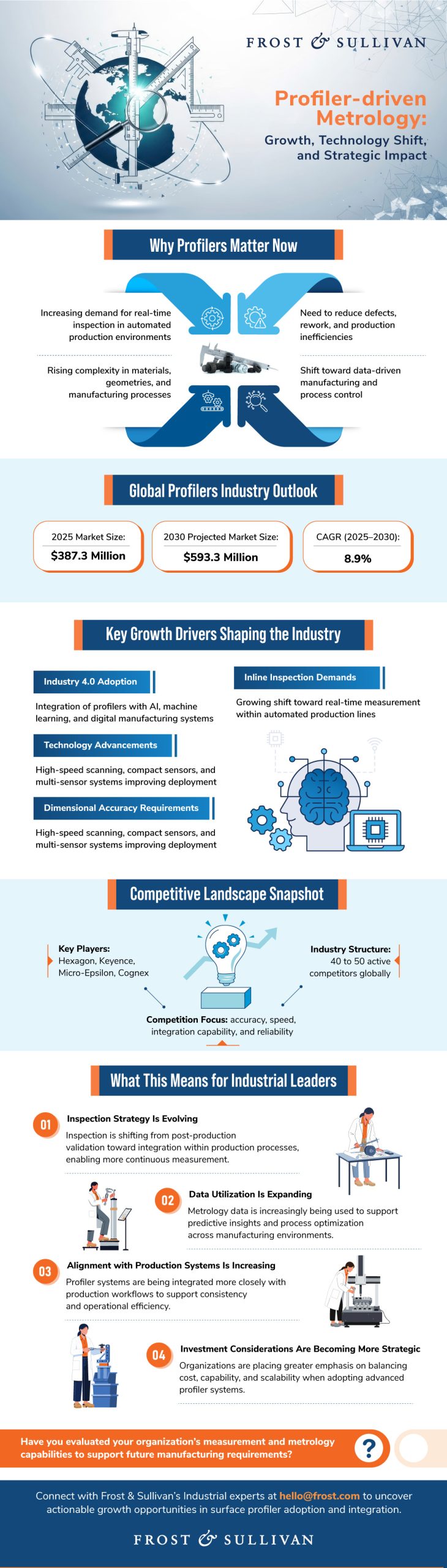
According to Frost & Sullivan, the global Profilers Market was valued at $387.3 million in 2025 and is projected to reach $593.3 million by 2030, growing at a compound annual growth rate of 8.9%. As manufacturers prioritize inline metrology, closed-loop process control, and faster defect detection, profilers are increasingly being evaluated not as inspection assets, but as investments that support measurable gains in speed, dimensional accuracy, and operational performance.
Lead the Shift in Profiler System Strategy
Evaluate how measurement systems influence production performance
Identify where advanced profiling capabilities create operational advantage
Understand how manufacturing complexity is reshaping inspection approaches
Benchmark your organization’s measurement capabilities against industry leaders
How prepared is your current metrology strategy for this shift?
Strategic Imperatives Reshaping the Global Profilers Industry
- Disruptive Technologies
Manufacturers are investing in digital technologies such as artificial intelligence (AI), machine learning (ML), big data analytics, and digital twins to improve operational efficiency, reduce costs, and strengthen production visibility. This is increasing demand for in-line profiler solutions that enable real-time measurement, automated inspection, and faster process correction within connected manufacturing environments.
- Internal Challenges
A shortage of skilled engineers and technicians is creating pressure to simplify inspection workflows and reduce dependence on manual expertise. In response, companies are prioritizing automated and robot-mounted profiler systems that improve consistency, accelerate throughput, and support scalable production operations.
- Geopolitical Chaos
Supply chain disruptions, economic uncertainty, and geopolitical tensions are influencing capital investment decisions across end-user industries. These conditions are increasing demand for profiling solutions that improve production resilience, reduce waste, and optimize existing manufacturing assets while moderating the pace of broader Industry 4.0 adoption.
Key Growth Drivers Accelerating the Global Profilers Industry
- Increasing Penetration of Industry 4.0 Across Manufacturing: As manufacturers advance digital transformation initiatives, demand is rising for intelligent measurement systems that support connected production environments. Profilers are enabling real-time inspection, in-line process control, and improved production visibility across smart factory operations.
- Advancements in Profiler Technology Supporting Wider Adoption: Continuous innovation in speed, resolution, automation compatibility, and non-contact measurement capabilities is improving the value proposition of profiler systems. These advancements are expanding adoption across industries requiring higher dimensional accuracy, faster throughput, and more consistent dimensional accuracy.
- Rising Focus on Quality, Accuracy, and Reliability: Competitive manufacturing environments are increasing the need for tighter tolerances, repeatable performance, and reduced defect rates. Advanced 3D profiler solutions are helping manufacturers strengthen quality assurance, improve process consistency, and maintain reliability across critical production stages.
Barriers Limiting Scaled Adoption of Profiler Systems
- High Cost of Advanced Systems
Adoption of 3D and integrated solutions is constrained by higher upfront investment, particularly for small and mid-sized manufacturers evaluating return against production needs.
- Limited Availability of Skilled Expertise
Deployment and interpretation require specialized capabilities, creating gaps in organizations that lack dedicated metrology or data expertise.
- Continued Reliance on Conventional Tools
Mechanical gauges and traditional inspection methods continue to be used in several regions, slowing the transition toward more advanced measurement systems.
Where Demand Is Expanding Across Industries
- Aerospace: Demand is increasing due to advanced materials and tighter performance requirements, positioning it as a key driver of advanced profiler adoption.
- Automotive: Continues to anchor volume, though expansion is stabilizing as production strategies evolve and investment priorities shift.
- Rail and Industrial Applications: Demand remains consistent, supported by infrastructure development and gradual adoption of automated manufacturing processes.
Technological Trends Reshaping the Global Profilers Industry
- AI-driven Edge Analytics
Profilers are becoming intelligent edge devices that process data in real time. This is enabling faster defect detection, dimensional checks, and quicker production responses in high-speed manufacturing environments.
- Cloud-connected Metrology
Manufacturers are prioritizing profiler systems with cloud connectivity and open communication protocols. These capabilities are improving multi-site visibility, comparative analytics, and predictive maintenance planning across operations.
- Robot- and Cobot-based Inspection
2D and 3D profilers are increasingly integrated into robotic and collaborative robot systems to enable flexible, high-speed measurement with stronger repeatability and faster changeovers.
- Software-based Vision Alternatives
Camera and AI-based inspection systems are emerging in selected use cases where flexibility, deployment speed, and cost efficiency are priorities.
Which of these technology shifts will create the greatest advantage for your manufacturing strategy?
Growth Opportunities Accelerating the Global Profilers Industry
- Inline Profilers Enabling Smart Factory Quality Control
As smart factories expand, demand is rising for inline and robot-compatible profilers that support real-time inspection, automated feedback loops, and connected production environments. Opportunities are strongest in manufacturing, mobility, and aerospace, with a 1-to-3-year action window across North America, Western Europe, Asia-Pacific, and Central & East Europe.
- EV Production Driving Precision Measurement Demand
Electric vehicle (EV) manufacturing is increasing the need for profiler solutions that support tighter tolerances, battery pack assembly, lightweight materials inspection, and flush-gap measurement. Modular, automation-ready systems integrated with robotic lines present a strong medium-term growth pool, with a 3-to-5-year timeline across North America, Western Europe, and Asia-Pacific.
- Aerospace Advancing High-resolution Inspection Requirements
Stringent aerospace regulations, complex composite materials, and aging aircraft fleets are increasing demand for ultra-high-resolution profilers across production and maintenance environments. Growth opportunities include defect detection, digital twin integration, predictive maintenance workflows, and compliance-led inspection systems, with a 1-to-3-year opportunity horizon across North America, Western Europe, and Asia-Pacific.
Which of these end-user opportunities is best aligned to your next growth strategy?
How Leading Players Are Positioning for Growth
- Hexagon: Aligning advanced metrology systems with digital manufacturing environments to improve measurement consistency and production control
- Keyence: Focusing on high-speed, easy-to-deploy measurement solutions that support efficiency in production environments
- Micro-Epsilon: Leveraging precision sensing expertise to address complex measurement requirements across industrial applications
- Cognex: Expanding capabilities in vision-based inspection to support high-throughput and automation-intensive environments
Strategic Takeaway
Dimensional measurement is becoming a defining factor in production performance. Organizations that align profiling systems with operational priorities are improving control, reducing variability, and strengthening output consistency in increasingly complex manufacturing environments.
Ready to Lead the Transformation
- Book a Growth Strategy Session: Align your growth roadmap with Frost & Sullivan’s visionary Growth Pipeline™ Dialog.
- Engage with Growth Experts: Co-design AI-enabled, data-driven operating models that scale industry-specific and commercial impact.
- Share Your Transformation Story: Position your organization as a transformation leader through Frost & Sullivan’s Transformational Growth Leadership platform.
- Join the Growth Council: Collaborate with industry leaders shaping the future of your ecosystem.
- Nominate for the Best Practices Recognition: Be recognized for excellence in growth strategy, execution, and customer impact.
- Demonstrate Industry Positioning on the Frost Radar™: Benchmark your growth performance and innovation strength against industry competitors.
- Activate Brand & Demand Growth: Accelerate awareness, engagement, and revenue growth through integrated brand and demand generation strategies.
Frequently Asked Questions (FAQs): Profiler Systems
- How should organizations evaluate the role of profilers within their production strategy?
Profilers are no longer limited to inspection. They are increasingly integrated into production workflows to improve process control, reduce variability, and support consistent output quality across automated manufacturing environments.
- Where are profiler systems delivering the highest value today?
Profiler systems are delivering strong value across aerospace, automotive, rail, and advanced manufacturing environments where manufacturers require high-accuracy dimensional measurement, inline inspection, and reliable quality control across increasingly complex production processes. - What capabilities should companies prioritize when adopting advanced profiler systems?
Evaluation is shifting toward systems that can scale with production complexity, maintain accuracy under demanding conditions, and support consistent performance across varied applications.
- What are the key barriers organizations must address before scaling adoption?
High system costs, limited availability of skilled expertise, and continued reliance on conventional tools remain the primary constraints affecting broader deployment.
- How is the role of measurement evolving within manufacturing environments?
Measurement is becoming a core part of production operations, influencing process decisions, improving control, and supporting long-term performance rather than serving only as a validation step.