This blog is based on a collection of recent analyses authored by Frost & Sullivan’s Growth Experts from the Mobility team, specializing in the two/three-wheelers, shared mobility and electric vehicle domains. You can access the reports at Frost & Sullivan’s online store.
How Urban Mobility Solutions Are Transforming Last-Mile Delivery
Urban mobility solutions are fundamentally redefining how cities move people and goods. The global transportation landscape is transitioning from ownership-based, mechanical systems toward decentralized, AI-driven ecosystems prioritizing sustainability and speed.
Cities worldwide are abandoning traditional vehicle ownership models. Instead, integrated urban mobility solutions powered by software, renewable energy, and cloud intelligence are becoming the default infrastructure.
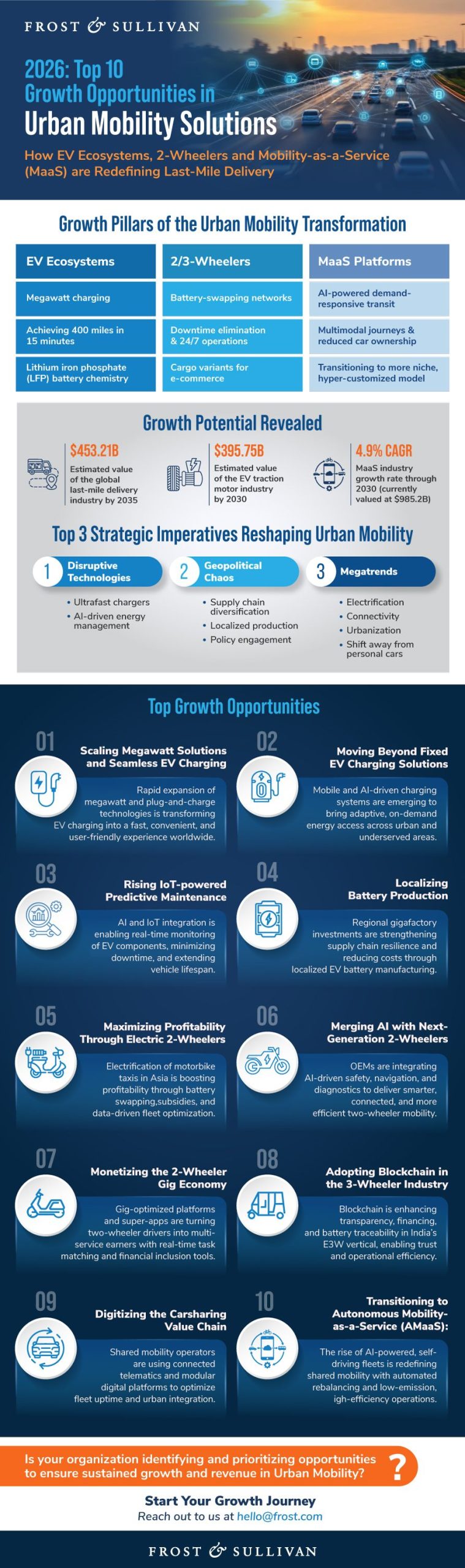
The shift encompasses three converging pillars:
- Next-generation electric vehicle (EV) ecosystems with megawatt charging.
- Electric two wheelers and three-wheelers optimized for last-mile mobility.
- Mobility-as-a-Service platforms evolving toward fully autonomous operations.
Uncover the Top Growth Opportunities now! Listen to the podcast. 🎧
DID YOU KNOW?
By 2030, the global motor industry is projected to reach approximately $395.75 billion, expanding at an average annual rate of 20.0% from 2024 to 2030.
Is your organization prepared to lead the urban mobility transformation?
What’s Happening Across Urban Centers Globally
Across Asia, Europe, and North America, regulatory mandates, economic incentives, and consumer demand are giving rise to unprecedented growth opportunities.
- Southeast Asia and India: ride-hailing platforms are electrifying entire fleets. Gojek and Grab are deploying AI-powered route optimization that reduces energy consumption per kilometer while maximizing driver earnings. Battery-swapping networks, once dismissed as niche technology, are becoming essential infrastructure, keeping electric two-wheelers operational 24/7 without traditional charging downtime.
- Europe and North America: are simultaneously scaling ultrafast charging networks. BYD, Tesla, and emerging startups are expanding networks that make electric trucks and buses economically viable for long-haul commercial operations.
The Numbers Behind the Transformation
- Last-Mile Mobility Expansion: The global last-mile delivery segment is projected to exceed $453.21 billion by 2035, a 8% compound annual growth rate. Asia-Pacific leads growth, driven by e-commerce penetration and quick-commerce platforms requiring cost-effective, high-frequency last-mile mobility solutions.
- EV Ecosystem Growth: The EV traction motor industry is projected to reach $395.75 billion by 2030, expanding at 20.0% annually. This underscores that electrification is becoming the default powertrain standard across commercial vehicles (CVs).
- MaaS and Autonomous Acceleration: The Mobility-as-a-Service industry is growing at 25.4% CAGR through 2029, currently valued at $270.8 million. Remarkably, 35% of consumers have already adopted MaaS services.
Strategic Imperatives Reshaping Urban Mobility Solutions
- Disruptive Technologies: Ultrafast and megawatt chargers are advancing rapidly, enabling EVs to gain up to 400 miles of range in under 15 minutes. AI and ML are optimizing charger placement and energy management to improve uptime and lower costs.
- Geopolitical Chaos: Navigating supply disruptions, volatile fuel prices, and shifting trade policies is becoming critical, prompting two/three-wheeler stakeholders to diversify sourcing, localizing production, and strengthening policy engagement.
- Transformative Megatrends: Electrification, connectivity, urbanization, and changing consumer preferences are heavily impacting carsharing by enabling more efficient, sustainable, and user-friendly shared mobility solutions. Cities are proactively trying to move away from personal cars to other sustainable transport options.
Growth Challenges Confronting Organizations
- Grid Infrastructure and Power Management: Megawatt charging requires grid upgrades, transformer installations, and interconnection negotiations, often requiring 18-36 months. Globally, many regions lack infrastructure capacity for simultaneous high-capacity charging.
- Capital Intensity and return on investment (ROI) Timing: Charging networks, autonomous fleet deployment, and integrated MaaS platforms require substantial upfront investment. Return timelines extend 5-7 years, pressuring organizations with shorter planning horizons.
- Regulatory Fragmentation: Charging standards differ between continents and battery recycling regulations vary nationally. Autonomous vehicle testing faces different approval processes across regions. Navigating this complexity while maintaining operational efficiency remains challenging.
Is your organization’s long-term growth strategy resilient enough to overcome these challenges?
Growth Drivers Propelling Transformation Forward
Cost Economics of Electrification: Battery prices are declining continuously. Electric two- and three-wheelers now deliver cost-per-kilometer advantages over combustion engines. Moreover, fleet operators are achieving profitability within 18-24 months through lower fuel and maintenance costs despite higher capital expenditure.
Increasing E-commerce and Quick-commerce Demand: Same-day and next-day delivery expectations have become a new-normal in the last 3-4 years. Quick-commerce platforms (10 to 30-minute delivery providers) are intensifying demand for cost-effective last-mile mobility solutions.
Government Support and Carbon Mandates: Purchase incentives, charging infrastructure investments, and carbon pricing mechanisms are clearly favoring electric mobility. EU commercial vehicle regulations, India’s electric three-wheeler initiatives, and California’s zero-emission mandates are accelerating policy tailwinds.
Top Three Growth Opportunities Driving the Transformation
- Megawatt Charging Infrastructure and Seamless Energy Access: Expanding charging access and reducing wait times drive consumer adoption globally. Megawatt charging technologies enable rapid refueling with greater convenience. Governments and private investors across Asia-Pacific and South America are aggressively scaling infrastructure to meet demand.
- Flexible and Autonomous Charging Solutions: Addressing geographic coverage gaps through mobile charging vehicles and autonomous charging robots. These technologies are reducing congestion and serving underserved areas while enabling predictive maintenance and dynamic load balancing.
- IoT-Powered Predictive Maintenance and Fleet Intelligence: Monitoring motor health, temperature, and vibrations in real-time through IoT-based predictive maintenance. Cloud-connected platforms detect anomalies early, significantly reducing downtime and extending component lifespan.
Best Practices for Industry Leadership
- Combining megawatt infrastructure investment with grid modernization partnerships, on-site battery energy storage, and intelligent energy management software. Winning operators are managing peak loads intelligently rather than simply multiplying charging stations.
- Developing strategic partnerships combining battery-swapping infrastructure with ride-hailing platforms and fleet operators. Most profitable models are integrating funding mechanisms (loans, leases, micro-insurance, etc.) to reduce friction for end-users.
- Forward-thinking companies are investing in IoT sensor integration and cloud analytics before competitors saturate this space. Organizations owning vehicle health data are winning in terms of customer relationships and aftermarket revenues.
Which proven best practices from industry leaders could help you in gaining a competitive edge?
Companies to Action: The Urban Mobility and Last Mile Delivery Champions
- Electric Vehicle Ecosystem Leaders: BYD, Tesla, Nio, Lucid
- Last-Mile Mobility Innovators: Gojek, Rapido, Ultraviolette Automotive, BMW Motorrad
- MaaS and Autonomy Pioneers: Baidu (Apollo Go), Zoox, Ridecell, Zipcar
- Supply Chain Specialists: CATL, Fluence, VeChain
Frequently Asked Questions
What are the main growth drivers for urban mobility?
Rapid urbanization, the expansion of the gig economy, and a global shift toward decarbonization are the key factors driving demand. Governments are also providing supportive subsidies for EV adoption in many countries across Europe, Southeast Asia and India.
How is AI changing last-mile delivery?
AI is powering predictive maintenance to reduce vehicle downtime, route analytics to maximize fleet utilization, and advanced rider assistance systems to improve safety in congested urban environments.
What is the role of megawatt charging in EV adoption?
Megawatt charging enables rapid refueling, significantly reducing wait times and making electric mobility more convenient for both consumers and commercial fleet operators.
Why is localized battery production becoming a priority?
Localization helps OEMs streamline logistics, lower production costs, and comply with stricter regional regulations while enhancing overall supply chain resilience against geopolitical disruptions.
Want to dive deeper? Click here to connect with our mobility growth experts to discover how these insights can help you achieve sustained growth. You can also connect with us at [email protected].
Ready to Lead the Transformation?
- Book a Growth Strategy Session: Align your growth roadmap with Frost & Sullivan’s visionary Growth Pipeline™ Dialog.
- Engage with Growth Experts: Co-design AI-enabled, data-driven operating models that scale industry-specific and commercial impact.
- Share Your Transformation Story: Position your organization as a transformation leader through Frost & Sullivan’s Transformational Growth Leadership platform.
- Join the Growth Council: Collaborate with industry leaders shaping the future of your ecosystem.
- Nominate for the Best Practices Recognition: Be recognized for excellence in growth strategy, execution, and customer impact.
- Demonstrate Industry Positioning on the Frost Radar™: Benchmark your growth performance and innovation strength against industry competitors.
- Activate Brand & Demand Growth: Accelerate awareness, engagement, and revenue growth through integrated brand and demand generation strategies.
Annexure
Frost & Sullivan has curated analyses that highlight growth opportunities, strategic imperatives, and technological transformations across the urban mobility segment, offering critical insights for innovation and modernization.
Here are a few of them that you would like reading:
Indian Electric Two-wheeler Growth Opportunities
Self-Driving Technology for Ridehailing Market, Global, 2026–2035
Voice of Consumer: Buyer Profiles of Three-Wheelers, India
Motorbike Taxi Market, Southeast Asia and India, 2026–2030