This blog is based on Frost & Sullivan’s analyses, “Mobile Threat Defense, Global, 2025–2029” and “Frost Radar™: Mobile Threat Defense, 2026,” authored by Ozgun Pelit, from the Security Practice Area.
Executive Summary
Mobile Threat Defense (MTD) is becoming a strategic component of enterprise cybersecurity as smartphones and tablets evolve into critical business endpoints. The convergence of mobile-first work environments, artificial intelligence (AI)-enabled threats, Bring Your Own Device (BYOD), mobile applications, digital transactions, and zero trust architectures is expanding the need for continuous protection beyond traditional mobile device management.
Key Takeaways
- AI is reshaping mobile security, enabling faster detection of sophisticated, emerging, and zero-day threats.
- MTD is converging with enterprise security platforms, connecting mobile risk with identity, Zero Trust, Extended Detection and Response (XDR), and security operations.
- Privacy and shadow AI are emerging priorities, particularly across BYOD environments and AI-enabled mobile workflows.
- MTD presents new growth opportunities across integrated security, privacy-centric protection, mobile AI security, and advanced threat intelligence.
Mobile devices are becoming critical gateways to enterprise applications, identities, transactions, and business operations, fundamentally changing how organizations approach mobile security. Mobile Threat Defense (MTD) is emerging as a critical security layer as mobile-first work models, remote operations, and enterprise applications expand the attack surface across devices, applications, networks, and user interactions.
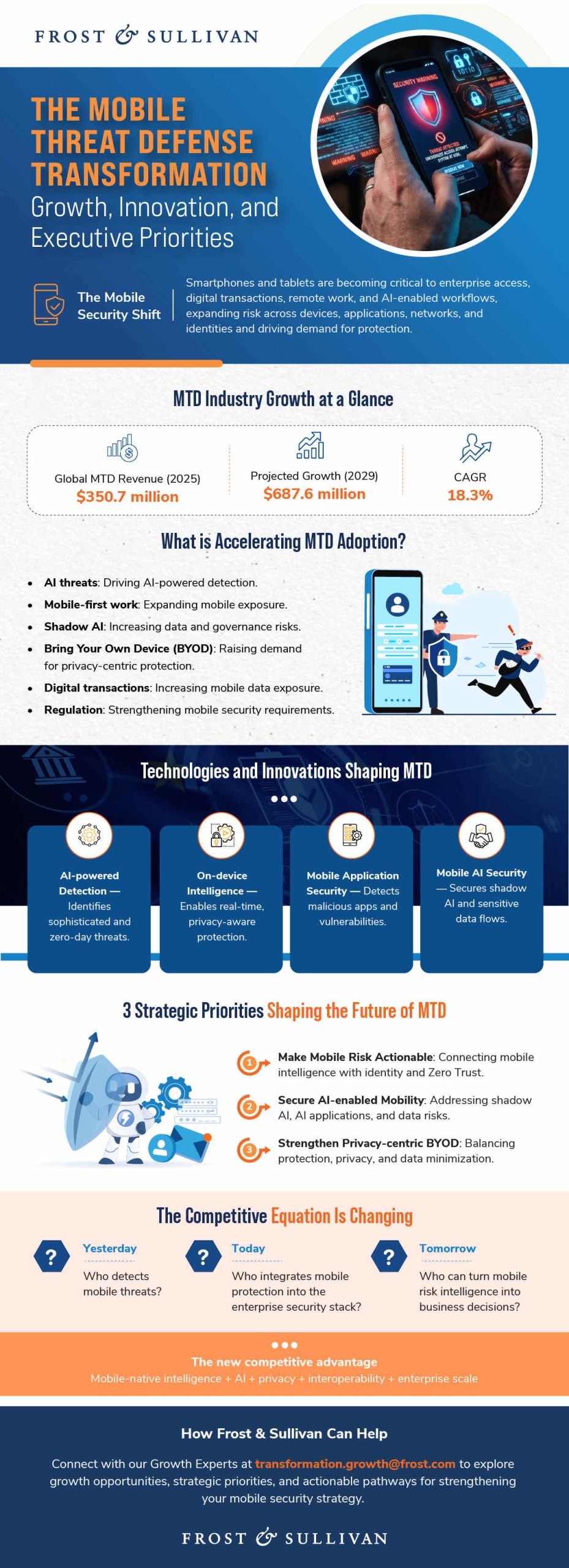
Mobile Device Management (MDM) and Unified Endpoint Management (UEM) remain essential for device administration and policy enforcement, but MTD extends protection through continuous threat detection, behavioral monitoring, and AI-driven intelligence. According to Frost & Sullivan, the global market for standalone MTD solutions is projected to grow from $350.7 million in 2025 to $687.6 million by 2029, at an 18.3% CAGR, reflecting growing demand for comprehensive mobile protection.
To navigate this shift, security leaders should integrate MTD with identity, Zero Trust, and security operations while strengthening AI-driven detection and privacy-centric protection. Aligning these capabilities with broader cybersecurity priorities will help organizations strengthen resilience and support secure digital growth.
Can your mobile security strategy keep pace with enterprise transformation?
Tune into our latest podcast episode on Growth Opportunities in Mobile Threat Defense Market.
What Is Mobile Threat Defense?
Mobile Threat Defense is a security capability designed to protect corporate-owned and BYOD mobile devices against threats targeting operating systems, applications, networks, and user identities.
Modern MTD platforms combine on-device security analytics, AI-powered threat intelligence, behavioral monitoring, and cloud-based analysis to detect known and emerging threats in real time. These capabilities help organizations defend against malware, phishing, malicious applications, network exploits, operating-system vulnerabilities, credential theft, and increasingly sophisticated mobile attacks.
Traditional Mobile Security vs. Intelligent Mobile Threat Defense
| Traditional Mobile Security | Intelligent Mobile Threat Defense |
| Device configuration and administration | Continuous threat detection |
| Periodic security checks | Real-time monitoring |
| Policy enforcement | Risk-based security decisions |
| Reactive threat identification | Behavioral and predictive detection |
| Device-centric visibility | Device, application, network, and user-risk visibility |
| Stand-alone mobile controls | Integration with Identity and Access Management (IAM), UEM, Security Information and Event Management (SIEM), XDR, Security, Orchestration, Automation and Response (SOAR), and Secure Access Service Edge (SASE) |
| Limited visibility in BYOD environments | Privacy-centric risk monitoring |
Strategic Imperatives Shaping the Mobile Threat Defense Market
- Disruptive Technologies
Artificial intelligence (AI) and machine learning (ML) are improving behavioral analytics, anomaly detection, predictive threat intelligence, and zero-day protection. At the same time, the growing use of shadow AI on mobile devices is creating new requirements around application monitoring, data protection, and AI governance.
- Customer Value Chain Compression
MTD is increasingly being integrated with UEM, IAM, SIEM, XDR, SOAR, and SASE to reduce security silos and enable risk-based decisions across the enterprise. Mobile security is becoming part of a connected security workflow rather than a stand-alone capability.
- Competitive Intensity
Competition is intensifying in the mobile security market as specialists and broader cybersecurity providers converge. Vendors are differentiating through AI-driven threat detection, mobile-native intelligence, application security, privacy, deployment flexibility, scalability, and integration with wider security ecosystems. Leading participants include Zimperium, Lookout, Check Point, Corrata, ESET, and Pradeo.
According to Frost & Sullivan, Mobile Threat Defense is evolving from a device-level security capability into an enterprise-wide intelligence layer that connects mobile risk with identity, Zero Trust, and security operations. Vendors that combine mobile-native protection with AI-driven detection, privacy, and broader security integration will be best positioned to capture the next phase of market growth.
Recent Developments and Key Growth Drivers Accelerating MTD Adoption
- AI-driven threats are escalating, increasing demand for AI-powered detection and behavioral analytics.
- Mobile-first work is expanding the attack surface, with greater reliance on smartphones, tablets, and enterprise applications.
- Shadow AI is creating new risks, increasing the need to monitor unsanctioned AI applications and data flows.
- BYOD is driving privacy-centric security, with organizations seeking protection without compromising employee privacy.
- Security integration is accelerating, connecting MTD with UEM, IAM, Zero Trust, XDR, SIEM, SOAR, and SASE.
- Regulatory requirements are strengthening mobile security priorities, particularly for organizations handling sensitive data.
Top 3 Growth Opportunities Shaping the Mobile Threat Defense Market
Enterprise Mobile Threat Defense is creating new opportunities to integrate mobile security with Zero Trust, identity, and AI governance. They include:
- Mobile AI Security and Shadow AI Governance
AI is becoming embedded across mobile applications, devices, and workflows, creating demand for greater visibility into AI usage and data sharing. MTD providers can address this opportunity through application monitoring, data-loss prevention, behavioral analytics, and AI-specific policy controls, particularly as on-device AI models and agents become more prevalent.
- Integrated Mobile Security and Zero Trust
The growing use of mobile devices to access enterprise applications and sensitive resources is creating opportunities to connect MTD with IAM, conditional access, Zero Trust, and SASE. Real-time mobile risk signals can inform access decisions, helping organizations strengthen adaptive security while simplifying broader security operations.
- Privacy-centric Security for BYOD and Regulated Environments
The expansion of BYOD is increasing demand for MTD solutions that balance enterprise protection with employee privacy. Privacy-first architectures that minimize personal data collection while maintaining effective threat detection can help overcome adoption barriers and strengthen mobile security across regulated environments.
According to Frost & Sullivan, organizations that combine mobile security effectiveness with privacy, interoperability, and broader enterprise integration will be better positioned to capture the next wave of MTD growth.
Benchmarking the Top Innovators Driving Mobile Threat Defense
The Frost Radar™: Mobile Threat Defense, 2026, benchmarks providers across Growth and Innovation, highlighting a competitive landscape increasingly shaped by mobile-native capabilities, AI, privacy, and broader security integration.
- Zimperium: Mobile-native Innovation at Scale — A leading performer across growth and innovation, combining AI/ML-driven detection, application vetting, and mobile threat analysis with large-scale enterprise deployment.
- Lookout: Advancing Mobile AI Security — Differentiates through extensive mobile telemetry, threat intelligence, global scale, and growing capabilities for securing AI usage and data flows.
- Check Point: Connecting MTD With Zero Trust — Leverages its broader security portfolio to integrate mobile threat intelligence with SASE, secure access, and risk-based security decisions.
- Corrata: Privacy-first Mobile Protection — Stands out through on-device security and privacy-preserving threat detection, while expanding data loss prevention for generative AI (GenAI) and cloud applications.
- Pradeo: Automated On-device Protection — Combines AI-powered malware prediction, application security, and automated remediation across Android and iOS environments.
Access the Sample Analysis for complete benchmarking of leading Mobile Threat Defense providers.
Best Practices for Technology Leaders Navigating Mobile Threat Defense
- Treat mobile as a strategic attack surface
Assess mobile alongside traditional endpoints, networks, cloud infrastructure, and identities. Identify where mobile devices are accessing sensitive applications, data, and enterprise resources.
- Prioritize AI-powered and on-device detection
Select platforms that can detect behavioral anomalies, sophisticated malware, phishing, and zero-day threats without relying solely on cloud analysis. Hybrid architectures combining on-device and cloud intelligence can provide scalable, low-latency protection.
- Integrate mobile risk into enterprise security workflows
Enterprise Mobile Threat Defense should be integrated with UEM, IAM, SIEM, XDR, SOAR, SASE, and conditional access platforms to enable mobile risk signals to inform broader security decisions. This integration can help organizations connect mobile protection with enterprise-wide security operations.
- Build privacy into BYOD strategies
Select architectures that minimize personal data collection and clearly separate enterprise security requirements from employee privacy.
- Prepare for mobile AI security
Evaluate how employees are using GenAI and AI-enabled applications on mobile devices. Establish visibility and governance for unsanctioned AI services, sensitive data flows, and risky application behavior.
The Next Phase of Competition in Mobile Security Market
Competition in MTD is shifting toward AI-powered protection, platform integration, privacy, and enterprise-wide risk intelligence. Vendors are differentiating through on-device AI, application security, automated response, data protection, and integration with Zero Trust and SASE, while broader cybersecurity providers are embedding mobile capabilities into their wider security platforms.
North America remains the largest region, while APAC is expected to experience the fastest growth, supported by mobile-first economies, regulatory developments, and digital transformation. Providers that combine mobile-native security with AI, privacy, interoperability, and scalable enterprise delivery will be better positioned to capture emerging opportunities.
Frequently Asked Questions: Mobile Threat Defense
1. What is Mobile Threat Defense in cybersecurity?
Mobile Threat Defense (MTD) is a cybersecurity capability that continuously protects mobile devices against threats targeting devices, applications, networks, and users. It uses technologies such as behavioral monitoring, threat intelligence, and AI-driven detection to identify and respond to malware, phishing, malicious applications, vulnerabilities, and other mobile-specific threats.
2. What are mobile security threats?
Mobile security threats include malware, phishing and smishing, malicious applications, network attacks, credential theft, device vulnerabilities, spyware, and data leakage. The growing use of mobile devices for enterprise access and digital transactions is also increasing exposure to sophisticated and emerging threats.
3. Why is the mobile security market growing?
MTD adoption is being driven by the expansion of mobile-first work environments, remote and frontline operations, enterprise mobile applications, BYOD, mobile banking, shadow AI, sophisticated mobile threats, and evolving regulatory requirements. Organizations are increasingly seeking continuous protection that extends beyond traditional mobile device management.
4. How does AI improve Mobile Threat Defense?
AI and machine learning enhance behavioral analysis, anomaly detection, predictive threat intelligence, and the identification of sophisticated and zero-day threats. On-device AI can also enable faster detection and response while reducing reliance on cloud-based analysis.
5. Why is privacy important in Mobile Threat Defense?
Privacy is particularly important for BYOD environments, where organizations need security visibility without unnecessarily accessing employees’ personal information. Privacy-centric architectures can minimize data collection while still identifying compromised or high-risk devices, helping improve employee trust and MTD adoption.
6. Which industries are adopting Mobile Threat Defense?
Key adopting sectors include banking and financial services, government and defense, healthcare, technology and telecommunications, manufacturing, retail and e-commerce, utilities and energy, education, and professional services. Industries handling sensitive data and operating under elevated cybersecurity requirements represent particularly strong opportunities for MTD adoption.
7. What should organizations look for in Mobile Threat Defense solutions?
Organizations should evaluate AI-powered threat detection, on-device protection, application security, continuous monitoring, privacy capabilities, scalability, deployment flexibility, and integration with UEM, IAM, SIEM, XDR, SOAR, and SASE environments.
Ready to Lead the Transformation?
- Schedule a Growth Strategy Dialog: Align your growth roadmap with Frost & Sullivan’s Visionary Growth Pipeline™ Dialog.
- Engage with Growth Experts: Co-design AI-enabled, data-driven operating models that scale industry-specific and commercial impact.
- Showcase Your Transformational Leadership: Position your organization as a transformation leader through Frost & Sullivan’s Transformational Growth Leadership platform.
- Join the Growth Council: Collaborate with industry leaders shaping the future of your ecosystem.
- Explore Best Practices Recognition: Be recognized for excellence in growth strategy, execution, and customer impact.
- Benchmark Your Industry Positioning on the Frost Radar™: Benchmark your growth performance and innovation strength against industry competitors.
- Tell Your Story: Accelerate awareness, engagement, and revenue growth through integrated brand and demand generation strategies.