This blog is based on Frost & Sullivan’s recent analysis, “Automated Security Validation (ASV) Market, Global, 2025-2030,” authored by Daphne Dwiputriane and Ying Ting Neoh from the Security Practice Area.
Every security program is built on the assumption that controls will perform when tested. Today’s threat environment challenges that assumption, as attacks move across cloud, identities, applications, and AI-driven environments, exposing gaps that traditional validation methods struggle to detect. At the same time, expanding digital ecosystems and increasing regulatory pressure are reshaping how organizations measure cybersecurity effectiveness.
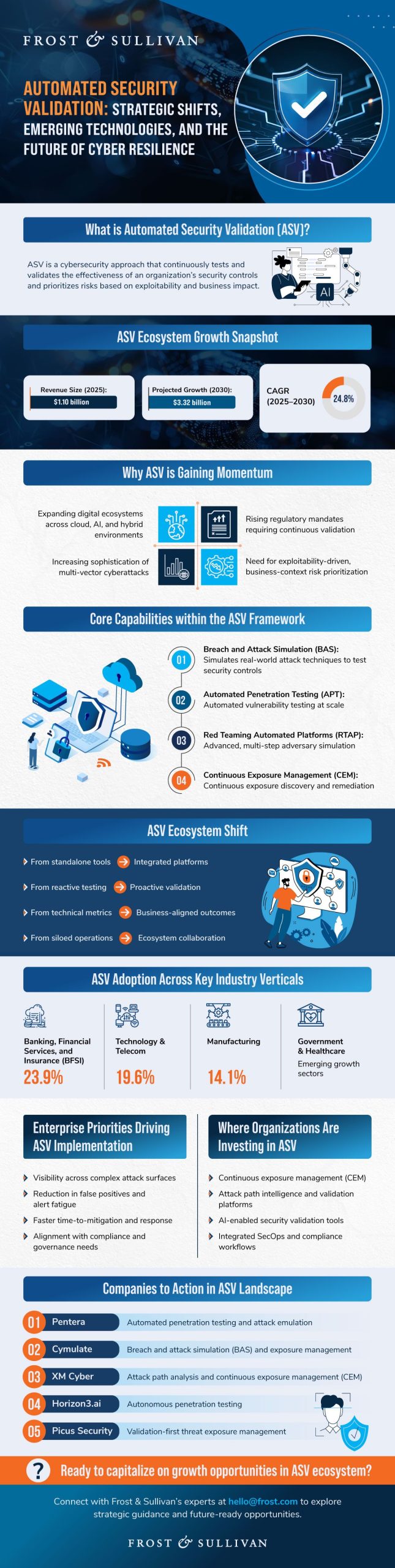
As a result, Automated Security Validation (ASV) is gaining traction, enabling continuous simulation of real-world attack scenarios and verification of control performance. The global ASV domain is projected to grow from $1.10 billion in 2025 to $3.32 billion by 2030, highlighting its rapid rise as a critical capability for modern cyber resilience. This momentum reflects a broader shift, prompting leadership teams to strengthen continuous validation practices and better align security efforts with enterprise risk and resilience goals.
Ready to lead in the next phase of Automated Security Validation?
Explore:
- Emerging validation technologies
- Regional adoption dynamics
- Emerging growth opportunities
- Competitive benchmarking
How prepared is your organization to align cybersecurity strategy with emerging ASV transformation?
Listen to our podcast episode on growth opportunities in the Automated Security Validation ecosystem.
The Strategic Importance of Automated Security Validation
Automated Security Validation is a proactive cybersecurity approach that continuously tests and validates the effectiveness of security controls across an organization’s environment. Unlike static assessments, ASV simulates real-world attack scenarios to identify exploitable vulnerabilities and prioritize remediation based on actual risk.
The ASV framework brings together four key capabilities:
- Breach and Attack Simulation (BAS): Continuous simulation of real-world attack techniques to test security controls
- Automated Penetration Testing (APT): Scalable, automated vulnerability testing
- Red Teaming Automated Platforms (RTAP): Advanced, multi-step adversary simulation
- Continuous Exposure Management (CEM): Ongoing identification and remediation of exposures
ASV matters because it shifts cybersecurity from reactive vulnerability fixes to continuous validation and actionability, enabling organizations to identify security gaps and exploitability and prioritize the exposures that have the greatest impact on business risk and outcomes.
Strategic Imperatives Driving Growth Across ASV Ecosystem
Transformative Megatrends
Expanding attack surfaces across on-premises, multi-cloud, Operational Technology (OT), and AI environments are driving demand for end-to-end visibility and exploitability-based risk prioritization, with growing focus on AI-related exposures.
Industry Convergence
The industry is advancing toward integrated platforms, replacing fragmented tools with solutions that combine validation, exposure management, and Security Operations (SecOps) across domains such as vulnerability management (VM), external attack surface management (EASM), governance, risk, and compliance (GRC), and extended detection and response (XDR).
Disruptive Technologies
Cloud-native architectures, AI-driven analytics, and attack path modeling are enabling more adaptive, scalable, and realistic security validation.
Is your organization aligned with the key strategies shaping the future of security validation? Download the full analysis.
Key Growth Drivers and Restraints Influencing the ASV Landscape
Growth Drivers
- Expanding digital ecosystems: Increased cloud adoption, remote work, and connected systems are widening organizational attack surfaces
- Regulatory pressure: Frameworks such as DORA, NIS2, and PCI DSS 4.0 are driving demand for continuous validation and audit-ready evidence
- AI and cloud adoption: Rapid integration of AI introduces new risks, increasing the need for advanced validation capabilities
- Platform consolidation: Organizations are seeking unified solutions to reduce complexity and improve efficiency
Growth Restraints
- Limited awareness: Many enterprises still view ASV as an extension of vulnerability management
- Budget constraints: Macroeconomic pressures are limiting cybersecurity investments priorities
- Operational inertia: Resistance to replacing legacy tools and processes
- Channel readiness: Limited partner maturity and long procurement cycles slowing adoption
Regional Adoption Pattern Across the Global ASV Ecosystem
- North America: The most mature and largest economy, driven by high cybersecurity awareness and advanced adoption of emerging technologies.
- Europe, the Middle East, and Africa (EMEA): Strong adoption influenced by strict regulatory frameworks, with emphasis on compliance-aligned solutions.
- Asia-Pacific: Growing economy with varied maturity levels, where cost efficiency and scalability are key considerations.
- Latin America: Early-stage adoption, primarily driven by regulatory requirements in sectors such as Banking, Financial Services, and Insurance (BFSI).
Expert’s Corner
“As attack surfaces continue to widen, security teams are drowning in fragmented alerts. Over the next three years, Automated Security Validation will continue to gain momentum as a core enabler of CTEM, correlating BAS, APT, RTAP, and CEM signals into a unified view. This shift from reactive vulnerability scanning to continuous, contextual validation not only cuts through alert fatigue but also prioritizes remediation based on real exploitability and business‑critical risk.”
Ying Ting Neoh,
Industry Analyst, Cybersecurity, Frost & Sullivan
Growth Opportunities in Automated Security Validation
- Continuous ASV Platforms with Attack Path Analysis
Organizations are moving toward unified platforms that provide continuous discovery, validation, and remediation. Attack path analysis, powered by knowledge graphs, is enabling enterprises to understand how vulnerabilities connect and how attackers move across systems.
- Strategic Alliances and MSSP Partnerships
Partnerships with cloud providers, managed security service providers (MSSPs), and system integrators are becoming critical for scaling ASV adoption. These alliances enable deeper integration into enterprise workflows and faster time-to-value.
- AI-driven Security Validation
The rise of AI is creating both risk and opportunity. ASV vendors are expanding capabilities to validate AI systems, including Large Language Models (LLMs), while leveraging AI for predictive analytics, automated remediation, and real-time decision-making.
Which strategic opportunities should your organization prioritize in the ASV ecosystem?
Download the full analysis to access detailed ASV growth opportunity analytics.
Best Practices for Decision Makers to Strengthen Security Validation Strategies
- Embracing continuous, attacker-centric validation to strengthen real-world cyber resilience
- Prioritizing exploitability and business impact to drive risk-informed remediation
- Consolidating fragmented tools into unified platforms to enhance visibility and operational efficiency
- Leveraging AI-driven capabilities to enable contextual risk prioritization and faster decision-making
- Aligning security validation with compliance mandates and enterprise risk objectives
Advancing Toward Continuous, Intelligence-driven Cybersecurity
Automated Security Validation is redefining how organizations approach cybersecurity. By transitioning from periodic assessments to continuous, attacker-centric validation, enterprises can improve visibility into risk exposure, prioritize critical vulnerabilities, and strengthen resilience. For leadership teams, the focus is on ensuring security controls are continuously validated against real-world threats.
Frequently Asked Questions: Automated Security Validation
1. What is Automated Security Validation (ASV) in cybersecurity?
ASV is a proactive cybersecurity approach that continuously tests and validates the effectiveness of security controls by simulating real-world attack scenarios. It provides ongoing visibility into security posture and helps prioritize remediation based on exploitability and business impact.
2. Why is Automated Security Validation important?
ASV is important because modern threat environments are dynamic and complex. It enables organizations to continuously assess their security posture, identify exploitable gaps, and ensure security controls remain effective against evolving attack techniques while supporting compliance and risk management.
3. How does ASV differ from Traditional Security Testing?
Traditional security testing methods, such as periodic penetration testing and vulnerability scans, provide point-in-time insights. ASV, in contrast, operates continuously, simulates real-world attacker behavior, and delivers contextual insights that help prioritize risks and improve remediation efforts.
4. How often should security validation be performed?
Security validation should be performed continuously. Given the constant evolution of threats, infrastructure changes, and software updates, continuous validation ensures that security controls remain effective and aligned with current risk exposure.
5. What are the primary benefits of using ASV?
- Continuous visibility into security posture
- Prioritization of risks based on exploitability and business impact
- Reduced alert fatigue through contextual insights
- Improved compliance with audit-ready evidence
- Faster remediation and stronger overall cyber resilience
Ready to Lead the Transformation?
- Book a Growth Strategy Session: Align your growth roadmap with Frost & Sullivan’s visionary Growth Pipeline™ Dialog.
- Engage with Growth Experts: Co-design AI-enabled, data-driven operating models that scale industry-specific and commercial impact.
- Share Your Transformation Story: Position your organization as a transformation leader through Frost & Sullivan’s Transformational Growth Leadership platform.
- Join the Growth Council: Collaborate with industry leaders shaping the future of your ecosystem.
- Nominate for the Best Practices Recognition: Be recognized for excellence in growth strategy, execution, and customer impact.
- Demonstrate Industry Positioning on the Frost Radar™: Benchmark your growth performance and innovation strength against industry competitors.
- Activate Brand & Demand Growth: Accelerate awareness, engagement, and revenue growth through integrated brand and demand generation strategies.