This blog is based on Frost & Sullivan’s analysis, “Frost Radar™: Risk Intelligence Solutions, 2026,” authored by Danielle VanZandt and Dolores Aleman, from the Security Practice Area.
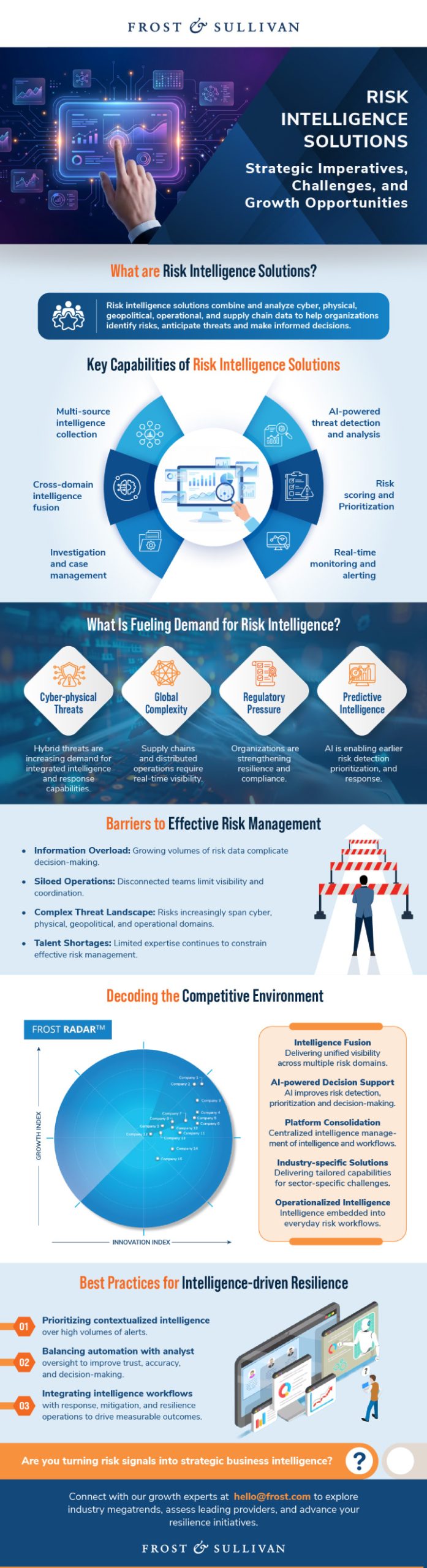
The boundaries between cyber, physical, operational, and geopolitical risks are becoming increasingly blurred, creating new challenges for organizations seeking to anticipate and respond to disruptions. This convergence is driving demand for integrated approaches to risk management that provide a holistic view of the enterprise risk.
In response, enterprises are prioritizing risk intelligence platforms that can unify diverse risk signals, enhance situational awareness, and enable more proactive, intelligence-driven making across security, operations, and leadership functions.
According to Frost & Sullivan’s latest Frost Radar™ analysis, the risk intelligence industry is expected to grow from $58.8 billion in 2025 to $170.1 billion by 2030, reflecting a 19.4% CAGR. This growth reflects a broader shift from reactive threat monitoring toward intelligence-driven resilience, where organizations are leveraging advanced analytics, contextual intelligence, and predictive capabilities to anticipate disruptions and make more informed decisions.
Is your organization equipped to manage converging cyber, physical, geopolitical, and operational risks?
Listen to our growth podcast episode on the leaders and technologies shaping the future of risk intelligence.
|
Frost & Sullivan’s Frost Radar™: Risk Intelligence Solutions, 2026 Highlights · Strategic assessment of the leading risk intelligence providers across innovation and growth · Analysis of AI-powered intelligence, predictive analytics, and converged risk management strategies · Best practices for improving situational awareness, resilience, and risk-informed decision-making · Benchmarking of the providers advancing intelligence-driven risk operations Click here to download the sample and benchmark your risk intelligence strategy.
|
Strategic Imperative: Why Enterprises Are Investing in Risk Intelligence Platforms
Organizations have access to more data than ever before, yet transforming that information into timely, actionable decisions remains a significant challenge. Security teams, operations leaders, and executives often rely on multiple systems and data sources to assess emerging threats, creating gaps in visibility and slowing response efforts.
Several factors are driving increased investment in risk intelligence platforms:
- Growing convergence of cyber, physical, operational, and geopolitical risks
- Increasing demand for real-time visibility across global operations and supply chains
- Evolving regulatory requirements related to resilience, compliance, and governance
- Greater emphasis on predictive intelligence to support proactive decision-making
- Need for stronger coordination across security, risk, operations, and executive leadership teams
For security and business leaders, risk intelligence is evolving from a monitoring function into a strategic capability that supports resilience, continuity, and enterprise-wide decision-making.
How Industry Leaders Are Advancing Intelligence-driven Resilience
- Converged Risk Visibility: Leading platforms are integrating cyber, physical, geopolitical, operational, and supply chain intelligence to deliver a unified view of organizational risk.
- AI-powered Decision Support: Providers are leveraging AI and machine learning to identify anomalies, detect emerging threats, prioritize risks, and accelerate decision-making.
- Predictive Risk Analysis: Advanced Risk intelligence solutions are evolving beyond monitoring and alerting toward forecasting potential disruptions and enabling proactive mitigation strategies.
- Operationalized Intelligence: Leading providers are embedding intelligence directly into workflows that support investigations, crisis management, executive protection, fraud prevention, and resilience planning.
Growth Opportunities Shaping the Risk Intelligence Industry
- Converged Risk Intelligence: Unifying cyber, physical, operational, and digital risk signals is enabling more proactive and coordinated decision-making.
- Explainable AI Adoption: Transparent AI-driven intelligence is improving threat detection while strengthening trust, accountability, and governance.
- Industry-specific Solutions: Tailored intelligence offerings aligned with sector-specific risks and business priorities are accelerating adoption and delivering greater value.
Leading Innovators Shaping the Risk Intelligence Landscape
- Ontic: Advancing preventive, human-centric risk intelligence through AI-assisted threat detection, investigations, and threat assessment workflows.
- Dataminr: Strengthening cross-domain intelligence with AI-powered detection, cyber-physical risk convergence, and real-time situational awareness.
- Seerist: Delivering decision-centric intelligence through predictive analytics, contextual risk assessment, and explainable AI capabilities.
- Crisis24: Expanding enterprise resilience through AI-enabled intelligence, global risk monitoring, and integrated crisis management capabilities.
- Flashpoint: Combining cyber, fraud, physical security, and vulnerability intelligence into a unified risk intelligence framework.
Download the sample analysis to explore how the leading risk intelligence providers compare across innovation, growth, and strategic execution.
What Will Define Leadership in Risk Intelligence?
Competition in the risk intelligence industry is centered on intelligence quality, operational relevance, and decision support capabilities.
Key areas of differentiation include:
- Advancing AI-powered threat detection and predictive analytics
- Expanding cyber-physical risk convergence capabilities
- Delivering explainable and transparent AI-driven intelligence
- Supporting executive decision-making with contextualized risk analysis
- Enabling broader operational resilience through integrated workflows
Future industry leaders will be defined by their ability to combine intelligence fusion, predictive analytics, AI-driven automation, and operational resilience into a unified decision-support platform.
Frequently Asked Questions: Risk Intelligence
What is a risk intelligence platform?
Why are organizations investing in risk intelligence?
What are common risk intelligence use cases?
How does AI improve risk intelligence?
What is converged risk intelligence?
What should organizations evaluate when selecting a risk intelligence platform?
Ready to Lead the Transformation?
- Book a Growth Strategy Session: Align your growth roadmap with Frost & Sullivan’s visionary Growth Pipeline™ Dialog.
- Engage with Growth Experts: Co-design AI-enabled, data-driven operating models that scale industry-specific and commercial impact.
- Share Your Transformation Story: Position your organization as a transformation leader through Frost & Sullivan’s Transformational Growth Leadership platform.
- Join the Growth Council: Collaborate with industry leaders shaping the future of your ecosystem.
- Nominate for the Best Practices Recognition: Be recognized for excellence in growth strategy, execution, and customer impact.
- Demonstrate Industry Positioning on the Frost Radar™: Benchmark your growth performance and innovation strength against industry competitors.
- Activate Brand & Demand Growth: Accelerate awareness, engagement, and revenue growth through integrated brand and demand generation strategies.