This blog is based on the analyses titled, “Energy-harvesting Sensors for Large-Scale Ambient IoT,” authored by Frost & Sullivan’s Sensors & Instrumentation growth expert, Varun Babu from the TechVision team.
Energy-harvesting sensors are emerging as a foundational technology layer for large-scale Ambient Internet of Things (IoT) ecosystems as organizations prioritize autonomous sensing, intelligent infrastructure monitoring, and scalable low-power connectivity. Initially adopted for niche ultra-low-power applications, these sensors are rapidly evolving into intelligent sensing platforms capable of supporting distributed and infrastructure-intensive environments without dependence on wired power or frequent battery replacement.
Revealed: Energy-harvesting Sensors’ Next Growth Phase
Gain a clear view of how battery-free sensing, ultra-low-power electronics, and Ambient Internet of Things ecosystems are reshaping smart infrastructure, industrial monitoring, and sustainable connectivity.
What’s In It for You?
• Key growth opportunities shaping energy-harvesting sensor adoption across buildings, utilities, logistics, and infrastructure
• Technology pathways, adoption drivers, and commercialization priorities for scalable Ambient Internet of Things deployment
Explore the Ambient Internet of Things Opportunity Landscape
- Organizations are increasingly prioritizing battery-free sensing ecosystems to reduce maintenance costs, improve operational efficiency, and support sustainability-driven infrastructure strategies.
- Advancements in ultra-low-power electronics, power management integrated circuits (PMICs), energy-aware firmware, and intermittent computing are enabling more efficient autonomous sensor operation.
- Ambient energy sources such as light, heat, vibration, and radio frequency (RF) are enabling scalable and maintenance-free sensing across industrial, smart infrastructure, logistics, and environmental monitoring environments.
- The rise of Ambient IoT ecosystems is accelerating demand for dense sensor deployments capable of operating autonomously across distributed infrastructure environments.
- Energy-harvesting sensors are evolving into intelligent sensing platforms supporting smart infrastructure, industrial monitoring, environmental sensing, and connected low-power IoT ecosystems.
How are energy-harvesting sensors influencing your organization’s Ambient IoT and autonomous sensing strategy?
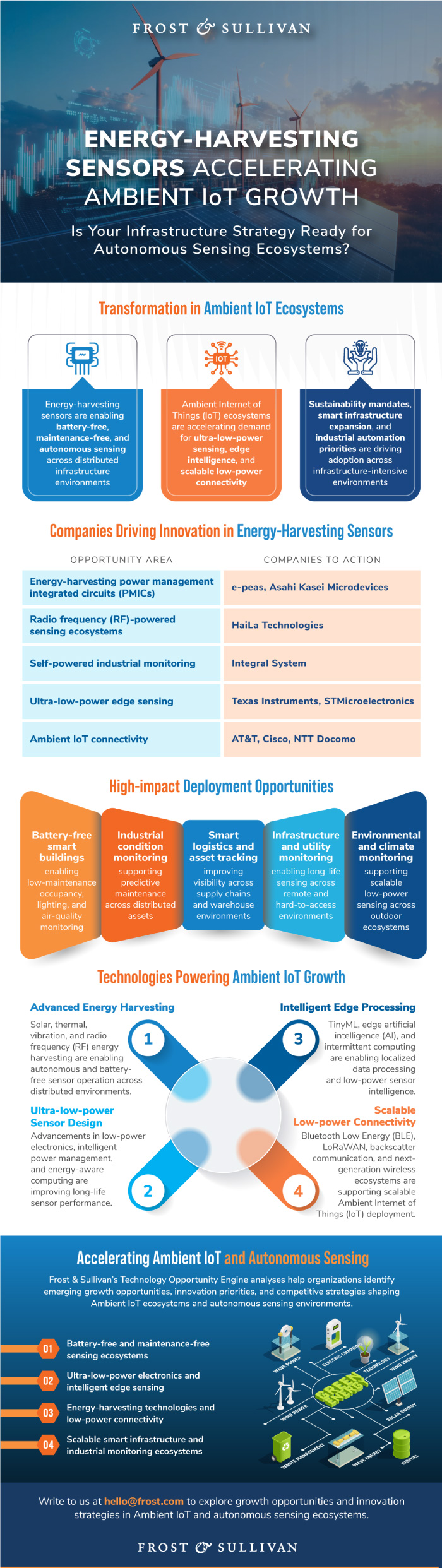
Strategic Imperatives Reshaping Energy-Harvesting Sensors
- Innovative Business Models: Energy-harvesting sensors are reshaping Ambient IoT economics through battery-free, maintenance-free, and ultra-long-life sensing platforms supporting scalable deployments across smart infrastructure, logistics, buildings, and cities.
- Competitive Intensity: Competition is accelerating across solar, thermal, vibration, and RF energy harvesting technologies alongside advancements in ultra-low-power sensor integrated circuits (ICs), PMICs, and low-power connectivity ecosystems.
- Transformative Megatrends: Sustainability mandates, smart infrastructure expansion, climate monitoring priorities, and labor shortages are accelerating demand for autonomous, low-maintenance, and large-scale Ambient IoT sensing networks.
How are energy-harvesting sensors influencing your organization’s Ambient IoT and autonomous sensing strategy?
What Is Accelerating Ambient IoT Sensor Adoption?
- Scalable Low-maintenance Sensing Economics: Energy-harvesting sensors are reducing dependence on battery replacement and manual servicing, enabling lower-maintenance and longer-life sensing deployments across smart infrastructure, logistics, industrial monitoring, and environmental applications.
- Advancements in Intelligent Low-power Architectures: Innovation across ultra-low-power electronics, energy-aware computing, wake-up radios, and advanced power management systems is improving autonomous sensing reliability under constrained energy environments.
- Expanding Edge Intelligence and Sensor Efficiency: Next-generation materials, compact sensing architectures, and edge processing capabilities are enabling more efficient real-time data collection and localized decision-making across distributed Ambient IoT ecosystems.
| Technologies Accelerating Energy-Harvesting Sensor Adoption
• Low-power edge computing enabling intelligent Ambient Internet of Things (IoT) sensing How are enabling technologies accelerating your Ambient IoT deployment strategy? |
What Challenges Could Influence Large-scale Deployment?
- Supply Chain Trust and Component Authenticity: Counterfeit sensors and compromised edge components can create operational reliability concerns, increase maintenance complexity, and weaken trust across connected sensing ecosystems.
- Evolving Regulatory and Compliance Frameworks: Fragmented standards and uneven regulatory development across regions may slow commercialization timelines and complicate cross-border deployment strategies for autonomous sensing systems.
- Expanding Cybersecurity Exposure: As sensing ecosystems become increasingly connected and cloud-integrated, organizations face greater risks related to cyberattacks, operational disruption, and sensitive infrastructure data exposure.
Foundational Technologies Powering Ambient IoT
Energy-harvesting sensors are enabling autonomous and maintenance-free Ambient Internet of Things (IoT ecosystems by converting ambient energy sources such as light, heat, vibration, and RF signals into usable electrical power. These technologies are accelerating scalable low-power sensing across smart infrastructure, logistics, industrial monitoring, environmental sensing, and connected infrastructure environments.
Key Energy-harvesting Technologies
- Photovoltaic (PV) harvesting: Converts indoor and outdoor light into electrical power for low-power sensing applications
- Thermoelectric harvesting: Uses temperature gradients and waste heat for autonomous sensor operation
- Vibration and kinetic harvesting: Captures motion and mechanical vibration to power distributed sensors
- RF energy harvesting: Uses wireless communication signals such as Wi-Fi, Bluetooth, and cellular networks for low-power energy conversion
Technologies Accelerating Ambient IoT Deployment
- Growth in battery-free sensing platforms and ultra-low-power electronics
- Advancements in edge computing, TinyML, and AI-enabled sensing
- Expansion of 5G/6G, Bluetooth Low Energy (BLE), and backscatter communication ecosystems
- Increasing deployment of maintenance-free distributed sensor networks across infrastructure-intensive environments
How are energy-harvesting technologies influencing your Ambient IoT deployment strategy?
| Companies to Action Accelerating Energy-harvesting Sensor Innovation
1. e-peas (Belgium): Advancing energy-harvesting PMICs and reference designs supporting battery-free Ambient Internet of Things (IoT) deployments across smart buildings, logistics, industrial monitoring, and wearable ecosystems. 2. HaiLa Technologies (Canada): Developing ambient RF-powered Wi-Fi communication solutions enabling maintenance-free and battery-less sensing applications for asset tracking and connected smart environments. 3. Asahi Kasei Microdevices (Japan): Innovating ultra-low-current PMIC technologies designed for energy-harvesting sensor systems and efficient low-power battery charging environments. 4. Integral System (France): Launching self-powered industrial monitoring sensors integrating Bluetooth Low Energy (BLE) and LoRaWAN connectivity for long-range wireless monitoring applications. How are emerging innovators influencing your autonomous sensing and Ambient IoT strategy? |
Growth Opportunities Accelerating Ambient IoT Adoption
- Battery-free Smart Buildings and Facility Automation: Energy-harvesting sensors are enabling maintenance-free occupancy sensing, air quality monitoring, lighting optimization, and energy management across commercial buildings, campuses, and smart infrastructure environments. Integration with building management systems and digital twins is further improving operational efficiency and long-term asset monitoring.
Impact Takeaways:
- Reduced battery replacement and facility maintenance costs
- Improved building energy optimization and sustainability performance
- Scalable deployment of distributed low-power sensing networks
- Infrastructure, Utilities, and Remote Monitoring: Autonomous sensing platforms are supporting long-term monitoring across pipelines, power grids, renewable energy infrastructure, and remote industrial assets where wired power and frequent battery replacement are impractical. Energy harvesting from vibration, heat, and ambient energy sources is enabling scalable predictive maintenance and real-time infrastructure monitoring.
Impact Takeaways:
- Expanded remote monitoring across hard-to-access infrastructure environments
- Improved predictive maintenance and operational reliability
- Lower servicing requirements for distributed industrial sensing networks
How are energy-harvesting sensors influencing your autonomous sensing and infrastructure monitoring strategy?
Ready to Lead the Technology Transformation?
- Book a Growth Strategy Session: Align your growth roadmap with Frost & Sullivan’s visionary Growth Pipeline™ Dialog.
- Engage with Growth Experts: Co-design AI-enabled, data-driven operating models that scale industry-specific and commercial impact.
- Share Your Transformation Story: Position your organization as a transformation leader through Frost & Sullivan’s Transformational Growth Leadership platform.
- Join the Growth Council: Collaborate with industry leaders shaping the future of your ecosystem.
- Nominate for the Best Practices Recognition: Be recognized for excellence in growth strategy, execution, and customer impact.
- Demonstrate Industry Positioning on the Frost Radar™: Benchmark your growth performance and innovation strength against industry competitors.
- Activate Brand & Demand Growth: Accelerate awareness, engagement, and revenue growth through integrated brand and demand generation strategies.
Frequently Asked Questions About Energy-harvesting Sensors and Ambient IoT
- What are energy-harvesting sensors?
Energy-harvesting sensors are autonomous sensing systems that convert ambient energy sources such as light, heat, vibration, or radio frequency (RF) signals into usable electrical power, enabling battery-free or low-maintenance sensor operation.
- Why are energy-harvesting sensors important for Ambient Internet of Things (IoT) ecosystems?
Energy-harvesting sensors support scalable Ambient IoT deployment by reducing dependence on wired power and battery replacement. They enable long-life, maintenance-free sensing across distributed environments such as buildings, factories, logistics networks, utilities, and smart infrastructure ecosystems.
- Which energy sources are commonly used in energy-harvesting sensors?
Common energy-harvesting modalities include:
- Photovoltaic (PV) harvesting using indoor or outdoor light
- Thermoelectric harvesting using temperature gradients and waste heat
- Vibration and kinetic harvesting using motion and mechanical activity
- RF harvesting using ambient wireless communication signals
- What technologies are accelerating Ambient IoT deployment?
Ambient IoT deployment is accelerating through advancements in:
- Ultra-low-power microcontrollers and power management integrated circuits (PMICs)
- TinyML and AI-enabled edge sensing
- Energy-aware firmware and intermittent computing
- Bluetooth Low Energy (BLE), backscatter communication, and 5G/6G connectivity ecosystems
- What industries are adopting energy-harvesting sensors?
Energy-harvesting sensors are gaining adoption across:
- Smart buildings and facility automation
- Industrial monitoring and predictive maintenance
- Utilities and infrastructure monitoring
- Logistics and asset tracking
- Environmental and climate monitoring ecosystems
- How are energy-harvesting sensors influencing sustainability strategies?
Energy-harvesting sensors help organizations reduce electronic waste, minimize battery dependence, lower maintenance requirements, and support energy-efficient infrastructure modernization initiatives aligned with sustainability and net-zero objectives.