This blog is based on the analysis titled, “Advancements in Edge AI-enabled Sensor Solutions for Autonomous Systems and Industrial IoT,” authored by Frost & Sullivan’s growth expert, Varun Babu, from the TechVision—Sensors & Instrumentation team.
Executive Summary
Edge AI-enabled sensor solutions are transforming autonomous systems and Industrial Internet of Things (IIoT) environments by enabling real-time intelligence, localized decision-making, and intelligent automation. Advances in embedded AI, multimodal sensing, and edge computing are accelerating adoption across manufacturing, mobility, healthcare, and smart infrastructure. For business leaders, technology providers, and industrial organizations, Edge AI-enabled sensor solutions present a strategic opportunity to improve operational efficiency, strengthen resilience, and unlock new growth opportunities through intelligent, connected operations.
What Are Edge AI-enabled Sensor Solutions?
Edge artificial intelligence (AI)-enabled sensor solutions combine intelligent sensors with embedded AI algorithms to process data and make decisions directly at the point of data generation. Unlike conventional sensors that transmit data to the cloud for analysis, Edge AI-enabled sensors perform real-time analytics locally, enabling faster, low-latency, and autonomous decision-making.
By integrating AI with technologies such as computer vision, LiDAR, radar, and environmental sensing, these solutions improve perception, strengthen data privacy, and reduce bandwidth requirements. They are increasingly being adopted across autonomous systems, Industrial Internet of Things (IIoT), robotics, healthcare, and smart infrastructure to improve operational efficiency and enable intelligent automation.
Frost & Sullivan Perspective
Frost & Sullivan believes Edge AI-enabled sensor solutions are transforming intelligent sensing by enabling real-time, autonomous decision-making at the edge. Organizations that embed AI directly into sensing systems will be better positioned to improve operational agility, optimize performance, and accelerate innovation across connected environments.
Why Edge AI-enabled Sensor Solutions Are Becoming a Strategic Priority
AI is increasingly moving from centralized cloud platforms to the network edge, where data is generated and decisions must be made in real time. This shift is being driven by growing demand for autonomous systems that require immediate responses, continuous operation, and reliable performance without depending on constant cloud connectivity. Organizations are managing larger volumes of sensor data while facing increasing expectations around cybersecurity, privacy, and operational efficiency. Processing information locally reduces latency, lowers bandwidth costs, and enables faster, context-aware decision-making across mission-critical environments.
Discover the Future of Edge AI-enabled Sensor Solutions
What you’ll discover:
- ✓ Emerging trends reshaping intelligent sensing and Edge AI
- ✓ High-growth opportunities across autonomous systems and Industrial IoT
- ✓ Innovation leaders driving the next generation of Edge AI-enabled sensor solutions
- ✓ Regional trends and strategic market developments
Download the Complimentary Sample Analysis
As a result, Edge AI-enabled sensor solutions are becoming a strategic investment for organizations seeking to accelerate automation, improve resilience, and create differentiated products and services across autonomous systems and IIoT applications.
Is your organization prepared to transition from cloud-dependent sensing to intelligent, autonomous Edge AI systems?
Three Trends Reshaping Edge AI-enabled Sensor Solutions
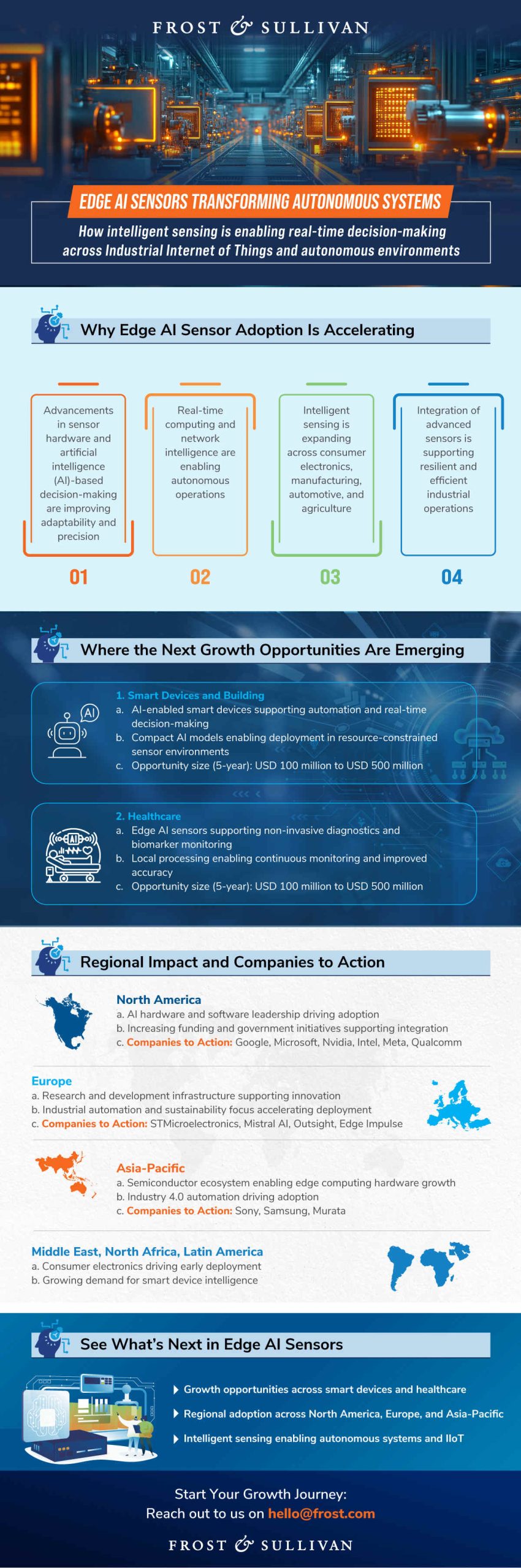
The evolution of Edge AI-enabled sensor solutions is being driven by advances in sensing technologies, embedded intelligence, and industrial automation. Three trends are defining the next phase of innovation and adoption.
- Multimodal Intelligent Sensing: Organizations are combining computer vision, LiDAR, radar, acoustic, environmental, and inertial sensors to create richer contextual awareness. AI-powered sensor fusion improves perception, enhances accuracy, and enables more reliable decision-making across autonomous vehicles, robotics, and smart infrastructure.
- AI-native Edge Intelligence: Embedded AI processors and optimized inference engines are enabling sensors to process information locally with minimal latency. This shift reduces cloud dependency, improves responsiveness, and supports secure, real-time decision-making across connected environments.
- Autonomous Industrial Operations: Edge AI-enabled sensors are enabling predictive maintenance, intelligent robotics, quality inspection, and autonomous process optimization across IIoT environments. These capabilities are improving productivity, reducing downtime, and supporting the transition toward self-optimizing industrial operations.
Key Takeaway: The next phase of Edge AI innovation will be driven by the convergence of intelligent sensing, embedded AI, and autonomous decision-making. Organizations that invest in multimodal sensing platforms, AI-native edge intelligence, and industrial automation capabilities will be well positioned to accelerate digital transformation and capture emerging growth opportunities.
Emerging Business Models Accelerating Edge AI Adoption
As Edge AI-enabled sensor solutions become more intelligent and autonomous, organizations are moving beyond traditional hardware sales toward service-oriented business models that deliver continuous value, scalability, and recurring revenue. These models are lowering adoption barriers while enabling organizations to deploy AI capabilities more efficiently across autonomous systems and IIoT environments.
- Sensing-as-a-Service: Organizations are combining intelligent sensors with AI analytics, monitoring, and lifecycle management through subscription-based offerings. This model enables continuous asset visibility, predictive maintenance, and reduced upfront investment.
- AI Models-as-a-Service: Pre-trained and industry-specific AI models are being delivered on a subscription basis, enabling organizations to deploy and update AI capabilities at the edge without extensive in-house development.
- Edge Platform-as-a-Service: Integrated edge platforms combine AI hardware, software, connectivity, and device management into scalable solutions, enabling organizations to deploy, monitor, and manage Edge AI applications more efficiently.
Frost & Sullivan Perspective
Frost & Sullivan believes competitive differentiation will increasingly depend on an organization’s ability to deliver integrated Edge AI ecosystems rather than standalone sensing technologies. Combining intelligent sensors, embedded AI, and flexible service-based business models will enable organizations to create greater customer value and unlock new growth opportunities.
Companies to Action: Innovators Shaping Edge AI-enabled Sensor Solutions
Innovation across Edge AI-enabled sensor solutions is being driven by organizations advancing embedded AI, intelligent sensing, and scalable edge computing platforms.
| Company | Why It Matters |
| STMicroelectronics | Advancing embedded AI through low-power microcontrollers that enable real-time on-device intelligence. |
| Synaptics | Developing AI-native edge computing platforms for multimodal sensing and intelligent automation. |
| Sony Semiconductor Solutions | Expanding AI-enabled vision sensing through intelligent image sensors and edge AI platforms. |
| Ceva | Accelerating Edge AI deployment with optimized AI software, neural processing technologies, and embedded AI toolkits. |
Is your organization collaborating with the right technology innovators to strengthen its Edge AI strategy?
Growth Opportunities: Where Is the Next Wave of Value Creation Emerging?
As Edge AI-enabled sensor solutions become more intelligent, connected, and autonomous, new opportunities are emerging at the intersection of embedded AI, intelligent sensing, and real-time edge computing. Organizations that invest in scalable sensing platforms and AI-native edge intelligence will be better positioned to improve operational performance, accelerate automation, and create new sources of business value.
Growth Opportunity 1: Multimodal Edge AI Sensor Platforms
Advancing Autonomous Perception Through Intelligent Sensor Fusion
The convergence of computer vision, LiDAR, radar, inertial, and environmental sensors is enabling multimodal Edge AI platforms capable of delivering richer contextual awareness and faster, more accurate decision-making. These platforms are supporting the next generation of robotics, autonomous mobility, industrial automation, and smart infrastructure.
Why It Matters
- Improves perception and situational awareness through intelligent sensor fusion.
- Enables faster, low-latency decision-making at the edge.
- Supports autonomous operations across dynamic and safety-critical environments.
- Creates opportunities for integrated hardware and software sensing platforms.
Growth Opportunity 2: AI-enabled Predictive Intelligence for Industrial IoT
Building Smarter, More Autonomous Industrial Operations
Edge AI-enabled sensor solutions are enabling manufacturers to move from reactive monitoring to predictive and autonomous operations. By processing sensor data locally, organizations can detect anomalies earlier, optimize equipment performance, reduce unplanned downtime, and improve operational resilience across connected industrial environments.
Why It Matters
- Enables predictive maintenance and continuous asset monitoring.
- Improves productivity through real-time operational intelligence.
- Reduces downtime, maintenance costs, and cloud dependency.
- Accelerates the adoption of autonomous factories and intelligent industrial ecosystems.
Future Outlook
The future of Edge AI-enabled sensor solutions will be shaped by advances in embedded AI, multimodal sensing, edge computing, and autonomous decision-making. As industries accelerate digital transformation, intelligent sensing will become increasingly central to automation, predictive operations, and connected ecosystems.
According to Frost & Sullivan, organizations that invest early in AI-native sensing platforms, ecosystem partnerships, and scalable Edge AI architectures will be better positioned to unlock new growth opportunities, strengthen operational resilience, and establish long-term competitive advantage in autonomous systems and IIoT applications.
How will your organization leverage Edge AI-enabled sensor solutions to build smarter, more autonomous, and future-ready operations?
Ready to Lead the Transformation?
- Schedule a Growth Strategy Dialog: Align your growth roadmap with Frost & Sullivan’s Visionary Growth Pipeline™ Dialog.
- Engage with Growth Experts: Co-design AI-enabled, data-driven operating models that scale industry-specific and commercial impact.
- Showcase Your Transformational Leadership: Position your organization as a transformation leader through Frost & Sullivan’s Transformational Growth Leadership platform.
- Join the Growth Council: Collaborate with industry leaders shaping the future of your ecosystem.
- Explore Best Practices Recognition: Be recognized for excellence in growth strategy, execution, and customer impact.
- Benchmark Your Industry Positioning on the Frost Radar™: Benchmark your growth performance and innovation strength against industry competitors.
- Tell Your Story: Accelerate awareness, engagement, and revenue growth through integrated brand and demand generation strategies.
Frequently Asked Questions (FAQs)
1. What are Edge AI-enabled sensor solutions?
Edge artificial intelligence (AI)-enabled sensor solutions combine intelligent sensors with embedded AI algorithms to process data and make decisions directly at the point of data generation. Unlike conventional sensors that rely on cloud processing, Edge AI-enabled sensors perform real-time analytics locally, enabling faster response times, improved privacy, and autonomous decision-making across industrial and connected environments.
2. How do Edge AI-enabled sensor solutions differ from conventional sensors?
Traditional sensors primarily collect and transmit data for centralized analysis, whereas Edge AI-enabled sensors analyze data locally using embedded AI. This reduces latency, minimizes bandwidth requirements, improves cybersecurity, and enables intelligent, real-time decision-making without continuous cloud connectivity.
3. Which industries are adopting Edge AI-enabled sensor solutions?
Edge AI-enabled sensor solutions are being adopted across manufacturing, autonomous vehicles, robotics, healthcare, agriculture, logistics, energy, and smart infrastructure. These technologies support applications such as predictive maintenance, intelligent quality inspection, autonomous navigation, patient monitoring, and industrial process optimization.
4. Why is Edge AI becoming important for autonomous systems and Industrial Internet of Things (IIoT)?
Autonomous systems and IIoT applications require real-time intelligence, low-latency processing, and reliable decision-making. Edge AI enables sensor data to be processed locally, improving operational efficiency, reducing cloud dependency, and supporting autonomous operations in mission-critical environments.
5. What technologies are driving the growth of Edge AI-enabled sensor solutions?
Key technologies include embedded AI processors, multimodal sensing, computer vision, LiDAR, radar, sensor fusion, edge computing, and low-power AI accelerators. Together, these technologies improve perception, enable localized intelligence, and support intelligent automation across connected systems.
6. What are the biggest growth opportunities in Edge AI-enabled sensor solutions?
High-growth opportunities are emerging in multimodal Edge AI sensor platforms, predictive intelligence for Industrial IoT, intelligent robotics, autonomous mobility, and smart infrastructure. Organizations investing in AI-native sensing platforms and integrated edge ecosystems are well positioned to capitalize on these expanding markets.
7. How are Edge AI-enabled sensor solutions improving industrial operations?
Edge AI-enabled sensor solutions enable continuous asset monitoring, predictive maintenance, autonomous quality inspection, and real-time process optimization. These capabilities reduce downtime, improve equipment reliability, enhance worker safety, and increase overall operational productivity.
8. What is the future outlook for Edge AI-enabled sensor solutions?
The future of Edge AI-enabled sensor solutions will be driven by advances in embedded AI, multimodal sensing, edge computing, and intelligent automation. As organizations accelerate digital transformation, these technologies will play an increasingly important role in enabling autonomous systems, Industrial Internet of Things (IIoT), and next-generation connected operations.