This blog is based on the analysis, Frost Radar™: Intelligent Virtual Agents for Customer Experience, 2026, authored by Frost & Sullivan’s growth expert Bernardin Arnason from the Contact Center Solutions team.
Executive Summary
The next generation of intelligent virtual agents (IVAs) is transforming customer experience from reactive, self-service processes to intelligent, outcome-driven engagement. Combining conversational AI, enterprise integrations, and agentic AI, these platforms are enabling organizations to move beyond automation toward autonomous resolution. Organizations that scale these capabilities effectively will be better positioned to improve customer outcomes, operational efficiency, and long-term competitive growth.
What are Intelligent Virtual Agents?
Intelligent virtual agents are AI-powered conversational systems that understand natural language, maintain context, and autonomously resolve customer interactions across digital channels. Unlike traditional chatbots, IVAs can interpret intent, manage complex conversations, and execute actions by integrating with enterprise systems. According to Frost & Sullivan, IVAs are evolving into strategic enterprise platforms that enable autonomous customer engagement, improve operational efficiency, and accelerate AI-driven customer experience transformation.
The Future of Customer Experience: Beyond Traditional Virtual Agents
The role of virtual agents is changing. What began as a tool for automating routine customer interactions is rapidly becoming a strategic capability that helps organizations improve customer experience, increase operational efficiency, and scale service delivery.
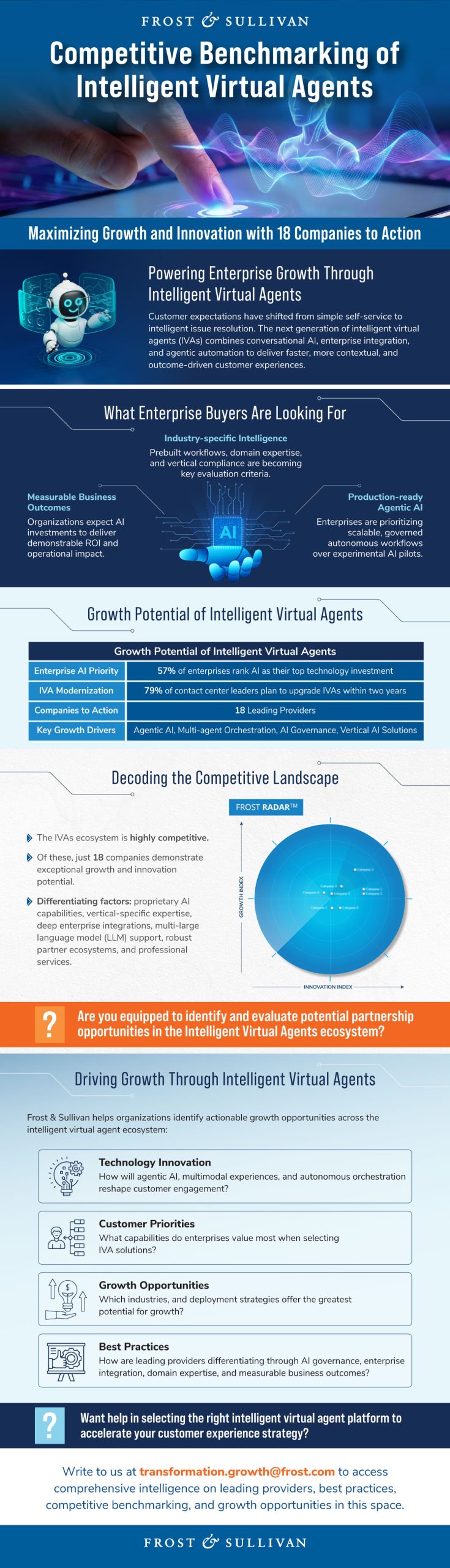
Today’s AI virtual agents combine conversational AI, enterprise integrations, and agentic AI to understand customer intent, execute workflows, and resolve increasingly complex interactions. According to Frost & Sullivan, 57% of organizations identify AI as their top technology investment priority, but only 12% have deployed agentic AI across multiple enterprise use cases. The opportunity now lies in turning AI investments into measurable business outcomes rather than isolated automation initiatives.
Benchmark the Future of Intelligent Virtual Agents
Explore the competitive strategies, best practices, and Companies to Action shaping the next generation of AI-powered customer experience.
Top 3 Strategic Imperatives Transforming Intelligent Virtual Agents
- Disruptive Technologies: From Automation to Autonomous Resolution
Advances in agentic AI, large language models (LLMs), and multi-agent orchestration are enabling virtual agents to understand intent, execute workflows, and resolve increasingly complex customer interactions with minimal human intervention.
- Internal Challenges: Leveraging Governance to Build Enterprise-ready AI
As IVAs take on more transactional and decision-making responsibilities, governance, explainability, data quality, and human oversight are becoming essential for building trusted, scalable AI deployments.
- Industry Convergence: Enabling Interoperable Customer Experiences
Emerging interoperability standards such as Model Context Protocol (MCP) and Agent-to-Agent (A2A) are creating connected AI ecosystems where virtual agents can securely collaborate with enterprise applications and specialized AI agents to deliver seamless customer experiences.
Frost & Sullivan Perspective
Frost & Sullivan believes that the next phase of IVA adoption will be driven not only by advances in autonomous AI but also by seamless enterprise interoperability, robust governance, and trusted data ecosystems. Organizations that invest in integrating IVAs across enterprise workflows while prioritizing responsible AI and scalable automation will be better positioned to deliver differentiated customer experiences and unlock long-term competitive advantage.
What separates tomorrow’s CX Leaders from the rest?
Explore the top strategic imperatives shaping the AI-first transformation in the CX ecosystem
Business Implications to keep in mind
- Organizations that continue relying on legacy interactive voice response (IVR) systems and rule-based chatbots risk falling behind as customer expectations shift toward intelligent, resolution-first experiences.
- Without strong AI governance, high-quality data, and enterprise-wide integration, scaling intelligent virtual agents will become increasingly difficult, limiting AI performance and business value.
- Delaying investment in interoperable AI ecosystems may reduce an organization’s ability to deliver seamless customer journeys, accelerate innovation, and compete in an increasingly agentic AI landscape.
Key Takeaways
Organizations that move beyond standalone AI deployments to build interoperable, enterprise-ready virtual agent ecosystems will be better positioned to create lasting competitive differentiation.
Understanding the Virtual Agent Ecosystem
Do you have the tools to identify the best practices in this space?
Listen to our growth podcast featuring Frost & Sullivan experts.
AI Virtual Agents: Growth Snapshot
| Area | Key Insight |
| Competitive Ecosystem | Competition spans Contact Center as a Solution (CCaaS) platforms, conversational AI vendors, hyperscalers, and frontier AI labs, each bringing distinct AI capabilities and enterprise strengths. |
| Growth Differentiators | Leading providers compete through agentic AI, enterprise integrations, vertical expertise, multi-LLM architectures, and robust partner ecosystems. |
| Regional Momentum | North America leads enterprise adoption, APAC is a high-growth mobile-first opportunity, while EMEA emphasizes compliance, sovereignty, and trusted AI deployment. |
Read the top best practices from industry leaders on Agentic AI in contact centers.
Subscribe to our Growth Opportunity Newsletter to gain strategic CX perspectives.
Top 3 Growth Opportunities Defining the Next Generation of Intelligent Virtual Agents
- Vertical-specific Intelligent Virtual Agents
Enterprise demand is shifting toward industry-specific IVAs designed for healthcare, financial services, insurance, and other regulated sectors. Solutions that combine prebuilt industry workflows, enterprise integrations, and compliance-ready architectures present a significant opportunity to accelerate deployment and deliver measurable operational outcomes.
- Proactive Outbound Virtual Agents
Customer service is shifting from reactive support to proactive engagement. Future AI virtual agents will identify trigger events, initiate customer outreach, and resolve issues before customers contact the organization, expanding value from cost reduction to revenue protection and customer retention.
- Agent-to-Agent Customer Experiences
The next frontier extends beyond human-to-AI conversations. As customers increasingly use personal AI assistants, organizations will need agent-to-agent interaction models, creating an entirely new customer engagement paradigm.
Key Takeaways
Leading organizations are treating intelligent virtual agents as a long-term business capability rather than a standalone technology investment, balancing AI innovation with governance, operational readiness, and customer trust.
Top 3 Best Practices Leveraged by Leading Intelligent Virtual Agent Providers
- Leading with High-probability Use Cases
Focus on use cases with clean data, structured workflows, and measurable outcomes to build confidence, reduce implementation risk, and accelerate AI adoption.
- Managing IVAs as an Extension of the Human Workforce
Treat intelligent virtual agents as an extension of the human workforce. Successful deployments combine onboarding, governance, performance management, and hybrid workforce management (WFM) to continuously improve AI performance alongside human agents.
- Build Trust Through Transparency
As IVAs replace legacy bots, organizations should focus on transparent AI interactions and clearly demonstrate customer value. Combining explainable AI with reliable outcomes helps strengthen customer trust and encourages wider adoption of intelligent virtual agents.
Future Outlook on AI Virtual Agents
The future of Intelligent Virtual Agents (IVAs) will be shaped by advances in agentic AI, multimodal interactions, enterprise interoperability, real-time data integration, and responsible AI governance. As organizations accelerate AI-driven customer experience transformation, IVAs are expected to evolve from digital support tools into autonomous orchestration platforms that proactively resolve customer needs and optimize enterprise operations.
According to Frost & Sullivan, organizations that invest early in scalable AI platforms, integrated enterprise ecosystems, and governance frameworks will be better positioned to deliver differentiated customer experiences, improve operational efficiency, and establish a sustainable competitive advantage in the era of autonomous customer engagement.
Listen to our growth podcast featuring Frost & Sullivan experts.
Ready to Lead the Transformation?
- Schedule a Growth Strategy Dialog: Align your growth roadmap with Frost & Sullivan’s Visionary Growth Pipeline™ Dialog.
- Engage with Growth Experts: Co-design AI-enabled, data-driven operating models that scale industry-specific and commercial impact.
- Showcase Your Transformational Leadership: Position your organization as a transformation leader through Frost & Sullivan’s Transformational Growth Leadership platform.
- Join the Growth Council: Collaborate with industry leaders shaping the future of your ecosystem.
- Explore Best Practices Recognition: Be recognized for excellence in growth strategy, execution, and customer impact.
- Benchmark Your Industry Positioning on the Frost Radar™: Benchmark your growth performance and innovation strength against industry competitors.
- Tell Your Story: Accelerate awareness, engagement, and revenue growth through integrated brand and demand generation strategies.
Frequently Asked Questions (FAQs) on Intelligent Virtual Agents
1. How are cross-border payment solutions evolving beyond traditional banking infrastructure?
Modern cross-border payment solutions are increasingly built on API-first architectures, cloud-native platforms, and interoperable payment networks that connect banks, FinTechs, and payment providers more efficiently. As financial ecosystems become more connected, organizations are evaluating how technologies such as payment APIs, ISO 20022, and real-time settlement can improve scalability, operational resilience, and customer experience across international payment corridors.
2. Why is ISO 20022 becoming important for international remittance and payment modernization?
As international remittance volumes continue to grow, ISO 20022 is emerging as the common language for financial messaging. It enables richer payment data, improves interoperability between financial institutions, and supports greater automation across compliance, reconciliation, and transaction processing. For executives, ISO 20022 represents a long-term foundation for modernizing payment infrastructure and enabling future digital payment innovations.
3. How is artificial intelligence changing payment remittance operations?
The role of artificial intelligence in digital payments extends well beyond fraud detection. Increasingly, AI in payments is improving transaction monitoring, liquidity optimization, customer onboarding, and real-time decision-making. As payment ecosystems become more complex, organizations are integrating AI across payment remittance operations to improve efficiency, strengthen risk management, and enhance customer engagement at scale.
4. How do AI customer service agents complement CCaaS platforms?
AI customer service agents are increasingly becoming a core capability within modern CCaaS (Contact Center as a Service) environments. By integrating with routing, workforce management, CRM (Customer Relationship Management), and knowledge systems, they help organizations automate routine interactions while enabling human agents to focus on higher-value customer engagements.
5. How can conversational AI assistants improve enterprise productivity?
By integrating with enterprise applications and automating routine workflows, conversational AI assistants can reduce manual effort, accelerate decision-making, and support employees with real-time insights. This allows organizations to improve both operational efficiency and customer experience simultaneously.