This blog is based on the analysis, “Body in White (BIW) Inspection Market, Global, 2025–2030,” authored by Frost & Sullivan’s Growth Expert Shruti Bapusaheb Yewale, from the Industrial practice area.
Automotive manufacturers are navigating a period of heightened complexity as electric vehicle (EV) platforms introduce new materials, tighter tolerances, and battery-critical structures, while regionalized supply chains are reducing tolerance for quality variation across plants. In this operating environment, quality issues introduced early in production are carrying disproportionate cost, risk, and downstream disruption.
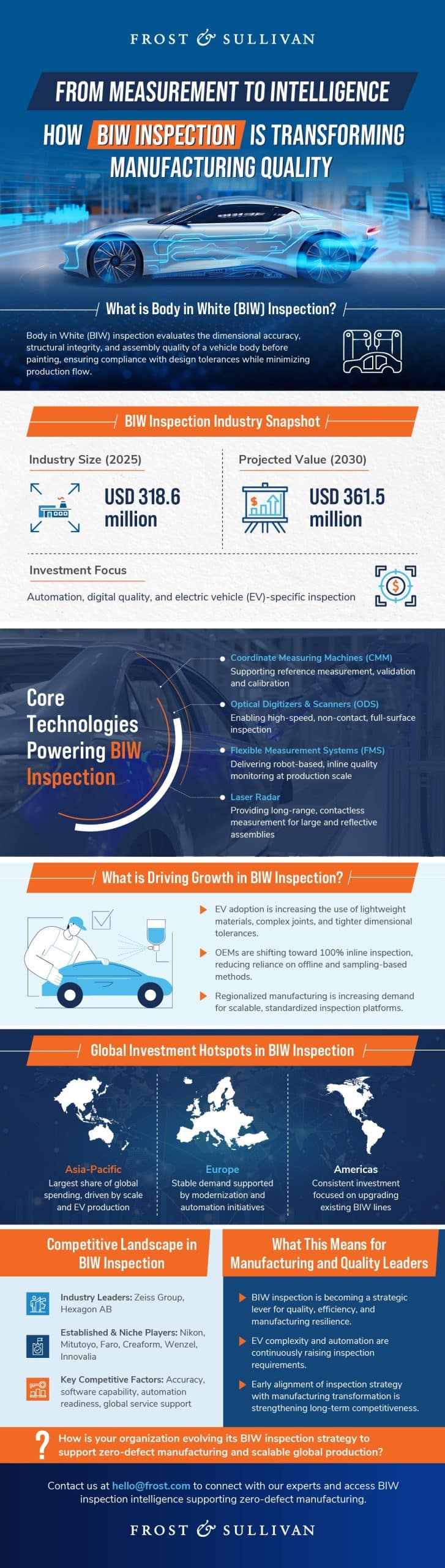
Against this backdrop, Body in White (BIW) inspection is emerging as a strategic lever rather than a downstream compliance activity. Frost & Sullivan’s BIW inspection analysis indicates that the BIW inspection landscape, projected to reach $ 361.5 million by 2030, is being shaped by investments in automation, digital quality control, and EV-specific inspection capabilities.
For OEMs and C-suite leaders, the imperative is to align BIW inspection strategies with inline automation, software-enabled quality systems, and scalable global deployment models to strengthen manufacturing resilience and competitiveness through 2030.
Listen to our growth podcast episode on how BIW inspection is transforming automotive manufacturing.
Strategic Imperatives Shaping the Future of BIW Inspection
- Disruptive Technologies
Body in White inspection platforms are increasingly adopting automation, advanced optics, and AI-enabled analytics to support inline measurement and faster defect detection. Vendors combining high-precision hardware with software-driven workflows and analytics are emerging as leaders in next-generation BIW inspection platforms.
- Internal Challenges
Rising system costs, integration complexity, and shortages of skilled metrology personnel are pushing OEMs and suppliers to move away from manual, offline inspection models toward automated and standardized inspection architectures.
- Transformative Megatrends
EV adoption, Industry 4.0 initiatives, and supply chain localization are increasing demand for scalable, software-enabled inspection platforms that integrate with MES, digital twins, and enterprise quality systems.
Key Technologies Driving Growth in BIW Inspection
- Coordinate Measuring Machines (CMMs) continue to support reference measurement and calibration but are increasingly constrained by offline operation and lower throughput.
- Optical Digitizers and Scanners (ODS) represent the largest segment, offering non-contact, high-speed, full-surface inspection suited to EV architectures and mixed materials.
- Flexible Measurement Systems (FMS) are gaining adoption as OEMs pursue automation, enabling inline inspection and continuous quality monitoring.
- Laser radar is emerging for large assemblies and reflective surfaces, providing long-range, absolute measurement where traditional systems face limitations.
Across all categories, software, analytics, and integration capabilities are becoming as critical as hardware accuracy.
Key Growth Drivers and Challenges Reshaping the BIW Inspection Industry
Key Growth Drivers Accelerating BIW Inspection Adoption
- Electric Vehicle Manufacturing: EV platforms introduce lightweight materials, complex joints, and battery-critical tolerances, driving demand for high-speed, non-contact, and full-surface inspection systems
- Shift Toward 100% Inline Inspection: OEMs are replacing offline, sampling-based inspection with inline and automated systems to support real-time quality monitoring and first-time-right production.
- Supply Chain Regionalization: New manufacturing hubs in Asia-Pacific, the Americas, and Europe are increasing demand for standardized, globally deployable BIW inspection solutions.
Key Restraints and Adoption Constraints
- High Capital Investment Requirements: Advanced BIW inspection systems remain capital-intensive, particularly for Tier I and Tier II suppliers.
- Integration Complexity: Aligning inspection systems with production automation, MES, and digital quality platforms continues to be a challenge.
- Skills and Expertise Gaps: Shortages of experienced metrology and automation professionals are slowing adoption of advanced inspection solutions.
Growth Opportunities Emerging in the BIW Inspection Market
- Electric Vehicle Manufacturing: EV manufacturers are increasing BIW inspection complexity, driving demand for advanced, non-contact solutions that support lightweight materials, battery-critical tolerances, and mixed EV–internal combustion engine (ICE) production.
- OEM Supply Chain Diversification: Regionalized manufacturing is creating opportunities for standardized, turnkey BIW inspection platforms that can be deployed consistently across new plants and supplier networks.
- Artificial Intelligence-enabled Inspection: Rising quality expectations and labor constraints are accelerating adoption of AI-driven defect detection and predictive analytics integrated with existing manufacturing systems.
Access the full analysis for detailed growth opportunity analytics.
Companies to Action in BIW Inspection Landscape
The global Body in White inspection domain is moderately fragmented, with more than 20 active participants competing across hardware, software, and automation capabilities. The industry leadership is concentrated among a few players with strong OEM relationships and end-to-end metrology portfolios.
- Zeiss Group leads the market with a comprehensive BIW inspection portfolio spanning optical metrology, inline inspection cells, and software-driven analytics, supported by strong integration with Industry 4.0 and digital twin environments.
- Hexagon AB maintains a strong competitive position through its broad dimensional metrology stack, combining inspection hardware, inline solutions, and advanced quality and manufacturing intelligence software.
- Nikon Metrology plays a key role in optical scanning and laser radar solutions, particularly for large BIW assemblies and reflective surfaces.
Other notable participants, including Mitutoyo, Faro, Creaform, Wenzel Group, API Metrology, Innovalia Metrology, and Scantech, compete by addressing specific applications, regional requirements, or cost-sensitive segments, often leveraging niche expertise or flexible deployment models.
Body in White inspection is moving from a quality control function to a strategic pillar of automotive manufacturing. As EV complexity, regionalized production, and zero-defect goals intensify, organizations that adopt inline, software-driven, and scalable inspection strategies will be best positioned to manage risk, control costs, and remain competitive through 2030.
Ready to Lead the Transformation?
- Book a Growth Strategy Session: Align your growth roadmap with Frost & Sullivan’s visionary Growth Pipeline™ Dialog.
- Engage with Growth Experts: Co-design AI-enabled, data-driven operating models that scale industry-specific and commercial impact.
- Share Your Transformation Story: Position your organization as a transformation leader through Frost & Sullivan’s Transformational Growth Leadership platform.
- Join the Growth Council: Collaborate with industry leaders shaping the future of your ecosystem.
- Nominate for the Best Practices Recognition: Be recognized for excellence in growth strategy, execution, and customer impact.
- Demonstrate Industry Positioning on the Frost Radar™: Benchmark your growth performance and innovation strength against industry competitors.
- Activate Brand & Demand Growth: Accelerate awareness, engagement, and revenue growth through integrated brand and demand generation strategies.
Frequently Asked Questions (FAQs): BIW Inspection Industry
- What is Body in White inspection, and why is it becoming more important for automotive manufacturers?
BIW inspection assesses the dimensional accuracy, structural integrity, and assembly quality of a vehicle body before painting. Its importance is increasing as EV platforms, lightweight materials, and tighter tolerances raise the cost and risk of early-stage defects, pushing manufacturers toward automated, inline BIW inspection to support zero-defect manufacturing and operational stability.
- What technologies are shaping the future of the BIW inspection market?
Optical digitizers, flexible measurement systems, and AI-enabled analytics are gaining traction as OEMs move toward high-speed, non-contact, and inline BIW inspection, while CMMs remain primarily for reference measurement
- Where are the key growth opportunities in the BIW inspection market through 2030?
Growth opportunities are concentrated in EV manufacturing, regionalized OEM supply chains, and AI-driven inspection platforms that enable predictive quality and scalable deployment across plants