This blog is based on the recent Frost & Sullivan analysis, “Growth Opportunities in Global Pharmaceutical Industry, 2026,” authored by Surbhi Gupta, Industry Principal, Healthcare & Life Sciences Practice.
The global pharmaceutical industry covers the discovery, development, and commercialization of medicines, with large molecules driving most incremental growth while small molecules continue to provide a stable revenue base. Right now, the industry is going through a major shift toward cardiometabolic and oncology therapies, led by GLP-1 platforms and antibody-drug conjugates (ADCs).
Redefine Your Pharma Growth Strategy
Explore the shifts shaping execution, regulation, and market access across the pharmaceutical industry.
At the same time, pharmaceutical companies are dealing with growing operational and pricing pressure. Inflation Reduction Act (IRA)-driven Medicare negotiations in the US, evolving EU Health Technology Assessment (HTA) and exclusivity reforms, and rising biosimilar competition are all compressing value capture windows and raising the bar on speed to market and supply reliability.
With the industry projected to reach approximately $1.72 trillion in 2026, organizations that strengthen their manufacturing networks, commercialization capabilities, and strategic partnerships will be better placed to compete and grow. That’s why companies are increasingly putting resources into sterile fill-finish capacity, HPAPI (Highly Potent Active Pharmaceutical Ingredient) manufacturing, bioconjugation capabilities, and regulated AI applications across discovery and development.
With competition intensifying across pricing, regulation, and manufacturing, is your organization prepared to scale while protecting speed, access, and long-term value?
Strategic Imperatives Transforming the Global Pharmaceutical Industry
Disruptive Technologies
- AI, automation, digital twins, and advanced analytics are reshaping how drug development, manufacturing, and laboratory operations are run across the pharmaceutical value chain.
- From predictive modeling to lab automation and advanced manufacturing, companies are deploying these tools to cut inefficiencies and speed up biologics and ADC production.
Innovative Business Models
- The traditional pharma models built on volume, pricing control, and indication expansion is giving way under payer pressure and patent expires.
- In response, companies are pivoting toward platform-based innovation, strategic partnerships, and outcomes-linked models that prioritize access and adherence.
Geopolitical Chaos
- Trade restrictions, tariff pressures, and shifting policy landscapes are forcing companies to localize supply chains.
- Domestic manufacturing has moved up the priority list for governments worldwide, channeling higher investment into regional R&D and supply security.
So, which growth processes and strategies will help your teams adapt to these headwinds?
The Pharmaceutical Industry at a Glance
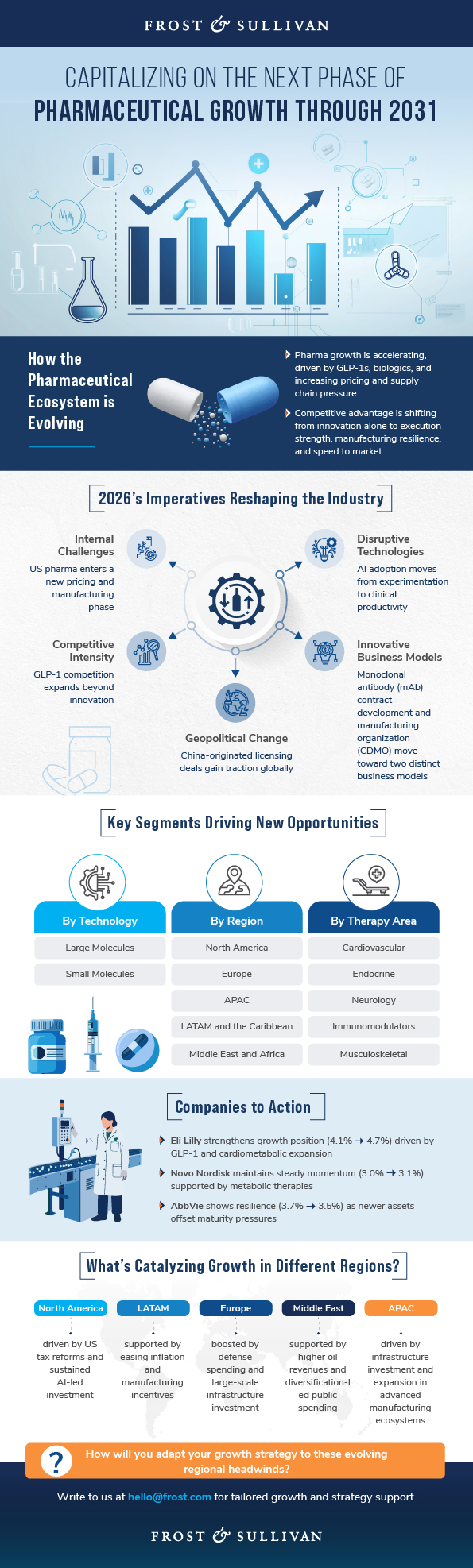
Regional Megatrends Influencing Pharmaceutical Growth
North America & Europe
- Growth remains moderate with increasing pressure from pricing controls.
- US and EU policy changes are reshaping pricing, access timelines, and revenue stability across products.
Japan
- Policy continues to balance cost control with support for innovation.
- Greater focus is being placed on post-launch pricing and supply chain resilience.
China
- Volume-based procurement continues to put pressure on pricing in commoditized products.
- At the same time, policy support is driving innovation and local partnerships in advanced therapies.
India
- Manufacturing capacity is expanding through government-led incentives in active pharmaceutical ingredients (APIs) and biopharma.
- Growth is supported by exports and targeted innovation rather than broad R&D expansion.
Latin America & Caribbean
- Growth is supported by strong generics penetration and access initiatives.
- Performance remains uneven due to currency volatility and procurement cycles.
Are you implementing best practices to maximize ROI across high-growth regions?
Emerging Opportunities in the Global Pharmaceutical Industry
- Building the Payer/Employer Operating System for Obesity Care
GLP-1 therapies are facing a growing challenge beyond demand and persistence. With discontinuation rates reaching 46.5% in type 2 diabetes and 64.8% in obesity without diabetes within one year, long-term value increasingly depends on sustained adherence and outcomes. As policy shifts toward outcomes-linked reimbursement and oral GLP-1s expand use, access alone is no longer enough.
To capture durable value, pharmaceutical companies are:
- Designing GLP-1 offerings as integrated models that combine access, supply, digital support, and payer engagement under PMPM (Per Member Per Month) arrangements.
- Bundling therapy with services such as titration support, side-effect management, refill automation, and adherence-linked maintenance programs.
- Working with digital health, retail, and pharmacy partners to improve persistence through last-mile access, coaching, and ongoing patient support.
- Industrializing ADC platformization for portfolio advantage
ADCs are moving from niche oncology assets to a repeatable modality, where competitive advantage is defined by industrialization rather than discovery alone. As pipelines mature and oncology portfolios face loss of exclusivity pressure, demand for ADCs is accelerating as a pipeline-replacement strategy. At the same time, manufacturing has become the primary constraint, with challenges centered on HPAPI supply, conjugation capacity, and reliable Good Manufacturing Practices (GMP) scale-up rather than clinical performance.
To build scalable and resilient ADC platforms, biopharma companies are:
- Treating ADC industrialization as a core strategy, integrating payload, linker, conjugation, fill-finish, and release capabilities (e.g., Pfizer–Seagen integration).
- Securing dual-source supply and early Phase II/III manufacturing slots to reduce capacity and geopolitical risk (e.g., Daiichi Sankyo ENHERTU network).
- Embedding CMC readiness and manufacturing scalability into licensing and M&A decisions (e.g., Merck–Daiichi Sankyo collaboration).
- Confirmatory-ready Trials as a Premium Clinical Research Offering
By 2026, clinical trial delays are increasingly driven by execution gaps such as slow enrollment, underdiagnosis, and confirmatory trial readiness. In rare diseases, patient identification is becoming as important as trial execution, while Food and Drug Administration (FDA) expectations are shifting confirmatory studies to the pre-approval stage.
To respond to these shifts, clinical development stakeholders are:
- Evolving Contract Research Organization (CRO) offerings from staffing to execution-focused models combining patient access, site selection, and decentralized trial delivery.
- Partnering across genomics and registries to improve patient identification and embed confirmatory planning early in development.
- Moving decentralized trial providers to integrated platforms that combine data quality, site management, and trial execution.
Which of these opportunities will have the maximum impact on your organization, and how will you measure it?
Where Pharma Competitive Advantage Is Shifting Next
Across clinical development, manufacturing, and commercialization, the pharmaceutical industry is shifting toward execution-led value creation. Companies that build these integrated capabilities early will be better positioned to manage regulatory pressure, reduce delays, and deliver outcomes on a scale.
Frequently Asked Questions (FAQs)
What is the global pharmaceutical industry?
The global pharmaceutical industry covers the research, development, manufacturing, and commercialization of medicines. It spans small and large molecule drugs, biologics, and advanced therapeutics such as GLP-1 therapies and ADCs. The market is projected to reach approximately $1.72 trillion in 2026, driven by rising demand for innovative treatments across developed and emerging markets.
What are the 4 types of validation in pharma?
The four main types of pharmaceutical validation are:
- Process Validation — confirms manufacturing processes consistently meet quality standards
- Analytical Method Validation — verifies testing methods are accurate and fit for purpose
- Equipment and Facility Validation — ensures equipment is correctly installed and performs as intended
- Cleaning Validation — confirms cleaning procedures effectively remove residues between production runs
What is the difference between small and large molecules in pharma?
Small molecules are chemically synthesized, low molecular weight compounds — typically taken orally and easier to manufacture. Large molecules, or biologics, are complex proteins derived from living cells, usually administered by injection. Small molecules form the traditional pharma base, while large molecules are driving most incremental growth today, particularly in oncology and cardiometabolic disease.
What are the 4 classifications of drugs?
The four main drug classifications are:
- Over-the-counter (OTC) Drugs — available without a prescription for self-manageable conditions
- Prescription Drugs — require licensed healthcare provider authorization
- Controlled Substances — regulated based on abuse and dependence potential
- Biological Products — derived from living organisms, including vaccines, gene therapies, and monoclonal antibodies
Ready to Lead the Transformation?
- Book a Growth Strategy Session: Align your growth roadmap with Frost & Sullivan’s visionary Growth Pipeline™ Dialog.
- Engage with Growth Experts: Co-design AI-enabled, data-driven operating models that scale industry-specific and commercial impact.
- Share Your Transformation Story: Position your organization as a transformation leader through Frost & Sullivan’s Transformational Growth Leadership platform.
- Join the Growth Council: Collaborate with industry leaders shaping the future of your ecosystem.
- Nominate for the Best Practices Recognition: Be recognized for excellence in growth strategy, execution, and customer impact.
- Demonstrate Industry Positioning on the Frost Radar™: Benchmark your growth performance and innovation strength against industry competitors.
- Brand & Demand: Accelerate awareness, engagement, and revenue growth through integrated brand and demand generation strategies.