This blog is based on Frost & Sullivan’s recent analysis, “C5ISR Industry, United States, 2025–2030” authored by growth expert, Wayne Shaw and lead analyst, Shreya Khakurel from the Aerospace & Defense Practice Area.
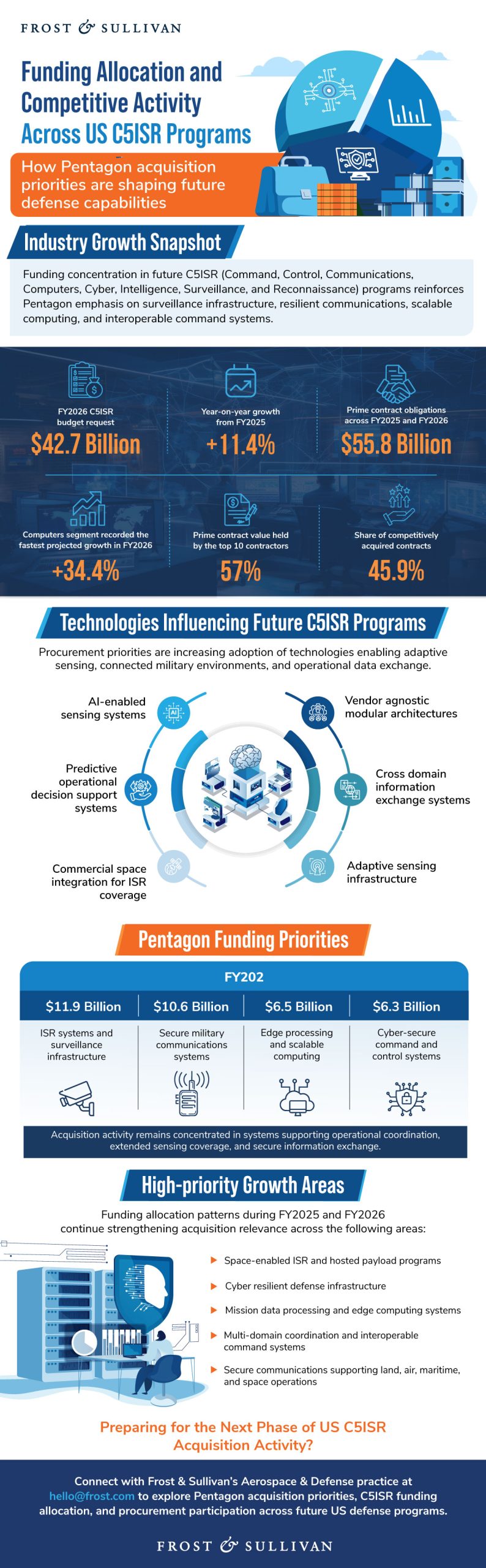
US defense modernization priorities are increasingly focused on interoperable command systems, resilient communications, and software-centric military operations. With $42.7 billion allocated across C5ISR (Command, Control, Communications, Computers, Cyber, Intelligence, Surveillance, and Reconnaissance) programs for FY2026, Pentagon acquisition activity is directing greater investment toward modular architectures, AI-enabled sensing, and multi-domain defense coordination systems. At the same time, 57% of prime contract value remains concentrated among the top 10 contractors, increasing competitive pressure across the broader defense ecosystem.
Explore Frost & Sullivan’s analysis addressing:
- Pentagon acquisition priorities
- C5ISR funding allocation trends
- Contractor participation shifts
- Strategic growth opportunities
Listen to Our Growth Podcast Episode on Pentagon Modernization and Emerging C5ISR Opportunities
The Strategic Imperatives Influencing Future C5ISR Investment Direction
Geopolitical Chaos
Rising pressure across the Indo-Pacific, Eastern Europe, and the Middle East is increasing Pentagon emphasis on faster decision support, connected defense coordination, and resilient communication infrastructure. Growing security demands are directing greater investment toward ISR systems, multi-layered missile deterrence systems, secure communications, and space-enabled surveillance and threat detection programs supporting multi-domain military operations.
Competitive Intensity
Updated MOSA implementation requirements are reshaping how organizations compete across future C5ISR programs. As Pentagon acquisition activity prioritizes interoperability and vendor-agnostic integration, specialized suppliers with modular software, sensing, communications, and mission integration systems are gaining greater procurement relevance across programs traditionally dominated by large defense primes.
Disruptive Technologies
Edge computing, AI-enabled sensing, automation, and commercial space integration are influencing how military data is processed, analysed, and deployed across defense environments. Demand is increasing for scalable architectures capable of supporting adaptive sensing, faster coordination, predictive decision support, and secure cross-domain information exchange across contested environments.
Key Challenges Slowing Advanced C5ISR Deployment
As Pentagon modernization accelerates across AI-enabled sensing, cyber resilience, and interoperable defense systems, organizations are facing increasing integration complexity across legacy systems and operating environments while managing expanding certification and deployment requirements.
- Integration Constraints: Legacy command and control (C2) networks and proprietary architectures continue increasing interoperability risks, engineering complexity, and deployment timelines across multi-domain defense systems.
- Workforce Pressure: Growing competition for AI, cloud computing, and cybersecurity expertise is intensifying pressure across software integration and advanced mission systems.
- Validation Requirements: Expanding compliance, software verification, and certification processes are extending transition timelines between prototype development and mission deployment for advanced C5ISR infrastructure.
Defense Priorities Accelerating Next-generation C5ISR Programs
Pentagon acquisition activity is increasingly directing funding toward capabilities supporting faster coordination, cross-domain communication, and real-time decision support across contested defense environments.
- MOSA Implementation Requirements: Vendor agnostic integration and modular architectures are widening procurement participation across specialized suppliers and nontraditional defense firms.
- Commercial Space Integration: Pentagon emphasis on commercial space data and hosted payloads is increasing demand across space-based ISR, surveillance, and communications technologies.
- AI-enabled Mission Support: AI adoption directives are accelerating procurement demand across adaptive sensing, edge processing, automation, and predictive decision support systems.
- Interoperable Defense Infrastructure: Rising connectivity requirements are increasing investment across resilient communications, cyber secure systems, and multi-domain coordination technologies.
Growth Opportunities Accelerating Across High-priority C5ISR Segments
Funding allocation patterns across FY2025 and FY2026 continue highlighting stronger Pentagon focus across ISR, communications, computing infrastructure, and C2 systems.
- ISR: Secured the largest FY2026 allocation at $11.9 billion, supported by rising surveillance, sensing, reconnaissance, and situational awareness requirements.
- Communications: Reached $10.6 billion in FY2026 funding as defense departments prioritize resilient connectivity and secure information exchange.
- Computers: Recorded the fastest projected growth at 34.4%, reflecting expanding investment across edge processing, cloud-enabled operations, and scalable computing infrastructure.
- Command and Control: Procurement obligations exceeded $7 billion across FY2025 and FY2026, driven by faster coordination and integrated decision support requirements.
Procurement Participation Across the US C5ISR Ecosystem
Procurement activity across the US C5ISR ecosystem remains concentrated among established defense contractors while continuing to support broader supplier participation across specialized acquisition categories. Across FY2025 and FY2026, the top 10 contractors accounted for 57% of total prime contract value, reflecting the role of major defense integrators across large-scale acquisition programs.
Key procurement activity across the US C5ISR ecosystem includes:
- General Dynamics, SAIC, RTX, Boeing, and Lockheed Martin accounted for significant acquisition activity across FY2025 and FY2026 programs.
- Competitively acquired contracts represented 45.9% of total contract obligations, supporting broader supplier participation across select procurement categories.
- Small businesses continue expanding participation across software integration, sensing technologies, communications infrastructure, and specialized mission support functions.
Strategic Positioning Priorities Across Future C5ISR Programs
MOSA implementation requirements and interoperability priorities are expanding procurement participation across future C5ISR programs. Pentagon acquisition activity continues to place increasing emphasis on modular systems, software integration, and secure coordination infrastructure supporting connected defense environments.
- Modular Capability Alignment: Vendor-agnostic architectures are increasing procurement relevance across evolving defense environments.
- Partnership Driven Expansion: Specialized suppliers are expanding participation alongside defense integrators, software providers, and mission system developers across larger acquisition programs.
- Mission Specific Specialization: Contractors supporting sensing technologies, cyber resilience, communications infrastructure, and defense data management are securing greater procurement importance across targeted acquisition categories.
- Scalable Defense Coordination: Pentagon acquisition priorities continue increasing emphasis on secure multi-domain coordination infrastructure and interoperable C2 systems.
Preparing for the Next Phase of Pentagon Acquisition Activity
Pentagon acquisition priorities are increasingly reshaping how organizations compete across the US C5ISR ecosystem. As defense departments expand investment across interoperable systems, software-enabled infrastructure, and mission-focused integration programs, funding concentration, supplier participation, and acquisition activity are increasing procurement relevance across future defense programs.
Ready to Lead the Transformation?
- Book a Growth Strategy Session: Align your growth roadmap with Frost & Sullivan’s visionary Growth Pipeline™ Dialog.
- Engage with Growth Experts: Co-design AI-enabled, data-driven operating models that scale industry-specific and commercial impact.
- Share Your Transformation Story: Position your organization as a transformation leader through Frost & Sullivan’s Transformational Growth Leadership platform.
- Join the Growth Council: Collaborate with industry leaders shaping the future of your ecosystem.
- Nominate for the Best Practices Recognition: Be recognized for excellence in growth strategy, execution, and customer impact.
- Demonstrate Industry Positioning on the Frost Radar™: Benchmark your growth performance and innovation strength against industry competitors.
- Activate Brand & Demand Growth: Accelerate awareness, engagement, and revenue growth through integrated brand and demand generation strategies.
FAQs: US C5ISR Industry
- What is C5ISR in Defense modernization?
C5ISR refers to Command, Control, Communications, Computers, Cyber, Intelligence, Surveillance, and Reconnaissance systems that support procurement coordination, decision support, secure communications, and situational awareness across defense environments.
- Why is MOSA important across future C5ISR programs?
MOSA implementation requirements support interoperable and vendor-agnostic system integration, allowing defense departments to simplify capability upgrades, accelerate deployment flexibility, and expand procurement participation across specialized suppliers.
- Which C5ISR segments are receiving the highest Pentagon funding priority?
ISR secured the highest FY2026 allocation at $11.9 billion, followed by communications at $10.6 billion, reflecting increasing emphasis on surveillance, sensing, resilient connectivity, and coordination capabilities.
- How is AI influencing future C5ISR procurement activity?
AI-enabled sensing, automation, edge processing, and operational decision support capabilities are increasing procurement demand across adaptive sensing systems, infrastructure data processing, and connected defense environments.
- Why are interoperable systems becoming increasingly important across Pentagon acquisition programs?
Interoperable architectures simplify integration across multi-domain defense operations, improve deployment adaptability, and support faster procurement coordination across connected military environments.