This blog is based on Frost & Sullivan’s latest analysis, “Growth Opportunities of Aeronautical Information Management (AIM) Solutions, Global, 2025–2035,” authored by Shantanu Gangakhedkar from the Aerospace & Industria Practice Area.
Air traffic management systems worldwide are operating under increasing operational strain. Rising passenger growth, rising flight movements, and expanding airport networks, particularly across Tier II and III airports, are placing new demands on air navigation service providers (ANSPs) and airport authorities. Workforce shortages, aging infrastructure, and interoperability challenges are exposing the limitations of legacy aeronautical information systems.
These pressures are prompting aviation leaders to reassess how aeronautical information is governed, delivered, and scaled. Aeronautical Information Management (AIM) is emerging as a strategic enabler of this shift, providing the digital, standardized, and interoperable data foundation required for safer, higher-capacity airspace operations.
Access Frost & Sullivan’s in-depth analysis to gain:
- Global AIM growth and outlook
- Technology and innovation priorities
- Competitive positioning and emerging growth opportunities
Listen to Our Growth Podcast Episode on Emerging Growth Opportunities in Aeronautical Information Management.
Why Aeronautical Information Management Is Central to Modern ATM Transformation?
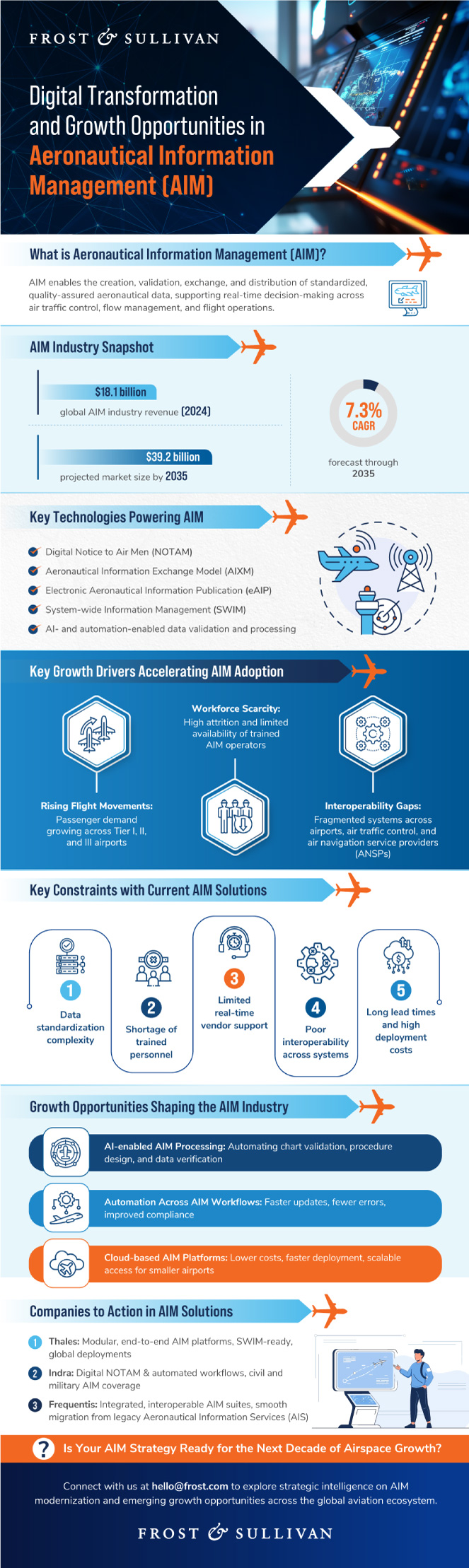
The global AIM industry is growing at a 7.3% CAGR through 2035, underscoring its expanding strategic importance within modern air traffic management (ATM). This growth reflects the critical role AIM is playing in enhancing airspace operational safety, efficiency, and resilience, for several key reasons:
- Supporting safe operations: AIM is delivering accurate, timely, and quality-assured aeronautical data for flight planning and air traffic control.
- Addressing growing complexity: Digital AIM is enabling consistent information sharing and situational awareness across ANSPs, airports, and stakeholders.
- Enabling data-driven performance: AIM is replacing static publications with machine-readable, real-time data, reducing manual effort and decision latency.
- Strengthening operational resilience: Automation is lowering human error, improving response times, and supporting rapid adaptation to changing airspace conditions.
Strategic Imperatives Shaping the AIM Landscape
- Transformative Megatrends: Safety, capacity, and efficiency are driving the accelerated shift from legacy Aeronautical Information Services (AIS) to digital AIM, reinforced by rising traffic density, airspace complexity, and global regulatory modernization initiatives.
- Competitive Intensity: With more than 50 active industry participants and aircraft numbers expected to double over the next two decades, AIM providers are competing to deliver cost-effective, automated, and scalable platforms that support higher traffic volumes without increasing manpower.
- Industry Convergence: AIM is converging with digital air traffic management ecosystems, integrating with air traffic control system, air traffic flow management, and System-wide Information Management (SWIM) frameworks to support remote towers, digital towers, and emerging airspace operations.
Key Growth Drivers Accelerating AIM Adoption
- Sustained passenger growth is increasing flight activity across airports of all sizes, driving demand for scalable and reliable aeronautical data systems.
- High attrition rates and limited availability of trained personnel are increasing reliance on automation and simplified workflows.
- Regulatory mandates and global harmonization efforts are accelerating adoption of standardized digital AIM solutions.
- Modular and cloud-based AIM platforms are reducing capital expenditure and lowering barriers to adoption.
- Airlines are exerting pressure on airports and ANSPs to improve capacity handling and operational predictability through better data quality.
Growth Opportunities in Aeronautical Information Management
- AI-enabled AIM Processing: Automation of data validation, chart verification, and procedure design can significantly reduce workload and improve capacity handling.
- End-to-end Workflow Automation: Automated origination, validation, and dissemination of aeronautical information improves compliance while reducing errors and delays.
- Cloud-based AIM Platforms: Subscription-based, cloud-hosted solutions offer faster deployment, lower costs, and scalability—particularly attractive for smaller and growing airports.
Get access to the detailed analysis of growth opportunities shaping the AIM landscape.
Companies to Action in AIM Solutions
The global AIM ecosystem includes more than 50 active solution providers, with the top players accounting for over 56% of total market revenues. Recent strategic developments illustrate how leading companies are strengthening digital capabilities, expanding geographic reach, and aligning with next-generation ATM requirements:
- Thales – Expanded its TopSky AIM ecosystem by integrating AIM with digital and remote tower solutions, supporting interoperable, SWIM-ready airspace modernization initiatives.
- Indra – Increased investments in AI, cloud, and cybersecurity to enhance automation, digital NOTAM readiness, and predictive analytics across AIM workflows.
- Frequentis – Strengthened its modular CADAS AIM suite to support seamless transition from legacy AIS to AIM while maintaining operational continuity.
- IDS AirNav – Expanded deployments across Asia-Pacific and emerging markets, targeting scalable, standards-compliant AIM solutions for Tier II and III airports and ANSPs.
From Support Function to Strategic Capability: The Future of AIM
Over the next decade, AIM platforms are becoming more deeply integrated into digital ATM ecosystems, fully aligned with SWIM frameworks, and increasingly powered by AI and automation. Standardized data formats and cloud-based delivery models are enabling broader access to real-time aeronautical data, supporting both existing operations and emerging airspace concepts.
Organizations that invest early in modular, interoperable, and future-ready AIM platforms are increasingly associated with improved management of airspace complexity, enhanced safety outcomes, and more efficient capacity scaling.
Ready to Lead the Transformation?
- Book a Growth Strategy Session: Align your growth roadmap with Frost & Sullivan’s visionary Growth Pipeline™ Dialog.
- Engage with Growth Experts: Co-design AI-enabled, data-driven operating models that scale industry-specific and commercial impact.
- Share Your Transformation Story: Position your organization as a transformation leader through Frost & Sullivan’s Transformational Growth Leadership platform.
- Join the Growth Council: Collaborate with industry leaders shaping the future of your ecosystem.
- Nominate for the Best Practices Recognition: Be recognized for excellence in growth strategy, execution, and customer impact.
- Demonstrate Industry Positioning on the Frost Radar™: Benchmark your growth performance and innovation strength against industry competitors.
- Activate Brand & Demand Growth: Accelerate awareness, engagement, and revenue growth through integrated brand and demand generation strategies.
FAQs: Aeronautical Information Management (AIM)
- What is Aeronautical Information Management (AIM)?
AIM enables aviation stakeholders to manage and exchange accurate, quality-assured, and standardized aeronautical data in digital, machine-readable formats. By replacing static, manual information flows with real-time, interoperable data, AIM is helping organizations improve airspace security, scale capacity, and make more informed decisions as airspace becomes increasingly complex.
- What is the growth rate of AIM?
The global AIM industry is valued at $18.1 billion (2024) and is growing at a 7.3% CAGR through 2035. Growth is being driven by rising flight movements, regulatory modernization, workforce constraints, and increasing adoption of digital, automated, and cloud-based AIM solutions.
- Who are the leading companies in the AIM industry?
Leading AIM solution providers include Thales, Indra, Frequentis, IDS AirNav, and Aireon, all of which are investing in automation, interoperability, and digital AIM platforms.
- What is the difference between AIS and AIM?
Aeronautical Information Services (AIS) rely on static, paper-based or manually updated information products. AIM replaces this approach with dynamic, machine-readable, and digitally integrated aeronautical data, enabling automation, real-time updates, and seamless integration with modern air traffic management systems.
- How does Aeronautical Information Management affect the future of air traffic management (ATM)?
AIM is becoming a foundational enabler of next-generation ATM by supporting real-time data exchange, automated workflows, and integration with systems such as air traffic control, air traffic flow management, and SWIM. This is enabling safer operations, improved capacity handling, and greater resilience in increasingly complex airspace environments.