This blog is based on Frost & Sullivan’s latest analysis, “Asia-Pacific Military Training & Simulation Industry Growth Opportunities, 2025–2029” authored by Shreya Khakurel from the Aerospace & Defense Practice Area.
Defense organizations across Asia-Pacific are operating in an increasingly complex security environment. Multi-domain operations accelerated technology adoption, workforce constraints, and persistent geopolitical uncertainty are collectively placing pressure on traditional approaches to military preparedness.
Conventional, asset-heavy training models are proving difficult to scale, costly to sustain, and limited in their ability to replicate modern operational complexity. In response, defense leaders are adopting a more strategic approach to readiness. Military training and simulation (T&S) is emerging as a practical and scalable solution, enabling forces to prepare for complex scenarios while reducing reliance on physical assets. Across the region, T&S is increasingly viewed as a core element of modern military readiness.
Access in-depth analysis on how defense modernization programs and training and simulation investments are evolving across Asia-Pacific.
The Importance of Training & Simulation (T&S) in Asia-Pacific
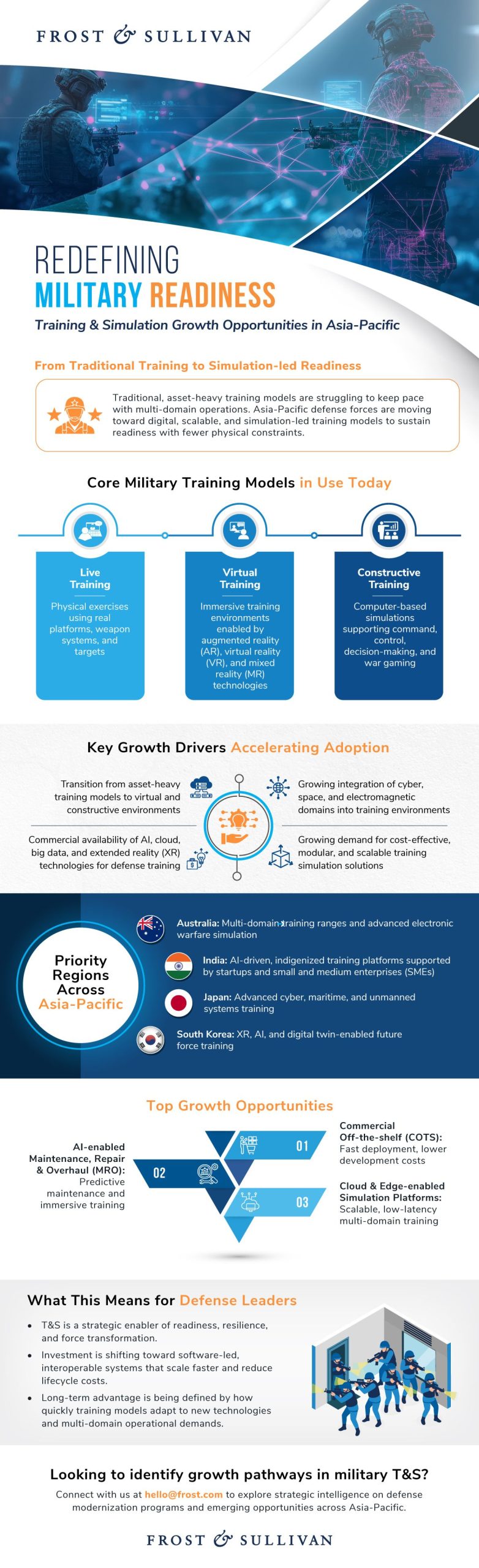
Asia-Pacific defense forces are operating across dispersed theatres, joint and coalition environments, and increasingly across cyber, space, and electromagnetic domains. T&S is enabling realistic, repeatable, and cost-effective preparation for these complex operational conditions.
Advanced T&S environments are supporting continuous readiness by allowing forces to train more frequently, test new concepts, and rehearse high-risk missions without operational disruption. These environments are also strengthening interoperability across services and allied nations, as multilateral exercises continue to expand across the region.
As rising modernization programs accelerate across the region, T&S is being integrated earlier into platform acquisition and force development, ensuring personnel readiness is evolving alongside technological advancement.
Strategic Imperatives Shaping the T&S Landscape in Asia-Pacific
- Transformative Megatrends
Recruitment challenges and rapid technological advancement are driving a shift toward smaller, more capable forces. Expanding investments in AI, robotics, and unmanned systems are increasing the need for continuous, specialized training to sustain operational effectiveness. - Competitive Intensity
Regional governments across Asia-Pacific are prioritizing self-reliance and domestic defense capability development. Policy initiatives, targeted funding, and innovation programs are encouraging participation from domestic firms, startups, and small and medium enterprises (SMEs) in military training and simulation. - Industry Convergence
Defense requirements are converging with commercial innovation, particularly in AI cloud computing, extended reality (XR), and data analytics. This convergence is driving new partnership models, with future training systems increasingly relying on open architectures and cross-sector collaboration.
Growth Drivers Accelerating T&S Adoption in Asia-Pacific
- Shift to Digital Training: Virtual and constructive environments are reducing cost, operational risk, and reliance on live exercises.
- Multi-domain Complexity: Cyber, space, and electromagnetic operations are increasing demand for simulation-led training.
- Technology Maturity: AI, cloud computing, big data, and XR are becoming commercially viable for defense use.
- Scalability Needs: Modular, software-driven systems are enabling rapid adaptation to evolving operational requirements.
Competitive Landscape for Military Training and Simulation in Asia-Pacific
The Asia-Pacific military training and simulation domain is maturing, with competitive intensity rising alongside accelerating defense modernization programs. The landscape is defined by collaboration between global defense primes and domestic players, underpinned by government-led indigenization and innovation initiatives.
Competitive activity is concentrated in Australia, India, Japan, and South Korea, where demand is increasing for software-led, immersive, and interoperable training and simulation solutions. Across these regions, domestic firms, startups, and small and medium enterprises (SMEs) are building niche capabilities, while international providers continue to address gaps in advanced simulation and systems integration, balancing near-term operational requirements with long-term domestic capacity development.
Growth Opportunities in Asia-Pacific Training & Simulation
- Commercial Off-the-shelf (COTS) solutions are enabling faster deployment, lower costs, and rapid adoption of emerging technologies while supporting indigenization and modular upgrades.
- AI-enabled Maintenance, Repair, and Overhaul (MRO) is improving platform availability while reducing downtime and lifecycle costs.
- Cloud and Edge-enabled Simulation Architectures are supporting scalable, low-latency, multi-domain simulations critical for joint, remote, and real-time training environments.
Explore the T&S Growth Opportunities in Detail by Accessing the Full Analysis
From Support Function to Strategic Capability: The Future of Training and Simulation
Military training and simulation in Asia-Pacific is undergoing a structural transition. What was once viewed primarily as a support capability is now a strategic enabler of readiness, resilience, and force transformation.
Defense organizations that are investing in interoperable, software-led, and scalable training ecosystems will be better positioned to adapt to emerging technologies and evolving operational demands.
Ready to Lead the Transformation?
- Book a Growth Strategy Session: Align your growth roadmap with Frost & Sullivan’s visionary Growth Pipeline™ Dialog.
- Engage with Growth Experts: Co-design AI-enabled, data-driven operating models that scale industry-specific and commercial impact.
- Share Your Transformation Story: Position your organization as a transformation leader through Frost & Sullivan’s Transformational Growth Leadership platform.
- Join the Growth Council: Collaborate with industry leaders shaping the future of your ecosystem.
- Nominate for the Best Practices Recognition: Be recognized for excellence in growth strategy, execution, and customer impact.
- Demonstrate Industry Positioning on the Frost Radar™: Benchmark your growth performance and innovation strength against industry competitors.
- Activate Brand & Demand Growth: Accelerate awareness, engagement, and revenue growth through integrated brand and demand generation strategies.
FAQs: APAC Military Training and Simulation
- Which technologies are driving growth in T&S?
AI, machine learning (ML), XR, cloud and edge computing, big data, and digital twins are the most influential technologies. - What challenges are defense organizations facing in adopting advanced T&S solutions?
Key challenges include integrating new systems with legacy infrastructure, ensuring interoperability across services and allies, managing cybersecurity risks, and developing the digital skills required to operate advanced simulation platforms. Addressing these challenges often requires phased adoption and strong industry partnerships.
- How will training and simulation strategies evolve through 2029?
Through 2029, training and simulation strategies are expected to become more software-centric, data-driven, and interoperable. Increased use of AI-enabled scenario generation, cloud–edge architectures, and modular platforms will allow defense forces to update training rapidly as threats, technologies, and doctrines evolve.