Global defense spending has surpassed $2 trillion and continues to rise in 2026. The more consequential shift, however, lies not in how much is being spent, but in how it is being allocated. Apart from replenishing stockpiles, the world’s militaries are fundamentally redesigning how they fight, deter, and sustain operations across complex, multi-domain, and highly contested battlespaces.
This transformation is driving a reallocation of defense budgets. Platforms are becoming software-defined. Networks are replacing stovepipes. Autonomy, AI, and data dominance are emerging as central sources of military power.
For industry leaders, this moment creates a rare opportunity to secure long-duration, high-value growth, but only for those aligned with the right strategic priorities.
Frost & Sullivan’s latest whitepaper identifies Top 10 Growth Opportunities in Aerospace & Defense in 2026, representing the key drivers of sustained strategic and commercial impact.
Listen to Our Podcast Episode on Growth Opportunities in Aerospace & Defense
Strategic Imperatives Shaping Aerospace & Defense in 2026
- Industry Convergence: Modern warfare spans land, air, sea, space, cyber, and the electromagnetic spectrum, making integrated, data-driven systems more valuable than standalone platforms.
- Competitive Intensity: AI, autonomy, and software-defined architectures are now driving faster decision -making, mission effectiveness, and battlefield advantage.
- Customer Value Chain Compression: North Atlantic Treaty Organization (NATO) nations are rebuilding supply chains, surge manufacturing, and local production to support sustained high-intensity conflict.
- Transformative Megatrends: Electromagnetic warfare and secure networks are determining whether armed forces can perceive, communicate, and operate in contested environments.
- Innovative Business Models: Cloud platforms, digital training, and service-based models are replacing one-time purchases with always-updated military readiness.
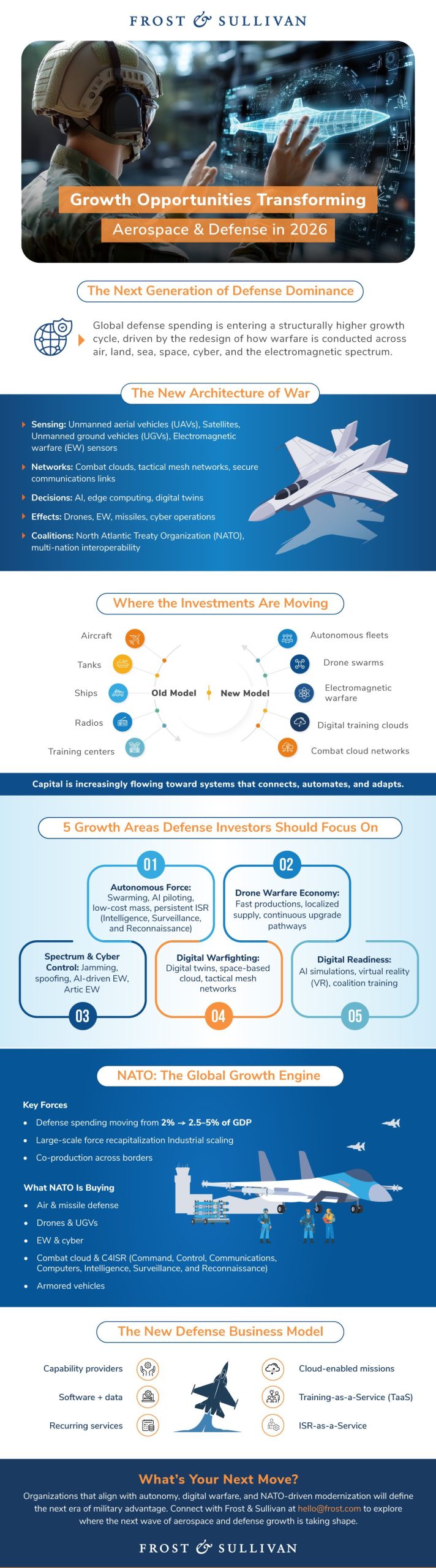
Growth Opportunities Reshaping Aerospace & Defense in 2026
Growth Opportunity 1: Unmanned Aerial Vehicles (UAVs) Become the Core of Airpower
UAVs are becoming the foundation of military aviation. From long-endurance surveillance over oceans to small tactical drones operating alongside infantry, unmanned aircraft now perform missions once reserved for manned fleets, often at lower cost, with greater persistence, and reduced risk.
What’s Driving the Growth?
- Persistent ISR (Intelligence, Surveillance, and Reconnaissance) through medium-altitude long endurance (MALE) and high-altitude long endurance (HALE) drones
- Tactical advantage delivered by small, low-cost UAVs
- AI-enabled autonomy allowing drones to fly, sense, and coordinate with limited human intervention
- Modular payloads architectures enabling rapid mission reconfiguration
Why It Matters
The future of airpower is centered on large, distributed, upgradeable fleets that operate as a network. Defense firms that master autonomy, data fusion, and secure communications will be better positioned to own this market.
Growth Opportunity 2: Drone-centric Warfare Is Changing the Economics of War
Modern battlefields are revealing a clear reality: mass combined autonomy is outperforming expensive platforms. Drone swarms, loitering munitions, and solar-powered high-altitude UAVs now conduct surveillance, strike, and electronic warfare at a fraction of traditional costs.
Key Elements Driving This Shift
- Drone swarm technology designed to saturate and overwhelm defenses
- Loitering munitions that blur the line between missile and drone
- Additive manufacturing enabling rapid, local production of unmanned systems
- Secure navigation and communications architectures designed to operate in jamming-intensive environments
Why It Matters
Drone-centric warfare is creating a new defense economy characterized by speed, software-driven, and adaptable. Companies that can deliver continuous upgrades instead of static platforms will be able to secure the next generation of contracts.
Access the full analysis to discover top 10 growth opportunities in Aerospace in Defense, 2026.
Growth Opportunity 3: Electromagnetic Warfare Is Becoming the New High Ground
Every modern weapon depends on the electromagnetic spectrum and control of that spectrum increasingly shapes operational outcomes. Electromagnetic warfare is evolving into AI-driven spectrum dominance, capable of detecting, learning, and neutralizing threats in real time.
Critical Growth Drivers
- Counter-unmanned aircraft systems (UAS) electronic warfare
- Cognitive electronic warfare (EW) using AI and machine learning (ML)
- Protection against jamming, spoofing, and electromagnetic deception
- Ruggedized EW for Arctic and extreme environments
Why It Matters
Future conflicts will be shaped as much by sensing and communications as by kinetic effects. Spectrum control has become a strategic enabler of military power.
Growth Opportunity 4: Digital Defense Training Redefines Military Readiness
European militaries are shifting from classrooms -based instruction to immersive digital battlefields. Live-virtual-constructive (LVC) environments allow armed forces from multiple countries to train together against simulated adversaries using real equipment, AI, and cyber tools.
What’s Driving Adoption
- North Atlantic Treaty Organization (NATO)-wide interoperability
- Simulation-based training that reduces costs and increases realism
- Training-as-a-Service (TaaS) business models that support continuous readiness
- Virtual reality (VR) and AI-driven training scenarios
Why It Matters
Military readiness is no more episodic; it has become continuous and data-driven. Digital training is creating recurring revenue streams for industry and superior preparedness for militaries.
Companies to Action
- Lockheed Martin – A leader in multi-domain combat cloud, missile defense, and manned–unmanned teaming, well positioned for multi-domain and software-defined warfare.
- Northrop Grumman – Strong in HALE UAVs, electronic warfare, and autonomous systems, benefiting from rising demand for ISR and spectrum dominance.
- Raytheon – A key player in electronic attack, counter-UAS, and missile defense as electromagnetic warfare becomes central to modern combat.
- BAE Systems – Well aligned with NATO defense spending and modernization initiatives through its land, naval, and electronic systems portfolio.
- General Atomics Aeronautical – The leading MALE UAV provider, driving growth in autonomous and scalable airpower.
The Defense Power Shift Is Underway
Aerospace & Defense in 2026 is driven by systems, software, and speed. UAVs, electronic warfare, digital training, and combat clouds are fueling a new supercycle built on autonomy, connectivity, and data marking a structural reset of military power. Governments, alliances, and defense firms will need to decide whether they lead as technology integrators and service providers or fall behind as legacy hardware players. The winners will be those who invest in open architectures, AI, resilient supply chains, and service-based models, shaping how global security is built and sustained.
Download the analysis to access detailed information on Top 10 Growth Opportunities in Aerospace & Defense, 2026.
FAQs: Aerospace & Defense in 2026
- Why is 2026 a turning point for Aerospace & Defense?
This is because defense spending is shifting from platforms to digital, networked, and autonomous defense systems that redefine how wars are fought and won. - Which technologies matter most in this cycle for defense organization in 2026?
AI, autonomy, electromagnetic warfare, multi-domain combat clouds, UAVs, and digital training platforms are driving the strongest growth and long-term strategic advantage. - What should defense companies prioritize in 2026?
Defense companies should prioritize open architectures, software-defined systems, supply-chain resilience, and service-based business models that deliver continuous military capability rather than one-time products.
Connect with our defense experts at [email protected] or schedule a Growth Pipeline Dialog to shape your strategy around the next phase of Aerospace & Defense transformation and growth.