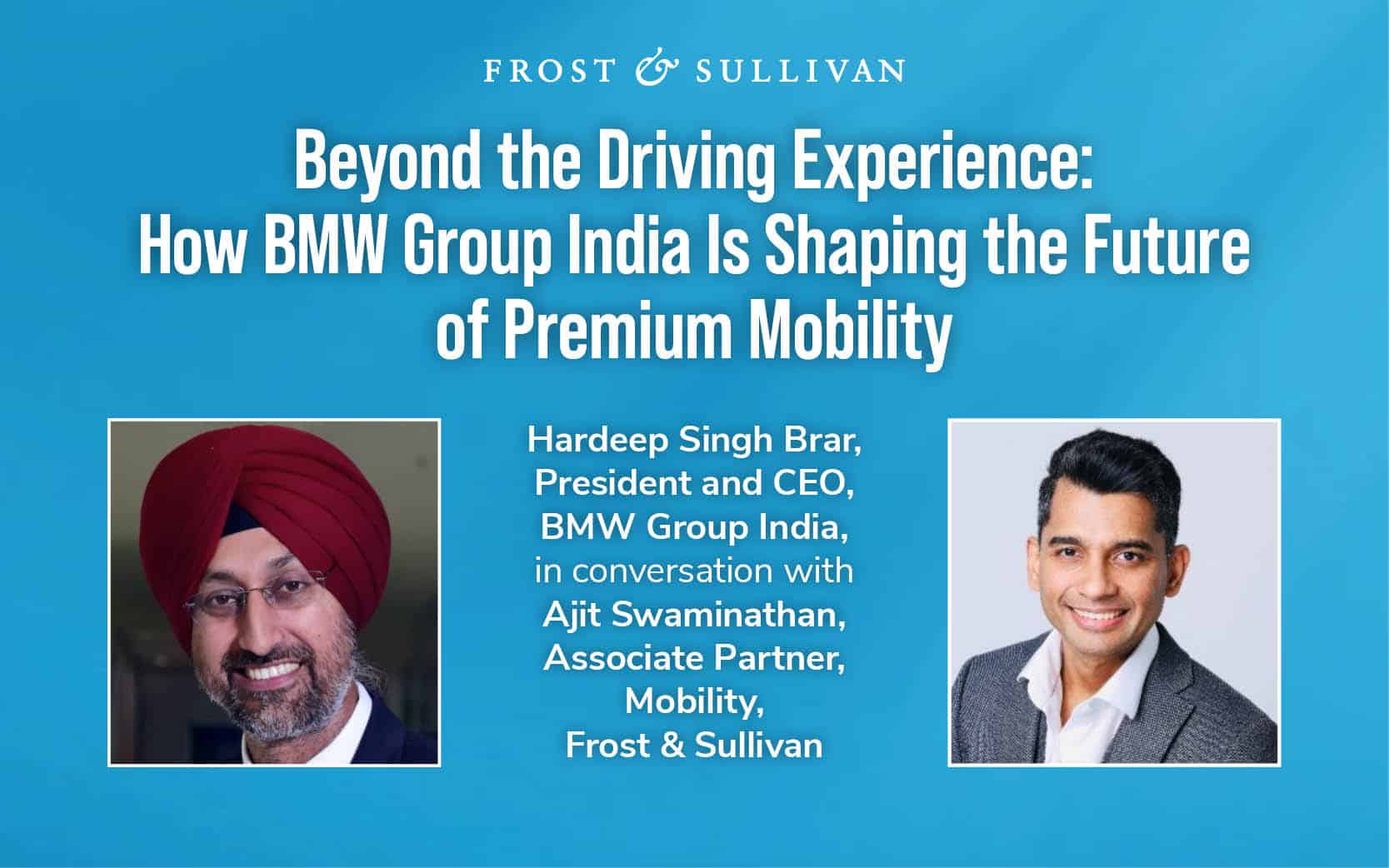
Hardeep Singh Brar, President and Chief Executive Officer, BMW Group India, in conversation with Ajit Swaminathan, Associate Partner, Frost & Sullivan
Download this Transformational Growth Leadership Discussion with Hardeep Singh Brar
India’s premium automotive sector is evolving as electrification, software-defined vehicles (SDVs), and digital capabilities reshape what customers expect from their vehicles. Alongside these developments, the economics of ownership, charging infrastructure, battery health, resale values, and changing consumer aspirations are influencing how customers evaluate premium mobility.
For Hardeep Singh Brar, President and Chief Executive Officer of BMW Group India, the challenge is to embrace these changes without compromising the attributes that define the BMW brand. Driving dynamics remain central, while software, digital experiences, experiential events, and new approaches to customer engagement are creating opportunities to strengthen the relationship between the brand and its customers. At the same time, growing aspirations beyond major metropolitan areas are opening new opportunities for premium vehicle ownership.
In this Transformational Growth Leadership discussion, Ajit Swaminathan, Associate Partner, Frost & Sullivan, speaks with Hardeep Singh Brar about the forces reshaping premium mobility in India, the evolution of electric vehicle (EV) adoption, charging infrastructure and residual value, BMW’s approach to digitalization and customer experience, opportunities beyond major cities, and the organizational agility required to support future growth.
“Decisive strength will lie in combining the experience of a 110-year-old organization with the speed and agility of a startup. As we grow, the opportunity is to simplify processes, enable faster decision-making, and preserve a startup mindset that helps us execute quickly and respond to change.”
— Hardeep Singh Brar, President and Chief Executive Officer, BMW Group India
From Electrification to Software-defined Vehicles
Ajit Swaminathan: We are at an important inflection point, not only in technology but also in consumer aspirations and the definition of luxury itself. From your perspective, what forces will reshape India’s premium automotive sector most significantly over the next few years?
Hardeep Singh Brar: I see three major forces: electrification, software-defined vehicles, and digitalization. Sustainability is also becoming increasingly important as consumers become more conscious of environmental considerations.
Electrification is particularly interesting because it changes some of the economics of owning a luxury vehicle. In conventional vehicles, maintenance costs can increase significantly when a customer moves from a mass-market car to a premium car. With electric vehicles, that difference can be much less pronounced while running costs also become more attractive.
The second major change is software-defined vehicles. A car will no longer be something a customer buys today and experiences in exactly the same way throughout its life. Software can continue to evolve the vehicle after purchase, creating opportunities to improve the experience over time.
Digitalization is the third element. Customers increasingly expect the kind of digital experience they are familiar with from their phones to be reflected in their vehicles. Together, electrification, software, digital capabilities, and sustainability will play a major role in shaping the future of premium mobility.
Understanding What Is Driving EV Adoption
Ajit Swaminathan: EV adoption has developed differently across countries, particularly as government incentives have changed. In India, do you see adoption being driven primarily by policy support, or are consumers increasingly choosing EVs because they genuinely want them?
Hardeep Singh Brar: Initially, policy support played a very important role. Differences in taxation helped bring electric vehicles closer to price parity with internal combustion engine vehicles, making the decision more attractive for customers.
For consumers, electric vehicles can offer a more predictable ownership proposition in terms of running and maintenance costs. We are also seeing greater availability of EVs across brands, and the category is becoming more established.
So, while policy support helped get adoption started, the overall proposition is becoming more compelling. The combination of economics, changing consumer preferences, and greater product availability is supporting the shift.
Making Electric Vehicle Ownership More Practical
Ajit Swaminathan: Charging infrastructure, upfront cost, and consumer confidence are often identified as barriers to broader EV adoption. From BMW Group India’s perspective, what needs to improve to make electric mobility more practical for customers?
Hardeep Singh Brar: Charging infrastructure in India is improving, although there is still considerable room for progress. I have used an EV extensively, including on longer journeys, because I wanted to understand the experience firsthand. Availability and reliability of fast chargers will be a real gamechanger to make long-distance travel more convenient.
The range of the vehicle is equally important because it determines how frequently customers need to stop and recharge. Our vehicles have been designed with substantial range, and the next products we are bringing in will extend that capability further. As range improves and charging infrastructure develops, the overall ownership experience becomes more practical.
We also need to think carefully about where charging infrastructure is deployed. Customers who can charge at home may not need fast chargers in cities for everyday use. Highway charging is particularly important for long-distance journeys, and reliable locations with suitable amenities can make the experience more convenient.
There are other considerations, too. Customers living in apartment complexes may not have access to private charging, and building-level safety standards need attention. Better charging access, reliable infrastructure, and appropriate safety standards can help make EV ownership more practical.
Building Confidence in Battery Life and Residual Value
Ajit Swaminathan: Range and charging are important, but customers also need confidence in the long-term value of the vehicle. How is BMW approaching concerns around battery life and residual value?
Hardeep Singh Brar: We address these concerns in two ways. Firstly, the high-voltage battery in our EVs come with a warranty of eight years or 160,000 kilometres, giving our customers confidence on the life of the battery. Secondly, to secure residual value, BMW India Financial Services, offers the BMW 360 Degree Finance Plan with assured buy-back value. That gives our EV customers complete peace of mind. Depending on the plan, the assured buyback values can be as good as 70%.
Preserving the BMW DNA While Evolving the Customer Experience
Ajit Swaminathan: BMW has historically built a distinctive position around driving dynamics and performance. As luxury increasingly encompasses technology, personalization, sustainability, and experiences, what elements of the BMW brand are non-negotiable, and where does the company need to evolve?
Hardeep Singh Brar: Driving dynamics are something we do not want to compromise on. Customers who buy a BMW often choose it because of the way the car drives, and we want to preserve that DNA as we introduce new technologies.
Even with EVs, performance remains important. The acceleration, torque, and driving dynamics need to deliver the experience customers expect from BMW. Our approach to vehicle balance and handling is also a fundamental part of what makes the brand distinctive.
Where we need to evolve is in digitalization and software. Customers, particularly younger buyers, are accustomed to using devices that improve and update over time. They expect a similarly intuitive experience from their cars.
The opportunity is to bring these elements together: the driving experience BMW is known for, combined with the digital capabilities and services customers increasingly expect. We want to deliver the best of both worlds without losing out on what makes the brand special.
Differentiating Through Brand, Customer Experience, and Community
Ajit Swaminathan: As vehicle specifications become more comparable across manufacturers, where do you see the biggest opportunity for BMW Group India to differentiate itself beyond the product?
Hardeep Singh Brar: I believe brand, customer experience, and community are three important differentiators. As technical specifications become more comparable, the experience surrounding the vehicle becomes increasingly important.
We have been investing in experiential activities that allow customers to engage with the brand in a different way. Our M Drift Academy, for example, gives participants an opportunity to experience the performance capabilities of BMW vehicles. We began with four cities and are expanding the program to 10, with the ambition of taking it to cities where BMW is present.
Our dealers are also becoming more active in organizing customer events. These initiatives create opportunities for customers to connect with the brand, the vehicles, and one another.
Customer experience is just as important operationally. A brand can communicate a particular promise, but the customer’s actual experience at the dealership and throughout the ownership journey has to support it. That is why we are placing considerable emphasis on operational excellence and the processes that shape customer interactions.
The product remains at the center of everything we do. But brand experiences, customer engagement, and community help us build a more distinctive relationship with the people who choose BMW.
Connecting With Younger Customers Through Digital and Lifestyle Experiences
Ajit Swaminathan: Not every potential customer is an automotive enthusiast. How is BMW Group India reaching younger buyers and people who may be attracted to the brand’s lifestyle and experiences as much as to the vehicle itself?
Hardeep Singh Brar: Digitalization and software will be important in connecting with younger customers, alongside the driving experience. We need to understand how they interact with technology and how we can make the vehicle experience relevant to them.
BMW TechWorks India (a joint venture between the BMW Group and Tata Technologies) is an advantage in this respect. The team is developing technology and software for vehicles, and its understanding of Indian consumers can help us respond to local expectations.
We are also creating experiences that bring together different interests. Joytown, for example, combines automotive experiences with music and entertainment. It brings together BMW and MINI cars, BMW Motorrad bikes, drifting and stunts, alongside performances by Indian and international artists. The event has been held in Delhi, Bengaluru, and Mumbai.
These experiences connect customers, dealers, younger audiences, and automotive enthusiasts in a setting that extends beyond a conventional dealership interaction.
We also have lifestyle products and merchandise, including miniature cars and original BMW collections. These provide additional ways for people to engage with the brand, including those who may not yet own a vehicle.
The broader objective is to build a relationship with customers at different stages of their lives, and not just when they are ready to purchase a car.
Building Organizational Agility for the Next Decade
Ajit Swaminathan: Technology and customer expectations are changing quickly, but transforming an established organization with legacy processes is not easy. What capability or cultural change will be most important for BMW Group India to remain successful over the next decade?
Hardeep Singh Brar: I would say agility and speed of response. We need to work with the speed and mindset of a startup, even within an established organization.
As companies grow and operate for many years, they naturally accumulate processes and layers of decision-making. These can make it more difficult to execute quickly. We need to ensure that our processes do not prevent us from responding to changes in technology, customer expectations, or the business environment.
For me, the objective is to build a start-up mindset within the organization. We need to remain agile, make decisions faster, and execute with the speed required in the current environment.
Defining the Role of Automotive Manufacturers in Charging Infrastructure
Ajit Swaminathan: In other countries, automotive manufacturers and charging operators have explored partnerships and consortia to expand charging networks. Do you see a similar collaborative model emerging in India, or even opportunities such as battery swapping?
Hardeep Singh Brar: There have been discussions about such partnerships in India, but we have not explored this deeply yet.
My view is that our primary role as an original equipment manufacturer is to build vehicles with enough range that customers do not need to depend on charging infrastructure as frequently.
Charging infrastructure is a specialized area, and there are companies whose expertise lies in building and operating these networks. I would rather concentrate on the areas where we have the strongest capabilities than expand into a different business without the same expertise.
That does not mean infrastructure is not important. It is essential to the wider adoption of electric mobility. But I believe each participant should focus on what it does best, while the broader ecosystem develops the infrastructure needed to support customers.
Aligning Local Growth with Global Strategy
Ajit Swaminathan: As Chinese automotive companies expand internationally; partnerships can provide access to technology and supply chains. Has BMW considered a partnership for the Indian market, or would that decision be made at a global level?
Hardeep Singh Brar: For BMW Group India, the important consideration is how we align with the company’s broader global strategy and bring the relevant capabilities to customers in India.
A View of India’s Luxury Automotive Sector in 2030
Ajit Swaminathan: If you had to make one prediction about the future of India’s luxury automotive sector, what do you believe will change most significantly by 2030?
Hardeep Singh Brar: The penetration of electric vehicles in the luxury segment will continue to increase at a rapid pace and will become the biggest tailwind for growing the size of luxury car market in India.
Closing Reflection: Balancing Brand Heritage with the Future of Mobility
BMW Group India’s next phase of growth rests on balancing continuity with change. Electrification, software-defined vehicles, and digital capabilities are reshaping the luxury vehicle ownership proposition, but driving dynamics remain central to the brand. The opportunity is to build on that foundation through improved ownership solutions, distinctive experiences, and stronger connections with customers across India.
The discussion also highlights that growth will depend on more than product innovation. Charging infrastructure, battery residual value, and access to customers beyond major metropolitan areas will continue to influence adoption. At an organizational level, the ability to respond quickly to changing expectations will be equally important. For Hardeep Singh Brar, the direction is clear: preserve what makes BMW distinctive while developing the agility and customer focus needed to remain relevant in a changing automotive environment.
About Hardeep Singh Brar
Hardeep Singh Brar is the President and Chief Executive Officer of BMW Group India since 1 September 2025. He has more than 30 years of experience in the Indian automotive industry, having held numerous senior management positions across sales, marketing, customer experience, network development, and corporate strategy.
Before joining BMW Group India, he served as Senior Vice President of Sales and Marketing at Kia India. His previous experience includes roles at Maruti Suzuki, Volkswagen Passenger Cars, General Motors, Nissan Motor, and Great Wall Motor Company.
He holds a degree in Mechanical Engineering from Thapar Institute of Engineering and Technology, Punjab, and is an alumnus of Harvard Business School’s Senior Executive Leadership Program.
Ajit Chander Swaminathan is Associate Partner and Mobility Practice Leader for Americas & South Asia at Frost & Sullivan. With 20+ years of experience, he specializes in strategic planning, business development, P&L ownership, and digital transformation. His industry leadership spans electrification, connected vehicles, manufacturing, aftermarket, and regulatory frameworks, helping mobility clients grow, scale, and transform across global markets.
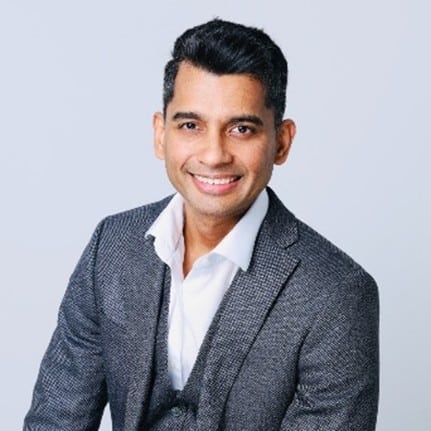
About Ajit Swaminathan
Ready to Lead the Transformation?
- Schedule a Growth Strategy Dialog: Align your growth roadmap with Frost & Sullivan’s Visionary Growth Pipeline™ Dialog.
- Engage with Growth Experts: Co-design AI-enabled, data-driven operating models that scale industry-specific and commercial impact.
- Showcase Your Transformational Leadership: Position your organization as a transformation leader through Frost & Sullivan’s Transformational Growth Leadership platform.
- Join the Growth Council: Collaborate with industry leaders shaping the future of your ecosystem.
- Explore Best Practices Recognition: Be recognized for excellence in growth strategy, execution, and customer impact.
- Benchmark Your Industry Positioning on the Frost Radar™: Benchmark your growth performance and innovation strength against industry competitors.
- Tell Your Story: Accelerate awareness, engagement, and revenue growth through integrated brand and demand generation strategies.
Appendix: Shaping the Future of Premium Mobility in India
As automotive manufacturers respond to electrification, software-defined vehicles (SDVs), evolving ownership expectations, and the expansion of luxury vehicle ownership, combining product innovation with a differentiated customer experience is becoming increasingly important. Developments in charging infrastructure, battery ownership models, connected vehicle capabilities, and customer engagement are creating new opportunities to strengthen the premium mobility ecosystem and reach emerging customer segments.
Frost & Sullivan’s automotive and mobility coverage supports organizations in evaluating these developments, including: