This blog is based on Frost & Sullivan’s recent analysis, “India’s Growth Outlook: Transformations and Megatrends, 2040” authored by growth experts Rituparna Majumder and Nikita Talnikar from the Economic analytics Practice.
India’s economic growth story is entering a decisive phase, with resilient consumption, public capital expenditure, digital transformation, and manufacturing initiatives strengthening the country’s long-term growth foundations through 2040.
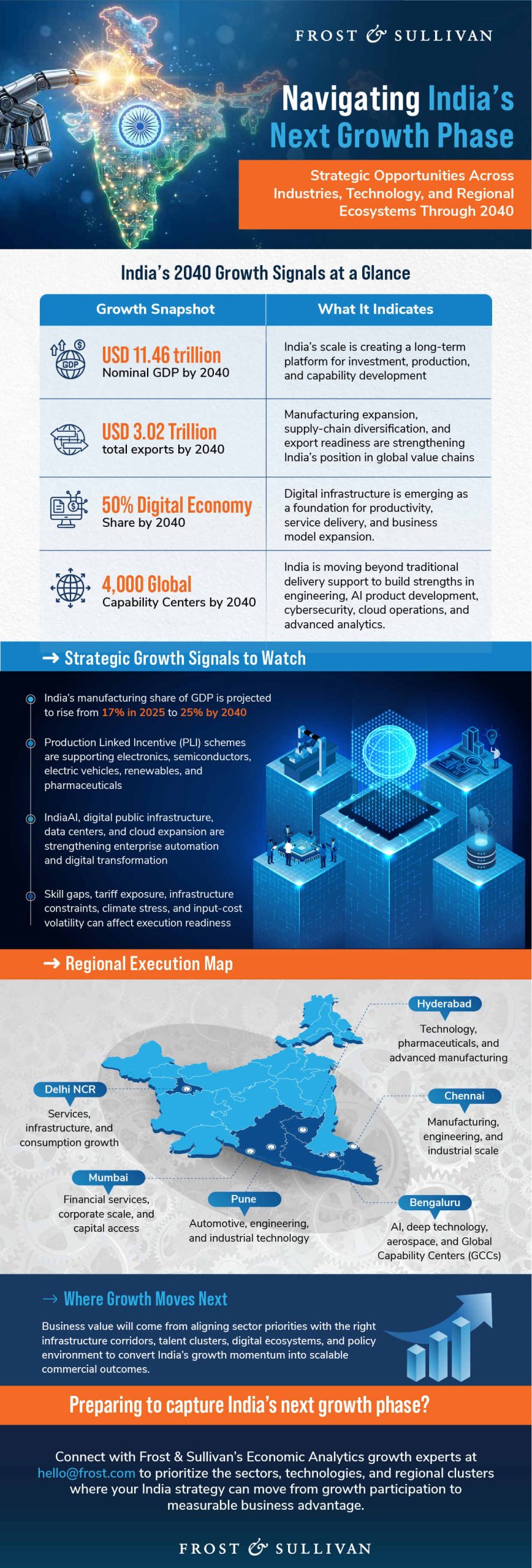
By 2040, India’s economy is projected to reach USD 11.46 trillion. Rising exports, expanding urban clusters, a growing working-age population, and the continued expansion of Global Capability Centers (GCCs) are expected to create new opportunities for long-term value creation.
For business leaders, the opportunity extends beyond participating in India’s expansion. The priority is to determine where investment should be placed, which capabilities need to be built, and which regional clusters can support stronger execution. Companies aligning their strategies with manufacturing hubs, digital ecosystems, infrastructure corridors, and talent clusters will be better positioned to capture the next phase of India’s economic transformation.
Turning India’s Growth Shift into Growth Action
Frost & Sullivan’s sample analysis helps businesses assess:
- Where India’s current momentum can translate into 2040 value creation
- How manufacturing, digital infrastructure, and talent clusters are reshaping expansion priorities
- Which growth restraints could affect execution, from skill gaps to tariff exposure
Strategic Imperatives Shaping India’s Economic Growth
For companies assessing India, the value of the strategic imperatives lies in using them as a decision filter: where demand is durable, where technology can improve productivity, and where business models can scale faster.
- Transformative Megatrends: Demographic advantage, urbanization, the green transition, and rising middle-class are creating opportunities across priority regions, segments, and product portfolios with stronger demand depth.
- Disruptive Technologies: Artificial intelligence (AI), Internet of Things (IoT), edge computing, and advanced robotics are improving productivity, service efficiency, and operational performance across industries.
- Innovative Business Models: Platform ecosystems, subscription models, sharing models, and outcome-based services are enabling new revenue streams, broader market access, and recurring customer engagement.
How will these strategic imperatives shape India’s next wave of investment, capability building, regional expansion, and long-term value creation?
Converting India’s Growth Drivers into Execution Advantage
India’s growth drivers create value when they help businesses determine where to scale, where to build capability, and where execution risk is manageable.
- Policy and infrastructure: Public capital expenditure, production linked incentive-(PLI)-backed manufacturing, freight corridors, multimodal infrastructure, and warehousing expansion are strengthening India’s production and supply-chain capabilities.
- Digital capability: Unified Payments Interface (UPI), 5G, IndiaAI, data centers, cloud expansion, and GCCs are improving the base for enterprise automation, engineering, analytics, and service delivery.
- Execution restraints: Skill gaps, low research and development intensity, tariff exposure, regulatory complexity, climate stress, and input-cost volatility can slow value creation.
Growth Opportunities Shaping India’s Next Phase of Business Growth
The next value creation in India economic growth will be driven by opportunities that improve productivity, strengthen urban execution, and expand enterprise capability. They highlight where businesses can convert India’s digital, infrastructure, manufacturing, and talent shifts into stronger business outcomes.
- AI-powered Industry Transformation and Enterprise Automation
AI adoption in India is accelerating across predictive maintenance, customer operations, healthcare, logistics, finance, and public sector applications. The opportunity lies in improving productivity, service efficiency, and decision-making at scale.
- Smart Infrastructure and Urban Technologies
Urbanization is increasing demand for smarter transport, utilities, energy systems, housing, and connected city services. The opportunity lies in solutions that improve infrastructure performance, energy efficiency, congestion management, and real-time urban operations.
- Advanced Manufacturing, Supply Chain Diversification, and GCC Expansion
Manufacturing growth, supply-chain diversification, and GCCs are strengthening India’s role in production, engineering, analytics, cybersecurity, cloud operations, and enterprise capability creation.
Regional Clusters Shaping India’s Execution Advantage
India’s 2040 urban opportunity spans established economic anchors and specialized technology and manufacturing hubs. Their relevance extends beyond city size to the financial, industrial, infrastructure, and talent capabilities they contribute to business expansion.
Regional Execution Map
- Bengaluru: Its technology base, deep-tech ecosystem, skilled workforce, and GCC concentration reinforce its position as a leading hub for innovation and high-value services.
- Mumbai: Its financial services and corporate ecosystem sustain its role as a major center for capital, enterprise activity, and business decision-making.
- Delhi NCR: Its economic scale and position among India’s principal urban engines support continued relevance across services, infrastructure, and consumption-led growth.
- Chennai: Its projected economic scale strengthens its role within India’s southern industrial and urban growth corridor.
- Hyderabad: Technology, pharmaceuticals, advanced manufacturing, and planned infrastructure investment are accelerating its position as a diversified growth hub.
- Pune: Automotive, engineering, information technology, and industrial corridor development connect manufacturing capability with technology-led expansion.
These clusters serve different roles within India’s growth architecture. Their combined strengths across capital access, production, technology, infrastructure, and talent provide a sharper basis for evaluating regional expansion and capability development through 2040.
Charting India’s Next Growth Path
India economic growth is creating multiple growth arenas across manufacturing, infrastructure, digital technologies, urban development, and advanced services. The next decade will reward businesses that look beyond demand scale and position India as a platform for production, innovation, talent development, and global capability creation.
The priority is to identify where sector opportunities, regional strengths, policy support, and execution readiness align. Businesses that make these choices early will be better positioned to convert India’s current momentum into long-term commercial advantage.
Ready to Lead the Transformation?
- Book a Growth Strategy Session: Align your growth roadmap with Frost & Sullivan’s visionary Growth Pipeline™ Dialog.
- Engage with Growth Experts: Co-design AI-enabled, data-driven operating models that scale industry-specific and commercial impact.
- Share Your Transformation Story: Position your organization as a transformation leader through Frost & Sullivan’s Transformational Growth Leadership platform.
- Join the Growth Council: Collaborate with industry leaders shaping the future of your ecosystem.
- Nominate for the Best Practices Recognition: Be recognized for excellence in growth strategy, execution, and customer impact.
- Demonstrate Industry Positioning on the Frost Radar™: Benchmark your growth performance and innovation strength against industry competitors.
- Activate Brand & Demand Growth: Accelerate awareness, engagement, and revenue growth through integrated brand and demand generation strategies.
FAQs
1. What is driving Indian economic growth through 2040?
Indian economic growth is being driven by resilient consumption, capital expenditure, digital transformation, manufacturing incentives, infrastructure expansion, and working-age depth. By 2040, these drivers are expected to strengthen India’s role as a platform for production, innovation, talent development, and global capability creation.
2. Why does India’s growth outlook matter for business strategy?
India’s growth outlook helps businesses look beyond GDP expansion and identify where to invest, build capabilities, and prioritize regional expansion. The strongest opportunities will emerge where manufacturing hubs, digital ecosystems, infrastructure corridors, and talent clusters support long-term value creation.
3. How will AI in India shape future business opportunities?
AI in India is moving toward enterprise workflow integration across manufacturing, logistics, finance, healthcare, customer operations, and public services. For businesses, the opportunity lies in improving productivity, service efficiency, decision-making, and scalable digital execution.
4. What role will Global Capability Centers in India play in long-term economic trends India?
Global Capability Centers in India are expanding into engineering, AI development, cybersecurity, cloud operations, advanced analytics, and product innovation. This strengthens India’s position as a global capability base and supports long-term economic trends India across digital services, enterprise operations, and high-value talent.
5. How are Megatrends in 2040 shaping India manufacturing growth and Urban India?
Megatrends in 2040, including urbanization, green transition, digital adoption, middle-class aspirations, and supply-chain diversification, are reshaping India manufacturing growth and urban India. Businesses will need to assess where policy support, logistics depth, supplier ecosystems, and workforce readiness can support scalable expansion.
6. How should companies read India’s megatrends market signals?
India megatrends market signals should be read through demand depth, urbanization, digital adoption, manufacturing capacity, talent availability, and regional execution readiness.
7. What does Market growth in India mean for business strategy?
Market growth in India should be assessed beyond demand scale. Businesses need to identify where policy support, infrastructure depth, and capability-building can support measurable expansion.