This blog is based on Frost & Sullivan’s latest analysis, “Seed and Fertilizer Treatments Market, Global, 2025–2032,” authored by Sanika Rajeev Narkar from the Chemicals, Materials & Nutrition Practice Area.
Agricultural production is becoming complex, with growers expected to deliver consistent yields under less predictable conditions. Variability in weather patterns, declining soil fertility, and rising input costs are reducing the reliability of traditional approaches and increasing resource intensity.
In this environment, seed and fertilizer treatments are becoming core components of crop production. Seed treatments support uniform crop establishment and early-stage protection, while fertilizer treatments improve nutrient efficiency and minimize losses.
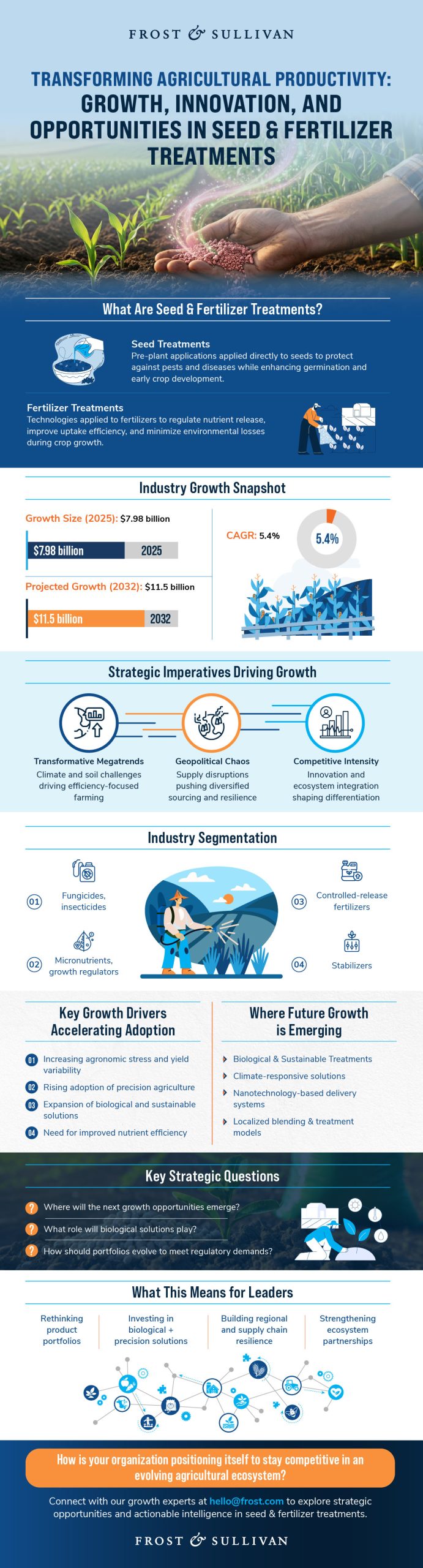
According to recent Frost & Sullivan’s analysis, the global seed and fertilizer treatments segment, valued at $7.98 billion in 2025, is expected to reach $11.5 billion by 2032, growing at a CAGR of 5.4%. This steady expansion reflects the increasing importance of efficiency-driven solutions in modern agriculture.
Where Growth is Accelerating in Seed & Fertilizer Treatments?
- Growth Opportunities
- Revenue Forecasts
- Strategic Priorities
- Competitive Dynamics
How is your organization adapting to the shift toward efficiency-driven agriculture?
Listen to our podcast episode on Growth Opportunities in Seed & Fertilizer Treatments.
How Is Agriculture Shifting from Input Intensity to Performance-driven Efficiency?
A defining transition in modern agriculture is the move away from input-heavy practices toward efficiency-led performance. Historically, yield gains were achieved by increasing the application of fertilizers, pesticides, and seeds. Today, this model is facing growing limitations due to economic, environmental, and regulatory pressures.
Key challenges reinforcing this transition include:
- Nutrient losses through leaching and volatilization
- Rising input costs
- Environmental impact and soil degradation
- Stricter regulatory controls on chemical usage
As a result, the focus is turning toward improving how inputs perform rather than increasing application volumes. Seed and fertilizer treatments play a central role by enhancing effectiveness at critical stages of crop development.
Controlled-release fertilizers and nutrient stabilizers are helping align nutrient availability with crop demand, reducing waste and improving utilization. In parallel, advanced seed coatings and biological treatments are strengthening seed performance under variable field conditions.
Technology Innovation Reshaping the Seed and Fertilizer Treatments Landscape
- Biological Treatments
Biological seed treatments are gaining momentum as farmers seek environmentally compliant alternatives. These solutions are leveraging beneficial microorganisms to enhance nutrient uptake, improve soil health, and increase crop resilience.
- Advanced Coating Technologies
Coating technologies are becoming more sophisticated, enabling precise delivery of active ingredients. These coatings improve adhesion, reduce dust-off, and ensure uniform application, critical for mechanized farming systems.
- Precision Application Systems
The integration of digital agriculture tools and precision farming techniques is enabling targeted application of treatments. This improves efficiency, reduces waste, and enhances overall farm productivity.
Key Challenges Limiting Seed and Fertilizer Treatment Adoption
- Regulatory Complexity: Evolving compliance requirements are increasing approval timelines and costs, while limiting the use of certain active ingredients.
- Cost Considerations: The upfront investment required for advanced treatment solutions is constraining adoption, particularly among smallholder farmers.
- Limited Awareness and Technical Support: Gaps in knowledge and access to agronomic guidance are slowing the uptake of newer technologies.
- Performance Consistency: While biological solutions are offering strong potential, variability across environmental conditions is affecting reliability and confidence in adoption.
Regional Dynamics: Where Growth Is Accelerating
While North America and Europe remain mature segments with high adoption levels, the strongest growth momentum is shifting toward Asia-Pacific.
This region is experiencing rapid expansion in commercial agriculture, increasing awareness of input optimization, and rising demand for higher productivity. As a result, it is emerging as the fastest-growing region for seed and fertilizer treatments.
At the same time, emerging regions face unique challenges, including cost sensitivity and reliance on farmer-saved seeds, which can limit adoption. Addressing these barriers will be critical for unlocking long-term growth potential.
Emerging Growth Opportunities Shaping Seed and Fertilizer Treatments
- Multi-functional Treatment Solutions
There is a growing shift toward integrated solutions that combine protection, enhancement, and performance benefits in a single application. These bundled approaches simplify usage and deliver more consistent results.
- Climate-responsive Technologies
As climate variability increases, there is a need for treatments that can adapt to diverse environmental conditions. Solutions tailored to specific soil and climate profiles will gain importance.
- Nanoparticles and Nanofibers
Emerging technologies such as nanoparticles and nanofibers offer the potential for more precise delivery of nutrients and active ingredients, although scalability and regulatory acceptance remain challenges.
- Localized Production Models
Decentralized blending and treatment models can improve responsiveness to regional demand, reduce supply chain risks, and enhance market penetration.
Competitive Environment: Key Players and Strategic Positioning
- Syngenta: Leveraging its integrated crop protection and seed platforms, Syngenta is focusing on advanced seed treatment portfolios and biological solutions to enhance early-stage crop performance and sustainability outcomes.
- BASF is strengthening its position through innovation in formulation chemistry and biologicals, developing solutions that combine crop protection with nutrient efficiency while aligning with evolving regulatory requirements.
- Yara is advancing fertilizer treatment technologies, particularly in nutrient stabilization and enhanced-efficiency fertilizers, enabling improved nutrient uptake and reduced environmental losses.
Organizations that align their strategies with the evolving industry dynamics, by investing in innovation, advancing sustainable solutions, and responding to regional needs, are strengthening their ability to capture long-term growth.
Frequently Asked Questions
- What is the seed treatment process?
Seed treatment is the application of chemical or biological agents to seeds before planting to improve performance and protection. The process typically involves coating, dressing, pelleting, or priming seeds with fungicides, insecticides, nutrients, or microbial solutions to enhance germination, protect against pests and diseases, and support early plant development.
- Which chemical is used for seed treatment?
Seed treatments commonly use a combination of chemical and biological actives, including:
- Fungicides (e.g., fludioxonil, metalaxyl, azoxystrobin) for disease protection
- Insecticides (e.g., imidacloprid, thiamethoxam) for early pest control
- Nematicides for managing soil-borne nematodes
- Growth regulators and micronutrients to support early plant vigor
Biological alternatives such as Bacillus, Trichoderma, and Pseudomonas species are also gaining adoption as sustainable options.
- What is the difference between chemical and bio-seed treatment?
- Chemical seed treatments use synthetic active ingredients to provide targeted protection against pests and diseases. They are typically fast-acting and widely used in commercial agriculture.
- Biological seed treatments use naturally derived microorganisms or compounds to improve nutrient uptake, enhance soil health, and increase plant resilience. They are considered more environmentally sustainable but may show variability depending on environmental conditions.
- What are the factors affect seed treatment and fertilizer treatment market?
Key factors include climate variability, soil degradation, demand for higher productivity, regulatory pressures, adoption of precision agriculture, and cost sensitivity in emerging markets.
Ready to Lead the Transformation?
- Book a Growth Strategy Session: Align your growth roadmap with Frost & Sullivan’s visionary Growth Pipeline™ Dialog.
- Engage with Growth Experts: Co-design AI-enabled, data-driven operating models that scale industry-specific and commercial impact.
- Share Your Transformation Story: Position your organization as a transformation leader through Frost & Sullivan’s Transformational Growth Leadership platform.
- Join the Growth Council: Collaborate with industry leaders shaping the future of your ecosystem.
- Nominate for the Best Practices Recognition: Be recognized for excellence in growth strategy, execution, and customer impact.
- Demonstrate Industry Positioning on the Frost Radar™: Benchmark your growth performance and innovation strength against industry competitors.
- Activate Brand & Demand Growth: Accelerate awareness, engagement, and revenue growth through integrated brand and demand generation strategies.