This blog is based on Frost & Sullivan’s analysis, “Frost Radar™: Digital Identity, 2026,” authored by Deepali Sathe from the Security Practice Area.
Executive Summary
Digital identity is becoming a strategic enabler of secure digital services and cross-sector collaboration. As investments in identity technologies accelerate, organizations need greater clarity on industry direction, innovation priorities, and technology providers. Explore the trends, growth opportunities, and competitive insights shaping the future of digital identity.
The digital identity market has become a strategic investment priority as governments, financial institutions, healthcare organizations, and enterprises strengthen secure authentication, digital identity management, and digital identity verification solutions to build trusted digital ecosystems.
Discover how the industry’s leading innovators are enabling secure, interoperable, and future-ready digital identity.
For business and technology leaders, the challenge extends beyond deploying new technologies. Growth depends on selecting platforms that can scale across ecosystems, support interoperability, strengthen security, and adapt to changing regulatory requirements while delivering measurable business value.
Is your digital identity strategy ready for the next generation of trusted digital ecosystems?
Tune into our podcast episode on top innovators shaping digital identity.
Key Takeaways
- AI, biometrics, digital wallets, verifiable credentials, and post-quantum cryptography are reshaping digital identity management strategies.
- Future market leaders will differentiate through ecosystem interoperability, privacy-first design, and scalable trust services.
- Organizations that benchmark technology providers based on innovation, growth, and strategic execution will be better positioned to build resilient digital identity strategies.
What Is Digital Identity?
Digital identity is the digital representation of an individual or organization’s identity, enabling secure authentication, identity verification, and trusted access to digital services. As governments and enterprises accelerate digital transformation, digital identity is becoming a strategic capability that supports secure interactions, regulatory compliance, fraud prevention, and seamless user experiences across interconnected digital environments.
Strategic Imperative: Why Digital Identity Is Becoming the Foundation of Trusted Digital Ecosystems
Several structural shifts are accelerating digital identity adoption worldwide:
- Governments are modernizing national identity infrastructure through digital public infrastructure (DPI) initiatives.
- Regulatory frameworks such as eIDAS 2.0 are prompting cross-border interoperability and digital trust.
- Enterprises are adopting digital wallets and verifiable credentials to streamline onboarding, authentication, and customer experiences.
- Financial institutions, healthcare organizations, and telecommunications providers are seeking reusable identity models that reduce fraud while improving operational efficiency.
Reflecting on these industry shifts, Deepali Sathe, Industry Principal at Frost & Sullivan, notes: “Success in digital identity market will depend on more than identity verification capabilities. Future leaders will be those that enable interoperable ecosystems, foster digital trust, and deliver secure, scalable identity solutions across industries.”
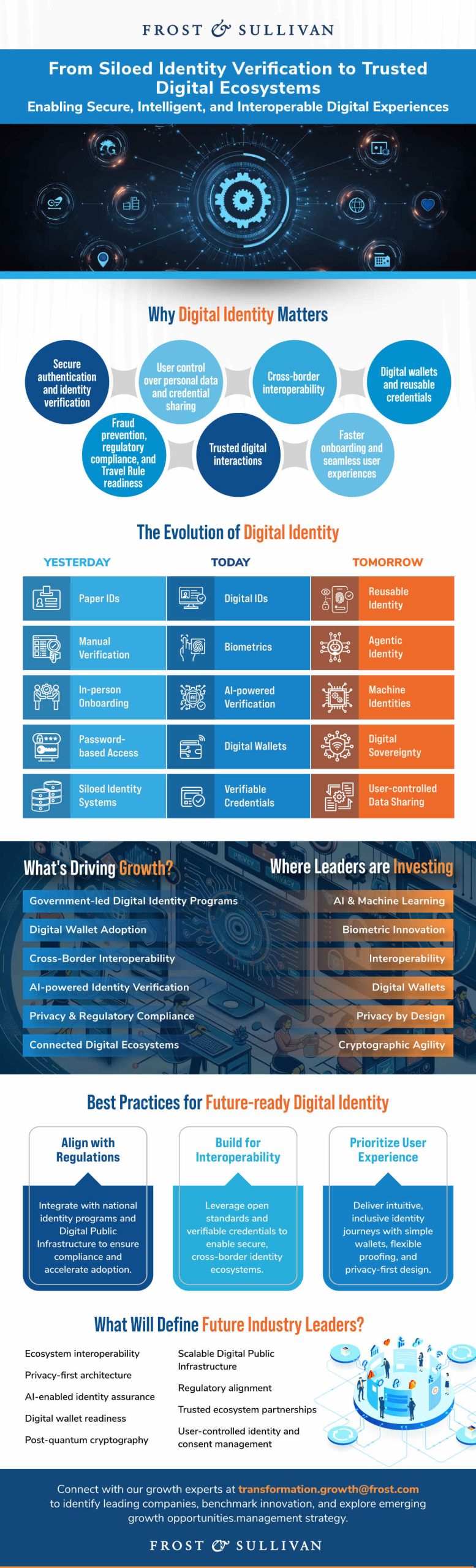
Traditional Identity Management vs. Modern Digital Identity
As organizations modernize identity strategies, the focus is shifting from isolated authentication systems to connected identity ecosystems that support secure, scalable, and user-centric digital interactions.
| Traditional Identity Management | Modern Digital Identity Management |
| Password and credential-based authentication | Passwordless authentication, biometrics, and digital wallets |
| Organization-specific credentials | Reusable verifiable credentials |
| Manual identity verification | Artificial intelligence (AI)-powered identity verification solutions and liveness detection |
| Reactive fraud prevention | Continuous risk assessment and adaptive authentication |
| Siloed identity infrastructure | Integrated DPI and ecosystem collaboration |
Why it matters: Organizations adopting modern digital identity frameworks can streamline user onboarding, strengthen fraud prevention, improve regulatory compliance, and deliver more secure, seamless digital experiences across industries and borders.
How Leading Innovators Are Advancing Digital Identity
Leading providers are focusing their innovation around several strategic priorities:
- Platform-based Identity Orchestration: Providers are integrating identity proofing, credential issuance, authentication, biometrics, and lifecycle management into unified platforms that simplify deployment and management.
- Standards-driven Interoperability: Support for open standards, decentralized identity frameworks, and verifiable credentials is enabling organizations to integrate identity services across multiple sectors and jurisdictions.
- Privacy and Trust by Design: Vendors are embedding privacy-preserving technologies, consent management, and secure credential exchange to strengthen user trust while meeting evolving regulatory requirements.
- AI-enhanced Identity Assurance: AI is improving document verification, biometric authentication, fraud detection, and risk-based decision-making to deliver faster and more accurate identity verification.
- Future-ready Security: Providers are strengthening cryptographic capabilities, credential protection, and post-quantum readiness to ensure long-term resilience against emerging cyber threats.
Top 3 Growth Opportunities Shaping the Digital Identity Market
Digital identity is evolving into a foundational layer for secure digital services, creating significant opportunities across both public and private sectors. According to Deepali Sathe, “The greatest opportunities in digital identity will emerge for organizations that build interoperable, standards-based identity frameworks capable of supporting trusted digital interactions at scale, while empowering individuals with greater control over their personal data, consent, and digital credentials.”
- Digital Public Infrastructure (DPI) Expansion
Governments worldwide are modernizing national identity systems and DPI, creating long-term opportunities for identity platforms, biometric technologies, credential issuance, and trust services.
- Growth of Digital Wallets and Verifiable Credentials
The adoption of digital wallets and verifiable credentials is transforming how citizens, consumers, and enterprises manage identity, enabling secure, reusable credentials across multiple services and digital channels.
- Cross-Border Digital Trust
Regulatory initiatives such as eIDAS 2.0 are accelerating demand for interoperable identity frameworks that enable trusted digital interactions across borders while supporting compliance and data sovereignty.
Top Visionary Leaders Driving the Next Generation of Digital Identity
Frost & Sullivan’s Frost Radar™: Digital Identity, 2026, benchmarks companies based on their Growth and Innovation performance, highlighting providers that are shaping the evolution of trusted digital identity. Rather than competing solely on identity verification, these organizations are advancing interoperable ecosystems, secure credential management, biometric innovation, and cryptographic trust.
- Thales: Driving large-scale sovereign identity programs through integrated digital credentials, digital wallets, secure travel solutions, and post-quantum-ready trust infrastructure.
- TECH5: Advancing DPI through AI-powered authentication, decentralized identity frameworks, and scalable national digital identity platforms.
- Entrust: Strengthening digital trust with cloud-native PKI, identity orchestration, digital credential lifecycle management, and post-quantum cryptography capabilities.
- NEC: Leveraging world-leading biometric technologies, AI-driven identity verification, and trusted government deployments to support secure, high-assurance digital identity.
- Signicat: Accelerating interoperability across Europe through digital identity orchestration, reusable electronic identities, and trusted digital wallet initiatives.
Download the complete Frost Radar™ analysis to benchmark your digital identity strategy against the industry’s leading innovators.
The Next Phase of Competition in Digital Identity Market
Competition is shifting beyond identity verification toward trusted digital ecosystem enablement. Future industry leaders will be differentiated by their ability to orchestrate interoperable identity platforms, support regulatory compliance, and deliver secure digital experiences across governments and enterprises.
According to Frost & Sullivan, the future of the digital identity market will be defined not only by advances in secure authentication technologies but also by organizations’ ability to build interoperable, privacy-first identity ecosystems that balance trust, compliance, and user experience.
Key areas of differentiation include:
- Advancing interoperable digital identity ecosystems built on open standards
- Expanding digital wallets, verifiable credentials, and reusable identity models
- Strengthening AI-driven identity verification solutions and fraud prevention
- Accelerating post-quantum cryptography and cryptographic trust services
- Simplifying identity orchestration across public and private sector ecosystems
- Enabling privacy-first, user-centric digital identity experiences
As governments continue to modernize DPI and enterprises accelerate digital transformation, technology providers that combine interoperability, trust, innovation, and scalable ecosystem partnerships will be best positioned to lead the next phase of digital identity adoption.
Frequently Asked Questions: Digital Identity
1. What are the examples of digital identity?
Common examples of digital identity include national digital IDs, mobile driver’s licenses (mDLs), digital passports, employee credentials, digital banking identities, healthcare IDs, student IDs, and digital wallets containing verifiable credentials. These identities enable secure access to digital services while protecting user privacy.
2. What are the key technologies driving digital identity?
Digital identity ecosystems are increasingly built around:
- Digital Public Infrastructure (DPI)
- Digital wallets
- Verifiable Credentials (VCs)
- Biometric authentication
- AI-powered identity verification solutions
- Public Key Infrastructure (PKI)
- Post-quantum cryptography (PQC)
These technologies collectively improve trust, interoperability, and resilience across digital ecosystems.
3. Which industries will benefit most from digital identity?
Digital identity adoption is accelerating across:
- Government and public services
- Banking and financial services
- Healthcare
- Telecommunications
- Travel and aviation
- Retail and digital commerce
- Education
- Mobility and transportation
These industries require trusted identity to streamline customer onboarding, improve security, and comply with evolving regulations.
4. How do digital wallets support digital identity?
Digital wallets securely store digital identities and verifiable credentials on a user’s device, allowing individuals to present only the information required for a specific transaction. This enhances privacy, simplifies authentication, and improves the overall user experience.
5. What are verifiable credentials, and how do they enable reusable identity?
Verifiable credentials are digital versions of trusted documents such as identity cards, educational certificates, professional licenses, or employee credentials that can be cryptographically verified. When stored in digital wallets, these credentials enable reusable identity, allowing individuals to verify their identity once and securely reuse trusted credentials across multiple services, organizations, and digital channels. This approach reduces fraud and verification costs, streamlines onboarding, strengthens privacy, gives users greater control over their personal data, and supports trusted digital interactions at scale.
Ready to Lead the Transformation?
- Schedule a Growth Strategy Dialog: Align your growth roadmap with Frost & Sullivan’s Visionary Growth Pipeline™ Dialog.
- Engage with Growth Experts: Co-design AI-enabled, data-driven operating models that scale industry-specific and commercial impact.
- Showcase Your Transformational Leadership: Position your organization as a transformation leader through Frost & Sullivan’s Transformational Growth Leadership platform.
- Join the Growth Council: Collaborate with industry leaders shaping the future of your ecosystem.
- Explore Best Practices Recognition: Be recognized for excellence in growth strategy, execution, and customer impact.
- Benchmark Your Industry Positioning on the Frost Radar™: Benchmark your growth performance and innovation strength against industry competitors.
- Tell Your Story: Accelerate awareness, engagement, and revenue growth through integrated brand and demand generation strategies.