The global supply chains are entering a more volatile operating environment as the ongoing Middle East conflict disrupts key trade corridors and shipping routes. Freight rates have increased two to five times on disrupted routes, while war risk premiums have risen from 0.15% to up to 10% of vessel value.
Discover the key risks and shifts supply chain leaders must prepare for, including cost volatility, trade disruptions, and sourcing realignment.
Click here to download
This is forcing organizations to reassess how supply chains are structured, sourced, and managed across regions.
- Rising freight volatility, higher insurance costs, and extended lead times
- Trade fragmentation influencing sourcing supplier diversification strategies
- Production shifting toward regionalized networks and multi-location manufacturing models
This transformation is reshaping how supply chains are structured, managed, and scaled across regions.
How exposed is your supply chain to sustained cost and disruption pressures through 2027?
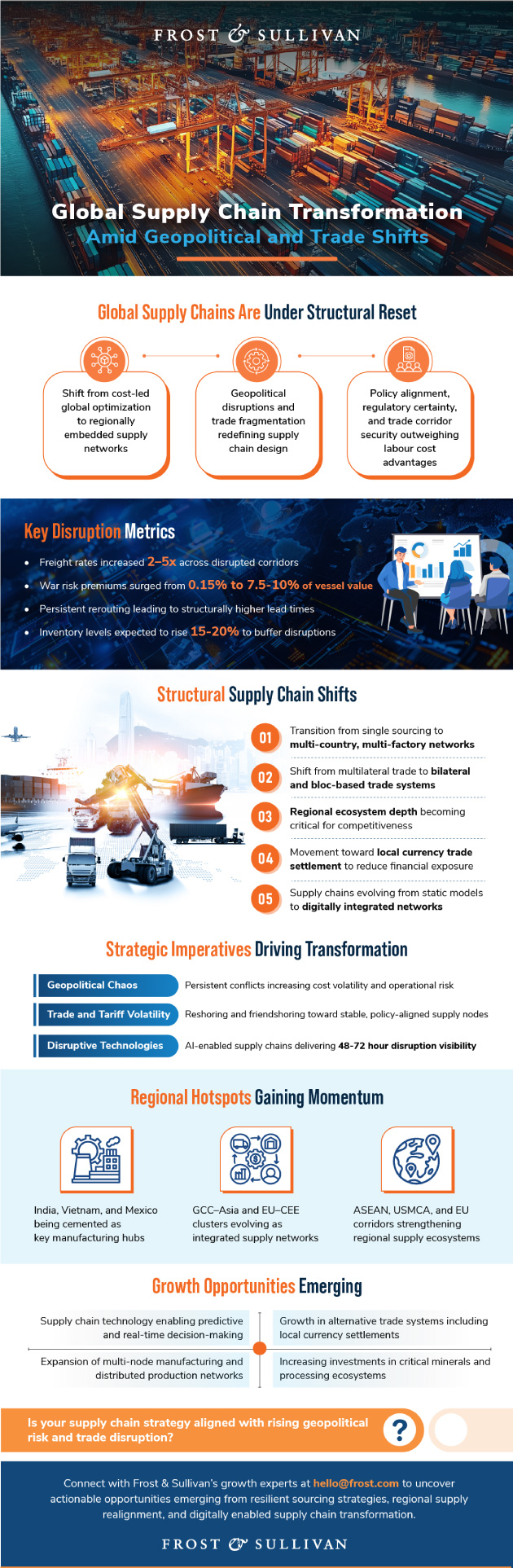
Strategic Imperatives Reshaping Global Supply Chains
Geopolitical instability, trade realignment, and rising operational costs are forcing organizations to reassess how global supply chains are structured, sourced, and managed.
Geopolitical Chaos
- Maritime chokepoints are increasing rerouting pressures, transit delays, and operational uncertainty across global trade corridors
- Rising freight and insurance costs are exposing organizations to sustained cost volatility and supply chain disruption risks
Internal Challenges
- Tariffs, bilateral trade agreements, and regulatory shifts are accelerating supplier diversification and reshaping sourcing strategies
- Policy incentives and regional trade frameworks are influencing manufacturing investments and production location decisions
Disruptive Technologies
- Predictive technologies are improving disruption visibility and enabling faster supply chain response capabilities
- Digitally integrated systems are strengthening operational agility, coordination, and supply chain resilience across networks
Together, these forces are accelerating a structural shift in how supply chains are designed and managed.
How are these shifts influencing your sourcing and production decisions today?
What This Means for Supply Chain Strategy
The transformation is being shaped by three key structural imperatives:
- Managing Cost Volatility and Operational Risk
Organizations are reassessing logistics, inventory planning, and supplier diversification strategies to reduce exposure to rising freight costs, operational disruptions, and geopolitical uncertainty.
- Reshoring and Friendshoring Toward Stable Supply Nodes
Businesses are accelerating reshoring and friendshoring initiatives to strengthen supply continuity, improve regional resilience, and reduce dependence on high-risk trade corridors.
- Adopting Predictive and Digitally Enabled Supply Chains
Organizations are investing in predictive technologies and digitally integrated supply chain systems to improve disruption visibility, operational responsiveness, and decision-making agility.
Where should you realign sourcing, production, and trade partnerships under these conditions?
What Could Slow Down Supply Chain Adaptation
Supply chain transformation will not occur uniformly across regions or industries.
- Supplier ecosystems remain underdeveloped across several emerging manufacturing hubs, limiting large scale sourcing diversification and supplier scalability efforts
- Critical raw materials and strategic inputs remain concentrated in limited geographies, increasing dependency risks and supply vulnerability across industries
- Transition and reconfiguration costs continue to remain significant, creating operational and financial pressure during long term supply chain restructuring initiatives
These constraints will influence the speed, scale, and effectiveness of long-term supply chain transformation initiatives.
Key Drivers Accelerating Supply Chain Reconfiguration
Organizations are accelerating supply chain reconfiguration efforts in response to shifting trade dynamics, geopolitical uncertainty, and rising operational costs. Key drivers supporting this transition include:
- Regional diversification across multiple production and sourcing locations is improving operational flexibility and reducing concentration risk across global supply networks.
- Policy incentives, trade frameworks, and government backed manufacturing initiatives are influencing long term investment and production location strategies
- Predictive technologies and digitally integrated supply chain systems are improving disruption visibility, operational responsiveness, and coordination across supply chain operations
These drivers are influencing the pace and direction of supply chain reconfiguration.
Industries Driving Supply Chain Transformation
Supply chain transformation is accelerating across industries with high geopolitical, economic, and operational significance:
Semiconductors
- Supply disruptions and geopolitical tensions are increasing pressure on semiconductor manufacturers to diversify sourcing strategies, strengthen production resilience, and reduce dependency on concentrated supplier ecosystems
Automotive and Electric Vehicles
- Dependence on geographically concentrated raw material supply chains is increasing sourcing risk and accelerating regional manufacturing and supplier diversification efforts across the automotive and EV ecosystem
Pharmaceuticals and Medical Devices
- Rising concerns around supply continuity and regulatory dependency are accelerating investments in localized production, regional manufacturing ecosystems, and distributed supply networks
These sectors are driving the need for supply chain redesign and resilience.
Where New Opportunities Are Emerging
As supply chains evolve, organizations are identifying new growth opportunities across manufacturing expansion, technology adoption, and trade ecosystem restructuring.
Regional Manufacturing Expansion
- India, Vietnam, and Mexico are cementing themselves as alternative manufacturing hubs, supporting supplier diversification and regional production strategies
- Policy incentives and regional trade partnerships are accelerating investments in distributed manufacturing ecosystems
Supply Chain Technology Adoption
- Predictive technologies and digitally integrated systems are improving disruption visibility and operational responsiveness across supply chains
- AI-enabled supply chain capabilities are strengthening inventory planning, risk assessment, and continuity management strategies
Local Currency Trade Systems
- Local currency settlement frameworks are reducing exposure to sanctions related risks and cross-border financial volatility
- Alternative trade systems are supporting more flexible regional trade and commercial partnerships
These opportunities are influencing how organizations approach long term growth and supply chain resilience.
Where should you position your organization to capture these emerging opportunities?
Best Practices for Navigating Supply Chain Shifts
Organizations are focusing on a few core actions to manage evolving conditions:
- Aligning sourcing strategies with trade frameworks and regulatory developments is improving supply continuity and reducing compliance related risks
- Building distributed production networks is helping organizations reduce concentration risk and improve operational flexibility across regions
- Strengthening supplier ecosystems and regional partnerships is supporting long term continuity and scalable sourcing diversification efforts
- Enhancing operational visibility through predictive and digitally integrated systems is improving disruption response and supply chain coordination capabilities
These practices are becoming increasingly important for sustaining operational resilience and long-term competitiveness under volatile market conditions.
The Road Ahead: Rethinking Supply Chains Through 2027
Global supply chains are no longer operating under stable, efficiency driven models. Cost structures are shifting. Trade flows are realigning. Risk is becoming embedded in operations.
For decision-makers, the focus is no longer on identifying disruption, but on responding with clarity and speed.
Organizations that align sourcing, production, and trade strategies with these structural changes will be better positioned to maintain continuity and competitiveness.
How will your organization adapt as supply chains continue to evolve through 2027?
Ready to Lead the Transformation?
- Book a Growth Strategy Session: Align your growth roadmap with Frost & Sullivan’s visionary Growth Pipeline™ Dialog.
- Engage with Growth Experts: Co-design AI-enabled, data-driven operating models that scale industry-specific and commercial impact.
- Share Your Transformation Story: Position your organization as a transformation leader through Frost & Sullivan’s Transformational Growth Leadership platform.
- Join the Growth Council: Collaborate with industry leaders shaping the future of your ecosystem.
- Nominate for the Best Practices Recognition: Be recognized for excellence in growth strategy, execution, and customer impact.
- Demonstrate Industry Positioning on the Frost Radar™: Benchmark your growth performance and innovation strength against industry competitors.
- Activate Brand & Demand Growth: Accelerate awareness, engagement, and revenue growth through integrated brand and demand generation strategies.
FAQ: Global Supply Chain Shifts and Impact
What is driving the current global supply chain disruption?
Geopolitical conflicts, trade fragmentation, and policy interventions are disrupting trade routes, increasing freight costs, and extending lead times across global supply chains.
How is the Middle East conflict affecting global supply chains?
The conflict is increasing freight volatility, raising insurance premiums, and causing rerouting across key maritime corridors, leading to higher costs and longer delivery timelines.
What are the biggest risks in global supply chain management today?
Key risks include rising freight and insurance costs, supply concentration in limited geographies, trade restrictions, and extended lead times affecting supply continuity.
How are companies building a resilient supply chain?
Organizations are diversifying production across regions, expanding supplier networks, increasing inventory buffers, and adopting predictive systems for better visibility and response.
What role does nearshoring play in supply chain strategy?
Nearshoring is helping reduce dependence on distant suppliers by shifting production closer to demand centers, improving supply continuity and reducing exposure to disruptions.
What is the future of AI in supply chain operations?
AI is enabling predictive visibility, which can help organizations anticipate disruptions 48 to 72 hours in advance and improve coordination across supply chain networks.