This blog is based on Frost & Sullivan’s analyses, “Compliance Automation Market, Global, 2025–2030“ and “Frost Radar™: Compliance Automation, 2026,” authored by Vivien Pua, from the Security Practice Area.
Executive Summary
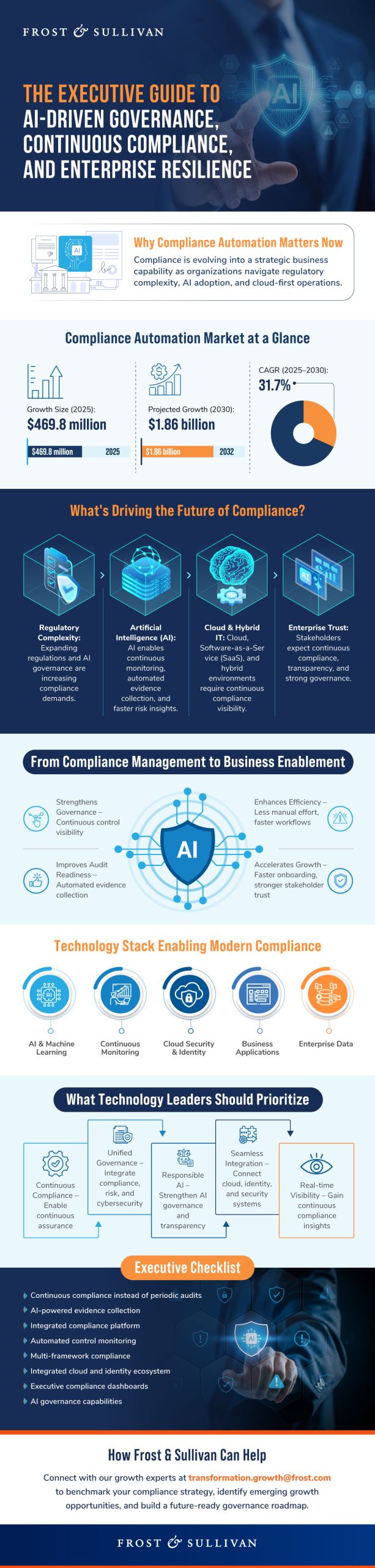
Compliance automation is becoming a strategic driver of business resilience, customer trust, and operational agility. As regulatory complexity and AI adoption accelerate, organizations are investing in intelligent compliance platforms that deliver continuous assurance, streamline governance, and enable faster, risk-informed decision-making. Understanding the key market trends, growth opportunities, and leading innovators is essential for building a future-ready compliance strategy.
Key Takeaways
- Compliance automation is evolving from a regulatory necessity into a strategic enterprise capability that strengthens governance, resilience, and stakeholder trust.
- AI-powered compliance platforms are replacing manual, audit-driven processes with continuous monitoring, intelligent automation, and predictive risk insights.
- Compliance automation platforms are expanding governance capabilities while integrating with broader enterprise risk and security workflows.
- Organizations that embed compliance into cloud, cybersecurity, and DevSecOps (Development, Security, and Operations) environments will be better positioned to accelerate digital transformation while reducing operational risk.
For years, compliance was managed as a periodic exercise focused on meeting regulatory requirements and preparing for audits. Today, it is becoming a strategic capability that supports enterprise governance, operational resilience, and business growth. Organizations are investing in compliance automation to strengthen governance, improve audit readiness, and gain visibility across digital operations. Intelligent platforms that combine AI-driven insights, continuous compliance monitoring, and broader governance capabilities are helping enterprises improve operational efficiency, manage risk proactively, and build stakeholder trust.
Ready to strengthen your compliance strategy?
- Growth Opportunities
- Top Compliance Platform Providers
- Strategic Priorities
Organizations that embed AI-powered compliance, unified governance, and continuous assurance into their enterprise strategy will be better positioned not only to meet evolving regulatory requirements but also to improve operational resilience, accelerate digital transformation, and create sustainable competitive advantage.
How is your organization leveraging compliance automation to strengthen governance and accelerate business growth?
Tune into our podcast episode on Growth Opportunities in Compliance Automation Market
What Is Compliance Automation and How Does It Help Organizations?
A compliance automation tool is an intelligent software platform that helps organizations streamline and continuously maintain adherence to security regulations and industry standards. These platforms automate evidence collection, control monitoring, risk assessments, policy management, compliance reporting, audit preparation, and governance workflows across multiple regulatory frameworks.
By integrating with cloud infrastructure, identity systems, cybersecurity tools, business applications, and DevSecOps environments, compliance automation platforms provide continuous visibility into an organization’s compliance posture while reducing manual effort. AI, continuous control validation, and real-time risk monitoring help organizations improve audit readiness, strengthen governance, respond faster to regulatory changes, and build stakeholder trust, making compliance a strategic enabler of business resilience and sustainable growth.
Traditional Compliance vs. Intelligent Compliance
As organizations modernize governance strategies, compliance is shifting from reactive, manual processes to intelligent, continuously monitored operating models.
| Traditional Compliance | Intelligent Compliance |
| Periodic audits and manual evidence collection | Continuous monitoring and real-time assurance |
| Spreadsheet-driven compliance management | AI-powered compliance automation platforms |
| Framework-by-framework management | Unified management across multiple regulatory frameworks |
| Reactive issue identification | Predictive risk insights and proactive remediation |
| Disconnected compliance, risk, and security functions | Integrated governance, risk, compliance, and cybersecurity |
| Manual reporting and audit preparation | Automated evidence collection and continuous audit readiness |
Strategic Imperatives Shaping the Compliance Automation Market
Three strategic imperatives are influencing the evolution of the compliance automation market, reshaping how organizations manage governance, risk, and regulatory requirements:
- Customer Value Chain Compression: Organizations are streamlining the compliance lifecycle through automated evidence collection software, integrated workflows, and faster audit readiness.
- Competitive Intensity: Platform consolidation is accelerating as compliance, GRC (Governance, Risk, and Compliance), and AI capabilities converge, with vendors competing through integration, ease of implementation, and business value.
- Disruptive Technologies: AI is enabling continuous monitoring, predictive risk insights, and intelligent automation while driving demand for AI governance capabilities.
Reflecting on these strategic imperatives, Vivien Pua, Industry Principal at Frost & Sullivan, notes that successful compliance automation extends beyond technology adoption. Organizations that address integration complexity, strengthen governance, and foster organizational readiness will be better positioned to scale compliance and achieve sustainable business outcomes.
Key Growth Drivers Accelerating Compliance Automation Adoption
- Growing Regulatory Complexity: Expanding global regulations, industry standards, and AI governance requirements are driving demand for compliance automation that simplifies regulatory management, improves audit readiness, and reduces operational complexity.
- Shift Toward Continuous Compliance: Organizations are replacing periodic audits with continuous monitoring and real-time assurance. Automated evidence collection software, continuous control validation, and proactive risk identification enable faster responses to evolving regulatory requirements.
- AI-powered Governance and Risk Management: AI is streamlining compliance by automating evidence collection, mapping controls across frameworks, identifying compliance gaps, and supporting faster, risk-informed decision-making.
- Integrated Compliance and Risk Visibility: Organizations are increasingly adopting integrated compliance automation platforms that unify compliance and risk management workflows, provide real-time visibility across systems, and simplify operations in increasingly complex IT environments.
Top 3 Growth Opportunities Shaping the Compliance Automation Market
As regulatory expectations become more complex and digital transformation accelerates, compliance automation is evolving beyond operational efficiency into a strategic platform for enterprise governance, business resilience, and competitive differentiation. The following growth opportunities are expected to define the market’s next phase of expansion.
- AI-native Governance and Continuous Assurance
AI reshaping compliance by enabling continuous monitoring, automated evidence collection, predictive risk analysis, and intelligent control validation. As AI governance regulations continue to evolve, organizations will increasingly invest in compliance automation platforms capable of managing both traditional compliance requirements and emerging AI-related risks.
- Platform Consolidation and Unified Compliance
Organizations are consolidating fragmented compliance tools into integrated platforms that centralize compliance, risk, and governance activities, reduce operational complexity, and provide a unified view of compliance posture and risk exposure. Vendors that deliver comprehensive, integrated platforms will be well positioned for long-term growth.
- Growing Adoption Across Mid-market Organizations
Compliance automation is expanding beyond highly regulated enterprises into mid-market organizations and cloud-native businesses seeking faster certification, simplified regulatory management, and scalable compliance operations. This presents significant opportunities for vendors offering rapid deployment, intuitive user experiences, and flexible cloud-native platforms.
According to Frost & Sullivan, enterprises that invest in AI-native compliance automation platforms and integrated governance strategies will gain a competitive advantage through greater agility, stronger risk management, and improved compliance outcomes.
Benchmarking the Top Innovators Driving Compliance Automation
Here are the top five compliance automation platform providers:
- Drata leads the growth index with its AI-native trust management platform, delivering real-time monitoring, compliance-as-code, and automated security reviews across nearly 30 regulatory frameworks.
- Vanta leads the innovation index through AI-powered automation, extensive integrations, and scalable compliance capabilities that simplify continuous compliance monitoring for organizations of all sizes.
- Scytale accelerates compliance through AI-assisted automation, expert implementation services, and continuous evidence collection, enabling organizations to achieve certifications faster while reducing manual effort.
- Centraleyes combines AI-driven compliance automation with proactive risk management through cross-framework mapping, intelligent gap analysis, and no-code workflows that strengthen enterprise governance.
- CyberSaint integrates compliance automation with cyber risk management, leveraging AI-native capabilities, dynamic control scoring, and business-impact analysis to enable continuous, risk-informed governance.
Best Practices for Technology Leaders Navigating Compliance Automation
- Adopt AI-native compliance platforms to automate workflows, enable continuous monitoring, and strengthen governance.
- Consolidate fragmented compliance tools into integrated platforms that improve visibility, streamline operations, and provide a unified view of compliance posture and risk exposure. Embed compliance into cloud and DevSecOps workflows to automate control validation and improve audit readiness.
- Prioritize interoperability by selecting platforms that integrate seamlessly with cloud, identity, security, and business applications.
- Measure compliance by business outcomes, focusing on operational efficiency, risk reduction, audit readiness, customer trust, and organizational resilience.
The Next Phase of Competition in Compliance Automation
Competition in the compliance automation market is shifting toward AI-driven governance and continuous assurance, with vendors differentiating through AI-native automation, unified GRC platforms, real-time monitoring, deep integration across cloud and security ecosystems, and responsible AI governance.
Organizations that align compliance with enterprise strategy will be better positioned to strengthen resilience, accelerate digital transformation, and achieve sustainable competitive advantage.
Frequently Asked Questions: Compliance Automation
What is compliance automation?
Compliance automation uses software to automate evidence collection, policy management, control monitoring, risk assessments, compliance reporting, and audit preparation. By integrating with cloud platforms, cybersecurity tools, and business applications, it enables organizations to maintain continuous compliance while reducing manual effort.
Which industries are adopting compliance automation tools most rapidly?
Adoption is strongest across:
- Banking, Financial Services, and Insurance (BFSI)
- Technology
- Manufacturing
- Healthcare
- Retail and e-commerce
- Professional services
- Education
These industries operate within highly regulated environments and require scalable, automated compliance capabilities.
How does compliance automation software improve governance?
Compliance automation software streamlines compliance workflows by automating evidence collection, policy management, control monitoring, and compliance reporting. It helps organizations improve operational efficiency, strengthen governance, and maintain consistent compliance across multiple regulatory frameworks.
What should organizations look for in compliance automation tools or platforms?
When evaluating compliance automation tools or a compliance automation platform, organizations should consider AI capabilities, support for multiple compliance frameworks, seamless integration with cloud and cybersecurity environments, continuous monitoring, automated reporting, and scalability to support evolving regulatory requirements.
What are the benefits of automating compliance processes?
Automating compliance processes helps organizations reduce manual effort, improve audit readiness, and strengthen governance through continuous monitoring and real-time visibility into compliance status. It also streamlines evidence collection, enhances operational efficiency, minimizes compliance risks, and enables organizations to respond more quickly to evolving regulatory requirements.
Ready to Lead the Transformation?
- Schedule a Growth Strategy Dialog: Align your growth roadmap with Frost & Sullivan’s Visionary Growth Pipeline™ Dialog.
- Engage with Growth Experts: Co-design AI-enabled, data-driven operating models that scale industry-specific and commercial impact.
- Showcase Your Transformational Leadership: Position your organization as a transformation leader through Frost & Sullivan’s Transformational Growth Leadership platform.
- Join the Growth Council: Collaborate with industry leaders shaping the future of your ecosystem.
- Explore Best Practices Recognition: Be recognized for excellence in growth strategy, execution, and customer impact.
- Benchmark Your Industry Positioning on the Frost Radar™: Benchmark your growth performance and innovation strength against industry competitors.
- Tell Your Story: Accelerate awareness, engagement, and revenue growth through integrated brand and demand generation strategies.