This blog is based on our analysis – Refrigeration Equipment Market, Global, authored by Frost & Sullivan’s Growth Expert, Melvin Leong, from the Homes & Buildings team.
Refrigeration equipment keeps food, pharmaceuticals, and industrial products at the right temperature, ensuring safety, quality, and efficiency.
Today, manufacturers face growing pressure. Rising demand for cold storage, stricter regulations on low-global warming potential (GWP) refrigerants, and higher expectations for energy efficiency are stretching traditional systems and supply chains. At the same time, advancements in Internet of Things (IoT), AI, and smart energy management are changing how companies design their systems.
Transform Your Cooling Operations
Unlock the Full Analysis
With the global refrigeration equipment industry projected to reach $101.9 billion by 2030 at a CAGR of 8.7%, companies that embrace IoT, AI, and smart energy management now will not only lower operating costs but also stay compliant and build more sustainable, high-performing cooling solutions.
As new technologies and regulations reshape the refrigeration industry, is your team equipped to capitalize on this transformation?
Listen to our latest podcast episode on the Refrigeration Equipment Industry.
What’s Driving Transformation in Refrigeration Equipment?
Three forces are reshaping the refrigeration equipment industry:
- Transformative megatrends: Climate change, urbanization, rising electricity costs, and health concerns are changing end users’ expectations. This is driving demand for energy-efficient and sustainable systems.
- Disruptive technologies: Refrigeration equipment is increasingly integrating IoT, AI, and cloud technologies. These capabilities allow systems to monitor performance in real time and optimize energy use.
- Competitive intensity: To keep up with growing competition, manufacturers are prioritizing energy savings, localized solutions, and green technologies to stay aligned with evolving industry megatrends.
Which growth strategies will help your teams adapt to these industry headwinds?
Refrigeration Equipment Industry – At a Glance
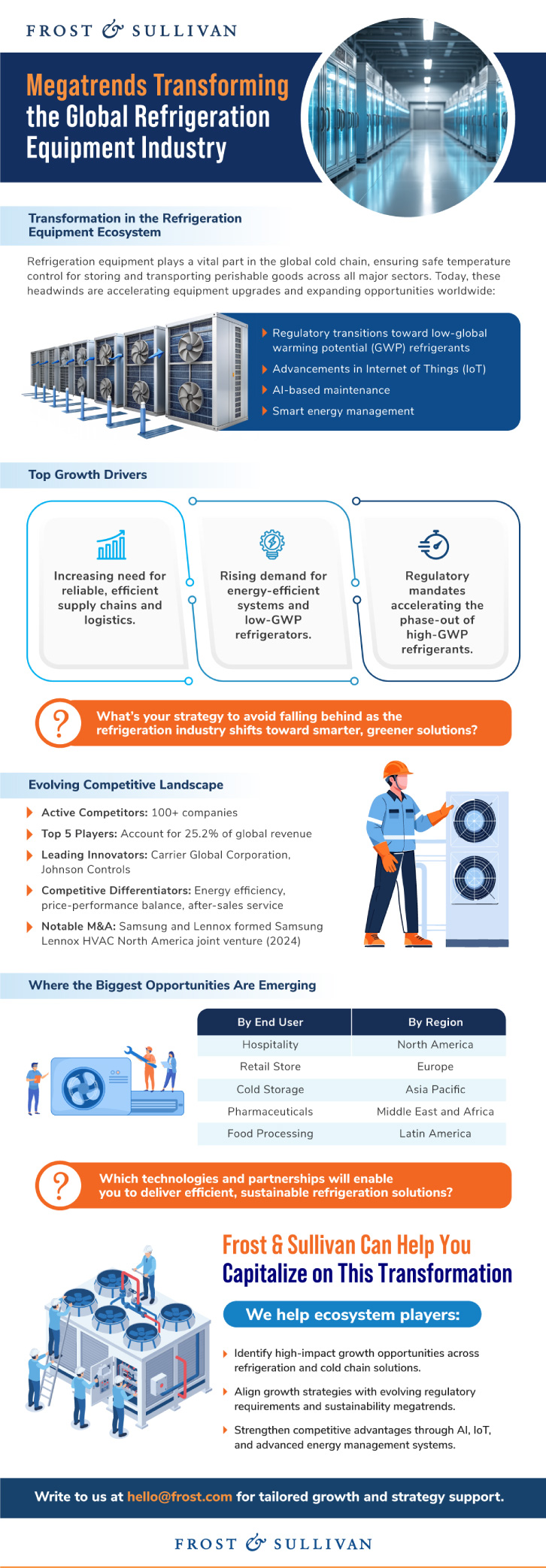
What’s Slowing Down Progress in the Refrigeration Equipment Industry?
Despite strong growth drivers, several structural challenges are slowing the pace of transformation across the industry:
- Geopolitical risks and localization mandates: Rising tariffs, regional conflicts, and local manufacturing requirements are disrupting global supply chains. For OEMs, this translates into higher production costs and new investments in regional facilities.
- Shortage of skilled technicians: Sustainable and smart refrigeration systems require expertise in electronics, controls, diagnostics, and flammable refrigerants. This skills gap is contributing to delayed installations, ineffective maintenance, and slower adoption of modern systems.
- Uneven environmental regulation compliance: The phase-out of high-GWP refrigerants and varying regional regulations, is complicating system upgrades. However, replacing with low-GWP alternatives often involves new system designs, higher upfront costs, and additional training.
Are you addressing these regulatory and operational barriers before they stall your organization’s growth?
Growth Dynamics Across Major Refrigeration Regions
From mature to emerging geographies, these regional megatrends show where companies can focus on maximizing growth and ROI:
- APAC: Leading global growth, driven by urbanization, expanding food retail, government-backed cold-chain refrigeration, and strong manufacturing activity in China and India.
- North America: Experiencing steady growth, fueled by food safety regulations and rising demand from pharmaceutical cold-chain applications.
- Europe: Accelerating the shift toward energy-efficient systems and low-GWP refrigerants under stringent environmental regulations.
- Middle East & Africa: Seeing moderate growth, supported by expanding healthcare infrastructure and rising demand from food imports, tourism, and hospitality.
- Latin America: Expanding at a measured pace, driven by urbanization and evolving food retail formats, despite infrastructure gaps and economic uncertainty.
Which best practices are you implementing to maximize ROI across high-growth regions?
Leading Refrigeration Equipment Providers Shaping 2026 and Beyond
- Carrier Global Corporation: Carrier is strengthening its leadership through smart refrigeration systems like the Supra A and Citimax D series. Its collaboration with METRO AG in Europe and digital offerings like Lynx and Refrigeration-as-a-Service, are helping customers improve visibility and performance without upfront investment.
- Johnson Controls: Johnson Controls is reinforcing its position with energy-efficient YORK® refrigeration systems, supported by growing demand from data centers and healthcare facilities, particularly in North America. Its OpenBlue digital platform and portfolio rationalization efforts are enabling a sharper focus on sustainable, natural-refrigerant-based solutions.
- Trane Technologies: Trane is advancing low-GWP, energy-efficient refrigeration through solutions like the Sintesis Balance CMAF units and its Adaptive Refrigerant System. The acquisition of BrainBox AI strengthens AI-driven optimization, helping reduce emissions while supporting long-term sustainability goals.
Is your team leveraging the right tools and technologies to stay competitive with these industry leaders?
Emerging Opportunities in the Refrigeration Equipment Industry
- Sustainable Refrigeration Technologies
The global push toward decarbonization and energy efficiency is accelerating the development of sustainable cooling technologies across industrial and commercial applications. At the same time, stricter regulations like the Kigali Amendment and the EU F-Gas Regulation are pushing end users to phase down high-GWP refrigerants and adopt natural or low-GWP alternatives.
To navigate this shift effectively, OEMs are:
- Investing in R&D to develop eco-efficient, regulation-compliant cooling solutions aligned with decarbonization mandates.
- Integrating smart energy monitoring and modular system designs with natural refrigerant compatibility to support long-term compliance.
- Forging partnerships with renewable energy, thermal storage, and policy stakeholders to accelerate adoption in regulation-driven markets.
- Natural Refrigerants
The phase down of high-GWP refrigerants like hydrofluorocarbon (HFC) is pushing the industry toward low-carbon alternatives. Meanwhile, natural refrigerants like carbon dioxide (CO₂) (R-744), ammonia (R-717), and hydrocarbons (R-290, R-600a) are gaining momentum due to their near-zero GWP, cost advantages, and compatibility with modern system designs.
To capitalize on this shift, manufacturers and OEMs are:
- Training and certifying technicians to accelerate adoption and safe handling of CO₂, ammonia, and other natural refrigerants.
- Retrofitting legacy installations in industrial and retail sectors while offering consulting to streamline the transition.
- Targeting government and institutional buyers to drive adoption of low-carbon, Environmental, Social, and Governance(ESG)-aligned refrigeration solutions.
Which of these opportunities will have the maximum impact on your organization, and how will you measure it?
Where the Refrigeration Industry Goes from Here
As ecosystems evolve and technologies mature, sustainability is becoming non‑negotiable, placing the refrigeration industry on the edge of transformative growth. Companies that modernize legacy systems and scale natural refrigerant and AI-enabled solutions across regions will lead the market. By embracing innovation and addressing operational challenges head-on, manufacturers can build efficient and environmentally responsible cooling ecosystems.
Frequently Asked Questions (FAQs)
What is refrigeration equipment?
Refrigeration equipment refers to systems and components used to remove heat from an enclosed space to maintain low temperatures for food preservation, medical storage, industrial processes, and climate control.
Common examples include refrigerators, freezers, chillers, cold storage units, and transport refrigeration systems, used across residential, commercial, and industrial applications.
What are the 4 types of refrigeration that will gain traction in 2026?
The four main types of refrigeration are:
- Vapor Compression: The most widely used system, found in household refrigerators, commercial cooling, and industrial chillers.
- Absorption: Uses heat instead of electricity, commonly applied in industrial and waste heat recovery systems.
- Thermoelectric: Relies on the Peltier effect, typically used in compact and portable cooling applications.
- Evaporative: Uses water evaporation for cooling, mainly applied in dry climates and specific industrial environments.
How big is the refrigeration market?
According to Frost & Sullivan, the global refrigeration market is projected to go over $101.88 billion by 2030 driven by increasing demand for cold storage and temperature-controlled solutions across food processing, pharmaceuticals, and retail sectors globally.
What is the biggest refrigeration company?
According to Frost & Sullivan, Carrier Global Corporation is widely recognized as the largest refrigeration and HVAC (heating, ventilation, and air conditioning) company globally, based on revenue, installed base, and geographic reach.
Other major global leaders include Johnson Controls, Trane Technologies, Danfoss, Daikin Industries, and Emerson Electric, each playing a critical role across commercial, industrial, and cold-chain refrigeration segments.
Ready to Lead the Transformation?
- Book a Growth Strategy Session: Align your growth roadmap with Frost & Sullivan’s visionary Growth Pipeline™ Dialog.
- Engage with Growth Experts: Co-design AI-enabled, data-driven operating models that scale industry-specific and commercial impact.
- Share Your Transformation Story: Position your organization as a transformation leader through Frost & Sullivan’s Transformational Growth Leadership platform.
- Join the Growth Council: Collaborate with industry leaders shaping the future of your ecosystem.
- Nominate for the Best Practices Recognition: Be recognized for excellence in growth strategy, execution, and customer impact.
- Demonstrate Industry Positioning on the Frost Radar™: Benchmark your growth performance and innovation strength against industry competitors.
- Activate Brand & Demand Growth: Accelerate awareness, engagement, and revenue growth through integrated brand and demand generation strategies.