This blog is based on our analysis, Building Technologies and Services Growth Opportunities in the Education Vertical, Global, 2025, authored by Frost & Sullivan’s Growth Expert, Melvin Leong from the Energy Practice Area.
Educational facilities are adopting building technologies to improve operational efficiency, sustainability, and learning environments. Solutions like building automation systems (BAS), building management systems (BMS), HVAC (heating, ventilation, and air conditioning), smart lighting, digital twins, building information modeling (BIM), and facility management are helping institutions optimize building performance and campus operations.
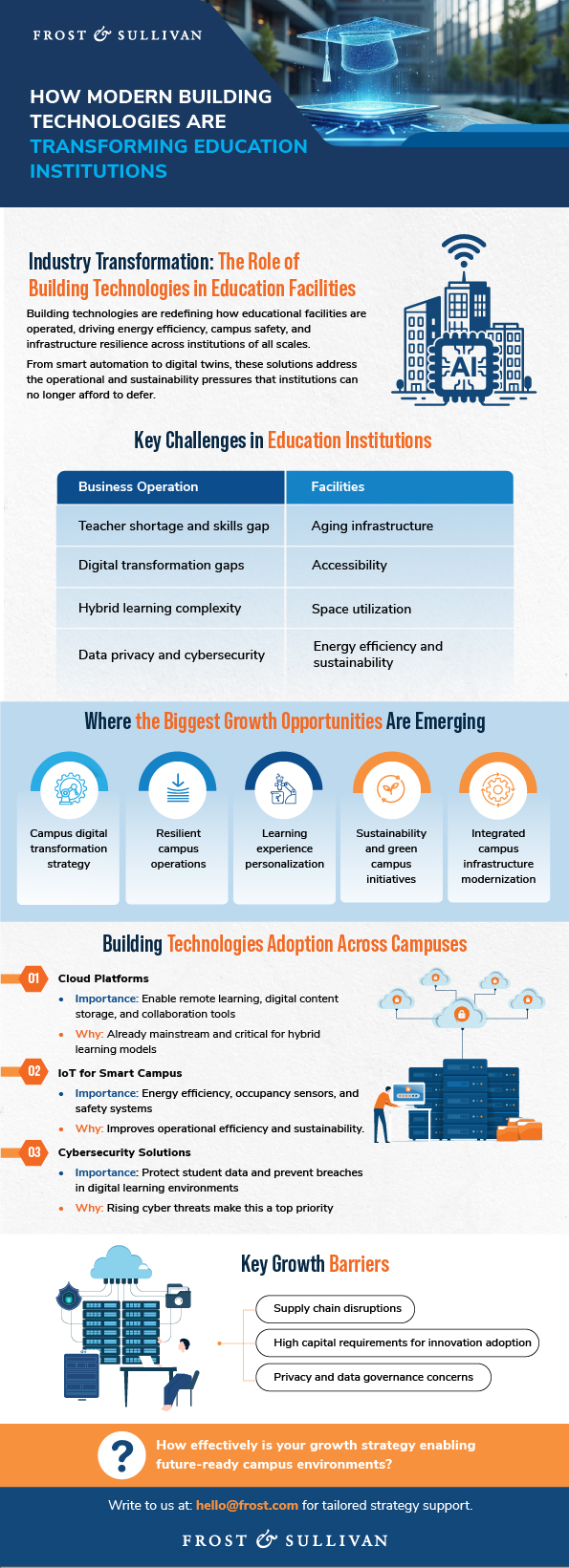
However, education providers face challenges in upgrading aging infrastructure while managing budget constraints, sustainability targets, and the complexity of integrating new technologies without disrupting academic activities. The adoption of hybrid learning models is further increasing the need for flexible and technology-enabled spaces.
Modernize Campus Infrastructure
Explore how BAS, BMS, digital twins, and smart building solutions are shaping the future of building services.
With the building technologies and services industry already valued at $1,749.60 billion in 2025 and continuing to grow at an 8.8% CAGR, providers that align their solutions with these requirements can help education institutions improve energy management, streamline facility operations, and enhance safety and occupant comfort.
As facilities evolve, are your building strategies ready to balance efficiency, sustainability, and occupant needs?
What’s Driving Transformation in Building Technologies and Services Industry
Innovative Business Models
- Customers are moving away from traditional one-time purchases and looking for flexible models that improve affordability and deliver long-term value.
- Subscription and outcome-based models, including Software-as-a-Service (SaaS), Energy-as-a-Service (EaaS), and predictive maintenance, are helping reduce upfront costs and support ongoing service delivery.
Disruptive Technologies
- AI, Internet of Things (IoT), edge computing, and cloud analytics are enabling better energy management, predictive maintenance, and building performance optimization.
- Digital twins, connected HVAC systems, and universal building information platforms (UBIPs) are improving planning, monitoring, and education facility management processes.
Transformative Megatrends
- Decarbonization, digitalization, and automation are increasing demand for energy-efficient technologies and connected building solutions.
- Net-zero targets and workforce shortages are increasing the need for automation, AI-enabled workforce management, and energy management solutions to improve operational efficiency.
Strategic Priorities for Modern Education Facilities
What’s Slowing Down Adoption of Building Technologies and Services?
While building technologies continue to advance, several challenges are affecting implementation across facilities:
- Supply chain disruptions: Instability in global supply chains is affecting the availability and cost of key components such as HVAC systems, sensors, and automation hardware. This is leading to procurement challenges and project delays.
- High capital requirements for innovation adoption: Technologies like digital twins, robotics, and modular construction involve significant upfront investment, making adoption difficult for many mid-sized companies.
- Privacy and data governance concerns: Increasing use of smart building systems is raising concerns among occupants around personal data sharing, transparency, and data protection compliance for building operators.
Building Solutions Addressing Education Facility Management Challenges
|
Solution Area |
Application |
Example |
|
Smart Classroom Systems |
Enabling hybrid learning through interactive whiteboards, IoT-enabled devices, and AV integration. |
SMART Technologies deployed interactive panels in classrooms across Ontario, Canada. |
|
Digital Access Infrastructure |
Enabling secure connectivity through high-speed Wi-Fi and campus networks. |
Cisco upgraded campus-wide Wi-Fi at the University of Michigan. |
|
Centralized Data Platforms |
Supporting data management through cloud-based platforms with cybersecurity measures. |
Microsoft migrated legacy systems to Azure Education Cloud at the University of Barcelona. |
|
Energy-efficient IT Rooms |
Optimizing cooling and power management for IT infrastructure. |
Schneider Electric implemented EcoStruxure™ at the National University of Singapore. |
Where to Invest: Growth Opportunities in Building Technologies and Services
As education institutions upgrade their facilities, building technology providers can focus on solutions that support campus modernization, operational efficiency, and infrastructure reliability. The following areas highlight key opportunities:
- Campus Digital Transformation Strategy
Universities are modernizing campuses by connecting building systems with digital platforms to improve facility operations and support hybrid learning models. This is creating demand for smart campus solutions that improve energy management, space efficiency, and coordination. To capitalize on this shift, providers are:
- Connecting BAS/BMS, HVAC, lighting, fire safety, low voltage switchgear (LVSG), and IT platforms to enable centralized control, scheduling, and energy optimization.
- Leveraging digital twins and analytics to support predictive maintenance, space efficiency, and sustainability initiatives.
- Delivering secure cloud-based platforms with cybersecurity and data privacy measures to support campus technology adoption.
- Resilient Campus Operations
Educational institutions are addressing risks from cyberattacks, natural disasters, and system failures that can disrupt campus activities. This is increasing the need for cybersecurity, monitoring, and continuity measures across critical infrastructure. To address this need, providers are:
- Embedding cybersecurity solutions within BAS/BMS platforms to protect critical infrastructure from digital threats.
- Deploying IoT-based predictive maintenance tools to identify failures and reduce downtime.
- Implementing real-time alerts, backup power, and emergency communication systems to support continuity during disruptions.
- Learning Experience Personalization
Students are increasingly expecting flexible learning environments supported by smart building technologies. The adoption of smart classrooms, automated lighting, HVAC, audiovisual systems, and immersive technologies is driving investments in learning spaces that support changing education needs.
To support evolving needs, providers are:
- Designing smart classroom solutions with automated environmental controls, flexible layouts, and IoT-enabled systems to support adaptive learning environments.
- Equipping campus facilities with augmented reality (AR)/virtual reality (VR) infrastructure to enable immersive learning applications.
- Incorporating accessibility features and inclusive classroom designs to meet diverse student needs and support compliance requirements.
Which of these opportunities will have the maximum impact on your organization, and how will you measure it?
What Will Matter Most for Education Facilities Next?
Education institutions will move toward integrated building solutions that connect systems, improve energy management, and support flexible learning environments. For building technology providers, success will depend on delivering solutions that address infrastructure upgrades, technology integration, and ongoing education facility management needs.
Frequently Asked Questions (FAQs)
What is the work of building technology?
Building technology improves how buildings are designed, operated, and maintained through integrated systems that manage energy, safety, comfort, and facility performance. It includes solutions such as HVAC controls, lighting, building automation systems (BAS), and building management systems (BMS).
What are the latest building technologies?
The latest building technologies include building automation systems (BAS), building management systems (BMS), digital twins, Internet of Things (IoT)-enabled controls, building information modeling (BIM), smart lighting, and cloud-based facility management platforms. These technologies help improve operational efficiency, energy management, and building performance.
What is a BMS in building?
A building management system (BMS) is a centralized platform that monitors and controls building systems such as HVAC, lighting, power, and security. It helps optimize energy use, automate building operations, and improve facility performance.
What is a building automation system?
A building automation system (BAS) automatically controls building equipment such as HVAC, lighting, and ventilation using sensors, controllers, and software. It enables centralized monitoring, scheduling, and energy-efficient building operations.
Ready to Lead the Transformation?
- Schedule a Growth Strategy Dialog:Align your growth roadmap with Frost & Sullivan’s Visionary Growth Pipeline™ Dialog.
- Engage with Growth Experts:Co-design AI-enabled, data-driven operating models that scale industry-specific and commercial impact.
- Showcase Your Transformational Leadership: Position your organization as a transformation leader through Frost & Sullivan’s Transformational Growth Leadership platform.
- Join the Growth Council:Collaborate with industry leaders shaping the future of your ecosystem.
- Explore Best Practices Recognition:Be recognized for excellence in growth strategy, execution, and customer impact.
- Benchmark Your Industry Positioning on the Frost Radar™:Benchmark your growth performance and innovation strength against industry competitors.
- Tell Your Story: Accelerate awareness, engagement, and revenue growth through integrated brand and demand generation strategies.