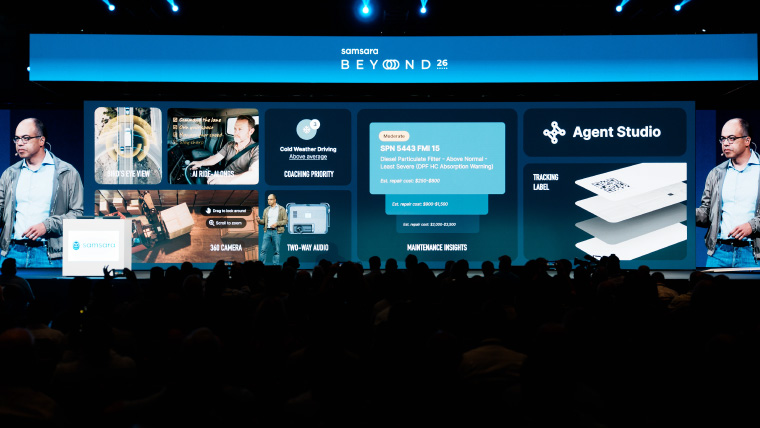
Samsara Beyond 2026, held from June 23 to June 26 in Las Vegas, brought together leaders from across the physical operations landscape to discuss how technology is reshaping safety, efficiency, driver experience, and enterprise productivity. The event made clear that Samsara is no longer positioning itself primarily as a GPS fleet tracking or telematics company. Its broader ambition is to become an AI-powered connected operations platform for the industries that run the physical world.
Samsara
Launches and updates at the event centered around three practical outcomes for operations leaders: reducing risk, improving efficiency, and digitally transforming manual workflows. Samsara’s core message was that AI should move beyond dashboards and alerts toward agentic AI systems that can interpret data, decide what action is needed, trigger workflows, and resolve exceptions either autonomously or with limited human intervention.
AI as the New Operating Layer
The strongest theme at Beyond 2026 was Samsara’s shift from visibility to action. For years, connected operations platforms have helped organizations “see” what is happening across vehicles, equipment, facilities, and frontline teams. Samsara is now trying to turn that visibility into action. The phrase that captured this direction was “Automate Away the Grind,” reflecting the company’s focus on removing repetitive administrative work from day-to-day operations.
A key enabler of this strategy is the range and depth of Samsara’s operational data, spanning video, location, engine diagnostics, hours-of-service, maintenance, and dispatch, unified with 350+ third-party integrations into one operating picture. Because Samsara sees not just what happened, but which interventions actually worked across its network, the platform’s models improve with outcome data, not just data volume. This is a harder advantage to replicate than scale alone, since it depends on linking action to result over time, not simply the number of connected vehicles. Every new customer that connects a vehicle, trailer, piece of equipment, or facility sensor adds more operating data to the platform, helping improve AI models. In turn, this strengthens product value while attracting more customers and assets.
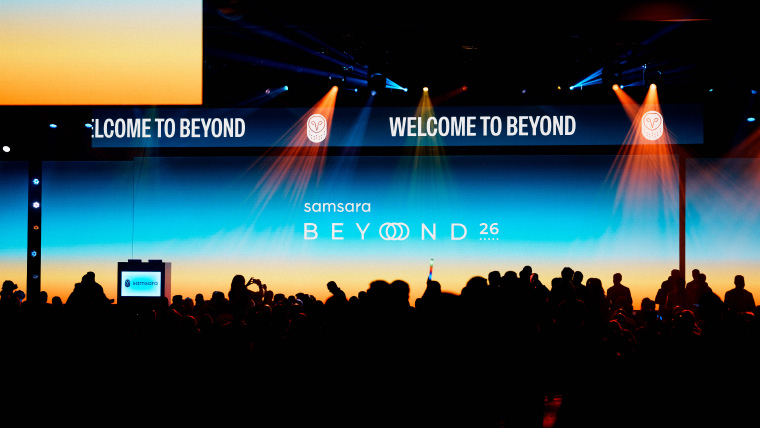
Agent Studio was the clearest expression of this strategy. It is a no-code environment that lets fleet and operations teams create AI agents in plain language, using Samsara data already available in the system. The agents reason across the whole operation (video, telematics, maintenance, HOS, dispatch, plus third-party integrations) in one model. They act natively inside the platform rather than just returning an answer. A general assistant can tell that a truck has a fault; a Samsara agent can check the warranty, pull the service history, and schedule the repair. This “acts inside the operation” point is the core of what is new and is the line that separates Agent Studio from ChatGPT-with-your-data.
Customers can start from more than 15 pre-built templates or build custom agents from scratch. These agents can support tasks such as daily fleet summaries, driver communications, maintenance workflows, start-of-shift briefings, ride-alongs, and warranty claim management.
This marks an important change in solution delivery. Instead of simply giving managers dashboards to review, Samsara is giving them tools that can monitor conditions, identify exceptions, and initiate action. The result is a platform that aims to support both frontline teams and back-office functions, with AI woven into daily operating routines rather than added as a separate layer.
Seeing and Acting on Risk Earlier with Safety Innovations
Samsara
Safety was a major pillar of the event. Samsara framed its new capabilities around helping fleets see, understand, and act on risk before it becomes an incident. The company noted that its customers prevented 380,000 accidents last year, and its latest safety tools are designed to build on these gains by improving visibility and prioritizing interventions, alongside supporting drivers in real time.
AI Multicam received several important enhancements. New edge AI detections, including Vehicle in Blind Spot and Rear Collision Warning, are designed to alert drivers to hazards that frequently contribute to crashes. Wireless Link automatically connects tractor-trailer cameras without driver input. Bird’s Eye View brings multiple camera feeds together into a single top-down view, helping drivers maneuver in tight yards, crowded urban environments, and other difficult spaces. Samsara said this feature uses AI to piece together video from four fisheye cameras around the vehicle.
The company also introduced a 360 Camera for operated equipment such as forklifts, pallet jacks, construction machinery, and airport ground equipment. This single-mount, all-weather camera provides a full panoramic view of the operator’s hands, feet, and surroundings. It helps close a visibility gap on non-road assets, where incident review and risk monitoring can be harder than in on-road fleets. Together with Bird’s Eye View, this hardware expansion shows Samsara extending safety innovation beyond trucks and into broader physical operations.
Samsara also focused on coaching and driver support. AI-powered ride-alongs provide a scalable alternative to in-person evaluations, assessing driver behavior against the Samsara Safety Assessment Standard™. Coaching Priority uses more than 45 risk factors and crash-related data from the Samsara Network to help managers identify which drivers may need attention first. The reimagined driver experience turns the dash cam into a two-way communication channel with automatic voice assignment and personalized briefings, together with hands-free messaging and acute risk intervention. During their Connected Operations Awards event, Samsara recognized its customers who prioritize driver safety, efficient operations and digital transformation, reinforcing those both as product themes and customer outcomes.
Recovering Hidden Operational Cost with Efficiency Innovations
Efficiency was another major theme. Samsara described many operational costs as “leaks” that build over time. These span downtime, manual dispatch coordination and unrecovered warranty claims to parts shortages and delayed maintenance. The new capabilities are intended to surface these issues earlier and automate the actions needed to address them.
Connected Maintenance is central to this efficiency story. Samsara is using AI to help maintenance teams move from reactive repairs to proactive asset uptime management. Enhanced Fault Insights analyzes patterns across the Samsara Network to show likely fault severity, urgency, estimated repair cost, and the risk of escalation if ignored. This gives shop teams better context before a vehicle is grounded by a breakdown.
The maintenance workflow also includes AI-powered warranty claims management, Shop Planner, and PO Automation. Warranty tools can generate OEM-specific compliance checklists, flag denial risks, and draft claims when authorized. This helps fleets recover value that might otherwise be missed. Shop Planner gives managers a prioritized view of assets needing attention based on DVIRs, overdue preventive maintenance, fault codes, and predictive alerts. PO Automation monitors inventory and suggests purchase orders when parts fall below reorder thresholds, reducing the risk of vehicles sitting idle while teams wait for parts.
Commercial Navigation attacks a different kind of leak: the time and money lost when dispatch and drivers are out of sync. A dispatcher reroutes a driver, a customer moves a delivery window, a road closes. Today, all three still get resolved by phone. But with Commercial Navigation, dispatchers can now add stops directly into a driver’s active route, with updates appearing in real time. Across a fleet running hundreds of routes a day, this reduces the phone calls, manual adjustments, and mismatched plans that can slow operations down. And the new Android Auto support, alongside existing Apple CarPlay support, makes truck-safe navigation easier to adopt in the in-cab systems drivers already use.
Digital Transformation Beyond the Fleet
Beyond 2026 also showed Samsara pushing into a wider connected operations market. The Samsara Tracking Label was one of the clearest examples. Designed for high-value and time-sensitive shipments, it provides near real-time location visibility from origin to delivery without requiring carrier cooperation, added hardware, or extra scans. It is a thin, single-use label with a 45-day battery life after activation.
This matters because freight visibility often depends on arrival and departure scans that may be days apart. Between scans, cargo can be delayed, misrouted, or stolen before anyone notices. Samsara’s Tracking Label, Shipment Center, and Shipment App are intended to close that gap by giving teams a centralized view of active shipments and location history.
The shipment tools are strategically important because they move Samsara further into distribution and supply chain visibility. They also reinforce the idea that the company’s platform is not limited to vehicles. By connecting shipments, equipment, drivers, facilities, and back-office workflows, Samsara is positioning itself as an operating system for complex physical businesses.
The launch of Samsara Community adds another layer to this transformation. It creates a professional network where customers can share experiences, troubleshoot challenges, and learn from one another. This customer ecosystem is set to disseminate best practices and deepen engagement with the platform, especially as customers adopt more AI-driven workflows.
Our Perspective
Samsara Beyond 2026 presented a company moving decisively into its next phase. The announcements were not just about new features but about a broader operating model in which AI helps physical operations teams make faster decisions, reduce risk, recover hidden costs, and automate routine work. Safety innovations from AI Multicam and 360 Camera to AI ride-alongs and Coaching Priority showed how Samsara wants to help customers prevent incidents before they happen. Meanwhile, Connected Maintenance and Commercial Navigation highlighted practical ways to staunch cost leakage across fleet operations.
Most importantly, the event reinforced Samsara’s strategic evolution from GPS fleet tracking to a full-stack, AI-driven operations platform. Amidst Samsara’s refreshed capabilities marked by AI solutions on top of core competencies, it will be interesting to see how the company balances its growing product footprint and investments to serve both existing customers and new operating environments.